
Peptides
October 16, 2026
PT-141 and blood pressure: why a temporary rise matters
On this page
Bremelanotide, also called PT-141, can raise blood pressure for several hours after administration. The effect usually resolves, but that does not make it irrelevant. The prescription product Vyleesi is contraindicated in people with uncontrolled hypertension or known cardiovascular disease, and its label calls for assessment of cardiovascular risk before treatment and periodically afterward. US prescribing information
The useful question is not simply whether the pressure eventually returns to baseline. It is how much it changes, when researchers measured it, which people were studied, and whether those findings apply to someone considering treatment. Those details explain why a medicine can have a short-lived effect and still require a meaningful safety restriction.
Pressure and pulse tell different stories
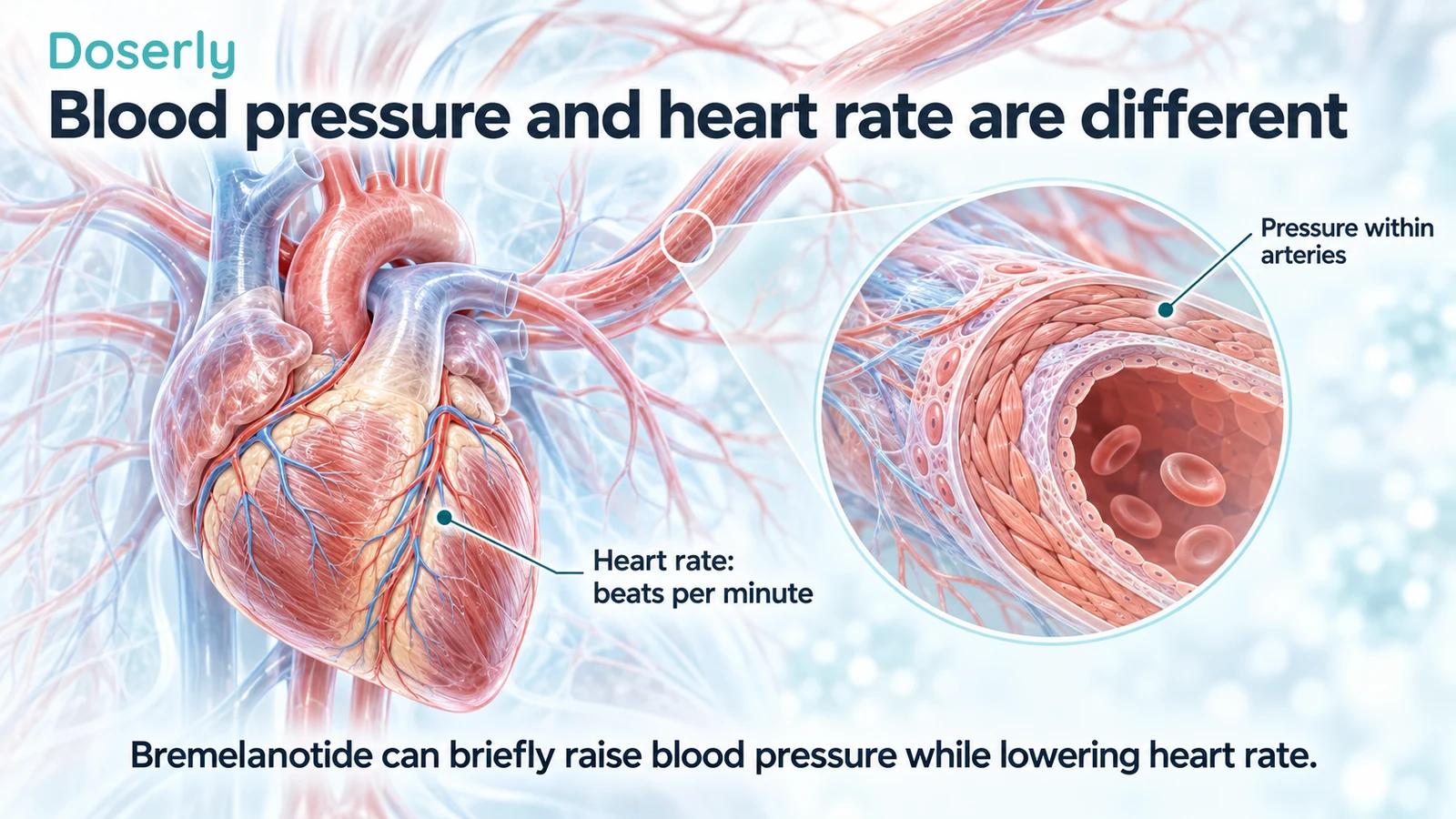
Blood pressure describes the force of blood against artery walls. The upper, systolic value reflects pressure during a heartbeat; the lower, diastolic value reflects pressure between beats. Heart rate is the number of beats per minute. These measures are related, but they are not interchangeable. American Heart Association explanation
With bremelanotide, the observed pressure increase can occur alongside a reduction in heart rate. A slower pulse therefore does not prove that cardiovascular strain has decreased. A wearable reporting a reassuring heart rate also does not establish that blood pressure is normal; it measures a different variable.
Bremelanotide activates melanocortin receptors, a family of cellular signaling proteins. Researchers have studied its cardiovascular effects because melanocortin receptor activity can affect pressure regulation. That biological explanation helps motivate monitoring, but the most clinically useful evidence comes from actual measurements in people. Our PT-141 guide explains the broader pharmacology without treating the proposed brain mechanism as a complete account of its effects.
What the label says about timing and magnitude
The Vyleesi label describes maximal increases of 6 mmHg systolic and 3 mmHg diastolic, peaking approximately two to four hours after a dose, with heart-rate reductions of up to five beats per minute. Pressure and heart rate generally returned to baseline within 12 hours. These are clinical-study descriptions, not guaranteed upper limits for every person. Label, cardiovascular warning
The timing matters when interpreting a personal report. A normal measurement the next morning cannot tell you exactly what happened several hours after administration. Likewise, a measurement taken immediately afterward may precede the period of greatest reported change. That is not a reason to design a home dosing experiment; it is a reason to discuss the relevant time course with the prescriber.
The units also matter. A rise of six millimeters of mercury is a pressure change, not six percent and not a six-beat increase in pulse. Its significance depends partly on the starting pressure and the person's cardiovascular condition. A trial average or summary value cannot be added to one home reading to calculate a reliable personal maximum.
How ambulatory monitoring detected the effect
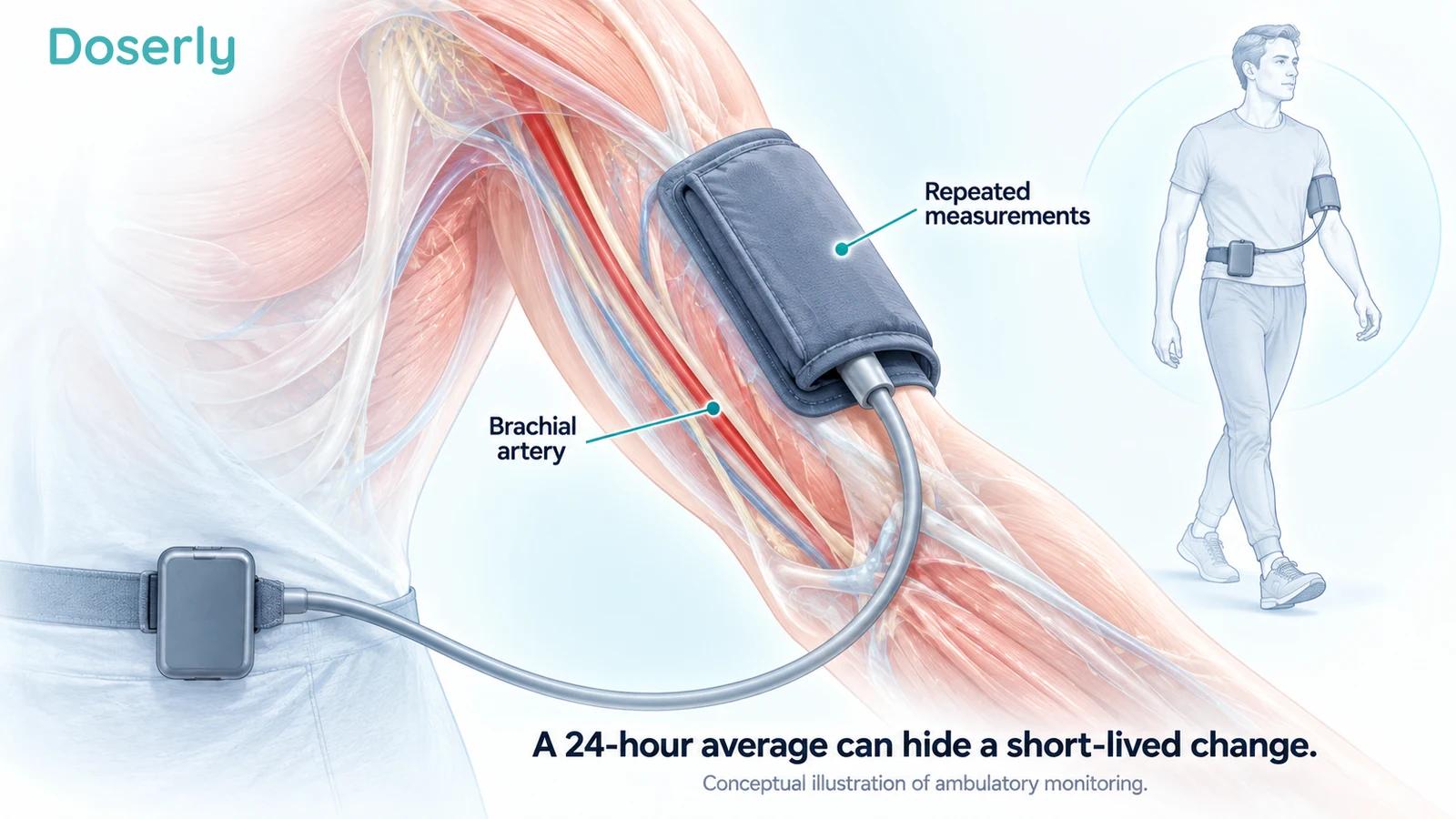
A randomized study reported in 2017 examined ambulatory blood pressure and heart rate in 397 premenopausal women with female sexual dysfunction and either normal pressure or controlled hypertension. Participants received placebo or one of three subcutaneous bremelanotide doses. An ambulatory monitor takes repeated measurements while a person goes about ordinary activities, providing a fuller picture than a single clinic reading. White and colleagues
For the 1.75-mg group, the reported systolic differences from placebo over the first four hours were approximately 3.1 and 3.2 mmHg after two doses separated by 24 hours. Heart rate fell by about 4.6–4.7 beats per minute over that interval. The authors reported that peak pressure increases typically lasted less than 15 minutes. Twenty-six participants stopped after meeting prespecified pressure-increase criteria, with similar proportions across the four groups.
Those findings illustrate both the usefulness and the limits of the design. Repeated readings can detect a small, temporary signal. The study did not establish that everyone experiences the same peak, that high-risk patients can use the drug safely, or that repeated exposure has no effect on cardiovascular events over years. Its population specifically did not represent uncontrolled hypertension. Original ambulatory-monitoring study
Why the study numbers differ from the warning
It is easy to see a three-point change in one source and a six-point change in another and assume one must be wrong. The descriptions refer to different analyses. An average over a four-hour interval, a maximum observed study effect, and a whole-day mean answer different questions. The label also draws on a wider development program than one published experiment.
Imagine a hypothetical pressure trace that rises for part of an afternoon and then settles. Averaging the entire day would dilute that rise with many unaffected readings. A shorter interval would show it more clearly. A peak would be larger still. This is a mathematical explanation, not a reconstruction of an actual participant's trace; no invented patient data are needed to understand it.
The label describes another open-label ambulatory study in 127 premenopausal women receiving daily treatment. After eight days, mean daytime increases were 1.9 mmHg systolic and 1.7 mmHg diastolic. This was a different schedule and comparison, and daily administration is not the recommended use of Vyleesi. The study is evidence about exposure under monitored conditions, not permission to adopt its schedule. Label, section 12.2
Why transient does not mean safe for everyone
The cardiovascular warning is not simply advice to watch for an uncomfortable sensation. Blood pressure can be elevated without a distinctive symptom. Feeling fine, or noticing no racing heart, cannot establish that the relevant effect is absent. A clinical decision considers the person's underlying condition as well as what happens after treatment.
The Vyleesi label makes three different statements: uncontrolled hypertension and known cardiovascular disease are contraindications; use is not recommended in people at high cardiovascular risk; and blood pressure should be well controlled before and during treatment. These categories should not be collapsed into a promise that any person with a normal reading is eligible. Contraindications and precautions
For example, a person with an established heart condition may have a normal pressure on medication. That normal reading does not remove the separate contraindication concerning known cardiovascular disease. Conversely, a person without a diagnosed heart condition may need assessment of persistent high readings rather than assuming the absence of a diagnosis means the absence of risk.
These distinctions also show why the early studies cannot settle every safety question. A trial selects participants, excludes some conditions, monitors them, and can stop treatment when a threshold is reached. Its results describe that system of care. Removing the exclusions or monitoring changes the situation to which the findings are being applied.
Frequency and combinations require their own consideration
The label limits administration to no more than once within 24 hours and does not recommend more than eight doses per month. It warns that doses taken too close together or too frequently may lead to more pronounced pressure increases. These are product safety limits, not an invitation to treat every schedule below them as individually safe. Patient counseling information
A common but unsupported idea is to balance one drug's pressure effect with another drug that moves pressure in the opposite direction. Opposite average effects do not ensure that timing, magnitude, or other physiological actions cancel. This article does not propose a combination regimen. A prescriber needs the complete medication and substance list, including medicines for erections, stimulants, and blood-pressure treatment.
Research-vial products add another uncertainty: the Vyleesi label describes a specific formulation and delivered amount. A supplier's PT-141 name does not demonstrate equivalent contents, exposure, or quality. FDA distinguishes approved products from compounded preparations, which are not reviewed for safety, effectiveness, and quality before marketing. FDA compounded-drug explanation
What a useful pressure record includes
When a clinician requests home monitoring, technique matters. The American Heart Association recommends a validated upper-arm device with the correct cuff size, quiet rest beforehand, a supported back and arm, and feet on the floor. Record the readings and timing rather than selecting only reassuring values. A clinician can explain how the measurement schedule relates to the treatment question. AHA home monitoring
A record is useful for describing what happened; it does not override a contraindication or replace cardiovascular assessment. Include symptoms and medication timing, but avoid deciding on your own that a change must have been caused by one exposure. Pain, activity, measurement conditions, and other influences can affect readings.
Markedly elevated pressure or concerning symptoms need appropriate medical attention rather than waiting for a presumed drug effect to wear off. AHA advises emergency help for pressure above 180 and/or 120 mmHg accompanied by symptoms such as chest pain, breathlessness, weakness, vision changes, or difficulty speaking. Severe symptoms themselves warrant urgent evaluation; do not delay while repeatedly checking a monitor. AHA guidance
The treatment question to bring to a clinician
Bremelanotide's temporary pressure effect is measurable and belongs in the decision about whether its expected benefit is worthwhile. Useful questions include whether your cardiovascular history makes it unsuitable, how well your pressure is controlled, what monitoring would mean in your circumstances, and whether the proposed product is the formulation studied.
The evidence neither proves that every short-lived increase causes harm nor permits it to be dismissed. It supports a more specific conclusion: Vyleesi can change pressure and pulse after a dose, and its approved use includes restrictions intended to protect people for whom that effect could matter more. The PT-141 safety section puts this alongside nausea, skin changes, and other treatment considerations.
Sources
- Vyleesi prescribing information.
- White and colleagues: ambulatory monitoring study, 2017.
- American Heart Association: blood pressure explained.
- American Heart Association: home monitoring.
- FDA: risks of compounded drugs.