
Supplements
October 16, 2026
Psyllium and cholesterol: a useful effect with a specific role
On this page
Psyllium is a fiber from the husk of Plantago ovata seeds. When mixed with water, it forms a gel, which helps explain both its use for bowel regularity and researchers' interest in cholesterol. Unlike many supplement claims built mainly on laboratory experiments, its LDL-cholesterol effect has been tested in people across multiple controlled trials.
Psyllium can make a useful contribution to lowering LDL cholesterol. That does not make it a replacement for every other part of cardiovascular care. The amount of improvement, your starting lipid levels, other medicines and the way you use the product all matter. A better blood result is also different from direct proof that a supplement prevents heart attacks or clears arteries.
This article explains the human findings and how to put them into a realistic conversation about treatment. Our psyllium husk guide provides more background on the fiber itself.
What changes when psyllium meets water?
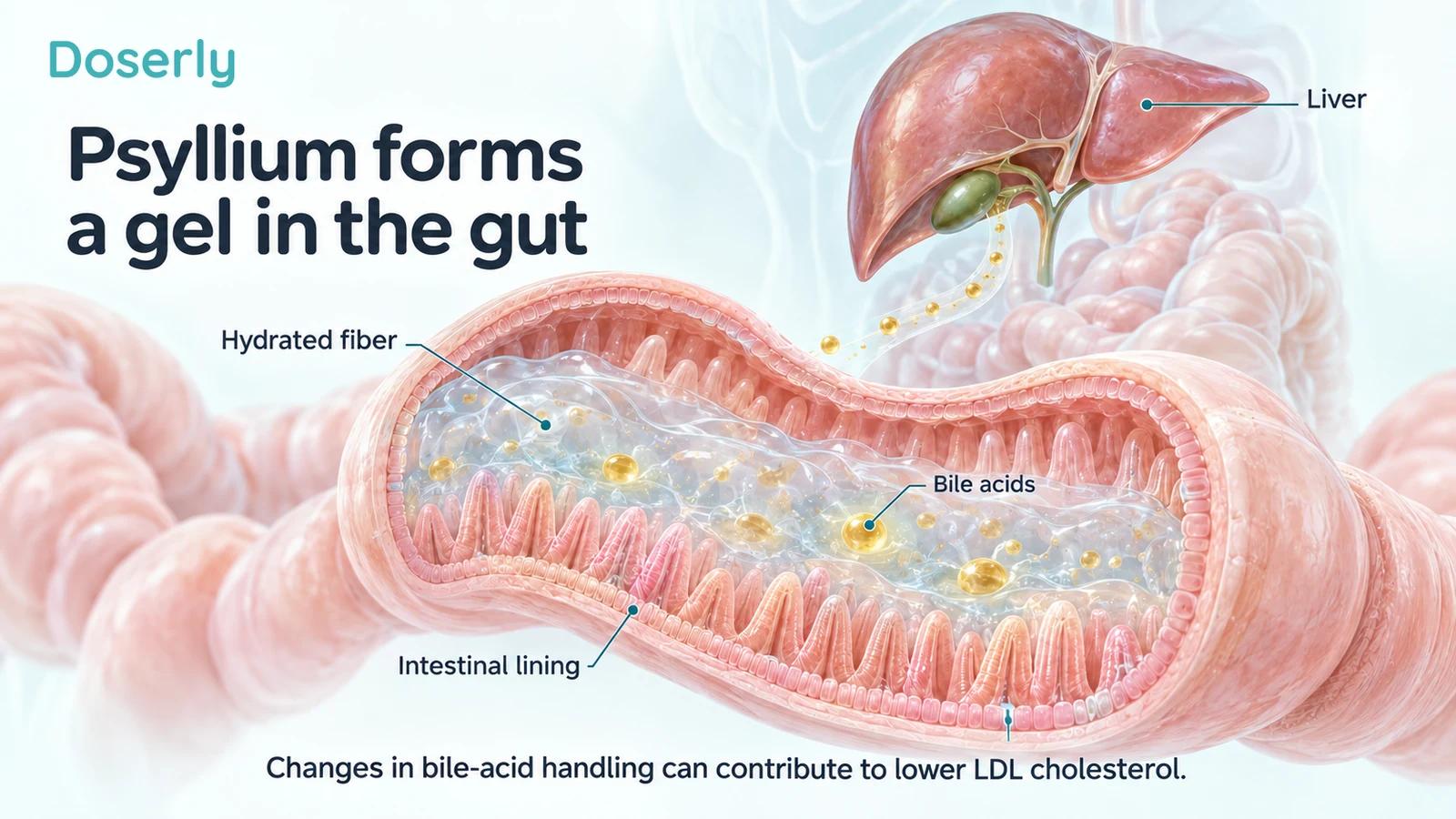
Psyllium absorbs liquid and forms a bulky hydrated material in the intestine. That physical property is central to its use as a bulk-forming laxative. It also explains why sufficient fluid is a safety requirement, not an optional extra. MedlinePlus psyllium information
For cholesterol, researchers have investigated how psyllium changes the handling of bile acids. These substances take part in digestion and normally circulate between the gut and liver. A fiber that alters their intestinal handling can affect the liver's use of cholesterol to make more bile acids.
A randomized crossover study in 20 men with moderately elevated cholesterol examined 40-day periods of psyllium and cellulose placebo. It measured cholesterol absorption and bile-acid kinetics, meaning how quickly those substances moved through their metabolic cycle. LDL cholesterol was lower with psyllium, and bile-acid turnover increased. Increased synthesis was particularly evident in participants whose LDL fell more than 10%. Human mechanism study
This supports a physiological explanation, but psyllium is not literally scrubbing cholesterol from blood vessels. The fiber acts within the digestive tract; the blood-lipid changes reflect the body's response. That distinction prevents a useful mechanism from turning into an inaccurate artery-cleaning story.
Which cholesterol result are we talking about?
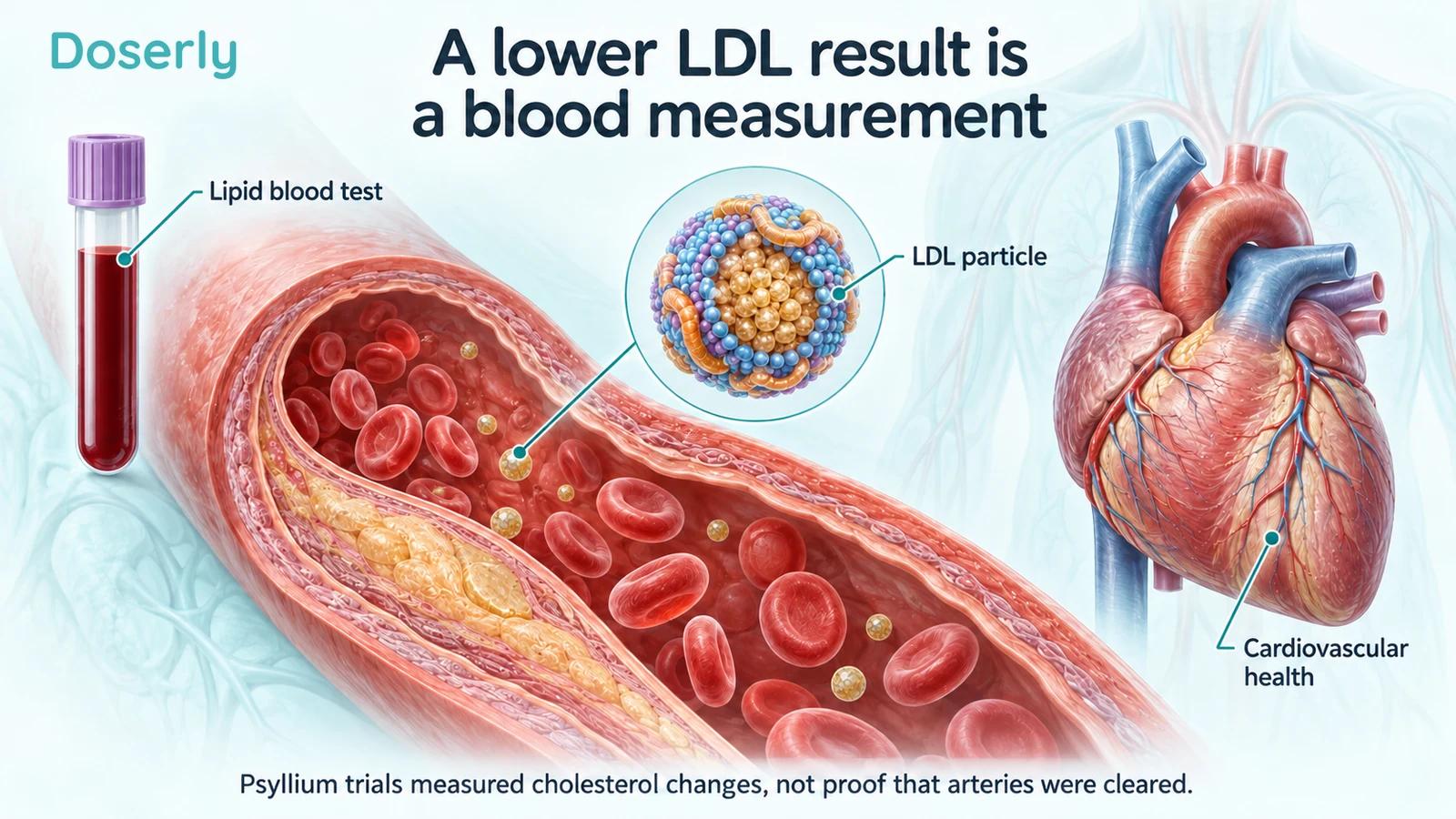
A standard lipid panel reports several measurements. LDL cholesterol describes cholesterol carried in low-density lipoproteins. HDL cholesterol describes cholesterol carried in high-density lipoproteins. Triglycerides are a different type of blood fat. Non-HDL cholesterol is calculated by subtracting HDL cholesterol from total cholesterol. NHLBI explanation of lipid testing
These numbers are related, but a treatment does not necessarily move all of them in the same direction or by the same amount. A claim that psyllium improves cholesterol is most useful when it names the measurement. For the trials discussed here, LDL reduction is the main recurring finding.
Another research measure is apolipoprotein B, usually shortened to apoB, a protein associated with atherogenic lipoprotein particles. A 2018 analysis assessed apoB alongside LDL and non-HDL cholesterol rather than treating total cholesterol as the only relevant outcome. Psyllium lipid analysis
For an individual, the target is not simply the lowest possible number on one test. A clinician considers the lipid pattern alongside medical and family history and overall cardiovascular risk. That context helps determine how much lowering is needed and whether dietary changes alone are likely to be enough.
How large is the average LDL effect?
The 2018 systematic review pooled 28 randomized trials involving 1,924 participants, including people with and without high cholesterol. The median psyllium amount was approximately 10.2 g daily. The pooled LDL difference was −0.33 mmol/L, with a 95% confidence interval from −0.38 to −0.27 mmol/L. Non-HDL cholesterol and apoB also decreased. The authors graded the LDL and non-HDL evidence as moderate quality because results varied across studies. Jovanovski and colleagues
That is an average difference between treatment conditions across studies, not a guarantee of an identical change for everyone. It also describes a particular body of trial evidence, not every fiber product on the market. The amount used in a study should be understood as part of its design, not automatically adopted as a personal prescription.
An average change can be useful without being sufficient. If someone's LDL is substantially above the level their clinician wants, a modest reduction may be one contribution to a larger plan. If the gap is smaller, the same absolute change may represent a larger share of what is needed. The starting point changes the practical meaning.
Did the effect persist beyond a few weeks?
A multicenter randomized trial followed a dietary run-in period with 26 weeks of psyllium or cellulose placebo, while participants continued dietary treatment. The research regimen used 5.1 g of psyllium twice daily. At 24–26 weeks, LDL cholesterol was 6.7% lower and total cholesterol 4.7% lower in the psyllium group than in the placebo group. Other measured outcomes did not differ significantly. Anderson and colleagues
This is useful longer-term evidence relative to a brief feeding experiment. It suggests that the LDL effect can be maintained over roughly six months when the intervention is continued. It does not show that one short course creates a permanent change after stopping.
The dietary background also matters. Psyllium was tested as an addition to an existing eating plan. Describing the outcome without that context would make the supplement appear to have been studied in isolation from the rest of care.
A person deciding whether to use it should therefore consider whether the preparation fits a routine they can maintain. Texture, fluid requirements, bowel effects and medicine timing are part of that decision. An intervention that looks promising on paper is less useful if it repeatedly becomes impractical.
What happened when psyllium was added to a statin?
A blinded trial involving 68 patients compared three approaches: simvastatin 20 mg with placebo, simvastatin 10 mg with placebo, and simvastatin 10 mg with psyllium. The study used 15 g of psyllium daily and measured blood lipids during follow-up.
At eight weeks, LDL had fallen by an average of 55 mg/dL from baseline with 10 mg simvastatin plus placebo and 63 mg/dL with 10 mg simvastatin plus psyllium. The higher-dose simvastatin group had a similar mean LDL reduction to the combination group. Moreyra and colleagues
The additional difference between the two lower-dose statin groups was about 8 mg/dL. This is evidence that psyllium can add to LDL lowering under those study conditions. It is not permission to halve a prescribed statin dose, and it does not establish equivalent prevention of heart attacks between the regimens.
Blood-lipid similarity in a small, short trial is a narrower finding than long-term clinical equivalence. Anyone considering a medication change should discuss the reason for the current prescription and the expected benefit of the whole treatment plan. The supplement should be included in that review, not used to make an unsupervised substitution.
Does every bulk-forming fiber have this effect?
No. A controlled study compared psyllium, methylcellulose, calcium polycarbophil and placebo after a dietary lead-in. Among the participants who completed that phase, the fibers were evaluated over eight additional weeks. Psyllium produced an 8.8% incremental LDL reduction relative to placebo, whereas methylcellulose did not show a significant LDL benefit and calcium polycarbophil did not reproduce the psyllium result. Comparative fiber study
This is one reason to distinguish an ingredient from the broad category “fiber.” Products can all be useful for stool management while having different physical and physiological effects. An interchangeable laxative role should not be assumed to imply an interchangeable lipid effect.
Labels can also distinguish total product weight, total dietary fiber and soluble fiber. A flavored powder may contain other ingredients, so one spoonful is not necessarily the same psyllium exposure as a spoonful from another container. Capsules, wafers and powders should be compared using their actual ingredient information and directions rather than their appearance.
Our prebiotic fibers guide explains another fiber category. Fermentation and microbiome effects are different questions from psyllium's gel-forming properties and its directly measured lipid effects.
What the trials do not establish about heart attacks
Lower LDL is relevant to cardiovascular prevention, but the psyllium trials above primarily measured blood markers over weeks or months. They were not designed as large event trials counting heart attacks, strokes or cardiovascular deaths over many years.
It would therefore be inaccurate to translate the pooled LDL reduction into a precise percentage reduction in your personal heart-attack risk. That calculation would require assumptions about baseline risk, duration, adherence and how the lipid change relates to events in this setting. None of those can be read directly from a powder's label.
NHLBI describes cholesterol treatment as a combination of heart-healthy lifestyle changes and medicines when appropriate, selected in light of the person's risk and health circumstances. A fiber supplement can fit within that approach without being asked to do everything. NHLBI treatment information
Fluid, swallowing and medicine timing are practical safety issues
Psyllium's expansion in liquid is exactly why preparation instructions matter. MedlinePlus directs users to take it with adequate liquid and to disclose swallowing problems or intestinal blockage before use. Difficulty breathing or swallowing after taking it requires prompt medical attention. Inhaling the powder can also provoke allergic reactions. MedlinePlus
The product can complicate medicine timing. The same source identifies specific medicines that should not be taken close to psyllium, including digoxin, salicylates and nitrofurantoin. A pharmacist should review the full medication list and product directions rather than applying a single guessed interval to every drug.
If you have a fluid restriction or a condition that makes swallowing difficult, ask whether this is an appropriate option before starting. A cholesterol benefit does not override a practical reason the preparation may be unsuitable. Likewise, persistent abdominal symptoms should be assessed rather than repeatedly treated with larger amounts of fiber.
How to judge whether it is helping you
A cholesterol intervention needs a cholesterol measurement. Bowel regularity, fullness after meals and the thickness of a mixed drink do not reveal whether LDL has changed. Agree with your clinician on which laboratory measure to follow and when to repeat it.
Record the product, amount actually taken, start date and any interruptions. Note changes in diet, weight or medication that occurred over the same period. If several things change together, an improved result is welcome, but it cannot be attributed entirely to psyllium.
It can also help to record tolerability: whether the preparation is easy to take, whether bowel symptoms improve or worsen, and whether the schedule interferes with medicines. A small laboratory improvement may be worthwhile when the routine is comfortable; the same improvement may be less attractive if the product causes ongoing problems.
Psyllium has a credible, specific place in the cholesterol conversation. Its value is best understood through the measured LDL effect, the person's broader care needs and the feasibility of consistent use. The Doserly psyllium guide can help you bring those details to the next appointment.
Sources
- Everson et al., 1992: human bile-acid mechanism study.
- Jovanovski et al., 2018: systematic review of lipid outcomes.
- Anderson et al., 2000: 26-week lipid trial.
- Moreyra et al., 2005: psyllium plus simvastatin.
- Comparative bulk-forming fiber trial, 1991.
- MedlinePlus: psyllium preparation and precautions.
- NHLBI: lipid testing.
- NHLBI: cholesterol treatment.