
Supplements
October 16, 2026
Pre-workout formulas: ingredient studies are not a trial of the tub
On this page
A pre-workout label often reads like a scientific bibliography compressed into a scoop. Caffeine, creatine, beta-alanine and several less familiar ingredients sit beside claims about energy, strength, focus and endurance. The presentation encourages one convenient conclusion: if the ingredients have studies, the mixture must have the same benefits.
That conclusion skips the most useful questions. Was the actual formula tested? Did the study measure something relevant to your training? Were its ingredients taken once before exercise or consistently for weeks? And did any immediate benefit come with a cost later that evening?
A product can contain a well-researched ingredient and still leave those questions unanswered. It can also produce a real, noticeable sensation without improving the outcome that justified buying it. The point of reading pre-workout evidence is to identify what the product has earned the right to claim.
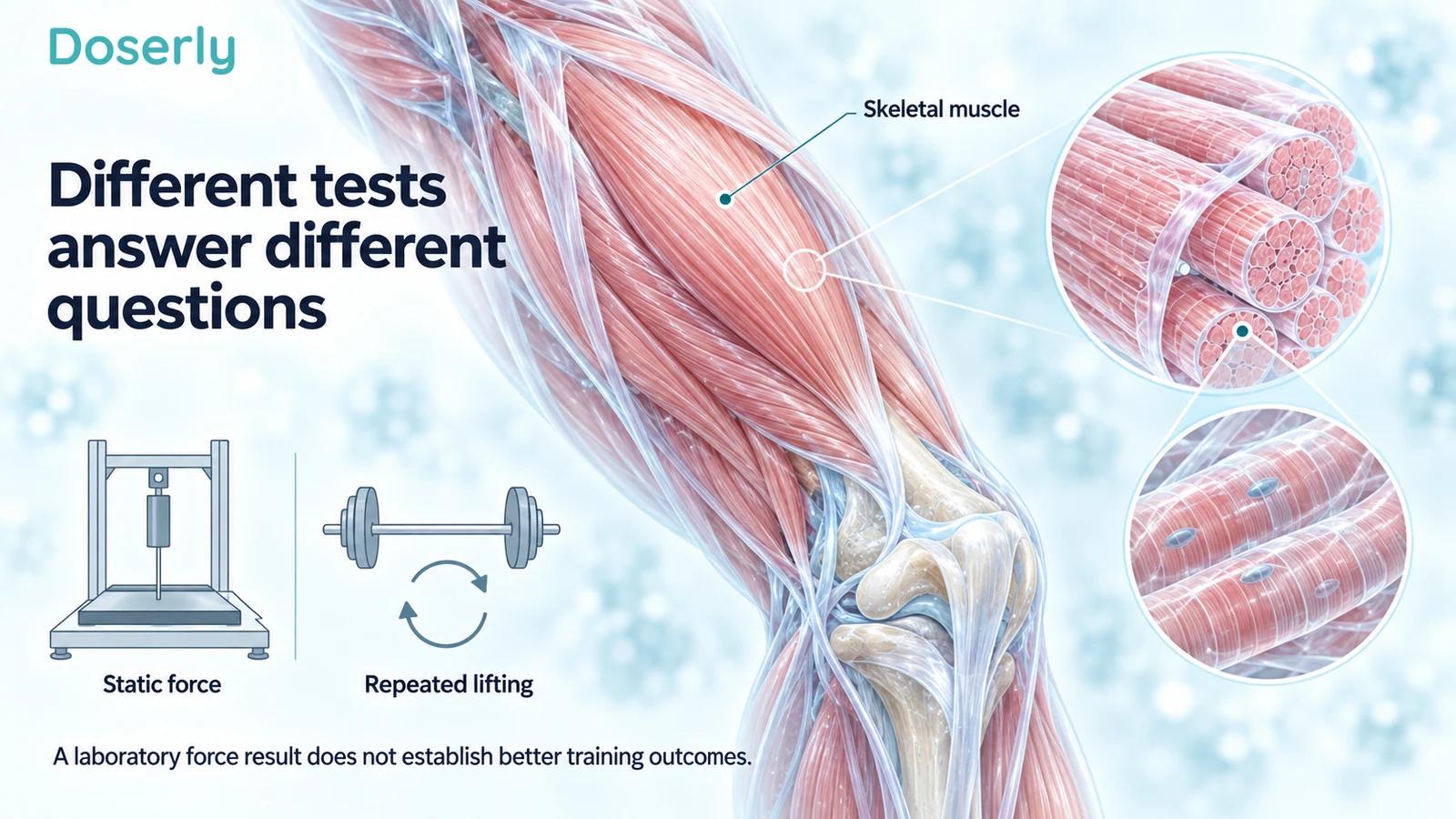
A formula trial with a revealing split between outcomes
A 2022 double-blind crossover experiment tested caffeinated and otherwise identical non-caffeinated pre-workout formulas against placebo in 24 resistance-trained adults, equally divided between men and women. The same participants completed the different conditions, allowing researchers to compare responses within individuals. They measured subjective feelings alongside several kinds of physical performance.
Both formulas improved peak force during an isometric squat test. The caffeinated version also increased reported energy. But the results did not show a broad improvement in conventional bench-press or leg-press strength and endurance. One exception actually went in the unfavorable direction: men's leg-press maximum was lower with the non-caffeinated formula. Some early force-development findings were favorable, while other force measures were not. Read the primary trial.
This is more informative than either “pre-workout works” or “pre-workout is useless.” It shows that a mixture's effect depends on the endpoint. A static contraction, a maximum lift, repeated repetitions and a rating of energy are different tasks.
There is also a difference between an acute response and training adaptation. A few laboratory visits cannot establish greater muscle growth months later. That would require a longer study with training exposure, adherence and the relevant body-composition or performance outcomes measured directly.
For a reader, the practical translation is simple: look for the result that matches the reason you are considering the product. A force-platform finding should not quietly become a promise about your next personal record.
What “clinically studied” should let you identify
A useful product claim should lead to an identifiable experiment. You should be able to work out which formula was used, how much of it participants received, who they were, how long the study lasted and what changed compared with the control group.
“Contains clinically studied ingredients” is a different statement. It may be literally true even when no one has tested the combination. Ingredients can appear at amounts or in forms different from those studied. A formulation can change while the promotional language remains familiar.
The distinction is especially important when a label gives a total weight for a proprietary blend without individual quantities. You cannot reliably compare an undisclosed amount with a study's exposure. A large number printed beside the blend does not solve that problem because it describes the mixture, not each component.
Here is a useful reading exercise. Suppose a fictional product cites a caffeine experiment in cyclists, a creatine muscle-biopsy study and a beta-alanine trial lasting several weeks. Those references could provide background for the ingredients. They would not, by themselves, establish that one scoop of that product improves today's bench-press session.
This is a question about the distance between evidence and advertising, not an accusation that combining ingredients automatically makes them ineffective. The formula needs its own evidence for claims that belong to the formula.
Ingredients do not all operate on a pre-workout clock
The name of the product category can obscure an important timing distinction. Some effects are studied after a single exposure; others depend on repeated intake and changes in tissue stores.
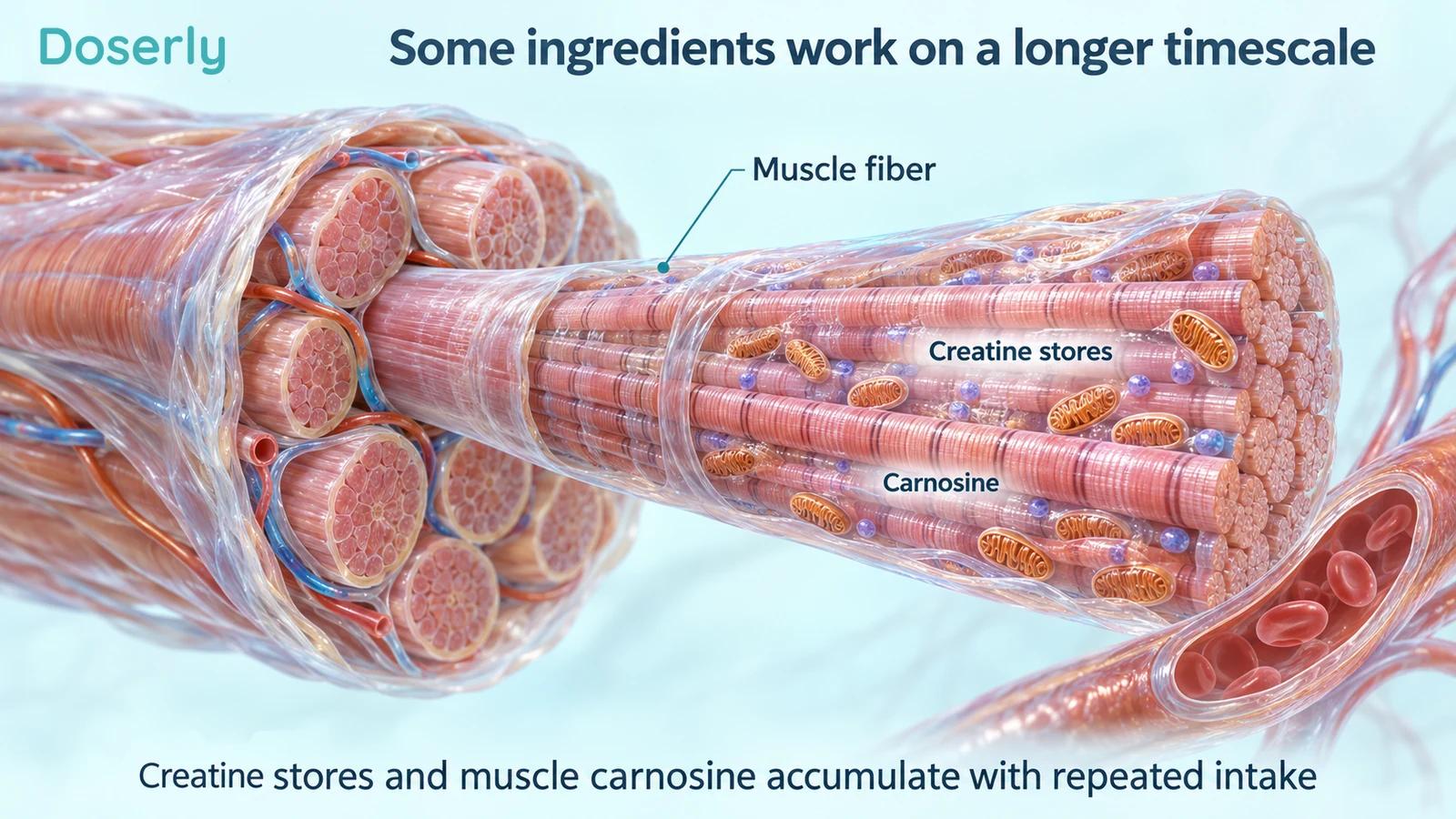
In a classic human study, researchers measured muscle creatine in 31 men under different supplementation schedules. Muscle stores rose with repeated use, including a slower increase over 28 days in the lower daily-intake condition. This was evidence about accumulating creatine in muscle, not proof that taking a mixed powder immediately before exercise produces a unique benefit. Read the muscle-creatine study.
Beta-alanine raises a related but separate timing issue. A human experiment assessed muscle carnosine and high-intensity cycling after several weeks of supplementation, with some participants continuing to ten weeks. That research schedule is very different from asking whether a single first scoop feels strong. Read the beta-alanine experiment.
Caffeine can affect alertness and exercise performance acutely. Beta-alanine can cause tingling, but tingling does not establish a performance improvement. The NIH exercise-supplement reference discusses both the ingredient evidence and these practical limitations. NIH Office of Dietary Supplements.
A product containing all three does not merge their timelines into one. Nor does an intense sensation tell you whether the longer-term ingredients were present in a studied amount.
Feeling ready is a result, but it is not every result
Perceived energy is relevant to the person who arrives at the gym after a demanding day. It is reasonable to care about how a session feels. The mistake is using that experience as proof of everything else on the label.
When a study measures several outcomes, check which ones actually changed. “Improved performance” can conceal a selective summary of one favorable test among several neutral results. Conversely, a neutral average does not prove that every participant experienced nothing. It means the study did not establish the broader claim being considered.
Individual experience also has competing explanations. Sleep, the previous session, food intake, motivation and the training plan can differ from day to day. A good workout after a new supplement is a useful observation, but it is not a controlled comparison.
For personal records, keep the categories separate. “Felt more alert” belongs beside your subjective experience. “Completed the planned repetitions at the usual load” belongs beside performance. “Had trouble falling asleep” belongs beside tolerability and recovery. Combining all three into a single “worked” score discards information you may need later.
The workout can end before the caffeine does
The caffeine question extends beyond the hour in the gym. A 2025 randomized crossover study tested 100 mg and 400 mg at four, eight and twelve hours before bedtime in 23 men with moderate habitual caffeine intake. Researchers used home sleep measurements as well as diaries.
The 100 mg conditions did not significantly alter the measured sleep outcomes compared with placebo. The 400 mg conditions produced adverse effects, including delayed sleep initiation or altered sleep architecture within twelve hours of bedtime and more fragmentation within eight hours. Participants' perceptions did not always match the objective changes. Read the caffeine timing trial.
Those are experimental doses and findings, not a universal cutoff or a recommendation to use either amount. The small, selected male sample cannot establish a safe schedule for everyone. The useful lesson is that dose and timing both matter, and feeling that you slept normally may not settle the question.
This creates a practical trade-off rather than a reason to judge only the most stimulating product. If an evening supplement makes training feel easier but sleep worse, the session and the night should be evaluated together. Repeatedly increasing stimulation to compensate for poor sleep can also make it harder to recognize the original problem.
Read the whole day's intake, not just one scoop
A label review starts with the serving size. “One scoop” is a physical measure; the amount of caffeine or another ingredient per labeled serving is the information needed for comparison. Check whether the suggested serving involves multiple scoops and whether the label has changed since your previous purchase.
Then consider other sources that day: coffee, energy drinks, separate caffeine products and overlapping supplements. The practical purpose is to reconstruct exposure, not to assume that each product operates independently.
Do the same for ingredients intended for repeated use. If creatine is already taken separately, the amount in a pre-workout belongs in the same record. If a blend hides individual amounts, record that uncertainty rather than inventing a total.
The Doserly pre-workout blends guide provides broader background for reviewing the category. For this particular decision, a photo of the exact label, the serving used, the time taken and other stimulant sources is often more useful than remembering the tub's color or the name of its flavor.
A pharmacist or clinician can review that complete list when medicines, cardiovascular concerns or significant adverse symptoms make the combination more complicated. A trial in healthy trained volunteers is not a personalized interaction assessment.
Quality testing answers another necessary question
Even strong research on a formula assumes the consumed product matches what was studied. Quality assurance addresses identity and contamination; it does not establish that an ingredient combination improves performance.
For athletes subject to drug testing, USADA recommends NSF Certified for Sport as a way to reduce supplement risk while emphasizing that no resource eliminates it. Verify the exact product through the certification program, rather than treating a manufacturer's general reputation as certification of every item it sells. USADA Supplement Connect.
Some ingredients also carry explicit regulatory warnings. In the United States, the FDA says DMAA is not a lawful dietary ingredient and advises consumers not to use products containing it. Marketing it as a stimulant or natural extract does not change that warning. FDA information on DMAA.
These are separate filters. A tested product can still lack convincing benefit evidence. A promising ingredient study does not excuse uncertain product contents. Passing one filter should not erase the other.
Save the label version as well as the brand name, so a later reformulation does not silently change the product being evaluated.
A decision that stays tied to your training
Before comparing tubs, name one specific goal: greater alertness for an occasional session, better performance in a particular exercise, or support for a longer-term training program. These goals require different evidence and may not require the same product.
Next, match that goal to the research. Favor a relevant population and outcome over a long ingredient list. Ask whether a reported effect is large enough to matter, whether the formula and exposure are identifiable, and whether the study lasted long enough to answer the advertised question.
Finally, include the burden of using it. Sleep disruption, unpleasant sensations, cost, complicated ingredient overlap and uncertainty about contents are part of the decision even if a laboratory measure improved. None needs to be dramatic to make a product a poor fit for someone's routine.
A useful record preserves the exact product and your reason for using it, then follows the outcome you actually care about. If the goal never becomes clearer than “a stronger feeling,” that is a reason to revisit the claim. The strongest evidence belongs to a defined preparation, a defined exposure and a measured outcome—not to the general idea of a pre-workout tub.
Sources
- The influence of caffeinated and non-caffeinated multi-ingredient pre-workout supplements on resistance exercise performance and subjective outcomes (2022)
- Influence of beta-alanine supplementation on skeletal muscle carnosine concentrations and high intensity cycling capacity (2007)
- Muscle creatine loading in men (1996)
- Dose and timing effects of caffeine on subsequent sleep: a randomized clinical crossover trial (2025)
- Dietary Supplements for Exercise and Athletic Performance
- DMAA in Products Marketed as Dietary Supplements
- Supplement Connect