
Supplements
October 16, 2026
Pre-sleep protein: does bedtime matter beyond the daily total?
On this page
Muscle does not stop maintaining its proteins when you go to sleep. Dietary protein consumed before bed can be digested, absorbed and used during the night. That makes bedtime a reasonable opportunity to eat protein, especially when an evening workout or a busy day has left meals awkwardly spaced.
The more ambitious claim is that protein becomes uniquely effective because it is taken immediately before sleep. To test that, researchers need to compare the same daily protein and energy intake at different times. A bedtime shake compared with a noncaloric placebo changes both the clock and the amount of nutrition received.
Human research supports overnight digestion and a short-term muscle-protein response. Some training studies also show benefits from adding a bedtime supplement. The evidence is less convincing that moving otherwise adequate protein to bedtime produces extra muscle or strength. The distinction can help you decide whether an evening serving solves a practical dietary problem or merely adds another rule to your routine.
What happens to protein while you sleep?
Protein in food is broken down into smaller peptides and amino acids. Amino acids enter the circulation and become available to tissues, including skeletal muscle. Muscle protein synthesis is the process of assembling amino acids into new muscle proteins; it occurs alongside protein breakdown as tissue is maintained and remodeled.
A 2012 experiment tested 16 healthy young men after evening resistance exercise. Everyone received recovery nutrition after the workout. Before sleep, participants then received 40 g of casein protein or a drink without protein. Researchers used labeled amino acids, blood samples and muscle biopsies to follow overnight metabolism.
Casein was digested and absorbed, circulating amino acids remained elevated and whole-body protein balance improved. Mixed-muscle protein synthesis was approximately 22% higher with protein, with a borderline p-value of 0.05. Res and colleagues
This answers an important physiological question: the overnight period is not a time when digestion and muscle protein synthesis become inaccessible to nutrition. It does not answer whether that same protein would have produced a similar benefit earlier in the day. The comparison was extra bedtime protein versus no extra protein.
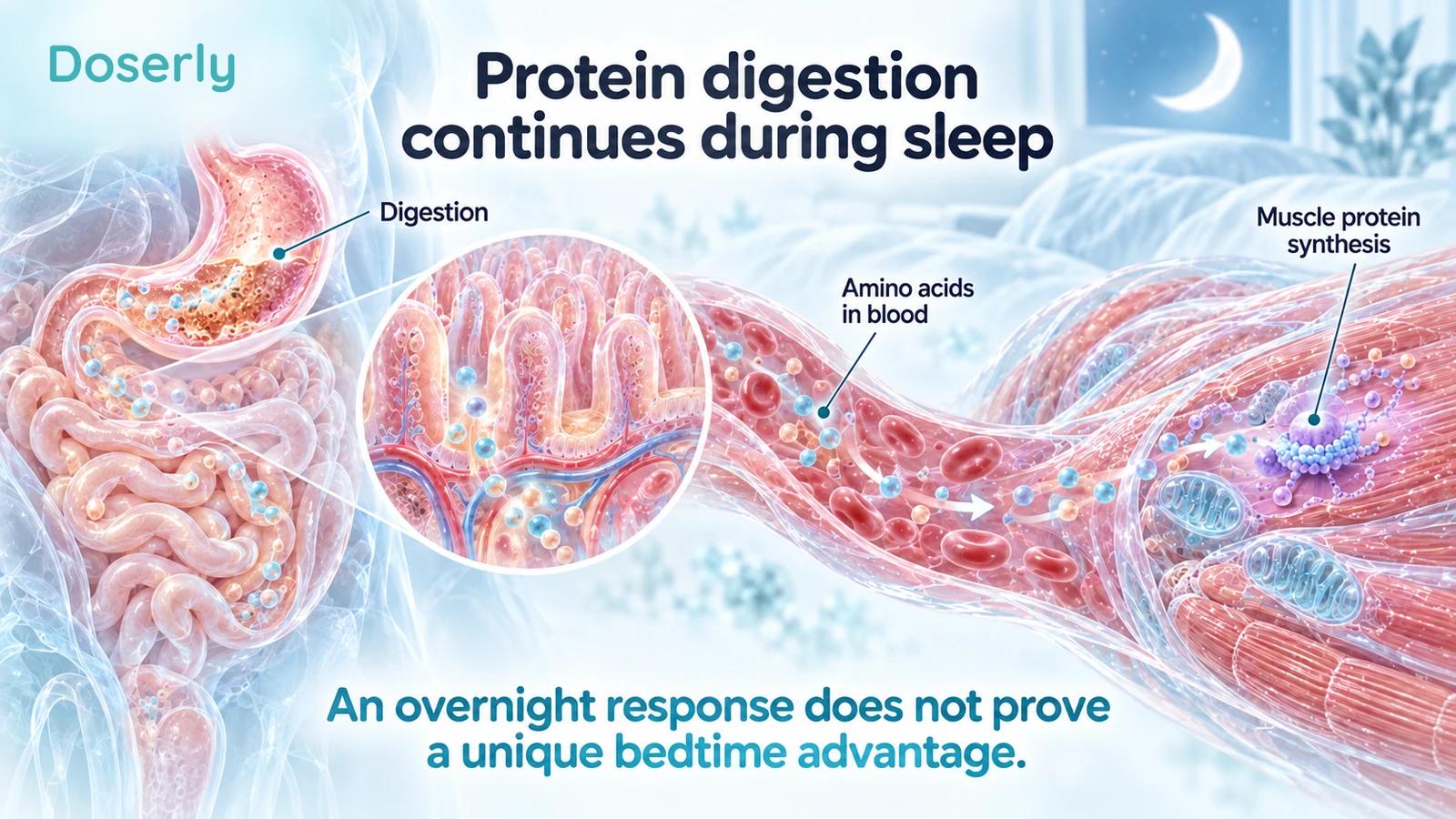
Conceptual digestion and muscle-protein synthesis. Enlarged particles and assembly structures are schematic, not molecular-scale measurements; the image does not claim night is superior to day.
Why casein appears so often in bedtime research
Casein is a milk protein frequently selected for overnight feeding experiments. Using a defined protein source helps investigators standardize the intervention and track amino acids derived from the supplement. It also makes the findings most directly relevant to that preparation under those conditions.
This does not establish that an ordinary food containing protein is ineffective before bed, or that every exerciser needs a separate casein powder. The studies are testing specific interventions, not an exhaustive competition among all possible evening meals. Our casein protein guide explains the product category and its practical uses.
It is helpful to separate a research choice from a dietary requirement. Researchers may select one source because its composition is consistent and it can be labeled for tracing. A person planning dinner is choosing among foods based on appetite, tolerance, access and the rest of the day's nutrition.
The question to ask is therefore not “Was this food mentioned in the bedtime study?” but “Does this serving fit the nutritional goal I am trying to meet?” If a powder makes adequate intake easier, that convenience can be useful without a unique nighttime effect.
The 12-week trial showed a benefit, but changed more than timing
A 2015 trial randomized 44 young men during a progressive 12-week resistance-training program. One group consumed a nightly supplement containing 27.5 g of protein, 15 g of carbohydrate and a small amount of fat. The other received a noncaloric placebo.
Quadriceps cross-sectional area increased by an average of 8.4 cm² in the supplemented group and 4.8 cm² with placebo. Strength and type II muscle-fiber growth also favored supplementation. These are meaningful training outcomes, not merely blood amino-acid changes. Snijders and colleagues
The result supports the whole strategy that was tested: resistance training plus an added nightly supplement. It cannot isolate the contribution of bedtime because the groups also differed in protein, carbohydrate and energy intake. There was no group receiving that same supplement at breakfast or lunch.
For someone struggling to consume enough protein, this distinction does not erase the usefulness of the result. Adding a manageable serving may help. It does change the explanation: the study does not demonstrate that the benefit would disappear if the serving were moved to an earlier, more convenient time.
A practical example makes the difference clearer. If a person adds an evening shake without changing meals, total daily intake rises. If another person moves a lunchtime shake to the evening, total intake stays the same. Those are different interventions even though both can be described as “taking protein before bed.”
What happened when daily intake was matched?
A 2018 preliminary trial directly compared daytime with nighttime casein during ten weeks of supervised resistance training. Thirteen men consumed 35 g of supplemental casein daily, with diets designed to provide equivalent energy and 1.8 g of protein per kilogram of body weight.
Both groups gained muscle-related measures and strength. There were no significant between-group differences in the outcomes assessed. Joy and colleagues
This design is closer to the timing question because the daily nutritional totals were matched. Its small size means it cannot prove that timing never matters or exclude a modest effect. But it does not support a confident claim that bedtime is superior when the same nutrition is available during the day.
The comparison is also more useful than contrasting unrelated trials. If a nighttime study reports more growth than a daytime study conducted elsewhere, differences in training, participants, diet and measurement could explain the gap. Randomizing timing within one study reduces those competing explanations.
For daily planning, the evidence supports flexibility more strongly than a rigid alarm-clock rule. A serving you can reliably tolerate and include may be more valuable than an allegedly perfect time that repeatedly conflicts with sleep, family meals or appetite.
Do older adults respond differently overnight?
Older muscle can respond less strongly to some feeding conditions, which has motivated studies of protein distribution and amount. A 2017 trial randomized 48 healthy older men to 40 g of casein, 20 g, 20 g plus leucine, or placebo before sleep.
Using one tracer method, overnight myofibrillar protein synthesis was higher with 40 g than placebo: 0.044 versus 0.033% per hour, p=0.02. The estimate using another tracer did not cross the conventional significance threshold, with p=0.08. Protein-derived amino acids were incorporated into muscle during the night. Kouw and colleagues
This supports an overnight biological response in the studied men, while the analytical difference keeps the certainty in perspective. It does not establish that everyone over a particular age needs that amount before bed, or that adding leucine makes a smaller serving equivalent to a larger one.
Age-related muscle care is also about sustained function. A short experiment can show nutrient use without showing fewer falls, easier stair climbing or preserved independence. Those outcomes require longer studies and cannot be calculated directly from an hourly synthesis rate.
A newer training trial found no extra benefit in older men
A 2025 study examined 30 untrained older men completing 12 weeks of supervised resistance training. Groups received 40 g of protein after exercise, before sleep, or training alone. Muscle thickness and strength increased with training, but the groups did not significantly differ.
The authors described participants as having adequate baseline protein intake of at least 1.0 g/kg/day. The trial was small and retrospectively registered, and its result applies to the program and population studied. Older-adult timing trial
This study is a useful counterweight to a simple assumption that a positive overnight synthesis response must translate into additional muscle growth over months. Training can produce substantial adaptation, and added protein may have less room to help when the starting diet is already sufficient for the circumstances.
It does not set a universal intake target. Nutritional needs vary with health, activity and goals, and this trial's baseline threshold should not be treated as a prescription for everyone. Its main contribution is the direct observation that the extra timing strategies did not improve the measured training outcomes in these participants.
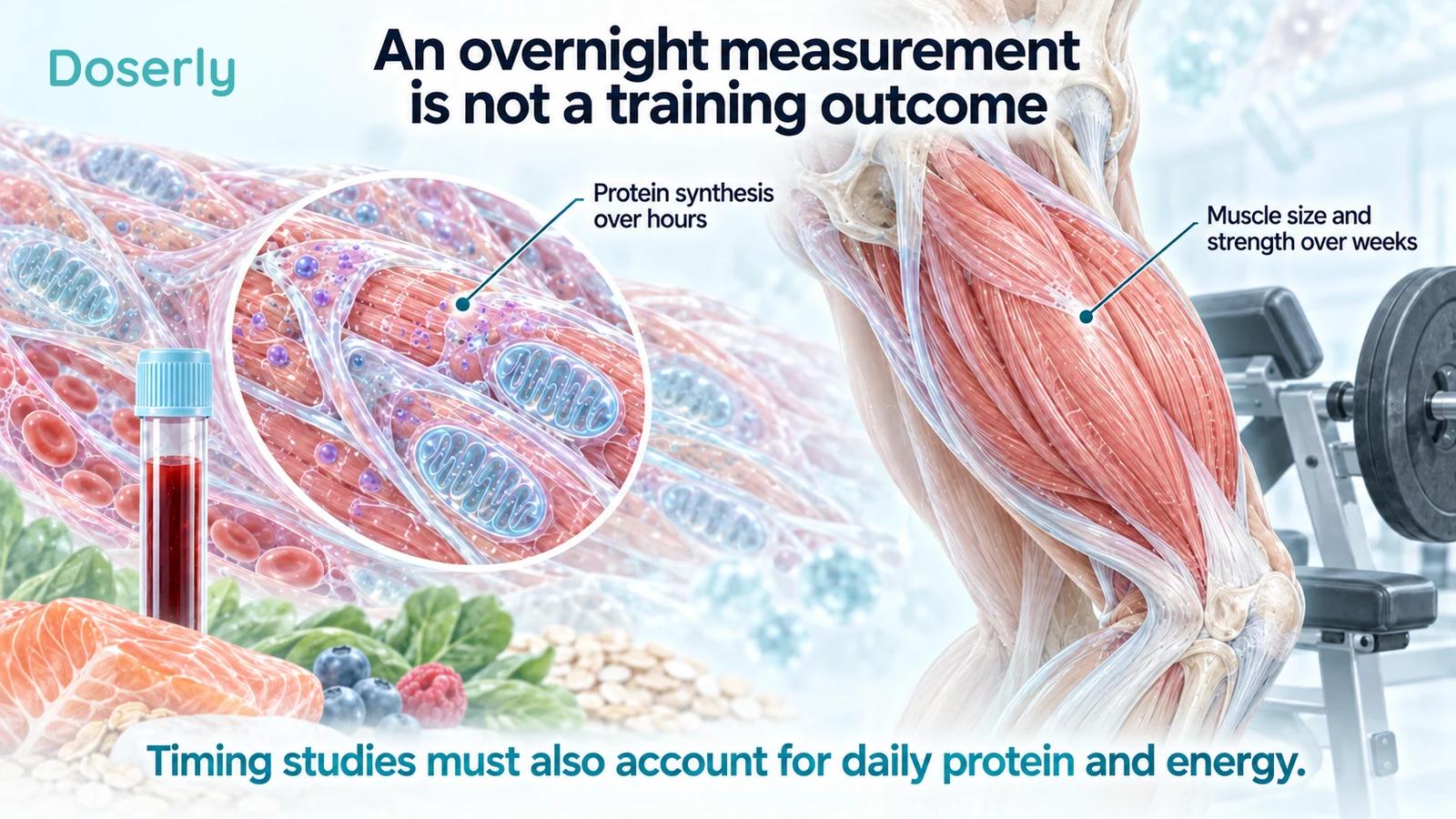
Conceptual measurement scales. Blood and muscle sampling help study metabolism; muscle size and strength are separate outcomes measured across training. No numerical growth or treatment advantage is illustrated.
Does a bedtime shake improve tomorrow's workout?
The word “recovery” can mean several things: protein turnover, soreness, restored performance or readiness to train. They should not be assumed to move together.
A 2022 study gave 18 resistance-trained men 40 g of casein or a noncaloric placebo before sleep after an evening workout. Participants had already received a standard recovery drink. The next morning, maximal-strength performance and the muscle-damage biomarkers assessed did not significantly differ. Next-day recovery study
That result does not contradict overnight digestion. It shows that demonstrating one biological response does not guarantee a detectable improvement in next-day performance. If your priority is training quality tomorrow, a study that measured actual performance is more relevant than a claim based only on amino acids appearing in blood.
A night of adequate sleep, an appropriate training load and enough overall food remain part of the context. The bedtime studies do not test a supplement as a substitute for those conditions. Nor do they show that waking during the night to consume protein is beneficial.
When might bedtime protein be practically useful?
Bedtime can be a convenient extra eating opportunity. Someone who trains late, has a small dinner or struggles to fit enough protein into daytime meals may find an evening serving easier to maintain. In that situation, the benefit may be achieving a more adequate diet, regardless of whether the clock itself adds anything.
Someone who already eats sufficient protein and energy may be asking a different question: whether another serving improves results enough to justify its cost and effect on appetite. The matched-intake and newer training studies do not provide a strong basis for promising extra gains from bedtime alone.
Consider whether the serving is added or substituted, whether it is comfortable to consume, and whether it disrupts the routine that lets you sleep. If a late shake causes symptoms or crowds out foods you otherwise need, the theoretical timing advantage should not automatically take priority. Milk-protein allergy and individual dietary restrictions also affect which products are appropriate.
NIH's sports-nutrition guidance emphasizes an adequate overall diet as the foundation for performance; supplements are additions to that foundation. People with medical dietary restrictions should establish an appropriate protein plan with their clinician or dietitian rather than importing amounts from healthy-volunteer experiments. NIH Office of Dietary Supplements
You do not need to choose between believing nighttime digestion is real and rejecting a rigid bedtime rule. Both can be true: protein is used during sleep, and the best time to consume a serving may still depend more on the whole day than on the final half-hour before bed.
Sources
- Res et al., 2012: overnight digestion and metabolism
- Snijders et al., 2015: 12-week supplementation and training
- Joy et al., 2018: matched daytime versus nighttime casein
- Kouw et al., 2017: overnight synthesis in older men
- Older-adult timing and training trial, 2025
- Next-day performance and recovery trial, 2022
- NIH: exercise and athletic-performance supplements