
Supplements
October 16, 2026
PQQ and mitochondria: what the human trials actually measured
On this page
Pyrroloquinoline quinone, usually called PQQ, is often described as a supplement that helps the body make more mitochondria. That description invites an appealing conclusion: more cellular energy machinery should mean more energy for exercise, work or daily life.
Human research makes the story more interesting—and less direct. A small training trial found a change in a protein involved in mitochondrial regulation without an added improvement in aerobic performance. Other small studies have reported improvements in selected strength or cognitive tests. These findings concern different people, measurements and products; they do not establish a general treatment for fatigue or mitochondrial disease.
The useful question is what a particular experiment showed. Our PQQ guide covers broader product context. Here, the focus is the evidence behind the leap from a cellular mechanism to something a person can actually feel or do.
What does “mitochondrial biogenesis” mean?
Mitochondria help cells turn nutrients into usable energy. Mitochondrial biogenesis describes the coordinated processes involved in building and maintaining mitochondrial components. It requires regulation across the cell, including gene expression, protein production and assembly.
A study can investigate this process at several levels. It might measure a regulatory protein, mitochondrial DNA, the abundance of particular enzymes, or the ability of sampled tissue to use oxygen. Those measurements answer related but different questions. None is automatically a count of newly functioning mitochondria throughout a person's body.
This distinction matters especially for PGC-1α, a protein involved in regulating mitochondrial and metabolic programs. An increase can support a mechanistic hypothesis. It doesn't, by itself, show that someone now produces more useful energy during activity or has recovered from fatigue. A human PQQ training study illustrates the difference particularly well. Exercise trial
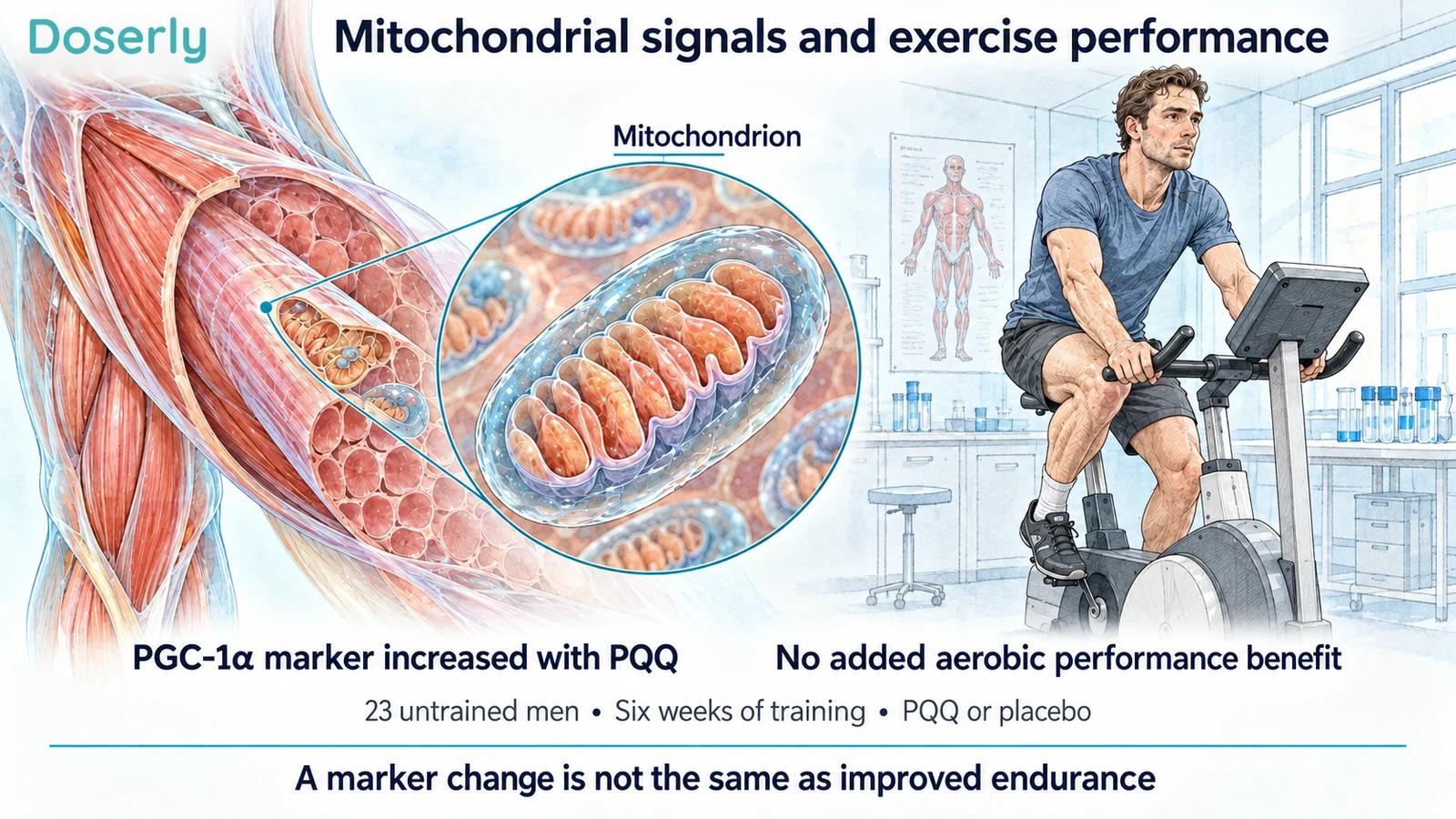
The exercise trial: a marker changed, performance did not
A randomized study in 23 untrained men compared 20 mg PQQ daily with placebo during six weeks of endurance training. Researchers assessed aerobic performance, body composition and indices related to mitochondrial biogenesis. PGC-1α protein increased with PQQ. However, the supplement did not provide an additional improvement in aerobic performance or body composition. Both groups improved with training. Hwang and colleagues
This result isn't evidence that nothing happened biologically. It is evidence that the measured biological change did not deliver an extra performance benefit under those study conditions. That is exactly the comparison needed when a product is promoted as an endurance aid.
The study was small and involved untrained men, so it cannot settle every question about older adults, highly trained athletes or people with a diagnosed illness. But those limits also prevent using it as proof of benefit in those other groups. A different population is a new research question, not a reason to assume a favorable answer.
The practical lesson is to keep the outcome visible. If your question is whether a supplement improves cycling endurance, a protein measurement is supporting information. The relevant test remains performance compared with a suitable control.
What a newer single-dose exercise study adds
A 2026 trial studied 60 male physical-education students, divided among PQQ, nicotinamide mononucleotide, their combination and placebo. The investigators gave a single dose before an exhaustive treadmill test and studied interoception—the perception of internal bodily signals—along with exercise-related measurements. Acute exercise study
The reported treatment interaction involved the “Body Listening” questionnaire domain. Exercise capacity did not differ significantly between groups. The study was also retrospectively registered, a limitation when judging how firmly its selected outcomes were established in advance.
This is a different experiment from six weeks of supplementation and training. A change in how participants report attending to bodily sensations is not an endurance improvement, and neither is evidence that mitochondria multiplied after one capsule. The newer paper broadens the questions researchers are asking without resolving the central performance claim.
A positive strength study deserves its own interpretation
Not every physical-function result has been negative. A 2024 randomized, double-blind study assigned 64 healthy volunteers to a PQQ disodium-salt preparation or placebo for 12 weeks; 62 completed the study. The reported daily amount was 21.5 mg of the disodium salt. Researchers reported favorable differences in lower-limb extension strength, grip strength and walking-related tests. Physical-function trial
These outcomes are more directly useful to people than a molecular marker alone. They provide a reason to study physical function further. They also come from one small study of a specific preparation and population. They do not show that PQQ improves every form of exercise, reverses frailty or treats a neurological cause of weakness.
Strength and aerobic endurance are not interchangeable. A supplement can plausibly affect one measured task without changing another, and differences between study designs can also produce different results. The appropriate response is to examine the task, effect size, reproducibility and participant characteristics rather than collapse all findings into a single “energy” claim.
The publisher's accessible abstract and indexed study sections supported this comparison, but did not provide a sufficiently complete basis here for a detailed adverse-event analysis. The article therefore should not be read as evidence of zero adverse events or comprehensive long-term safety.
Early metabolic research measured signals, not everyday vitality
An earlier human investigation involved 10 adults and short-term PQQ exposure. Researchers examined blood inflammatory markers and urine metabolites associated with energy metabolism. Changes in C-reactive protein, interleukin-6 and selected metabolites were interpreted as consistent with effects on inflammation and mitochondrial-related metabolism. Harris and colleagues, 2013
The experiment is useful for developing hypotheses and selecting measurements for larger studies. It did not directly count new mitochondria in muscle or demonstrate sustained relief of fatigue. Its small size and short duration also limit conclusions about what happens after months or years of supplementation.
A urine metabolite is influenced by production, utilization and excretion. A change can be biologically interesting without establishing a particular tissue-level explanation. Describing such research as showing “more energy” hides both what was measured and what remains unknown.
What about the studies of fatigue and sleep?
A frequently cited 2012 study followed 17 adults taking 20 mg PQQ daily for eight weeks. Participants reported improvements in measures of stress, fatigue and sleep. However, it was an open-label study without a placebo control. Original fatigue and sleep report
Those observations can justify a controlled follow-up. They cannot establish that PQQ caused the improvement. Symptoms may fluctuate, expectations can influence self-reports, and people can change sleep, exercise or other habits while participating in a study.
This doesn't make participants' experiences unreal. It means the design cannot separate a supplement effect from other explanations. Persistent fatigue also needs an appropriate clinical assessment rather than being assumed to represent a mitochondrial deficit that a supplement can correct.
For someone reading a testimonial alongside this paper, the crucial distinction is whether the experience is an observation or a tested comparison. Combining many uncontrolled observations does not create the missing placebo group.
Cognitive studies ask a different question
A placebo-controlled trial randomized 64 healthy volunteers, with 58 completing, to a PQQ disodium-salt preparation or placebo for 12 weeks. The study reported improvements in selected computerized cognitive domains, including memory and attention-related measures. Cognitive-function trial
That is human evidence about test performance. It isn't proof of dementia prevention, structural brain repair or a durable improvement in independent daily functioning. The distinction matters because a computerized battery can contain multiple domains, giving researchers numerous opportunities to observe a difference. Replication and a clear account of prespecified outcomes help establish which findings are dependable.
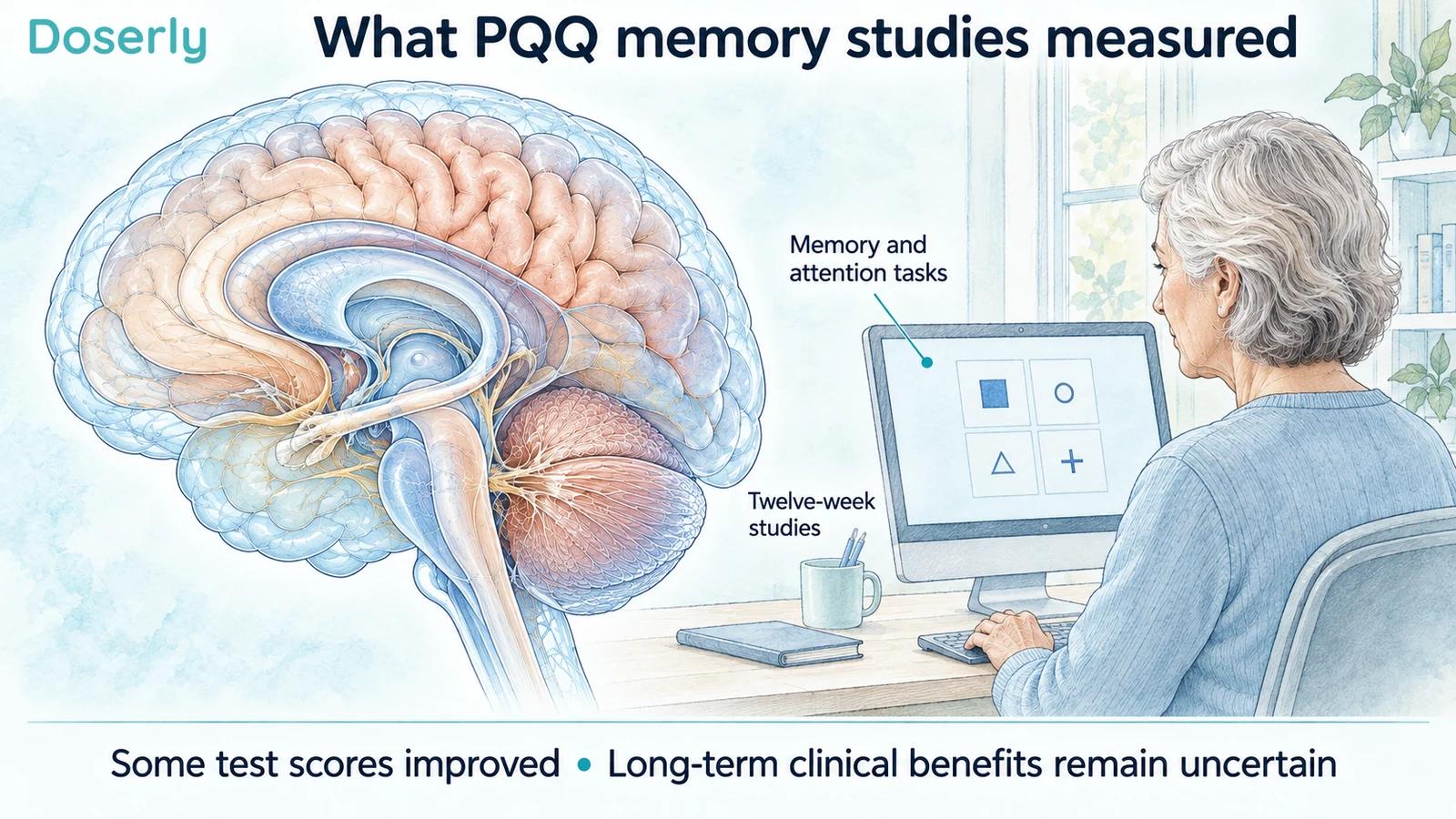
Healthy volunteers performing memory tasks also differ from people seeking treatment for progressive memory loss. New or worsening cognitive symptoms deserve assessment. A supplement trial in one group cannot substitute for identifying the cause of symptoms in another.
Why a combination study cannot prove a PQQ-only benefit
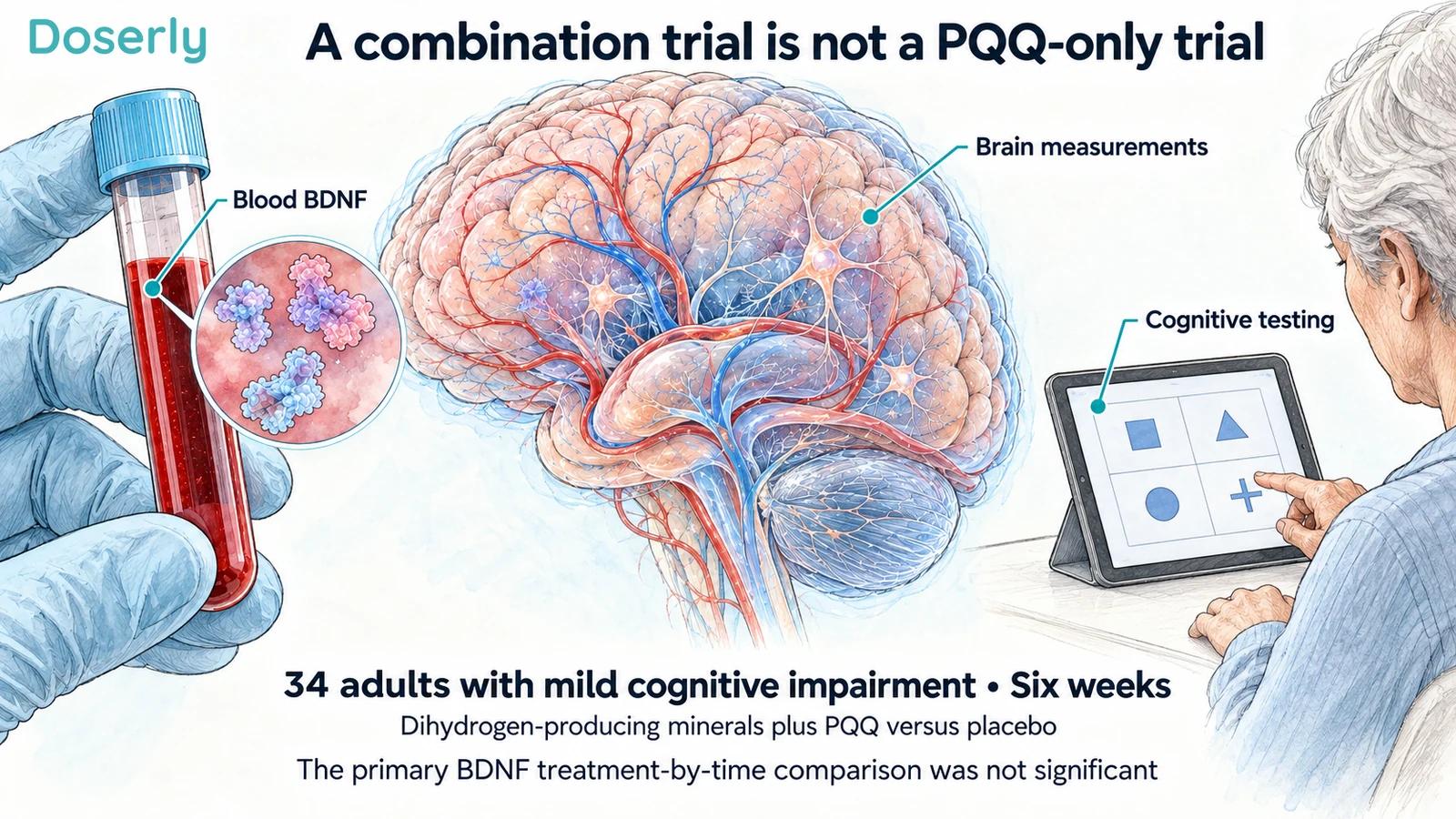
A 2024 trial studied 34 older adults with mild cognitive impairment over six weeks. The active intervention combined dihydrogen-producing minerals with PQQ. Researchers measured serum brain-derived neurotrophic factor, or BDNF, cognition and brain-related metabolic or oxygenation outcomes. Combination trial
BDNF increased within the active-treatment group, but the primary treatment-by-time interaction was not statistically significant. That is the important comparison for asking whether change differed between treatment and placebo. A significant before-and-after change in one group does not establish a significant difference between groups.
Some secondary results were favorable, including an orientation component of cognitive testing. These findings remain exploratory in a small, short combination trial. Even a convincing benefit from the combination would not identify which ingredient caused it or whether PQQ alone would reproduce it.
Safety findings have a defined scope
The European Food Safety Authority assessed a specific PQQ disodium-salt ingredient and concluded that it was safe under the proposed conditions of use: up to 20 mg daily for healthy adults, excluding pregnant and breastfeeding women. That assessment concerned a defined ingredient and exposure, not every marketed formulation or combination. EFSA safety assessment
A safety conclusion is also different from a finding that the product improves energy, cognition or longevity. Small efficacy trials cannot reliably detect uncommon harms, and short follow-up cannot answer all long-term questions. The study amounts in this article identify experiments; they are not a personal dosing recommendation.
People taking medicines, managing chronic illness, or considering use during pregnancy should discuss the actual product with a qualified clinician. A blend creates additional uncertainty because evidence about one ingredient does not establish the effects or interactions of the whole formulation.
A more useful way to read a PQQ label
Start with the promised outcome. “Supports mitochondria” is broad enough to encompass a regulatory protein or a metabolic signal. “Improves exercise performance” requires a demonstrated performance difference. “Treats fatigue” requires evidence in a clearly defined symptomatic population, including an appropriate comparison and clinically useful improvement.
Then identify the product and study context. Was PQQ tested alone? Was the amount expressed as PQQ or its disodium salt? Were participants healthy, cognitively impaired, young or older? Was the outcome selected before the trial or one favorable result among many tests?
Finally, distinguish uncertainty from personal experimentation. If someone chooses to use a supplement, a dated record of the product, formulation, other changes and meaningful symptoms can support a more informed conversation. It cannot prove causation, but it is more interpretable than a vague impression of “better mitochondria.”
PQQ has produced enough human findings to warrant further research, including some positive functional results. The current evidence supports discussing those individual findings precisely. It does not support treating every mitochondrial marker, memory score and fatigue report as confirmation of one universal energy benefit.
Sources
- Endurance-training and mitochondrial-marker trial
- Acute exercise and interoception trial
- Physical-function trial
- Short-term metabolic study
- Open-label fatigue and sleep study
- Cognitive-function trial
- Dihydrogen–PQQ combination trial
- EFSA ingredient safety assessment