
Supplements
October 16, 2026
Plant protein and muscle: compare diets, not just scoops
On this page
A scoop of pea protein, a soy-based meal and a carefully planned vegan diet are different interventions. Research on one does not automatically describe the others. That is why the argument over whether plant protein “works” often becomes less useful than it first appears.
The practical question is whether a particular eating pattern supplies enough usable protein to support the training someone actually performs. Protein source can matter, but so can the amount eaten, the amino-acid composition of a supplement, the rest of the diet, age and the outcome being measured.
Plant-based diets can support gains in muscle and strength. That does not mean every plant protein serving is interchangeable with every animal protein serving. Human trials become much easier to interpret once you separate comparisons of single drinks from comparisons of whole diets, and short metabolic experiments from months of training.
Start with what the body receives
Muscle uses amino acids to make proteins. Dietary proteins supply these amino acids after digestion; their amino-acid proportions and digestibility can differ. Essential amino acids must come from the diet. A plant protein does not become useless because its proportions differ from those of milk, but equal grams of two ingredients need not produce identical amino-acid availability.
A controlled experiment in 24 young men compared 30 g of milk protein with 30 g of a blend containing wheat, corn and pea proteins. Blood essential-amino-acid availability was higher after milk. Nevertheless, the measured five-hour muscle-protein synthesis response did not differ significantly between groups. Plant-blend experiment
That result cautions against treating the height of a blood amino-acid response as a direct measurement of muscle growth. It also applies to a specific blend and serving, not every scoop labeled “plant protein.” A product that uses different ingredients, proportions or quantities is a different intervention.
Our plant-based protein guide explains the product category. For this article, the important distinction is between an ingredient's properties and the performance of a complete eating pattern over time.
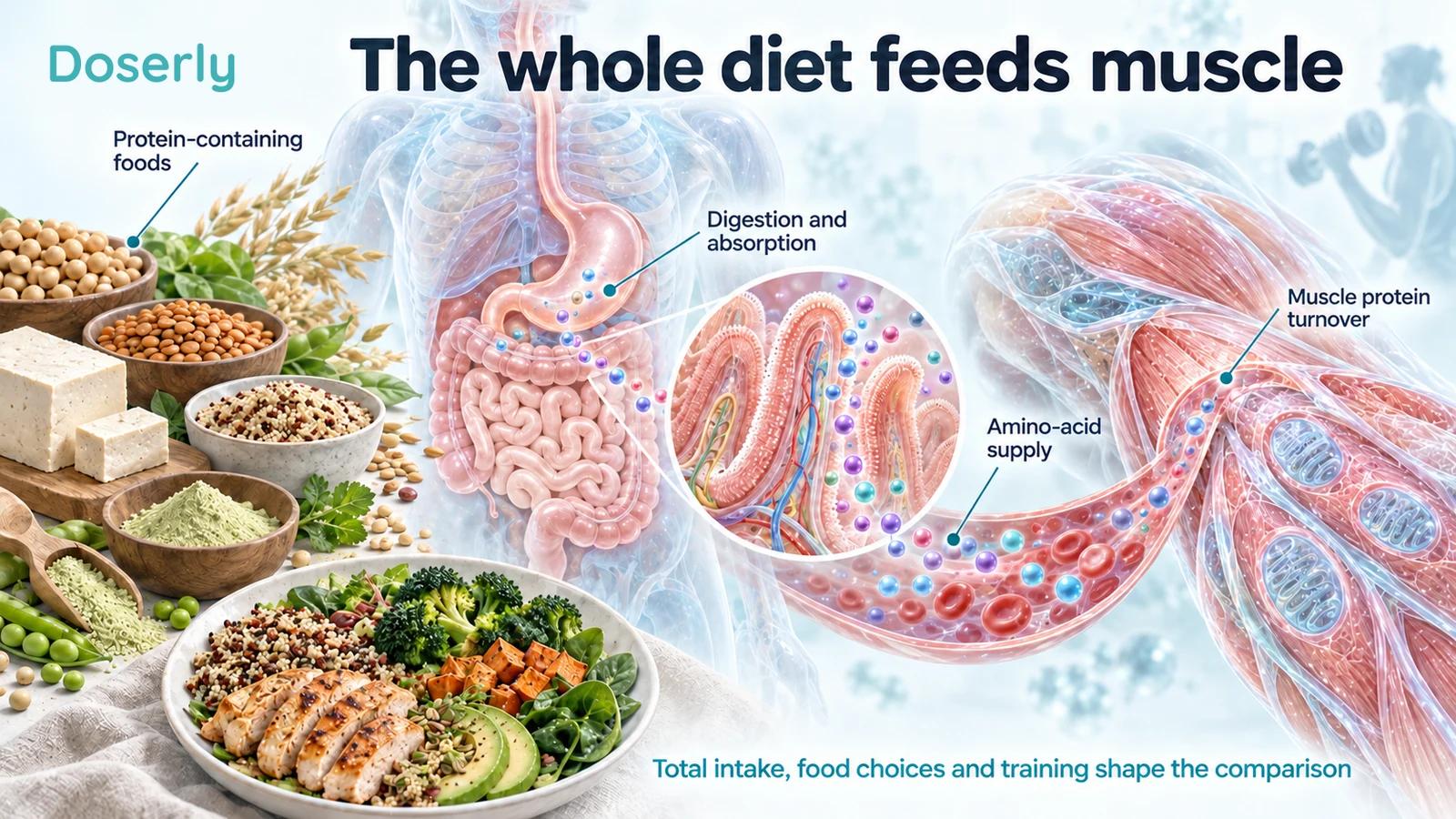
Conceptual nutrition and tissue turnover, not a measured pathway from one food to a particular amount of growth. Particles and anatomical insets are enlarged for explanation.
When soy and whey were matched for leucine
A 12-week randomized trial compared soy and whey supplements during resistance training. Sixty-one adults enrolled and 48 completed the study. The servings were designed to provide the same amount of leucine: 19 g of whey protein or 26 g of soy protein, each supplying approximately 2 g of leucine.
Lean mass and strength improved with training, without significant differences between the supplement groups. Lynch and colleagues
The serving sizes are central to interpreting the finding. This was not a demonstration that identical grams of soy and whey necessarily produce identical results. The researchers used more soy protein to match leucine. It is evidence that the tested soy strategy supported training adaptations under those conditions.
For someone comparing labels, that distinction is useful. “One scoop” is a packaging instruction, not a standardized protein quantity. Check the actual protein per serving and what the serving consists of. A flavored powder with added carbohydrate is not directly comparable with a concentrated protein powder simply because both come with a plastic scoop.
Whole-diet evidence in habitual vegans
A 2021 study followed 19 habitual vegans and 19 habitual omnivores through 12 weeks of resistance training. Investigators adjusted protein intake to approximately 1.6 g per kilogram of body weight daily, using soy supplementation in the vegan group and whey in the omnivorous group.
Both groups increased leg lean mass, muscle size and strength, without significant differences between groups. Average leg lean-mass gain was about 1.2 kg in each group. Hevia-Larrain and colleagues
This is encouraging evidence that a protein-matched plant-based diet can support training adaptations. It also has a design limitation: participants were already vegan or omnivorous. Researchers did not randomly assign their long-standing dietary patterns. The study therefore cannot remove every difference associated with choosing and maintaining those diets.
The takeaway is about feasibility under the tested conditions. A planned vegan diet with adequate protein supported measurable progress. It is not proof that diet composition never matters or that an unplanned low-protein diet would produce the same outcome.
Another trial used mycoprotein, which is fungal
A 2023 investigation studied vegan and omnivorous high-protein diets in two phases. A short phase examined daily muscle-protein synthesis; a separate 10-week phase followed training adaptations in 22 adults consuming approximately 2 g/kg of protein daily.
The vegan diet was rich in mycoprotein. Lean-mass gains, thigh-muscle enlargement and strength improvements were comparable between groups. Monteyne and colleagues
Mycoprotein deserves its own name here. It comes from fungi, not plants. It can fit a vegan eating pattern, but this trial should not be described as a direct test of pea, rice or soy protein alone. Calling every vegan protein intervention “plant protein” can obscure what participants actually ate.
The high total protein intake and structured training also matter. The findings describe a supported dietary strategy during a demanding program. They do not show that every product marketed to vegan athletes has been independently tested or that supplements are required to follow a vegan diet.
Positive findings do not erase trials favoring milk
Not every comparison has produced the same result. A 2007 randomized study assigned 56 young novice weightlifters to milk, soy or carbohydrate drinks during 12 weeks of training. The milk and soy drinks were matched for energy, protein and macronutrient proportions.
Milk produced greater gains in fat- and bone-free mass and type II muscle-fiber area than soy or carbohydrate. Strength gains did not differ significantly between groups. Hartman and colleagues
That study prevents a simplistic claim that source never affects adaptation. It also does not overturn every later trial using a different serving, dietary background or training program. The scientifically useful response to differing results is to examine those conditions, not select whichever study supports a preferred diet.
Muscle size and strength should remain separate outcomes. A difference in one does not establish a difference in the other. Likewise, failure to detect a difference in a small trial is not mathematical proof that two strategies are identical under all circumstances.
Older adults: encouraging metabolism, a more complicated training result
A controlled crossover trial in 34 active older adults compared 10 days of a varied vegan diet with 10 days of an omnivorous diet. Energy and nitrogen intake were matched. Daily mixed-muscle protein synthesis did not differ significantly between diets. Older-adult feeding trial
This supports the anabolic potential of a well-planned vegan diet in the studied population. It remains a short metabolic experiment in relatively active people. It did not establish equivalent long-term muscle growth in frail adults or people with poor appetite.
A newer randomized trial, published in September 2026, adds an important practical qualification. The IMPACT study enrolled 108 adults aged 55 or older in 12 weeks of resistance training with either a self-selected lacto-ovo vegetarian diet or an omnivorous diet. Both groups received dietary counseling and aimed for at least 1.2 g/kg of protein daily.
Average protein intake reached 1.24 g/kg in the vegetarian group and 1.58 g/kg in the omnivorous group. Both gained appendicular muscle mass and improved performance. However, the study did not establish non-inferiority of the vegetarian diet for muscle mass. The between-group estimate favored the omnivorous strategy, with uncertainty extending across no difference. IMPACT trial
This is not a vegan trial, and actual protein intake was not matched. It shows why real-world dietary execution matters: assigning the same minimum target does not ensure the same intake. Failure to demonstrate non-inferiority is also not the same as proving that vegetarian diets cannot build muscle.
A short synthesis result is not a growth forecast
Researchers can measure the incorporation of labeled amino acids into muscle proteins over hours or days. These methods provide information about tissue metabolism. A training study instead asks what happens to muscle size, lean mass, strength or function over weeks or months.
A 2025 controlled feeding trial illustrates the distinction. Forty young adults consumed vegan or omnivorous diets providing roughly 1.1–1.2 g/kg of protein during a nine-day intervention with resistance exercise. Researchers also compared more balanced and more uneven protein distribution. Daily myofibrillar protein synthesis did not differ significantly among the groups. Controlled feeding trial
That finding is informative about the measured short-term response. It cannot establish that meal distribution never matters, that everyone should use that intake or that every group would gain identical muscle after a year. The study measured synthesis during a defined period, not those broader claims.
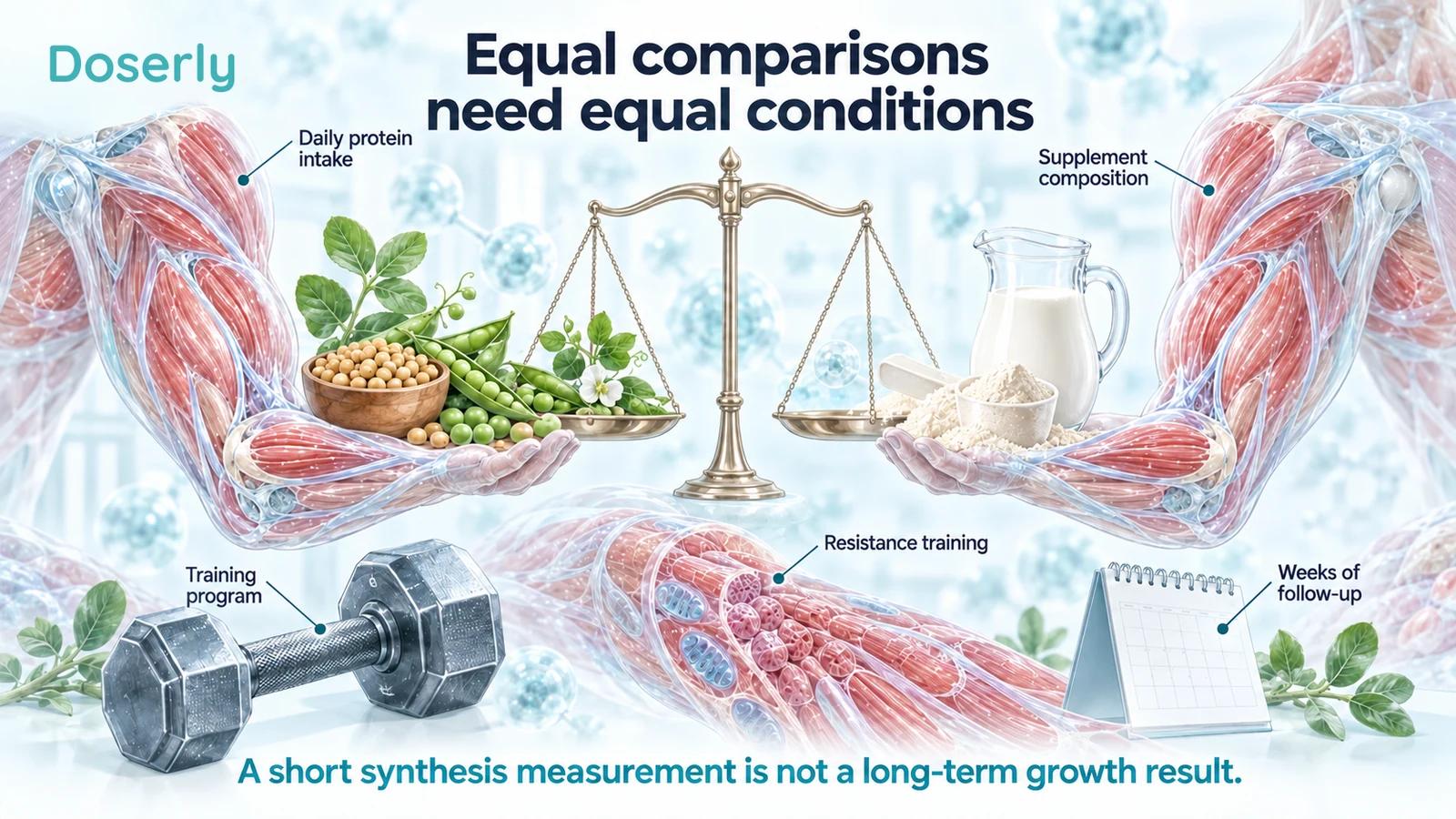
Conceptual study design. Equal-sized illustrated muscles do not depict trial outcomes; the foods and objects identify variables that can change between comparisons.
How to make the evidence useful at meals
Start by identifying the problem you are trying to solve. Someone who eats a varied diet but misses a convenient protein source after work has a different problem from someone whose overall food intake is low. A powder may help with convenience, but it does not replace the need to understand the rest of the diet.
Keep a short record of ordinary meals before making several changes. Note the protein-containing foods, approximate serving sizes, appetite and training schedule. The purpose is to discover patterns, such as repeatedly having meals with very little protein, rather than create a perfect daily score.
When switching products, compare actual protein quantity, ingredients, tolerance and cost per usable serving. If a new powder causes digestive discomfort or is unpleasant enough that you stop using it, an impressive laboratory comparison will not make the routine sustainable. Food preferences and dietary restrictions are legitimate parts of the decision.
For older adults with low appetite, unexplained weight loss or medical nutrition restrictions, an individualized plan is more useful than copying a dose from a young-athlete trial. The studies above enrolled selected populations and tested specific diets. Their intake figures describe the experiments; they are not universal prescriptions.
Training progress is also measured over time. Record exercise performance and consistent body measurements if those fit your goals. A single day's fullness, soreness or scale change cannot show whether a protein source is building more muscle. Changing the diet, training volume and several supplements simultaneously makes any improvement difficult to attribute.
The strongest practical conclusion is conditional and useful: plant-based eating can support muscle development when the diet and training program are well constructed. The evidence does not require declaring every protein source identical. It asks you to compare the actual serving, the actual daily intake and the outcome you care about.
Sources
- Plant-derived protein blend versus milk: acute muscle-protein synthesis
- Leucine-matched soy and whey during resistance training
- Protein-matched diets in habitual vegans and omnivores
- Vegan and omnivorous high-protein diets with mycoprotein
- Milk, soy and carbohydrate during training in novice weightlifters
- Controlled vegan and omnivorous diets in active older adults
- IMPACT vegetarian versus omnivorous training trial
- Vegan dietary patterns and daily synthesis during nine days of training