
Peptides
October 19, 2026
Peptide reconstitution myths: what the stability tests actually show
On this page
Does a fast stream of bacteriostatic water destroy a peptide? Can shaking ruin a vial? Does refrigeration preserve everything, and does a high-purity certificate prove that an opened solution is safe?
The evidence gives more useful answers than either “peptides are extremely fragile” or “all the handling rules are nonsense.” Some handling warnings have a sound scientific basis. Others are repeated with far more certainty than the available experiments justify. The biggest source of confusion is that people use the word degradation for several different problems, then use one laboratory result to answer all of them.
This review examines published experiments, current product instructions, original laboratory certificates, and newer community testing available through October 18, 2026. It distinguishes results we could inspect directly from results described by an organizer or commentator. It is an evidence review, not a validated storage protocol for unapproved injectable products.
The short answers, before the details
Topic
Fast water addition
- What the evidence supports
- No universal threshold is established. Product-specific instructions still matter.
Topic
Any shaking
- What the evidence supports
- Too simplistic. Agitation can cause physical instability without breaking the backbone.
Topic
Small peptides
- What the evidence supports
- Small size does not rule out aggregation; sequence, concentration and formulation matter.
Topic
Refrigeration
- What the evidence supports
- It may slow some processes, but does not stop every process or guarantee sterility.
Topic
99% purity COA
- What the evidence supports
- Relative purity does not establish that 99% of the original amount remains.
Topic
Bacteriostatic water
- What the evidence supports
- Preservative chemistry does not establish indefinite sterility.
Topic
Day 28
- What the evidence supports
- The familiar multidose-vial rule is not a universal chemical degradation deadline.
Topic
Freezing
- What the evidence supports
- Unproven as a general rule; freeze–thaw can introduce its own stresses.
A useful habit is to replace “Is the peptide still good?” with a more specific question: What changed, how was it measured, and does this experiment resemble the product and handling situation being discussed?
First, understand what a COA can and cannot tell you
A certificate of analysis is a report of particular tests on particular submitted material. Its value comes from the methods, sample identity and results, not from the presence of a percentage with several decimal places.
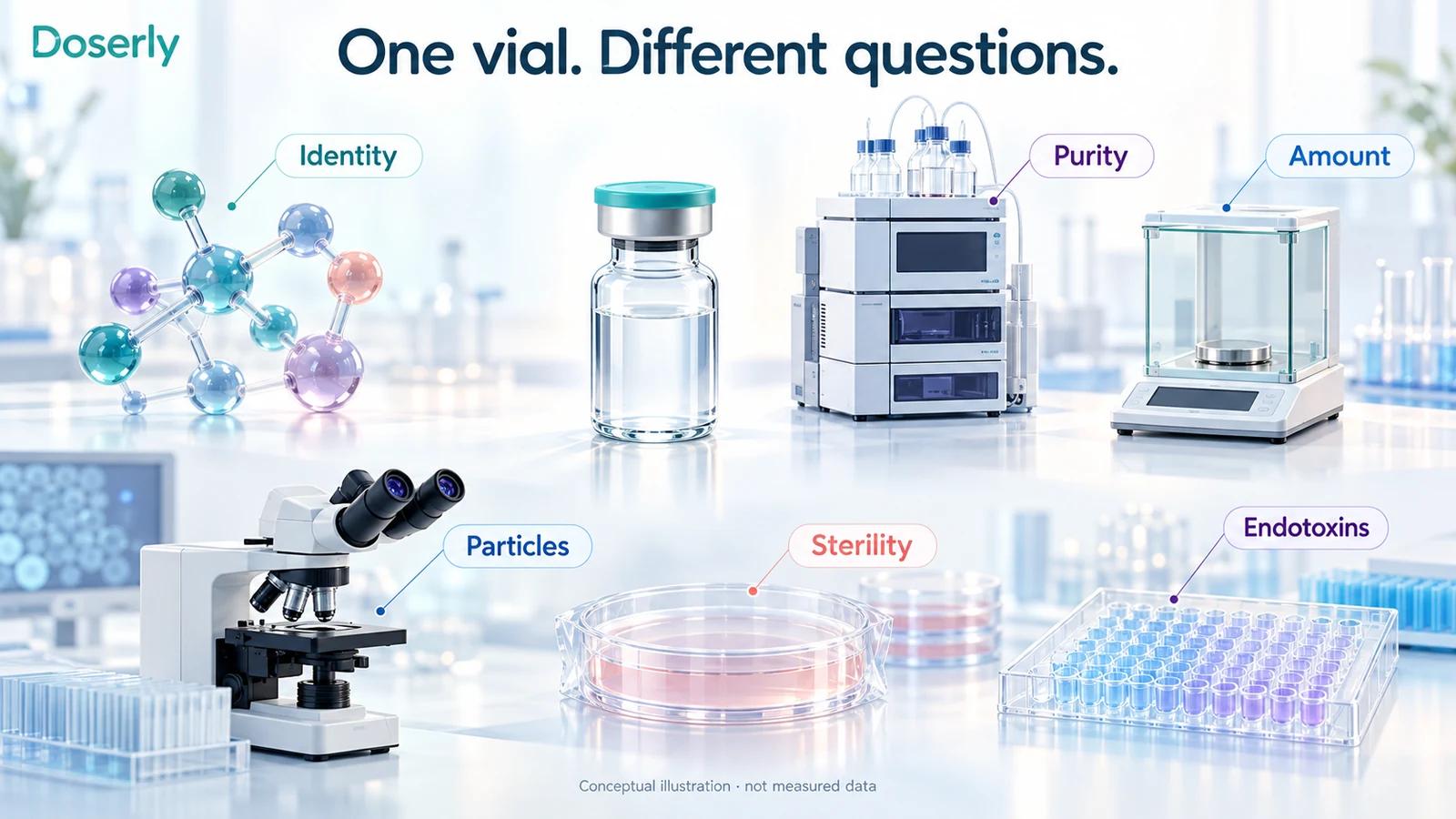
Identity asks whether the expected molecule is present. Chromatographic purity describes a relative analytical result, often the proportion of an integrated signal assigned to the main component. Content or assay asks how much of the intended material is recovered or quantified. Biological potency asks whether the material produces a specified biological response. These measurements can move in different directions.
For a simple illustration, imagine that a solution initially contains 10 mg of a target compound. Later, only 8 mg is recovered into the analyzed sample, but nearly all the detected material is still the target compound. The reported relative purity could remain high even though the recoverable amount fell. This is an explanatory example, not a claim about a particular vial or a correction to apply to a dose.
Conversely, a small fall in chromatographic purity does not automatically translate into an identical fall in clinical activity. Different products, analytical responses and degradation products make that inference unreliable. An assay measuring biological activity can supply information that a chromatogram cannot. A published insulin study, for example, used both chemical testing and a cellular response assay rather than treating them as interchangeable. Kaufmann and colleagues, 2021.
A high-purity result is not a sterility result
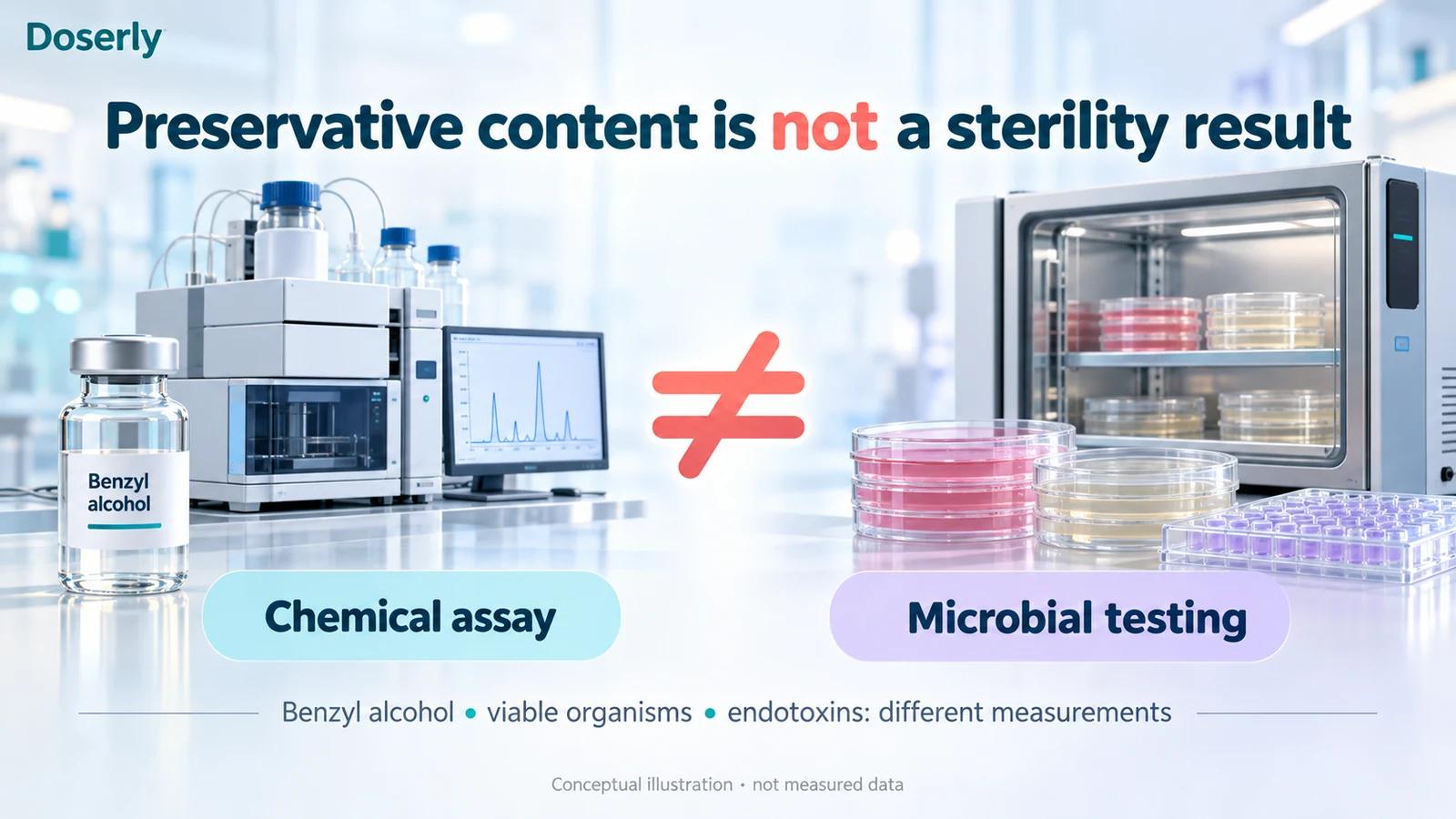
A chemical assay does not establish the absence of viable microorganisms. A sterility test does not, by itself, establish an acceptable endotoxin level. Neither measurement establishes the absence of all subvisible particles. A report must actually include the relevant method and result before it can support a claim about that endpoint.
This distinction becomes especially important after repeated stopper punctures. A baseline chemical certificate describes the submitted sample at that time. It cannot certify every later withdrawal from another vial. CDC guidance explains that preservatives in multidose vials provide incomplete protection against contamination and do not protect against viruses. CDC injection-safety guidance.
When someone posts “still 99% after three months,” the next questions should be: 99% of what measurement, compared with which baseline, and with what microbiological evidence? Those questions are more informative than arguing about whether the certificate is generally “good.”
Myth 1: adding water quickly automatically destroys a peptide
Verdict: a universal claim is not supported by the direct evidence located for this review.
The strongest version of this claim says that the force of a stream against the powder breaks the peptide molecules, sometimes implying a large and immediate loss from one imperfect addition. We did not locate a publicly inspectable, controlled short-peptide study that established such a universal rule by specifying addition speed, comparing matched vials, and measuring multiple relevant outcomes afterward.
That is an evidence gap, not proof that addition technique never matters. An experiment on one formulation would not settle the question for every peptide. “Fast” also needs a definition: a particular volume delivered over a measured time through a specified opening is an experimental condition; “I pushed harder” is not.
Reconstitution research in protein medicines shows why the process deserves attention. A study of stressed, lyophilized IgG1 examined physical instability after reconstitution, including particles and turbidity. Its results concern a large antibody formulation and the conditions used in that experiment. They do not demonstrate that a brief stream of diluent destroys BPC-157, KPV or GHK-Cu. Primary IgG1 study.
A fast addition may change wetting, foaming, local concentrations and contact with air or surfaces. These are plausible formulation concerns; they are not a measured percentage loss for an unspecified peptide. The practical reason to follow a labeled method is that it belongs to the tested product, not that an internet rule has established a universal molecular breaking point.
For an approved medicine, use its specified diluent and mixing instructions. For a research vial without validated instructions, a calculator can explain concentration arithmetic, but cannot fill in the missing stability, compatibility or sterility studies.
Myth 2: shaking is either catastrophic or completely harmless
Verdict: both blanket statements go beyond the evidence.
Agitation can expose molecules repeatedly to air–liquid interfaces and other surfaces. Physical instability may involve association, aggregation or particles rather than the dramatic image of a peptide chain being mechanically snapped. Duration, intensity, headspace, formulation and concentration all affect what an agitation experiment actually tests.
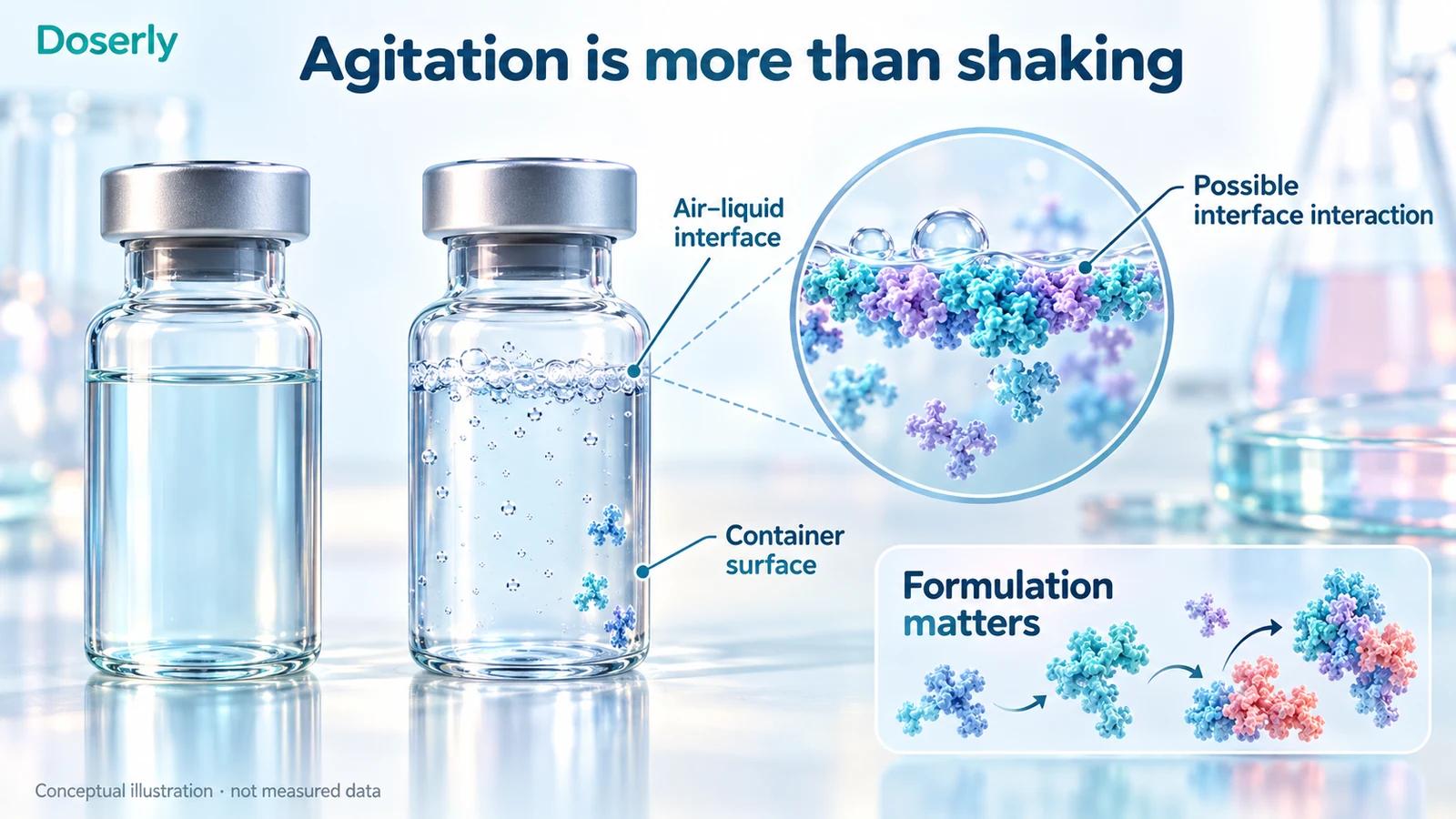
A particularly useful example is teduglutide, a peptide medicine rather than a monoclonal antibody. A 2023 characterization study evaluated the reconstituted product under several stresses. After three hours of smooth shaking at room temperature, researchers observed a small increase in high-molecular-weight species consistent with reversible association. Other structural measurements did not show the same kind of change. This was a defined, prolonged laboratory exposure, not evidence that a momentary accidental shake ruins a vial. Teduglutide stress-testing study.
The finding is valuable because it defeats two shortcuts at once. A peptide can experience a measurable physical change without obvious backbone destruction. And a statement that “the molecule was still intact” does not necessarily answer whether the formulation changed in other ways.
An additional experimental example involves CSP7, a seven-amino-acid peptide. Its formulation study reported aggregation under defined agitation conditions. Small molecular size therefore cannot serve as a universal exemption from physical instability. That result still cannot be transplanted into a loss estimate for another sequence or another solution. CSP7 formulation study.
What about claims from testing laboratories?
Laboratory experience can be useful, especially when it challenges an unsupported story. But an interview, a demonstration video and a controlled comparison have different evidentiary weight. Before interpreting a “shaking makes no difference” statement as a stability study, look for the sample identities, agitation conditions, baseline measurements, number of replicates and assays used.
A convincing negative result would say something like: under these measured conditions, this formulation showed no meaningful change in these specified endpoints within the method's sensitivity. It would not establish that every peptide tolerates every amount of agitation.
Likewise, a failed stress test does not establish that an ordinary handling event causes clinically important damage. If a study uses hours of shaking, it should be described as hours of shaking. There is no valid shortcut from that experiment to “one accidental shake ruined it.”
Myth 3: a clear solution with high purity has retained its full dose
Verdict: appearance and relative purity can miss other changes.
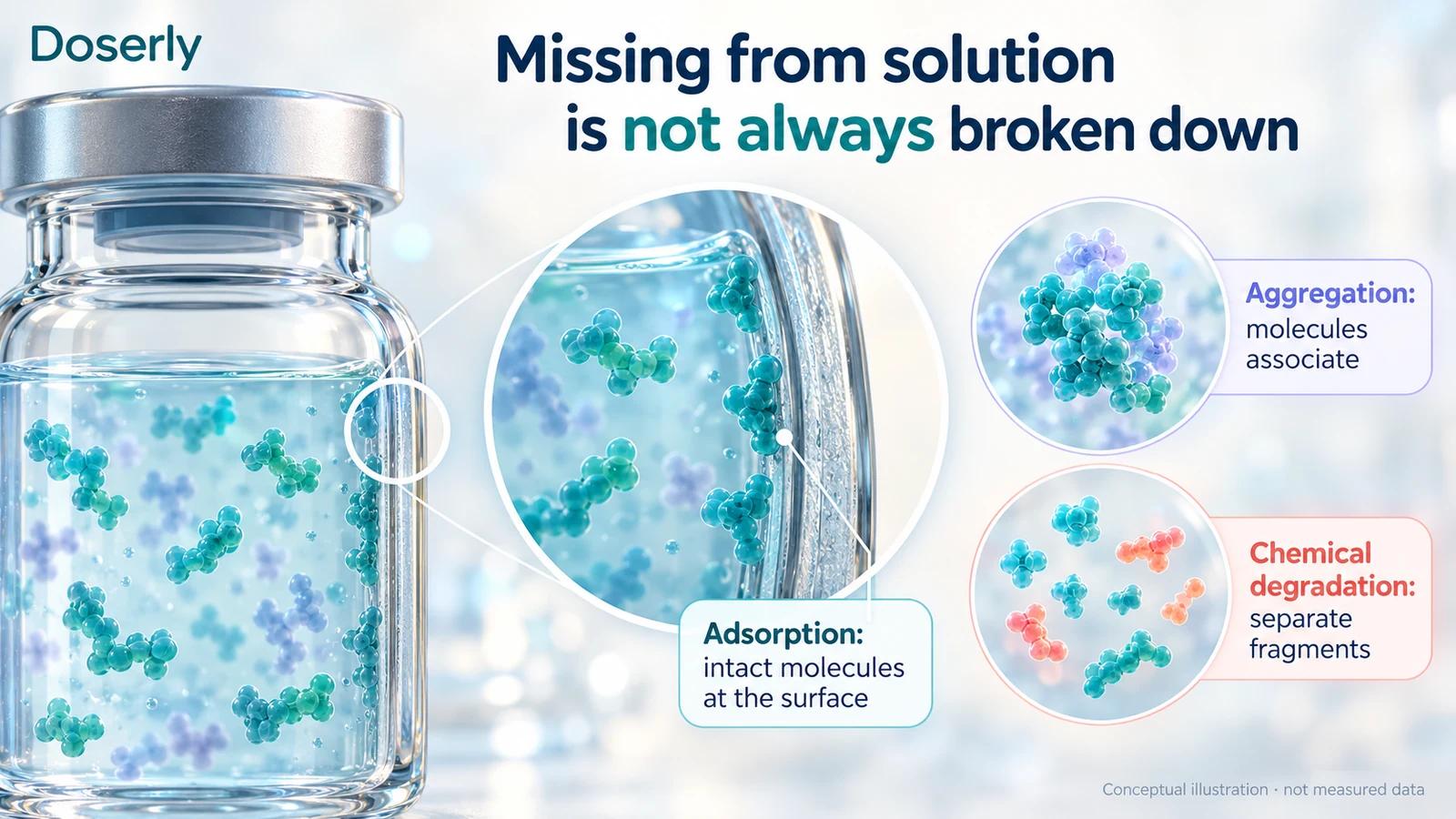
Three broad processes are worth keeping separate. Molecules can change chemically. They can associate into larger structures. They can also be lost from the sampled solution through adsorption to a surface. These possibilities call for different measurements and may coexist.
A primary study of three cationic peptides demonstrated substantial adsorption to glass and plastic under low-concentration experimental conditions. Recovery depended on concentration and container material. The result is evidence that surface losses can matter; it is not a basis for assuming the same losses in a concentrated clinical or research vial. Adsorption of cationic peptides to glass and plastic, 2015.
Sample preparation also matters. If a method excludes certain material before analysis, the resulting trace describes what reached the instrument. Without the procedure, it is difficult to interpret whether an apparent loss reflects degradation, recovery, sampling or another issue. Even a visually attractive chromatogram needs context.
For a storage experiment, the most useful report includes both relative purity and quantified content, along with a description of how the sample was prepared. Orthogonal measurements, meaning methods that examine different properties, strengthen the interpretation. A single endpoint should not be stretched into a full quality assessment.
What original BPC-157 certificates show over three months
Here is a concrete example where the public certificates allow the numbers to be checked instead of relying entirely on a summary.
Four Janoshik reports describe a BPC-157 series labeled as refrigerated after reconstitution. Each reports three content values and three purity values. The arithmetic means below were calculated from those displayed results. These are descriptive means; the certificates alone do not establish the full experimental design, independence of the samples, or a validated beyond-use date.
Time point
Baseline
- Mean reported content
- 11.103 mg
- Mean reported purity
- 99.885%
Time point
Month 1
- Mean reported content
- 11.047 mg
- Mean reported purity
- 99.831%
Time point
Month 2
- Mean reported content
- 9.767 mg
- Mean reported purity
- 95.119%
Time point
Month 3
- Mean reported content
- 9.717 mg
- Mean reported purity
- 93.691%
The baseline was analyzed on February 3, 2026; the follow-ups on March 3, April 2 and May 4. The original reports are 104458, baseline, 105944, month one, 105945, month two and 105946, month three.
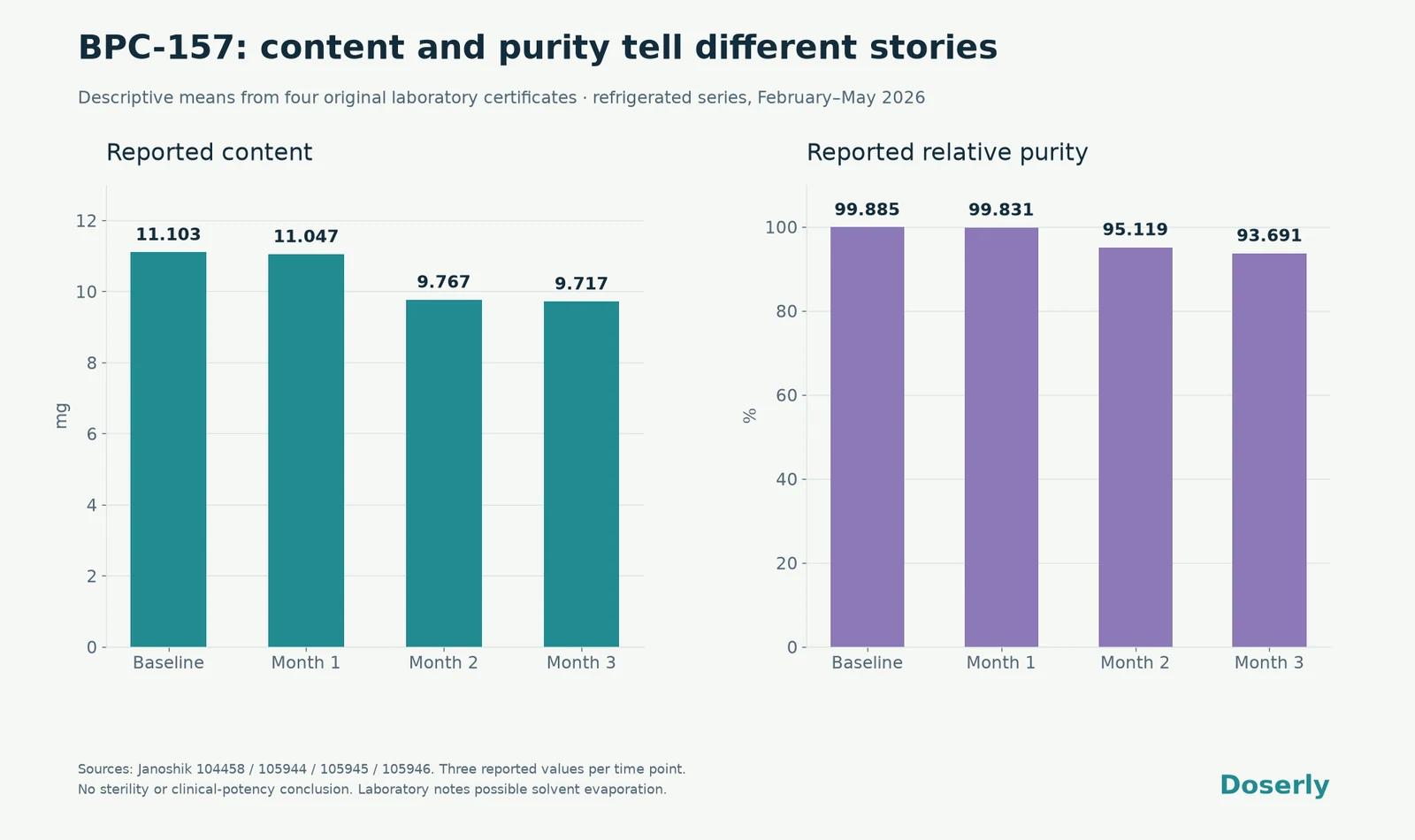
The first month looks quite different from the later measurements. The month-three content mean is approximately 87.5% of the measured baseline, while the relative purity is approximately 93.7%. Those percentages answer different questions. Neither is a measured clinical-potency percentage or a sterility result.
The laboratory also notes that partial solvent evaporation could make the first analyte concentration appear elevated. That caveat matters: volume changes can complicate comparisons of concentration and recovery. A precise-looking number does not remove uncertainty about the handling history.
This series supports a narrow conclusion: the reported chemical results changed over time in these submitted samples. It does not identify a universal degradation rate, prove why the change occurred, validate three months of use, or show what would happen in a differently formulated vial. The public certificates do not provide a complete temperature log, microbial challenge test or repeated-use validation.
A second BPC-157 series needs a different evidence label
An August 2026 secondary analysis describes another series comparing refrigerated and room-temperature storage. It reports approximately 87.1% versus 79.3% content retention at three months, respectively. We inspected the original baseline certificate, but could not independently inspect all the follow-up certificates behind that comparison. It therefore belongs in the category reported community evidence, not independently verified longitudinal COAs. Secondary analysis and its source links, original baseline report 163924.
The distinction is deliberate. A plausible result should not receive a stronger label merely because it agrees with expectations about refrigeration. Readers need to know which part of the evidence can actually be checked.
Myth 4: room temperature always destroys peptides, while refrigeration preserves them indefinitely
Verdict: temperature matters, but neither half of this claim is universal.
Temperature studies are meaningful only with a defined formulation, exposure and endpoint. “Room temperature” can mean a controlled laboratory condition, a changing indoor environment, or a package sitting in a hot vehicle. Those are not interchangeable exposures.
The BPC-157 certificates above already illustrate that refrigerated samples can change over time. They do not establish a room-temperature comparison by themselves. Conversely, some formulated medicines tolerate particular warm exposures better than a blanket fragility claim suggests.
In a 2021 primary study, investigators tested several insulin formulations under temperature cycling between 25°C and 37°C over four weeks. Chemical measurements remained within the study's pharmacopeial limits, and structural and cellular activity measurements supported stability under the tested conditions. Insulin in a manufactured formulation is not equivalent to an arbitrary peptide reconstituted in bacteriostatic water. Insulin heat-stability study.
That study is a useful counterexample to “all peptide solutions rapidly fail outside a refrigerator.” It is not permission to ignore another product's storage instructions. The correct lesson is that stability has to be demonstrated for the product and exposure in question.
The 2026 somatropin study shows why light deserves its own question
A study published online in December 2025 and in a January 2026 issue compared light-stressed somatropin in lyophilized, reconstituted and diluted states. Reported increases in high-molecular-weight species were 0.4, 2.7 and 4.7 percentage points, respectively. The researchers also measured charge variants and oxidation. Microfluidic imaging did not show a corresponding change in particles. Pritts and colleagues, somatropin photostability study.
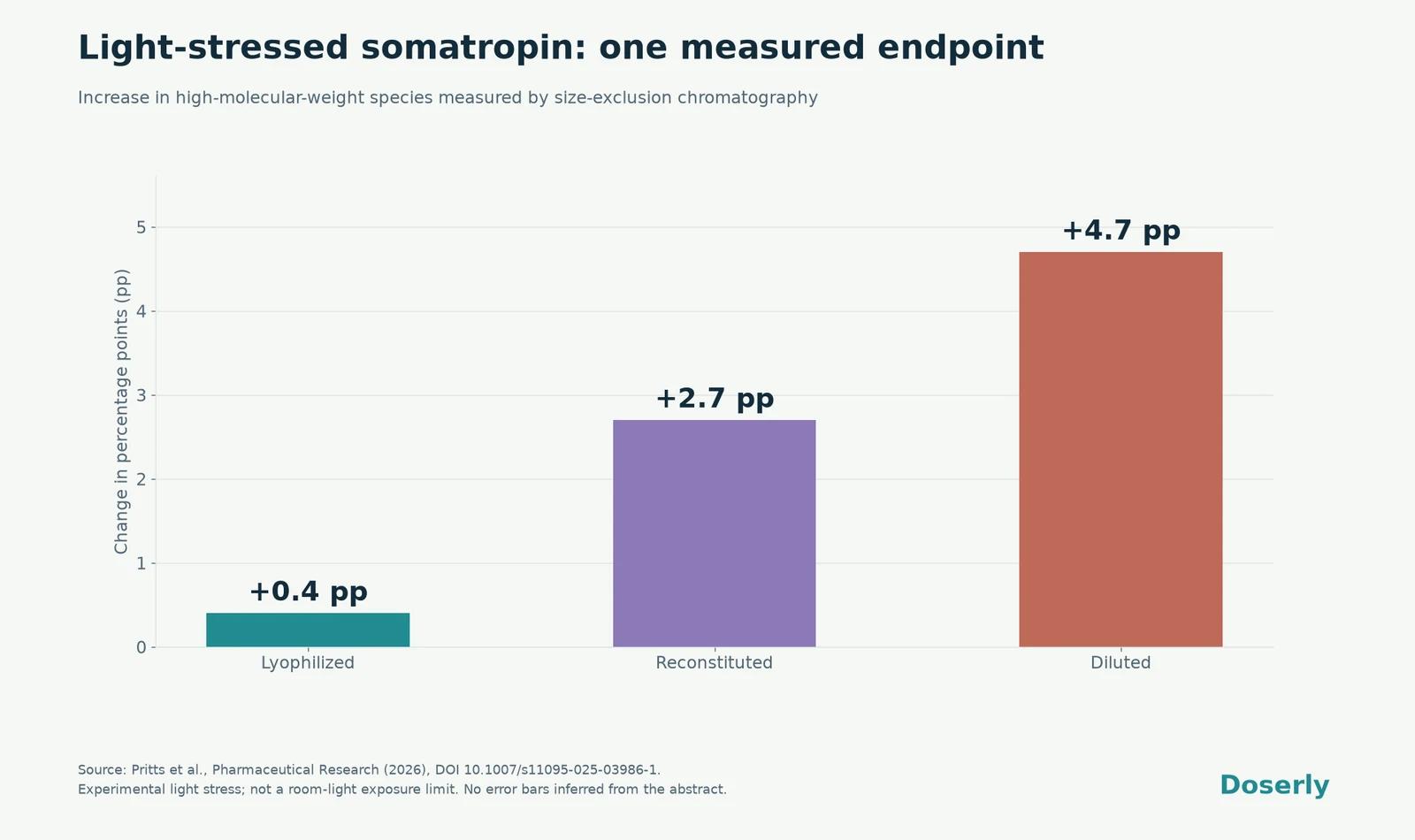
This is an especially good example of why one assay cannot answer every question. Different methods can reveal different aspects of the same sample. It also shows why a result from dry powder should not automatically be used to defend the stability of a mixed or diluted solution.
The experiment does not establish how many minutes a different vial can sit on a kitchen counter. Translating an accelerated stress condition into ordinary storage requires additional work. Reporting the study accurately means preserving that limit rather than turning the largest bar into a universal warning.
Myth 5: freezing a reconstituted vial must be better than refrigerating it
Verdict: freezing is not a universally validated rescue strategy.
Freezing and thawing are exposures to study, not automatic extensions of shelf life. A frozen state, the transition into it and the thawing process are separate parts of the experiment. Product instructions may explicitly prohibit freezing.
A September 2026 public retatrutide dataset illustrates both the value and the limitations of community testing. Two refrigerated 90-day entries reported content retention of 91.0% and 90.4%. Separate freeze–thaw entries followed for 45 days reported 85.6% and 86.6%. These were different experiments and durations, with small sample counts; they are not a randomized, matched head-to-head trial. PTDS dataset and downloadable results.
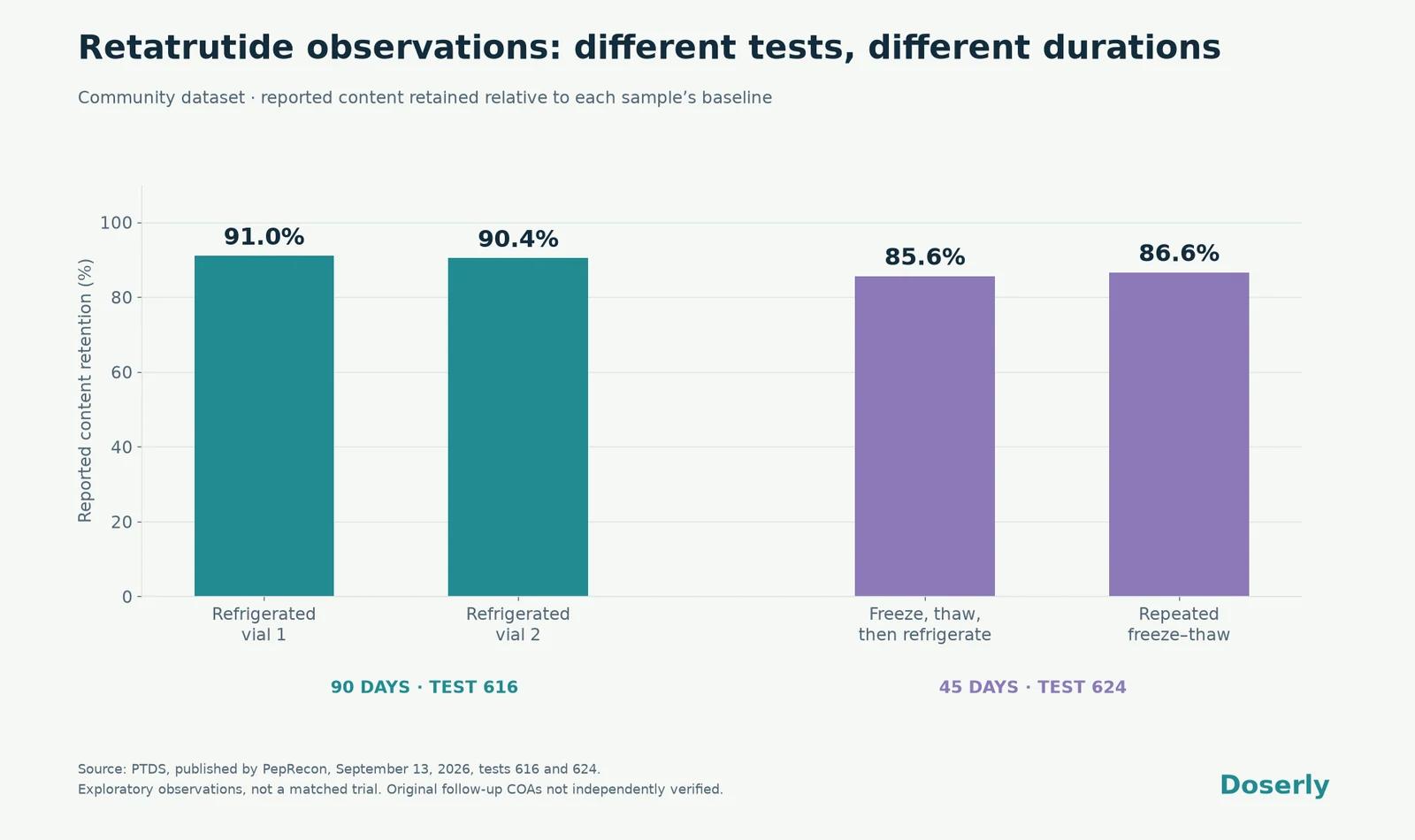
These observations justify asking better questions about freezing; they do not quantify a universal freezing penalty. The same dataset contains differing results across other samples and conditions. That variability should discourage confident shelf-life promises.
Another frequently misunderstood source is a 2026 tirzepatide analytical-method paper. Its stability experiments concern tirzepatide in rat plasma, including laboratory handling and storage conditions. Such validation helps establish whether study samples can be measured reliably. It does not establish the storage life of a repeatedly punctured vial reconstituted with bacteriostatic water. Tirzepatide LC-MS/MS method study.
Before sharing a freeze–thaw result, check the matrix. Plasma, buffer, commercial formulation and a home-reconstituted solution are different systems. A title containing the correct molecule is not enough to make the experiment applicable.
Myth 6: bacteriostatic water either protects every peptide or damages every peptide
Verdict: preservative compatibility is formulation-specific.
Bacteriostatic Water for Injection is not simply a universal peptide stabilizer. Pfizer's labeling describes water containing benzyl alcohol and directs users to follow the drug manufacturer's instructions when selecting a vehicle and handling the resulting preparation. The water's own storage instructions do not automatically become the mixed drug's instructions. Pfizer bacteriostatic-water labeling.
A 2025 primary study used NMR spectroscopy to investigate preservative interactions with a therapeutic incretin peptide. Benzyl alcohol did not produce significant interaction under the tested conditions; phenol-associated changes were reversible. HPLC and a cell-based assay supported essentially unchanged stability and potency in that system. The abstract does not identify the peptide as a particular community product, so it should not be relabeled as a tirzepatide or retatrutide study. Xie and colleagues, 2025.
A different primary study, involving recombinant human granulocyte colony-stimulating factor, found benzyl-alcohol-associated aggregation that depended on conditions including pH and temperature. That protein formulation is not evidence that benzyl alcohol damages every short peptide. Taken together, the studies show why compatibility must be investigated in the actual formulation. Primary rhG-CSF study.
“Contains a preservative” and “chemically compatible with this molecule for this period” are separate propositions. Neither follows automatically from the other. A preferred diluent should come from validated product instructions or an appropriate pharmacy, rather than from a rule based solely on the word peptide.
Myth 7: a preservative test proves sterility beyond 28 days
Verdict: this confuses a chemical measurement with a microbiological conclusion.
A public write-up of a 120-day bacteriostatic-water experiment reports benzyl alcohol concentrations in three vials under different handling conditions. Even if those chemical measurements are accepted as reported, they do not establish that all samples remained sterile. The account is useful for discussing preservative concentration, but it is not a substitute for original microbiological methods and results. Published 120-day study account.
The familiar 28-day recommendation concerns opened multidose vials unless the manufacturer specifies another date. It is not a chemical prediction that every peptide suddenly degrades on day 29. It also does not grant every compounded or reconstituted preparation 28 days of use. Product labeling and applicable pharmacy instructions can require a shorter period or different conditions. CDC multidose-vial guidance.
A particularly instructive exception is EGRIFTA WR. Its current instructions specify the supplied bacteriostatic water, gentle swirling without shaking, and a seven-day room-temperature period after mixing, with no freezing. That is a product-specific instruction set. It should not be generalized to other tesamorelin formulations or to an unrelated peptide. EGRIFTA WR prescribing information.
This example explains why “always refrigerate,” “always use within 28 days” and “BAC makes it safe longer” are all inadequate substitutes for checking the exact formulation. A rule can sound conservative while still contradicting the product's validated instructions.
What actual microbiological testing has found
There are culture-based studies of opened medication vials, although they should not be mistaken for controlled peptide-specific shelf-life trials. A 2023 study at Jimma Medical Center sampled 384 parenteral medication containers and reported 21 contaminated samples, all from multidose vials. Researchers used bacterial culture methods and examined handling practices. This was a cross-sectional hospital investigation, not a test proving contamination begins on a particular day. Tabor and colleagues, 2023.
An earlier pulmonary-hospital study cultured the contents of 205 opened vials and found contamination in 11, or 5.36%. Insulin was the most frequently contaminated medication. Again, the observed rate describes that clinical setting and sampling process. It is not an estimate of an individual person's risk from a particular vial at home. Baniasadi and colleagues, 2013.
These studies answer a question that an HPLC purity report cannot: whether sampled containers yielded microorganisms under the culture methods used. They also show why a medicine's chemical identity is not enough to dismiss contamination as a theoretical concern. Their limitations prevent a different overreach: neither study tells us that refrigeration, benzyl alcohol or a particular withdrawal count guarantees a specified period of safe use.
A negative culture result would need equally careful interpretation. It describes the tested samples, sample volume, organisms detectable by the method and sampling time. It does not retrospectively certify every prior withdrawal or guarantee every future one. For an in-use claim, a study needs a design that represents the proposed handling conditions and measures the endpoint being claimed.
How to judge the next viral reconstitution experiment
The best community experiments can identify questions that deserve larger studies. Their usefulness improves when the reports let other people reconstruct what was done. A dramatic before-and-after percentage is only the beginning.
Look first for the comparison. Were matched samples from the same lot assigned to different conditions? Was there an unstressed control? Were multiple vials tested, or was the same sample measured repeatedly? Technical repeat measurements can describe assay repeatability, but do not replace independent vials when the question concerns variability between vials.
Then look for the exposure. Addition speed should be measured, shaking should have an intensity and duration, and temperature should be logged. Diluent, concentration, container, headspace, light exposure, punctures and sampling history can all determine whether the result answers the advertised question. If several variables change together, the study cannot cleanly attribute the outcome to one of them.
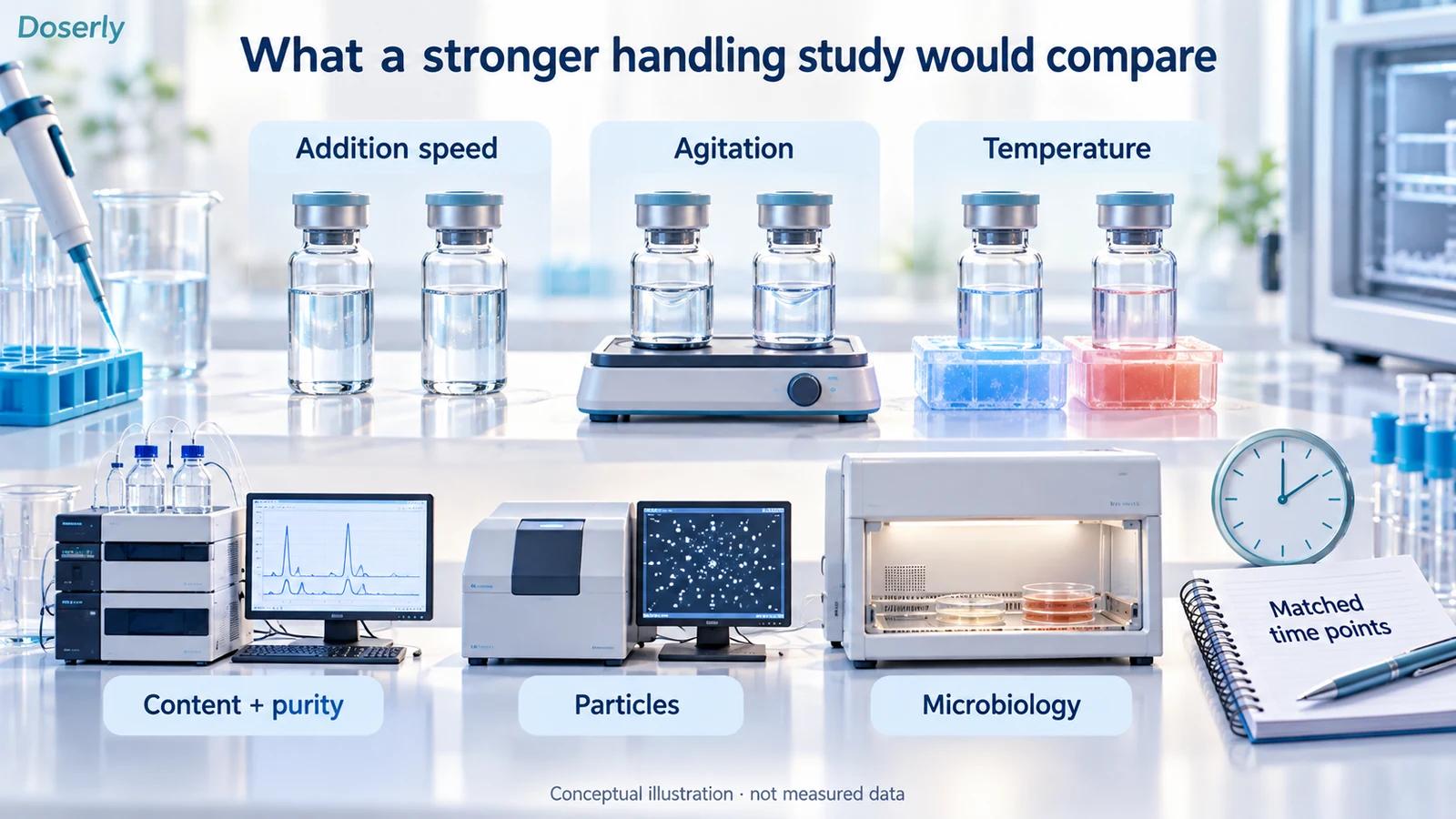
Finally, examine the measurements and reporting. A strong report gives original certificates or data, methods, units, baselines, individual results and uncertainty where available. It separates observed changes from proposed mechanisms. If the authors discuss sterility, there should be microbiological evidence. If they discuss biological potency, chemical purity alone is not enough.
For a fast-versus-slow addition experiment, a helpful design would hold the peptide, formulation, volume and container constant, vary a measured addition rate, and assess content, impurities and physical instability with appropriate controls. For a repeated-use storage question, the experiment would also need a defined withdrawal schedule and relevant microbiological work. Those are different studies, even if both start with a vial and a syringe.
A practical COA reading checklist
Before accepting a conclusion, ask whether the report identifies the sample and lot; whether there is a measured baseline; whether content and relative purity are both available; whether the method can detect the proposed change; whether the condition matches the claim; and whether the conclusion stays within the endpoints actually tested.
Also check for caveats written by the laboratory. The evaporation note in the BPC-157 series is exactly the sort of detail that can disappear when a screenshot becomes a social-media summary. Several decimal places should invite closer reading, not end it.
Where the evidence remains incomplete
The newest date is not automatically the strongest evidence. A recent community spreadsheet may contain genuinely useful observations while lacking the controls of an older formulation study. A peer-reviewed paper may have excellent methods yet examine a molecule, matrix or exposure that is poorly matched to the question. Relevance and methodological strength both matter.
For this review, the strongest directly inspectable community example was the four-report BPC-157 series. Other recent observations were retained with their access limitations stated. We did not treat a secondary account as if we had inspected every certificate, infer sterility from a preservative assay, or assign an unnamed experimental peptide a familiar commercial identity.
The biggest unresolved questions include controlled addition-rate comparisons for commonly discussed short peptides; reproducible agitation experiments at realistic handling durations; and chemical, particle and microbiological testing carried out together during a defined repeated-withdrawal schedule. Validated compatibility data for custom mixtures are another separate need. Results from each ingredient alone do not establish the behavior of the combined formulation.
A useful future update would add studies that close these gaps, rather than merely collecting more impressive-looking purity percentages. Until then, the most honest answer to some handling questions is that no sufficiently matched public test was located. That answer is more informative than a precise but unsupported storage promise.
What this means for everyday questions
“I shook the vial once. Is it ruined?”
The studies reviewed here do not establish a universal loss from one accidental shake. They also cannot certify your particular vial. Check the instructions for the actual product and ask the dispensing pharmacist about a handling deviation. Do not invent a compensating dose from an unrelated experiment.
“The vial was warm. Can I estimate the percentage lost?”
Not from temperature alone. You would need the formulation, duration and relevant stability data. A warm shipping test on dry powder cannot supply a loss estimate for a mixed solution. A laboratory stress test also cannot automatically be converted into a household time limit.
“Can I use the purity percentage to increase the dose?”
A relative purity percentage is not a validated dose-adjustment factor. It may not describe the recoverable amount, activity or contents of your vial, and it says nothing by itself about microbiological quality. Dose compensation would turn uncertainty in a laboratory interpretation into another uncertainty in administration.
“Does a calculator tell me whether a blend is stable?”
No. A reconstitution calculator can help keep mass, liquid volume and concentration consistent. It cannot establish that two substances are compatible in one vial, that a diluent is suitable, or that a preparation remains sterile for a chosen period. Correct arithmetic and validated formulation are different requirements.
“What should I record?”
For prescribed products, retain the exact formulation, concentration, dispensing instructions and relevant dates. A medication history is more useful when it records what was actually used rather than relying on memory. Doserly can help organize scheduled doses, reminders and inventory; it does not test vial quality or replace product-specific advice.
The most defensible conclusion from the current evidence is specific: handling can matter, but its effect depends on the molecule, formulation, exposure and measurement. Original test reports can challenge myths when their limits stay attached to the numbers. They become another myth when a narrow result turns into a promise about every vial.