
Peptides
October 16, 2026
PEG-MGF and anti-doping: why the exact category matters
On this page
For athletes subject to World Anti-Doping Code rules, PEG-MGF is not a substance to assess solely by whether a seller calls it experimental or whether human benefits have been proven. The current WADA list expressly includes mechano growth factors, or MGFs, within its growth-factor category.
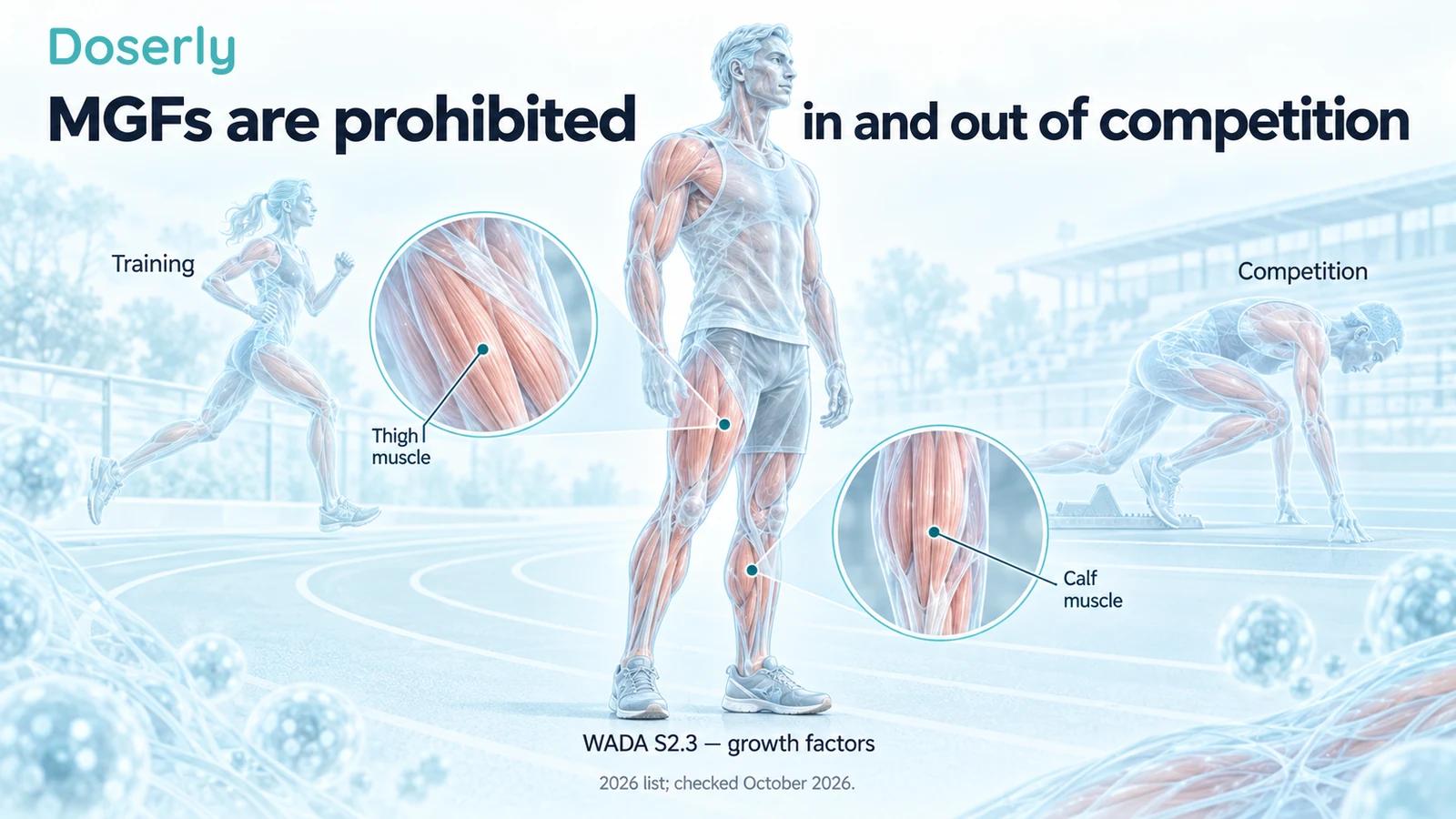
As of October 15, 2026, the relevant annual list is the 2026 Prohibited List. MGFs appear in S2.3, and S2 substances are prohibited both in and out of competition. The already-published 2027 list takes effect on January 1, 2027; publication does not make that future edition the current rulebook. WADA 2026 list, WADA 2027 list
That classification answers a sporting-rules question. It does not establish that PEG-MGF improves performance, is safe, or has a predictable detection window. Keeping those questions separate is essential when reading both sales claims and anti-doping research.
The Doserly PEG-MGF guide explains the wider scientific background. Here, the focus is how to interpret the category, the dates and the evidence without turning any of them into an unsupported assurance.
Why “unapproved peptide” is an incomplete explanation
It is common to hear experimental substances grouped together as simply “unapproved.” That description can be relevant to medicine regulation, but it does not identify the most specific anti-doping category.
WADA's S0 section concerns non-approved pharmacological substances that are not addressed by subsequent sections. MGFs are addressed in S2.3. The accurate starting point is therefore the explicit growth-factor listing, rather than assuming every experimental peptide belongs only in S0. 2026 Prohibited List, S0 and S2
The practical lesson is to read the category and its scope, not merely search for an exact commercial spelling. Product names can include prefixes, abbreviations or proprietary wording that differ from a class name in the list.
If the identity of a particular preparation is uncertain, that uncertainty calls for clarification from the relevant anti-doping organization. It does not make the product permitted by default.
This is also why a screenshot of an unsuccessful keyword search is weak evidence. A search tool may miss a synonym, an ingredient or a broader category. The underlying rule remains the authority.
The list is not a catalog of every product name
A regulatory category and a product catalog have different purposes. A catalog helps a buyer find a specific item; a prohibited list defines substances, classes and methods covered by sporting rules.
The inference “my exact label is not printed, therefore it is allowed” skips the category question. For PEG-MGF, the relevant family is not hidden: MGFs are named. A suffix or a claimed formulation change should not be treated as an exemption without authoritative confirmation.
Nor does a seller's explanation of the molecule settle its sporting status. The seller may be describing an intended mechanism, a marketing category or a research-use designation. None of those replaces the applicable anti-doping rules.
A useful inquiry includes the full product name, claimed active ingredient and any available composition information. Asking only whether “peptides” are permitted is too broad to produce a reliable answer.
The same care applies when sharing advice with teammates. Passing along a brand name without the active ingredient can strip away the information needed to check the rule correctly.
In-competition and out-of-competition are different scopes
A substance restricted only during competition raises a different timing question from one prohibited at all times. For MGFs, the latter scope applies under S2. The 2027 edition retains the MGF listing and the all-times scope when it becomes effective. 2027 Prohibited List
This means that the phrase “off-season recovery” does not itself resolve the rule issue. A training period is still part of an athlete's sporting life, and a product's intended purpose does not rewrite its category.
It is equally unhelpful to infer permission from a claim about how quickly a product leaves the body. Sporting status and laboratory detectability are separate questions. A seller's half-life claim cannot substitute for either an official classification or a valid clinical pharmacokinetic study.
Athletes should seek clarification about the rules that apply to their sport and level, especially when moving between organizations. The useful question is which rules govern the person and the substance, not whether a particular use feels distant from a competition.
Prohibited does not mean proven effective
A prohibition can be clear even when the human efficacy evidence is weak. These statements are compatible: a substance can fall within a prohibited category while lacking convincing clinical evidence for the benefit being advertised.
The Code also distinguishes use-related violations from whether an intervention succeeds. Article 2.2 states that success or failure of use is not material to establishing the relevant violation. “It did not work for me” therefore does not answer the sporting-rules question. World Anti-Doping Code, Article 2.2
Conversely, readers should not use the prohibited list as proof that a peptide builds muscle. That turns a classification into an efficacy trial it never was.
For an athlete considering a recovery claim, there are consequently at least three separate checks: sporting eligibility, evidence of clinical benefit, and evidence of safety. A favorable answer to one would not automatically answer the others.
Keeping these questions separate also improves journalism. “Banned performance drug” may be a compact phrase, but it can imply demonstrated performance effects that the cited scientific study did not measure.
What analytical MGF research actually establishes
Some MGF papers come from anti-doping laboratories. Their purpose is to characterize substances or develop ways to identify them in samples, rather than to test whether they improve recovery.
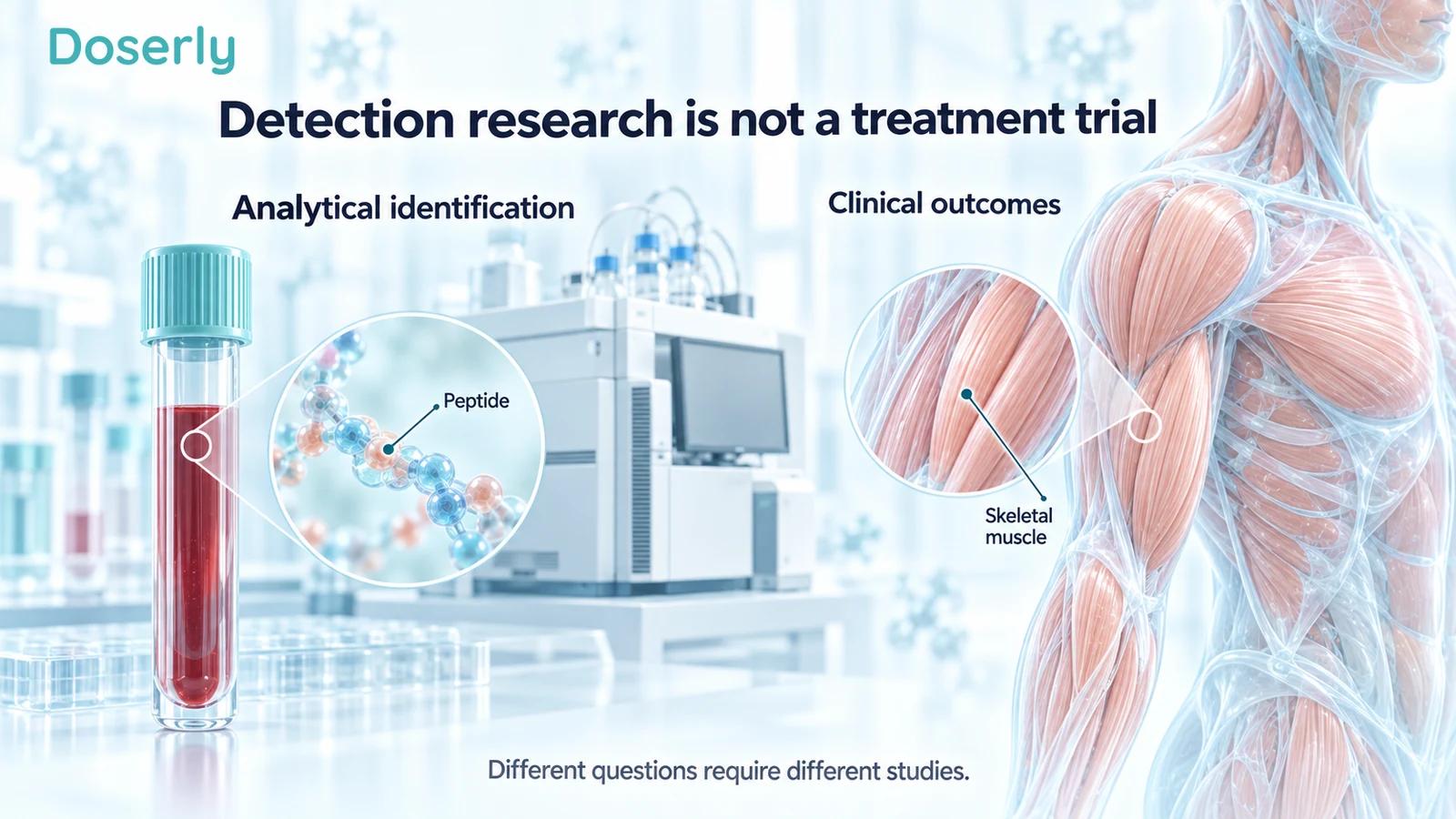
A paper on a biotechnologically produced full-length MGF described characterization of material offered through channels supplying athletes and adaptation of analytical methods for doping control. This is evidence about identifying a particular material. It is not a controlled trial of a PEG-MGF preparation in injured athletes. Full-length MGF characterization study
The phrase full-length matters. It should not be silently replaced with PEG-MGF, and an analytical method for one construct should not be described as a universal study of every product carrying an MGF label.
Likewise, a laboratory's ability to recognize a substance does not tell us the size of a clinical benefit. Analytical identity and therapeutic outcomes have different endpoints.
When reading a reference list, check whether “human samples” means samples used to validate an assay, samples from actual administration of the named substance, or samples from a different intervention. The distinction can change the entire interpretation.
A blood-method paper is not a PEG-MGF exposure trial
A 2022 paper examined a method for several peptidic substances in doping-control blood samples, including human MGF and MGF-Goldspink among its targets. Its proof-of-principle post-administration samples involved synthetic insulin analogues. Those samples should not be relabeled as people receiving PEG-MGF. Thomas and colleagues, 2022
This is a particularly useful example of why the methods matter. The same paper can discuss several target analytes while using a narrower set of real administration samples to demonstrate an aspect of the workflow.
The study does not provide a universal clearance timetable for PEG-MGF. Detection depends on the material, method, sample and circumstances, and the cited experiment does not establish a safe interval for avoiding a rule violation.
The appropriate takeaway is that analytical research is active and construct-specific. Neither “undetectable” marketing nor a generalized claim that every product is detected identically follows from this paper.
There is no need to turn laboratory limits into a strategy. For compliance, the relevant action is to establish whether the substance is permitted before use.
Athlete responsibility and consequences are separate questions
Under Article 2.1, an athlete is responsible for prohibited substances, metabolites or markers present in their sample; proving intent is not required to establish that presence violation. The Code's commentary also distinguishes this principle from how fault affects consequences. World Anti-Doping Code, Article 2.1
That distinction prevents two common errors. One is assuming that lack of intent automatically means no violation. The other is assuming that every case has an identical outcome regardless of facts.
This article does not predict a sanction for a hypothetical athlete. An actual case requires the applicable rules, evidence and process. General information should not be presented as an individualized determination.
For prevention, however, the lesson is practical: reassurance from a vendor, coach or acquaintance is not equivalent to a documented check with the appropriate authority.
It is sensible to preserve product information and written advice when asking for clarification. Good records help establish what was checked and when; they do not convert a prohibited substance into a permitted one.
A prescription is not the same as a TUE
A clinician's treatment decision and an anti-doping exemption are separate processes. USADA's therapeutic-use-exemption guidance describes assessment of a documented medical need against the relevant criteria, including permitted alternatives and the potential for performance enhancement beyond restoration of normal health. USADA TUE guidance
A prescription alone should therefore not be treated as proof of sporting permission. Nor should an athlete assume that any experimental recovery product will qualify for an exemption.
The appropriate organization depends on the athlete's circumstances. USADA's page is useful guidance for its setting, while athletes elsewhere should contact their own national anti-doping organization or international federation.
For a genuine health problem, clinical assessment remains important. The sporting question should be addressed alongside that care, using the formal process that applies, rather than by substituting internet advice for either one.
An exemption process is not a workaround for a desired performance product. It is a defined route for considering therapeutic need under anti-doping rules.
Purity and supplement claims do not establish permission
A purity certificate answers a different question from whether a substance is prohibited. If a product contains an explicitly prohibited active ingredient, confirming that ingredient's identity does not make it suitable for an athlete.
Supplement marketing can create additional confusion. UK Anti-Doping explains that product labels can be inaccurate, contamination can occur, and no supplement is guaranteed free of prohibited substances. It also states that anti-doping organizations do not endorse or approve supplement products. UKAD supplement-risk guidance
This does not mean that a research peptide should be treated as an ordinary dietary supplement. It means that familiar sales language—tested, certified or athlete friendly—needs careful interpretation.
Before relying on a claim, identify what was tested, by whom, and for what purpose. A quality test, a supplement batch program and an official determination of a substance's status are not interchangeable services.
For PEG-MGF, the named MGF category remains the starting point. A certificate cannot erase that category.
A practical way to check a claim
Start by writing down the exact claimed ingredient, rather than only the brand. Locate the current official list and note its effective date. Read the relevant category and its scope, then seek clarification from the organization responsible for your sport if the preparation or your obligations remain unclear.
Keep medical questions separate: what evidence supports the proposed benefit, and what human safety information exists? A sporting prohibition should not be used to exaggerate efficacy, just as missing efficacy data should not be used to dismiss a prohibition.
Finally, check dates when reading saved articles or screenshots. This article was researched in October 2026, when the 2026 list was in force and the 2027 list was published for the following year.
The defensible conclusion is specific: MGFs are expressly covered by the growth-factor category, and the scientific uncertainties around PEG-MGF do not create an exception. Accurate classification, current dates and direct guidance are more useful than assumptions based on a product name.
Sources
- WADA 2026 Prohibited List.
- WADA 2027 Prohibited List, effective January 1, 2027.
- World Anti-Doping Code, Articles 2.1 and 2.2.
- Full-length MGF analytical characterization.
- Thomas and colleagues: peptide analysis in blood samples (2022).
- USADA therapeutic-use-exemption guidance.
- UKAD supplement-risk guidance.