
Supplements
October 16, 2026
Paraxanthine versus caffeine: what the direct comparisons actually show
On this page
Paraxanthine is often introduced as the part of caffeine you wanted all along: more focus, fewer jitters and less trouble sleeping. The metabolic relationship makes the story sound intuitive. But being a caffeine metabolite is not the same as being a proven upgrade.
There are now human trials comparing paraxanthine directly with caffeine. The evidence has moved beyond the early placebo-only studies. It remains small, short and specific to particular tests and populations, with different findings for cognitive tasks, exercise performance and perceived sleep.
The useful question is therefore more precise than “Is paraxanthine better?” Better at what, compared with which caffeine dose, over what interval, and for whom?
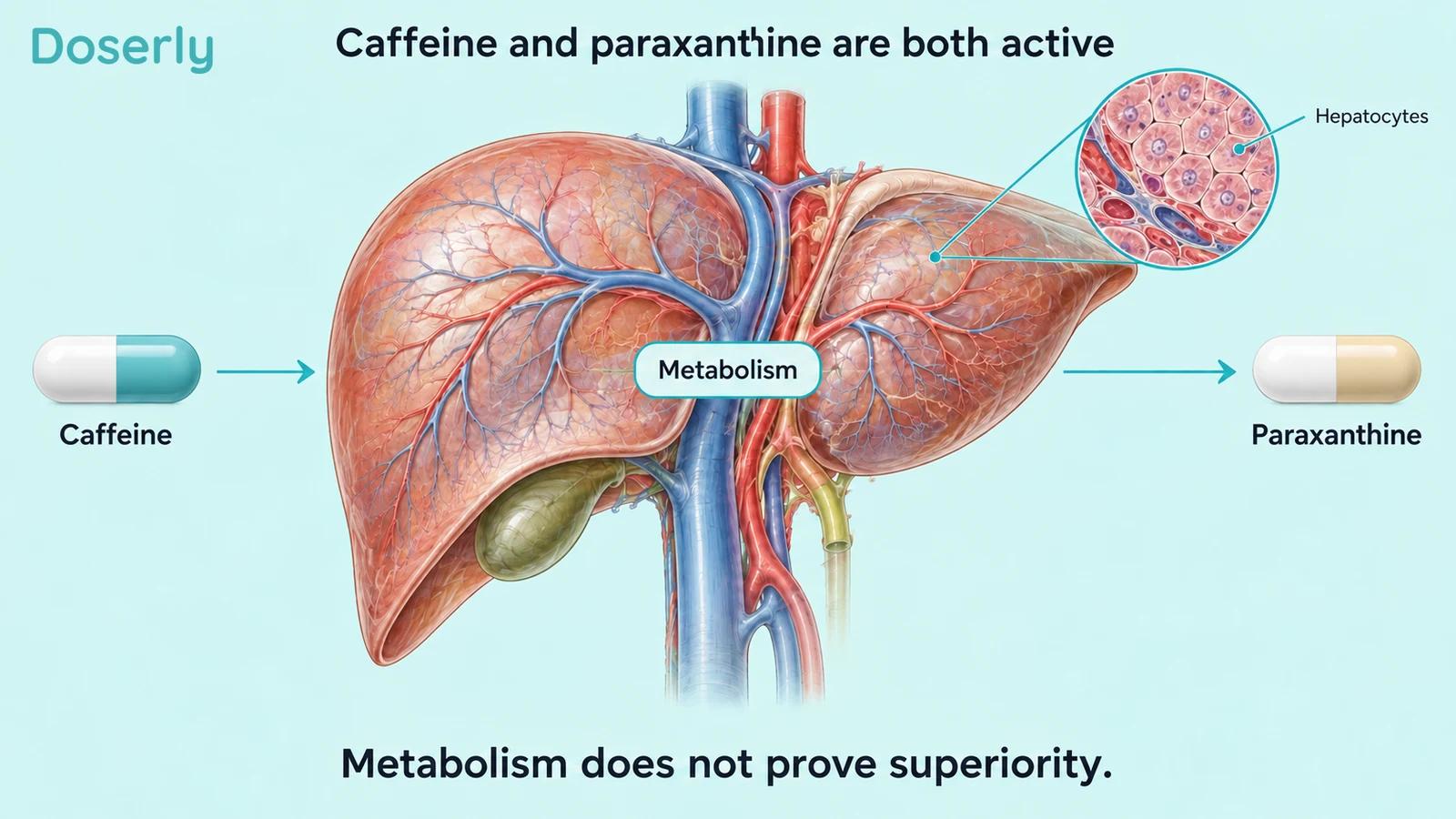
A metabolite is still an active exposure
The body converts much of the caffeine it receives into paraxanthine. A classic human pharmacology experiment reported that both compounds increased diastolic blood pressure, plasma epinephrine and free fatty acids under the tested conditions. In 12 participants, researchers compared caffeine and paraxanthine at matched doses of 2 or 4 mg/kg with placebo after methylxanthine abstinence. Responses were similar at the higher dose, while caffeine appeared stronger at the lower one. Benowitz and colleagues, 1995
That result matters because it challenges a simplistic distinction between a “stimulating” parent compound and a biologically quiet metabolite. Paraxanthine has activity of its own. It is not just an inert leftover that can be added without affecting the overall stimulant routine.
Taking paraxanthine directly also creates a different exposure pattern from allowing it to form after caffeine intake. The metabolic relationship alone cannot tell us whether a particular capsule improves sleep, avoids anxiety or produces a better workday. Those are clinical questions.
Our paraxanthine guide covers the ingredient more broadly. The caffeine guide is useful when comparing it with a familiar routine rather than evaluating the new product in isolation.
What the early placebo trial could establish
A 2021 crossover experiment enrolled 12 healthy volunteers and tested placebo alongside 50, 100 and 200 mg paraxanthine. Participants completed repeated cognitive testing over six hours and continued the assigned treatment for seven days before returning for assessment. The test battery included attention, response time, memory and executive-function tasks. Dose-response trial, 2021
The investigators reported selected benefits, with more consistent findings at 100 and 200 mg. They did not find significant differences in clinical chemistry or reported side-effect frequency and severity. However, many tasks and time points were examined, and the sample was small.
Most importantly for a comparison claim, that trial had no caffeine arm. It could contribute evidence that paraxanthine changes certain short-term outcomes compared with placebo. It could not show that paraxanthine works better than caffeine or causes fewer adverse effects than caffeine.
Its seven-day observation also cannot settle long-term daily use. “No significant difference in side effects” in 12 people over a short period is a much narrower statement than “no side effects.”
The 2024 runner trial did include caffeine
A later randomized crossover trial tested 12 trained runners under four conditions: placebo, 200 mg caffeine, 200 mg paraxanthine, and 200 mg of each combined. Cognitive testing occurred before supplementation, before exercise and after a 10-km treadmill run. This was a genuine active comparison, not an indirect comparison between unrelated studies. Runner trial, 2024
Paraxanthine performed better than caffeine on a specific measure of perseverative errors after exercise: repeated errors when a task's rule has changed. Other findings depended on the comparator and endpoint. Overall post-exercise reaction time was better with paraxanthine than placebo and the combination, but the paper's full results did not show a significant difference from caffeine on that overall reaction-time measure.
The title's broad claim of greater cognitive improvement therefore needs the detail beneath it. One favorable error measure does not mean every aspect of attention or reaction time improved more than caffeine.
This is evidence about a small group of trained runners around a demanding exercise task. It is not a trial of office productivity, exam results, ADHD treatment or everyday driving.
Why the exact task matters
“Focus” is a marketing umbrella. Cognitive experiments split it into narrower operations. A vigilance task asks whether someone keeps responding to a signal. A rule-switching task asks whether they adapt when the correct strategy changes. A memory task asks something else again.
A substance can affect one without improving all of them. Faster responses can also be less useful if accompanied by more mistakes, which is why accuracy and speed should be read together when both are measured.
For someone shopping for a workday supplement, the transfer is an additional assumption. A laboratory task has clear instructions and a short duration. Real work includes interruptions, judgment, motivation and deciding which problem deserves attention. The runner experiment gives a reason for further investigation, but it does not convert those broader activities into measured benefits.
It also does not follow that adding caffeine to paraxanthine should amplify the result. In that trial, the combination did not provide an additional cognitive advantage. More ingredients and a larger combined stimulant exposure are not a substitute for an outcome that was actually demonstrated.
The 2026 rowing comparison adds a different answer
A randomized crossover study published online in March 2026 enrolled 14 male university-level rowers. It compared placebo, caffeine, paraxanthine and their combination, using 200 mg of each active ingredient when present. The exercise test was a 2,000-m indoor rowing time trial. Rowing and sleep trial, 2026
The combination improved completion time and mean power relative to placebo. Neither caffeine alone nor paraxanthine alone showed clear evidence of a performance benefit in this small sample, although the estimates favored both. Conditions containing caffeine were associated with worse subjective sleep, while paraxanthine alone had more favorable sleep-related outcomes.
That is potentially useful evidence for tolerability. It is not a demonstration that paraxanthine alone is the stronger exercise aid. Nor did the study objectively measure sleep stages or architecture: sleep quality and daytime sleepiness were assessed with subjective scales.
The small, young, male sample matters. A finding in these rowers is a reason to ask better sleep questions in larger studies, not a guarantee that a late paraxanthine drink is sleep-neutral for everyone.
Two direct trials can differ without cancelling each other
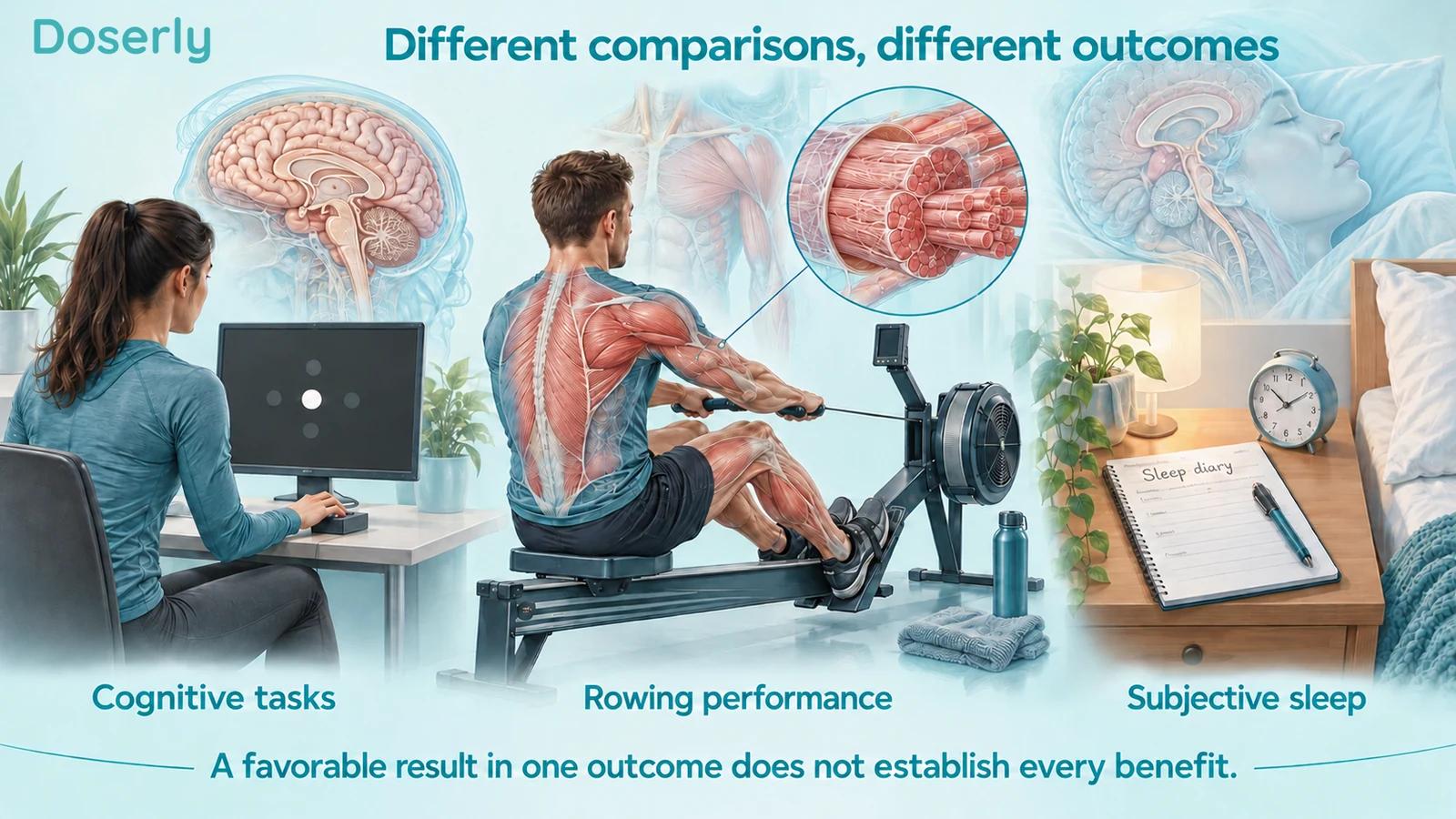
The runner and rower studies answer different questions. The first focused on cognitive testing around a long run; the second tested rowing performance and sleep-related reports. A combination that fails to add a cognitive advantage in one setting can still produce a performance signal in another.
The appropriate response is to preserve the distinction, rather than selecting whichever result supports the preferred product. A claim about better reaction time should identify the reaction-time comparison. A claim about better sleep should state whether sleep was reported or recorded. A claim about faster exercise performance should show the exercise result.
This is especially important when a study reports several outcomes. A headline can emphasize the favorable ones, while a person buying the product may care most about an outcome that was unchanged or not measured. Writing down the intended benefit before reading the marketing helps expose that mismatch.
These studies also do not establish equivalent potency milligram for milligram. Equal-mass doses are a clear experimental comparison, but that does not prove they represent identical biological exposure or an optimal dose of either compound.
Tolerability needs its own evidence
A person who dislikes caffeine may reasonably be interested in an alternative. The next step is to identify the specific problem: anxiety, palpitations, difficulty falling asleep, gastrointestinal discomfort or an unpleasant rise and fall in alertness. “Cleaner energy” does not distinguish these experiences.
The early human studies monitored short-term adverse effects, and the rowing trial contributes subjective sleep information. Neither can rule out uncommon problems or define safety in people with cardiovascular conditions, pregnancy, complex medication regimens or long-term daily exposure.
Preclinical research has tested paraxanthine for mutagenicity, genotoxicity and repeated-dose toxicity, including rat experiments lasting up to 90 days. The investigators reported no toxic effects at the tested repeated-dose levels. That supports further safety evaluation, but rat doses and laboratory toxicology are not a human supplement recommendation. Paraxanthine toxicology study, 2021
The 1995 human blood-pressure and epinephrine findings are also a reminder that absence of a jittery feeling does not mean absence of physiological activity. A smoother subjective experience and a lower cardiovascular effect would need to be demonstrated separately.
Caffeine guidance cannot be relabeled as paraxanthine guidance
The FDA's commonly cited 400 mg daily figure concerns caffeine for most adults, with substantial qualifications for individual sensitivity and medical circumstances. It is not a combined allowance for caffeine plus paraxanthine, and it does not establish a safe paraxanthine dose. FDA caffeine guidance
This distinction becomes practical when someone adds a paraxanthine drink while keeping their usual coffee. The routine now includes direct paraxanthine exposure as well as caffeine and the paraxanthine formed from it. A “caffeine-free” label should not be interpreted as “stimulant-free” if paraxanthine is present.
A pharmacist or clinician reviewing symptoms needs the actual ingredients and timing. Naming the product as an energy drink or nootropic is less informative than showing its label and explaining what else was consumed. Prescribed medicines should not be adjusted to accommodate a supplement without the prescriber's input.
How to read a comparison claim before buying
Start with the comparator. “Clinically studied” may refer to a placebo experiment, an active comparison, an animal study or a combination formula. Those are different levels of support for a replacement decision.
Then look for the outcome and its time frame. A six-hour response-time test is not a month of improved work performance. A better sleep questionnaire score is meaningful as reported experience, but should not be rewritten as more deep sleep. Short-term tolerability does not answer chronic safety.
Finally, check whether the marketed formulation matches the experiment. A beverage with several other stimulants is not the same exposure as the isolated compound in a capsule. Naming a branded ingredient in a paper does not validate every finished product containing it.
A useful claim would tell you the participants, dose, comparator and result in one understandable sentence. If the supporting explanation needs to slide from a rat mechanism to a human focus promise, or from placebo success to caffeine superiority, an evidentiary step is missing.
A more useful definition of “better”
For a personal routine, the relevant outcome might be finishing an ordinary day with adequate attention and acceptable sleep, rather than achieving the largest immediate sensation of energy. Recording timing, other caffeine, unwanted effects and next-day function can make that goal clearer. Such observations remain personal experience, not a substitute for controlled evidence.
The current direct trials make paraxanthine an interesting candidate for further study. They provide selected cognitive signals and preliminary subjective sleep findings, alongside inconclusive standalone exercise results. They do not justify a universal claim of superior focus, guaranteed sleep preservation or absence of stimulant effects.
A new label deserves a direct comparison. It also deserves a fair reading once that comparison exists: the actual outcomes, including the ones that did not clearly improve.
Sources
- Benowitz and colleagues: human sympathomimetic effects (1995)
- Paraxanthine dose-response crossover trial (2021)
- Paraxanthine and caffeine around a 10-km run (2024)
- Caffeine, paraxanthine, rowing and subjective sleep (2026)
- Preclinical paraxanthine toxicology (2021)
- FDA caffeine guidance