
Peptides
October 16, 2026
Oxytocin is not simply the “trust hormone”
On this page
Calling oxytocin the “trust hormone” makes a complicated research field sound like a simple prescription: increase the hormone, increase trust. Human studies do not support that reliable, universal relationship. Some early experiments reported changes in narrowly defined social decisions. Later replication work challenged prominent findings, while a 2026 preregistered study supported a narrower effect in men selected for low dispositional trust. Researchers have also identified reasons why the published literature could look more convincing than the complete record.
That does not make oxytocin biologically unimportant. It means its established physiology, experimental behavioral effects, and possible clinical uses need separate explanations. A hormone involved in human biology is not automatically a treatment for loneliness, relationship difficulties, or social anxiety. Nor does a laboratory decision reveal whether someone has become more loving, dependable, or safe to trust.
The Doserly oxytocin guide covers the wider evidence. Here, the question is narrower: what did the trust experiments measure, and how well did the original signal survive further testing?
Start with the biology, without turning it into a personality label
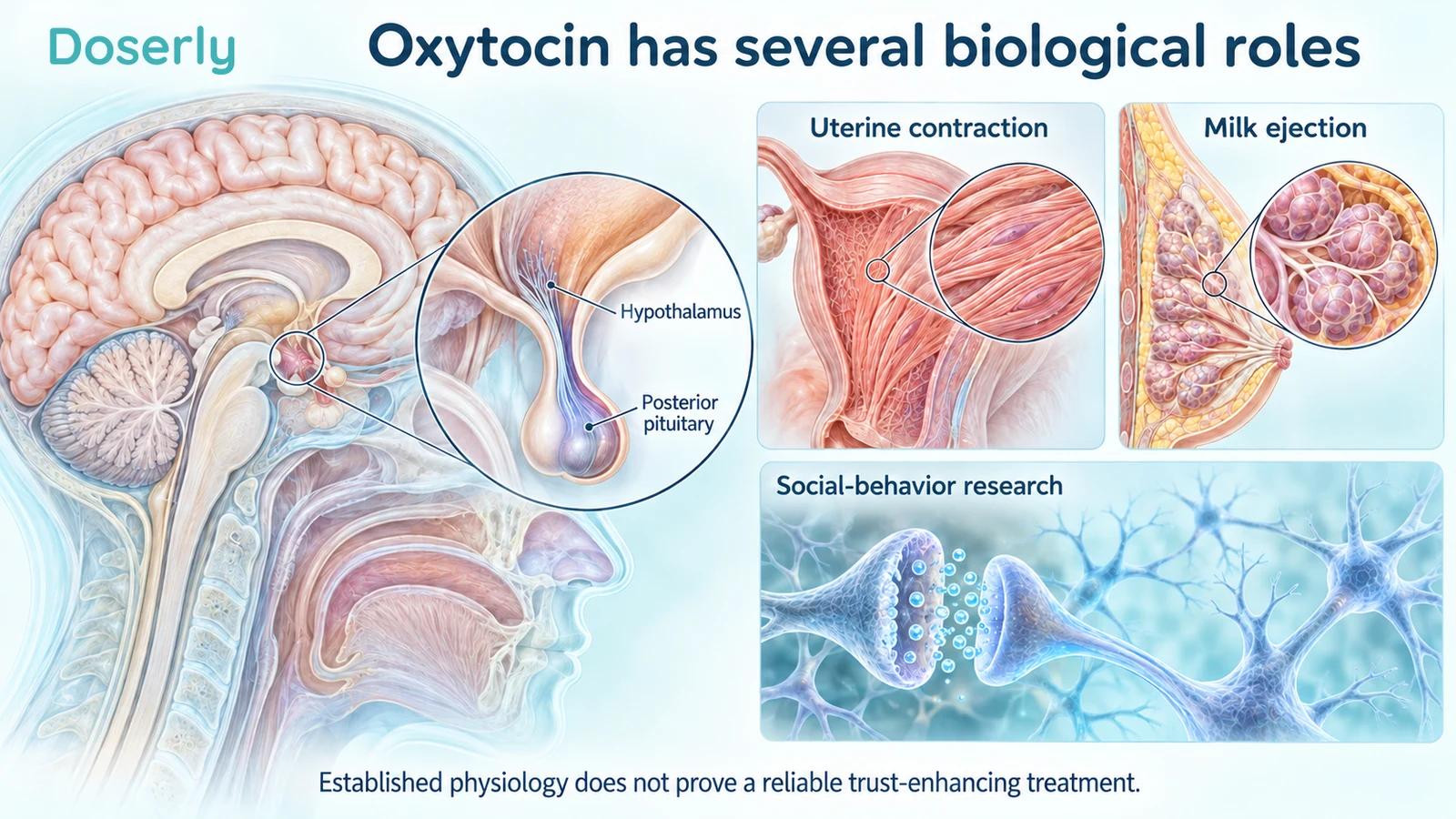
Oxytocin is synthesized in the hypothalamus, and hypothalamic neurons deliver it to the posterior pituitary for release into circulation. Its established functions include uterine contraction and milk ejection. Milk ejection is the movement of milk through contraction of specialized cells around the mammary glands; it should not be confused with the production of milk itself. Physiology overview, WHO breastfeeding physiology chapter
These functions show why the molecule matters, but they do not prove a general behavioral treatment effect. The approved injectable medicine Pitocin has specific obstetric uses and requires appropriate medical supervision. Its label does not describe an approved treatment for increasing trust or improving relationships. A product's established medical role cannot be transferred to an unrelated behavioral claim. Pitocin prescribing information
Animal research on affiliation and social recognition helped motivate human oxytocin experiments. Moving from that motivation to a clinical claim requires several additional steps: a defined human outcome, a reproducible effect, a useful magnitude of benefit, and an acceptable safety profile. A plausible biological story is a reason to investigate those steps, not evidence that they have already been completed.
The influential experiment concerned a money-transfer task
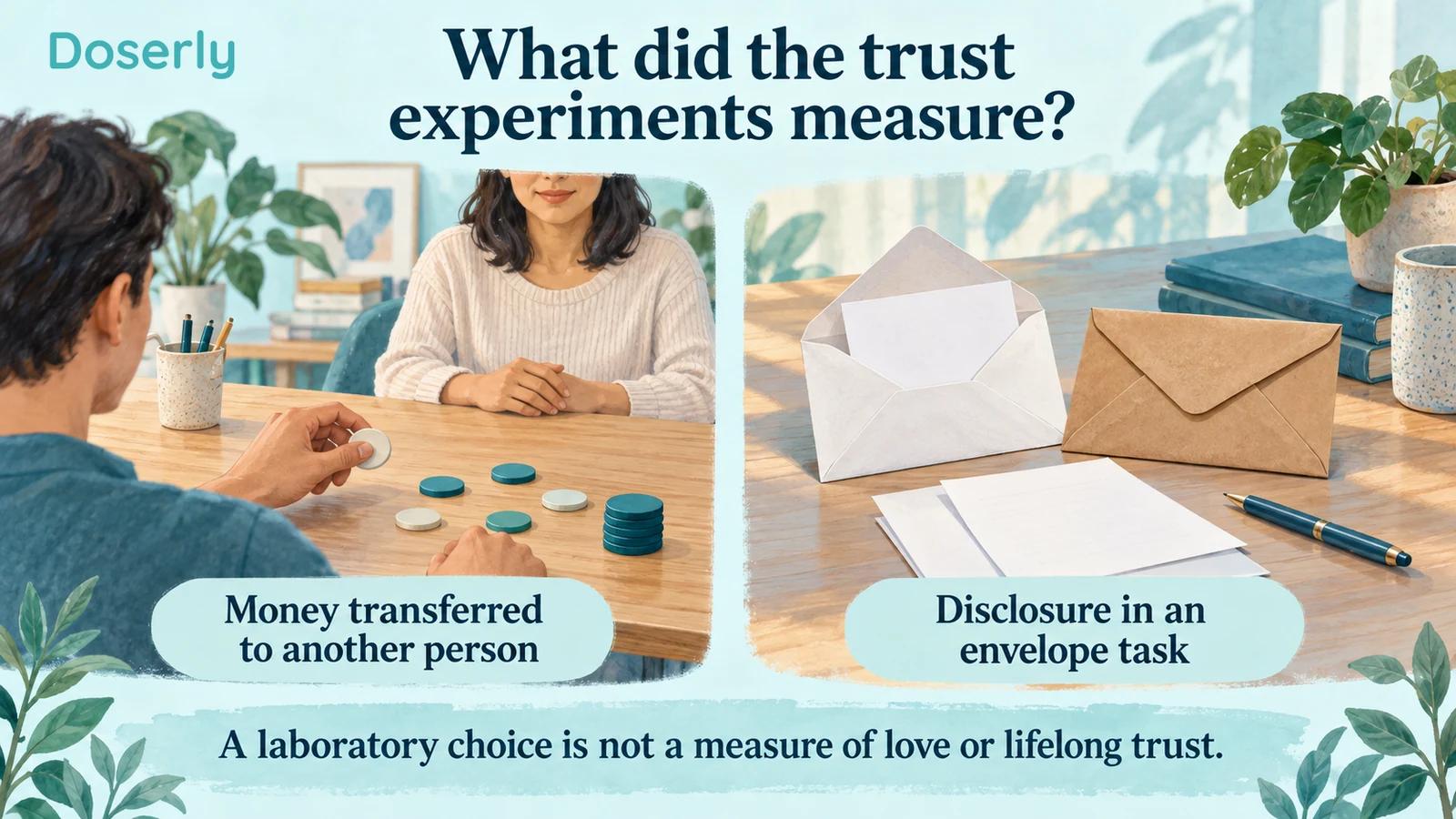
The 2005 paper titled “Oxytocin increases trust in humans” reported that intranasal oxytocin increased trusting behavior in an experimental setting. Participants made financial decisions involving another person. The investigators distinguished this social decision from a general willingness to take nonsocial risks. That distinction was part of the original result, rather than a claim that oxytocin simply made everyone more reckless. Original trust experiment
The task matters as much as the headline. Transferring more money to another participant is an operational measure: a behavior researchers can define and compare under controlled conditions. It is not a direct measurement of love, attachment, honesty, or the quality of a friendship. The experiment also does not show that the recipient became more trustworthy.
This is a subtle but practical distinction. Trusting behavior concerns the decision of the person who takes a social risk. Trustworthiness concerns whether the other person deserves that confidence. Increasing the first would not necessarily improve the second. An intervention could change a decision without making the surrounding relationship safer or more supportive.
Even if the original laboratory effect were consistently reproduced, a separate study would be needed to establish a lasting benefit in everyday relationships. The duration, setting, population, and outcome would all matter. “More money transferred in a game” and “better social wellbeing over months” are different claims, not interchangeable descriptions of the same result.
A registered replication did not reproduce the key effect
A 2020 registered replication directly addressed the earlier trust finding. It used a double-blind, placebo-controlled design and included a minimal-social-contact condition, an aspect that had differed in some intervening studies. The researchers did not find an oxytocin effect on trusting behavior in that condition. The report described high statistical power for its planned replication question. Registered replication
The same paper reported an exploratory suggestion of increased trust among participants with a low disposition to trust in a no-contact condition. The authors said in 2020 that this needed confirmation; a later study tested that narrower question, as discussed below. The exploratory result alone cannot be treated as a validated way to identify who should receive oxytocin. An analysis generated after examining the data carries a different evidentiary weight from the main question specified in advance.
Registration helps readers see that distinction. When the question and analysis are documented before results are known, an unexciting outcome is less easily replaced by whichever subgroup or outcome happens to look promising. Registration does not guarantee a perfect study, but it makes the relationship between the original plan and final claims easier to inspect.
The replication does not prove that oxytocin has no effect on any social behavior in any circumstance. It does materially weaken the simple claim that administering it reliably increases trust in the setting that made the original result influential. A broad marketing promise should not survive unchanged after the experiment supporting it becomes uncertain.
A 2026 study prospectively tested the low-trust hypothesis
The evidence did not stop at the exploratory finding. A preregistered study published in August 2026 recruited 359 men with a low disposition to trust and tested an anonymous trust game. The investigators reported that oxytocin increased trusting behavior by roughly 15%, with consistent results across their regression models. This is prospective positive evidence in a defined population, rather than another subgroup discovered after the main analysis. Preregistered low-trust study
That result changes the account: it is no longer accurate to say that the low-trust hypothesis simply awaits its first prospective test. It does not erase the earlier null findings, because the selected participants and experimental setting define a narrower question. Nor does it establish that the same effect occurs in women, in everyone who reports social difficulties, or in ordinary relationships.
The reported percentage concerns the experimental measure of trusting behavior. It is not a 15% improvement in relationship quality, a clinical response rate, or proof that another person became more trustworthy. Those distinctions preserve the positive finding without turning it into a broader treatment promise.
Another kind of trust task also produced failed replications
The envelope task used a different behavioral measure: how openly participants left an envelope containing confidential information. An earlier experiment had reported a large oxytocin effect. A later paper described two attempts that did not replicate that result, with samples of 95 and 61 participants. Envelope-task replication report
The investigators' interpretation was appropriately bounded. Their findings were incompatible with the large effect they had set out to reproduce, while remaining compatible with no effect or a smaller effect that those samples could not reliably detect. That is more informative than saying either “oxytocin definitely works” or “the study proved an exact zero.”
This second example also prevents a common shortcut: pooling very different meanings of trust into one intuitive idea. A financial transfer and the handling of confidential information involve different decisions. If effects differ across tasks, that could reflect context, measurement, statistical noise, or some combination. It does not automatically establish a sophisticated context-dependent benefit.
A context explanation becomes stronger when it predicts a result before another experiment is run. If every positive result is called evidence of oxytocin's power and every negative result is explained away as the wrong context, the claim becomes difficult to test. Useful explanations must expose themselves to the possibility of being wrong.
Why the published literature can look stronger than the complete record
A methodological analysis of intranasal oxytocin research raised concerns about small samples, limited statistical power, and bias. Its warning was about the reliability of a broad research literature, not proof that every individual finding was false. Small studies can miss real effects, while the positive findings that attract attention may overstate their magnitude. Statistical and methodological analysis
A separate paper examined the unpublished record within one laboratory. The researchers described eight studies involving 453 participants and a publication portfolio that had become less representative of their actual findings. They brought previously unreported work into view to address the possibility of publication bias. That is a direct account of one laboratory's experience, not a numerical estimate of missing studies across the entire field. File-drawer investigation
The practical problem is selection. If encouraging results are easier to publish, discuss, and remember than disappointing ones, a reader who sees only published success stories receives an incomplete sample of the evidence. The same distortion can occur in online testimonials, although testimonials lack many of the controls that experiments provide in the first place.
This is why counting favorable paper titles is not a dependable way to assess oxytocin. Ask whether the findings were independently reproduced, whether the outcome was planned in advance, and whether null results are visible. A smaller number of well-designed, informative studies may matter more than a long list of loosely related positive claims.
“Context-dependent” is a research question, not a dosing strategy
It is reasonable to investigate whether social setting, expectations, or individual characteristics change an intervention's effects. The 2020 replication and 2026 study show why this question needs planned tests in defined populations. Even a positive prospective laboratory result does not give a clinician a validated algorithm for choosing a patient, product, or administration schedule to improve everyday wellbeing.
For clinical use, the remaining step is translation beyond the experimental task. Researchers would need to establish meaningful outcomes over a relevant duration, reproduce the benefits, and characterize unwanted effects. The 2026 result is evidence about a specified behavior in selected men, not completion of those clinical requirements. Preregistered low-trust study
The same caution applies to the idea that someone who struggles socially must have “low oxytocin.” None of the trust experiments discussed here establishes a diagnostic test for that conclusion. Feeling lonely, cautious, or uncomfortable around others is not itself a laboratory measurement of a hormone deficiency. Nor does a response to a spray validate such a diagnosis.
What this means for real decisions
Begin with the difficulty that needs help. Is the concern fear in social situations, a relationship conflict, isolation, distress after betrayal, or a communication barrier? Those are not identical problems, and “increase trust” may not even be the right goal. Appropriate boundaries and accurate judgments about other people can be valuable outcomes too.
If oxytocin is proposed as a treatment, ask what clinical trial supports that exact goal in a relevant population. Ask which formulation was studied, what improvement was measured, how long it lasted, and what adverse effects or uncertainties were observed. A trust-game paper cannot answer all of those questions, and an obstetric drug label cannot substitute for a behavioral treatment trial.
A record of symptoms, circumstances, and meaningful daily goals can help a clinician understand the problem. Such a record cannot prove that a hormone caused a change, but it can make the conversation more concrete. For wider cautions about formulations and unestablished uses, see the oxytocin safety discussion.
The defensible interpretation is neither a universal trust enhancer nor a biologically irrelevant molecule. Oxytocin has established physiological roles and an active, contested behavioral research history. The trust studies support more precise questions about people and settings, including the positive 2026 result, while leaving the universal nickname and clinical treatment promise unsupported.
Sources
- Oxytocin physiology overview
- WHO breastfeeding physiology
- Pitocin prescribing information
- Original trust experiment, 2005
- Preregistered low-trust study, 2026
- Registered replication, 2020
- Envelope-task replications, 2015
- Methodological analysis
- File-drawer investigation