
Peptides
October 16, 2026
Oxytocin and autism: what the larger trials changed
On this page
Early oxytocin studies gave researchers reasons to investigate whether a nasal treatment could help with particular social difficulties experienced by autistic people. A larger, longer trial then found no significant benefit over placebo on its main outcome. That result deserves substantial weight, even though it does not answer every possible question about every formulation, age group, or future treatment approach.
The useful story is not that small studies were foolish or that one large study ended all research. Small experiments can identify signals worth testing. Larger controlled trials help determine whether those signals persist when more participants, longer follow-up, and more rigorous comparisons are involved. The conclusion should change when the evidence changes.
This article uses identity-first language while recognizing that individual preferences differ. Research goals should concern wellbeing, communication, autonomy, and difficulties the person wants help with. A questionnaire score is not a measure of someone's worth, and a treatment should not be framed as making an autistic person less themselves. For broader background, see the Doserly oxytocin guide.
Why researchers tested oxytocin
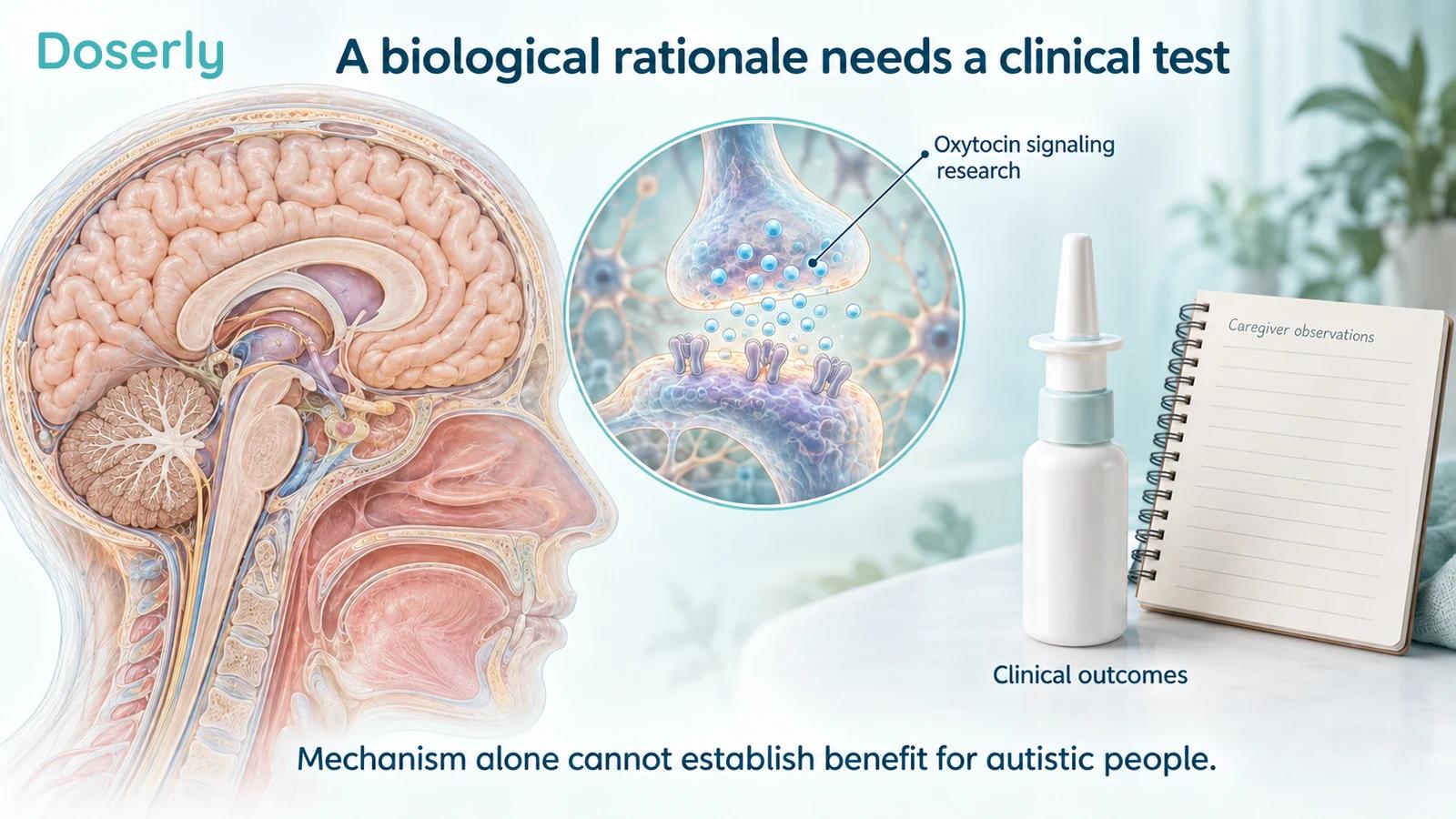
Oxytocin's role in social-behavior research supplied a biological rationale for clinical trials. But a rationale is several steps away from a useful treatment. A substance can influence a biological pathway without improving a meaningful daily outcome. It can also produce different effects across people or settings, which makes controlled testing more necessary rather than less.
The central question was therefore clinical: would intranasal oxytocin improve measured social functioning compared with placebo? That question does not assume that every social difficulty has the same cause or that all autistic people share one biological deficit. It asks whether a specified intervention helps the participants and outcomes under study.
The formulation and route are part of that question. A nasal research preparation is not interchangeable with an injectable obstetric product or an online preparation of uncertain quality. The existence of medically established oxytocin uses does not validate an autism treatment claim. The Pitocin label, for example, describes specific obstetric uses rather than treatment of autistic people's social difficulties. Pitocin prescribing information
A small crossover trial reported an encouraging signal
A trial published in 2016 enrolled 31 children and compared five-week periods of oxytocin and placebo, separated by a four-week washout. It reported improvement on its primary caregiver-rated social-responsiveness outcome with oxytocin. Reported adverse events included thirst, urination, and constipation. Original crossover trial
A crossover design means participants receive both conditions at different times. This can make comparisons efficient because each participant contributes information under both treatments. It also creates questions about period effects and whether an earlier treatment influences a later period. A washout is intended to address carryover, but the design still differs from a larger parallel-group study in which participants remain in separate assigned groups.
The positive finding was a reason to continue research. It was not a reliable estimate of what all autistic children would experience over a year, nor did it establish a benefit for adults. The sample size, duration, measured outcome, and design define the reach of the result.
Caregiver ratings are useful because caregivers observe daily life that a brief clinic visit may miss. They also make masking and an appropriate comparison important. A change in a reported score needs to be interpreted in relation to what happened in the control condition, not treated as self-evident proof of a drug effect.
A biomarker hypothesis emerged from another small study
A 2017 randomized study involved 32 children aged 6–12 years over four weeks. The investigators reported a social-responsiveness benefit when pretreatment neuropeptide measures were included in the statistical model, with lower starting blood oxytocin associated with greater improvement. They did not observe improvements in repetitive behaviors or anxiety. Original biomarker trial
That finding raised a testable question about whether baseline biology might help predict response. It did not establish a routine diagnostic threshold for an “oxytocin deficiency,” or a validated blood test that identifies children who should receive a nasal spray. A predictive association in a small trial needs independent confirmation before it becomes a treatment-selection rule.
This distinction is especially important when a biomarker story sounds intuitive. A lower measured concentration does not automatically identify the cause of a person's difficulties. Nor does increasing exposure necessarily correct the relevant biology. A clinically useful biomarker must improve decisions in a reproducible way, rather than merely correlate with an outcome in one analysis.
The larger trial gave a less encouraging answer
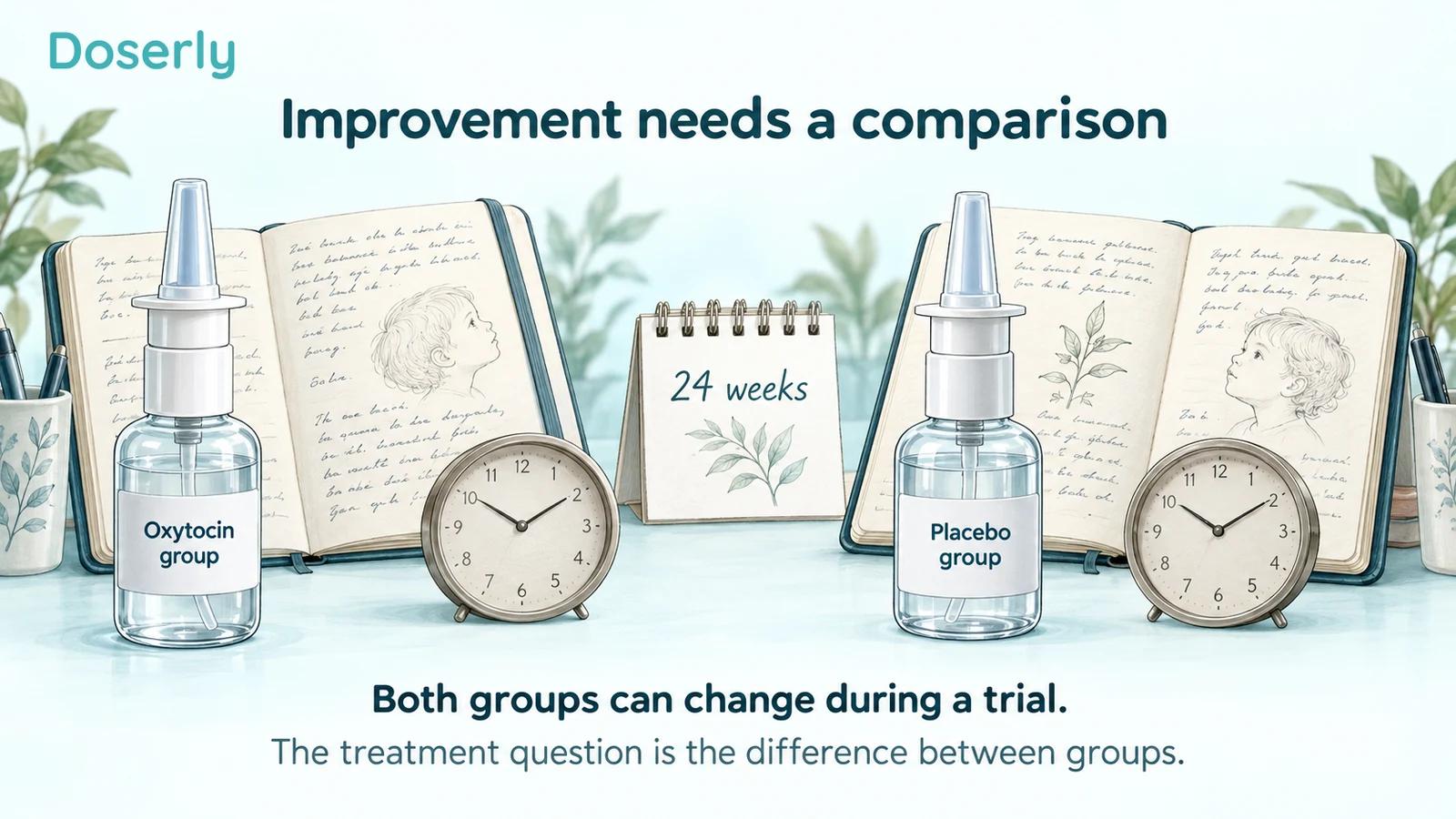
The 2021 SOARS-B trial enrolled 290 participants aged 3–17 years and compared intranasal oxytocin with placebo over 24 weeks. On the primary modified Social Withdrawal score, the estimated change was −3.7 with oxytocin and −3.5 with placebo. The between-group difference was −0.2 points, with a 95% confidence interval from −1.5 to 1.0. Secondary outcomes generally did not separate the groups. SOARS-B trial report
The primary measure, ABC-mSW, uses 13 caregiver-rated items and ranges from 0 to 39; higher scores represent more difficulty on the measured construct. The registry distinguishes the 24-week blinded comparison from a later open-label period. Observations after everyone can receive the active treatment do not provide another simultaneous placebo comparison. Trial registry
The result is not simply “some children improved.” Both groups changed. The treatment question is whether assignment to oxytocin produced a better outcome than assignment to placebo. Looking only at the active group's before-and-after change would discard the comparison that makes the trial informative.
A confidence interval describes uncertainty around the estimated group difference. An interval spanning zero does not prove an exact zero effect for every individual. It also does not support claiming a reliable benefit that the trial failed to demonstrate. The result should narrow confidence in the broad treatment promise rather than be dismissed because individual experiences vary.
A larger study can still have important limitations
The SOARS-B investigators noted that the modified primary scale had not been validated and that no minimum baseline score was required. They also discussed formulation and dosing differences from earlier studies. These limitations matter when interpreting exactly what was tested. Baseline-oxytocin adjustment did not reveal a benefit in their sensitivity analyses. SOARS-B trial report
A limitation is a reason to calibrate a conclusion, not automatically reverse it. If a scale is imperfect, a future study may need a better outcome measure. That does not turn a negative comparison into evidence of success. Similarly, proposing that another formulation might work creates a new research question; it does not establish the effectiveness of that formulation before testing.
The appropriate conclusion remains bounded: the tested intervention did not demonstrate the hoped-for advantage under those trial conditions. The study cannot resolve every future intervention, but it makes routine claims of established benefit harder to justify.
This is also why study size should not be the only criterion. A large poorly conducted trial can mislead, and a small carefully designed study can be informative. Here, size matters alongside randomization, blinding, duration, the comparator, and the consistency of the outcome pattern. Evidence appraisal combines those features rather than assigning credibility by participant count alone.
A later trial again separated an overall result from a subgroup signal
A subsequent trial included 87 children aged 3–12 years, with 12 weeks of treatment after a placebo lead-in period. It did not find an overall oxytocin effect on caregiver-rated social responsiveness. An age interaction suggested a possible signal among younger children, but other measures did not provide corresponding evidence of benefit in that age group. Later randomized trial
That pattern illustrates why subgroup findings require care. A result in a narrower group can be worth following up, especially if there is a credible rationale. It becomes more convincing when a new trial recruits that group and prospectively tests the same prediction. Until then, it should not be promoted as a confirmed exception to an otherwise negative overall result.
The next study should also examine whether the proposed benefit is meaningful to the children and families involved. A numerical change on one rating scale may not translate into easier communication, less distress, or greater participation in desired activities. Those connections need to be measured, not assumed.
What the dose-response meta-analysis can and cannot establish
A meta-analysis published in 2025 combined 12 randomized trials involving 498 participants for its selected outcomes. Its overall analyses did not show consistent benefit for social difficulties or repetitive behaviors. Dose-related analyses suggested possible advantages at higher studied doses, which the authors presented as a reason for further consideration. Dose-response meta-analysis
A meta-analysis is a synthesis of existing trials, not a new trial assigning all participants to a common dose comparison. Differences in dose can occur alongside differences in age, formulation, treatment duration, design, and outcome measurement. An apparent relationship across studies does not isolate dose as the cause in the same way as an appropriate randomized comparison would.
The title's phrase “optimal dose” should therefore not be read as a personalized prescribing instruction. A statistical pattern cannot establish that increasing exposure will help a particular child or that the risks are acceptable. The analysis's own lack of consistent overall benefit belongs in any summary of its findings.
It is also important to ask which outcomes and studies entered a synthesis. Different meta-analyses can answer different questions because their inclusion criteria differ. Their participant totals should not be treated as a census of every oxytocin autism study ever conducted, or as independent new participants beyond the trials they summarize.
Safety requires its own evidence
The large trial reported similar overall adverse-event incidence and severity between groups. That is reassuring within its scope, but it is not a guarantee of harmlessness. Trial monitoring, eligibility criteria, product quality, duration, and the ability to stop treatment all shape what a safety result means. SOARS-B trial report
A treatment without demonstrated benefit cannot be justified merely by saying that it is a hormone the body produces. Endogenous biology and administered medicine are different circumstances. Nor should an online spray inherit the safety record of a research preparation that was manufactured, supplied, and monitored under trial conditions.
For families considering a proposal, the relevant conversation concerns the actual product, the intended goal, the supporting trial, and a clear plan for monitoring adverse effects and reassessing benefit. The oxytocin safety section discusses broader uncertainties. These studies do not support a self-directed pediatric dosing experiment.
Defining progress without turning a child into a score
An outcome should reflect something valuable to the person receiving care. Examples might include communicating a need more comfortably, experiencing less distress in a chosen activity, or having access to supportive environments. A goal should not be assumed merely because a behavior differs from a social norm. Autistic people and families can have different priorities, and those priorities deserve to be explicit.
Caregiver observations are one part of that picture. Where feasible, the autistic person's own experience and preferences should be included, with communication support suited to them. A quieter child is not necessarily a more comfortable child; a higher level of social participation is not automatically desirable if it comes with distress or exhaustion. These are reasons to define meaningful outcomes carefully.
Keeping a record of daily goals and difficulties can help a clinical conversation, but a before-and-after diary cannot identify a drug effect on its own. Development, context, support, expectations, and ordinary variability can change observations over time. Controlled research helps separate an intervention's contribution from those other influences.
The oxytocin evidence supports continued scientific questions more strongly than a routine treatment promise. Early signals justified larger tests; those tests tempered the claim. Respecting that change protects the distinction between an interesting research hypothesis and a benefit that families can reasonably expect.
Sources
- Small crossover trial
- Biomarker trial
- SOARS-B trial report
- SOARS-B registry
- Later 87-child randomized trial
- Dose-response meta-analysis
- Pitocin prescribing information