
Peptides
October 16, 2026
Oxytocin and appetite: what meal studies tell us about weight loss
On this page
Oxytocin is a hormone involved in childbirth and milk release, but researchers also study its role in eating. That interest has a biological basis: oxytocin signaling involves brain regions that help regulate feeding, and early experiments suggested that giving it could change how much people eat. The question for someone struggling with appetite is whether those changes translate into a useful treatment.
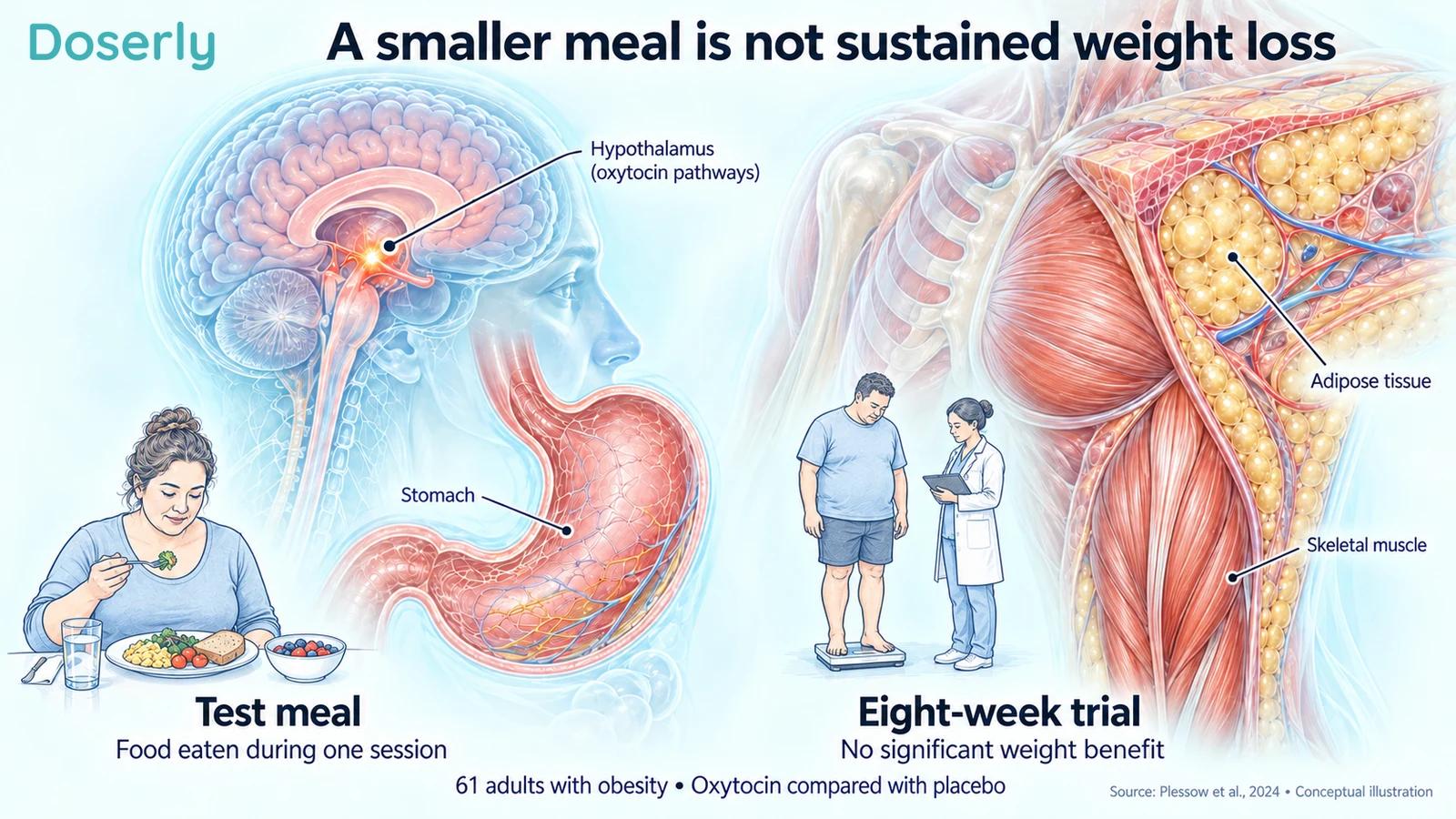
The clearest answer so far is more specific than “oxytocin suppresses appetite.” Some small studies found that men ate less at a laboratory meal after intranasal oxytocin. A larger eight-week trial in adults with obesity did not find a weight-loss benefit. Understanding both findings helps explain why an interesting appetite signal isn't yet a dependable weight-management treatment. Human meal study, eight-week trial.
Our oxytocin guide covers the hormone's broader uses and safety. Here, we'll focus on what researchers measured when they studied eating, body weight and related metabolic questions.
Hunger, eating and weight are different measurements
“Hunger” usually means the feeling that makes you want to eat. Scientists can ask participants to rate that feeling, but they can also measure how much food someone consumes. Those results don't always move together. A person may report similar hunger on two mornings yet eat different amounts when presented with a meal.
Food intake also reflects the setting. A buffet offers choices, a fixed meal limits them, and a snack offered after breakfast asks a different question from a meal after an overnight fast. These aren't trivial details when the outcome is how much food remains on a plate.
Body weight answers a longer-term question. It reflects the cumulative balance of intake and expenditure, alongside changes in water and body composition. One smaller breakfast doesn't reveal what someone eats at dinner, whether their activity changes, or whether the same response persists after repeated treatment. Multiplying a laboratory calorie difference by every day of a year would assume answers the experiment never supplied.
Researchers therefore distinguish a proposed mechanism, a short-term behavioral effect and a clinical outcome. Oxytocin could affect a process involved in eating without producing enough sustained change to reduce body weight. That possibility is why a weight trial remains necessary even after a promising meal experiment.
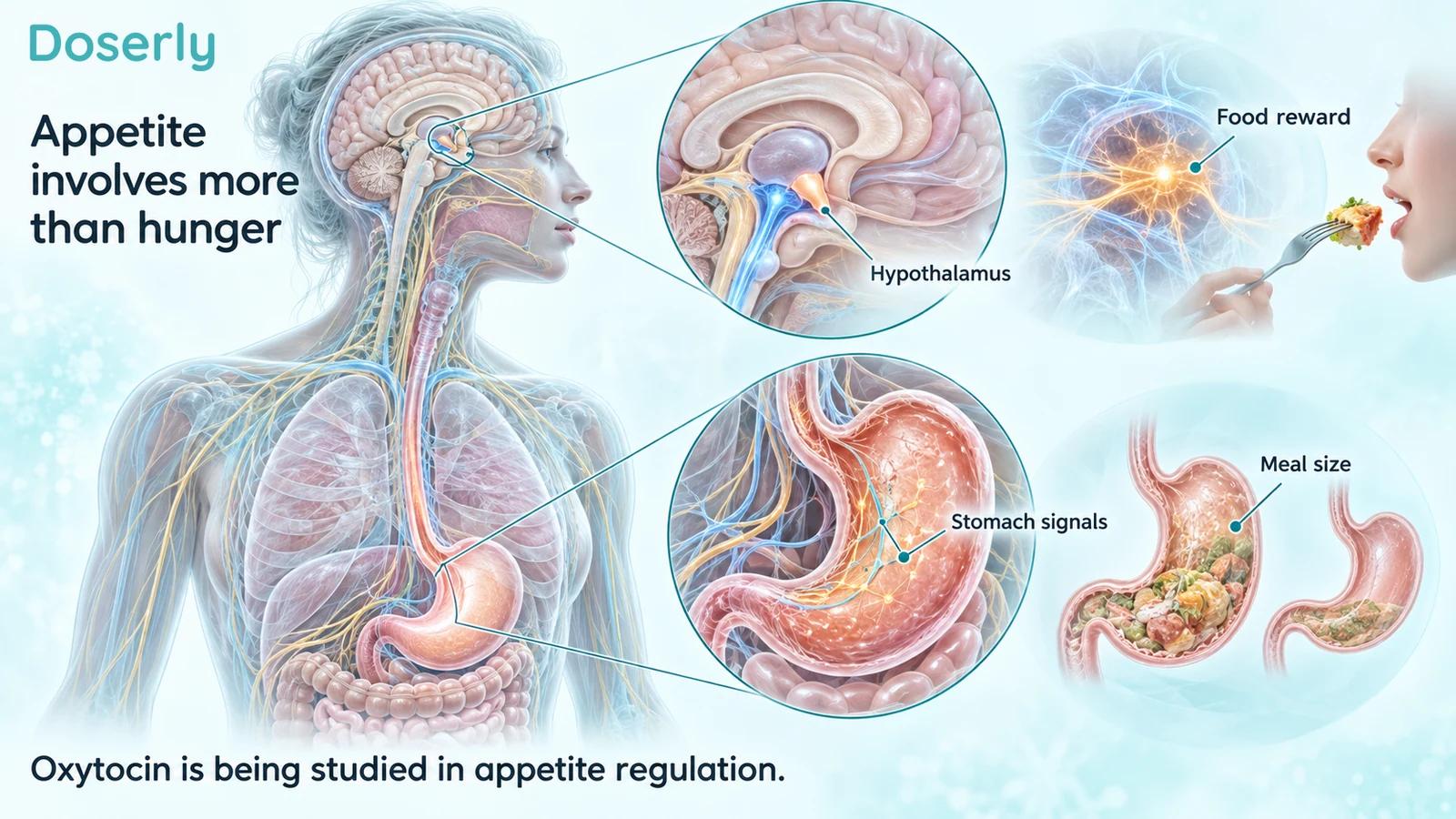
Before comparing numbers across papers, check whether food intake means calories consumed at one meal or the change from a baseline meal. A difference between those changes is not the same quantity as the total calories eaten.
What happened in the early breakfast experiment?
A 2015 randomized crossover study enrolled 25 healthy men. Each participant received intranasal oxytocin and placebo on separate study visits, allowing researchers to compare that person's eating under both conditions. After fasting, participants selected breakfast from a menu and were offered double portions.
The men consumed less after oxytocin. The indexed figure caption reports a mean difference of approximately 122 calories. However, appetite ratings did not change, and resting energy expenditure did not increase. The study suggested a change in eating under those experimental conditions, rather than showing that participants felt less hungry or burned more calories at rest. Lawson and colleagues.
A crossover design can be helpful because people differ greatly in usual meal size. Comparing someone with themselves reduces some of that variability. It still needs appropriate visit order, separation between conditions and careful measurement. Most importantly, this was a brief experiment in men, not a months-long weight-loss study in a broad clinical population.
The practical lesson is modest but useful: subjective appetite and observed intake are not interchangeable. If a headline describes this result as “less hunger,” it changes what the researchers found.
Did body size affect the response?
A subsequent report compared 18 young men with obesity with results in 20 men of normal weight. Researchers measured a test buffet after fasting and later snack intake. Oxytocin reduced the main meal in the men with obesity, while snack consumption fell in both groups; energy expenditure was generally unaffected. Thienel and colleagues, 2016.
The normal-weight data came from earlier work, as the figure description makes clear. This should not be described as a single newly recruited trial of 38 people randomly assigned by weight category. Weight category itself wasn't a treatment that researchers could randomly allocate.
The distinction between the main meal and later snacks is also helpful. Eating after a fast and eating appealing snacks after a meal involve overlapping but different influences. A study can find an effect in one situation without establishing a universal reduction in eating. Neither experiment tells us how an individual woman's appetite would respond over months.
The eight-week obesity trial tested the clinical question directly
The 2024 trial randomly assigned 61 adults with obesity, including women and men, to intranasal oxytocin or matching placebo for eight weeks. Its primary outcome—the main measurement chosen in advance—was change in body weight. Average weight change was +0.20 kg with oxytocin and +0.26 kg with placebo, a difference of −0.06 kg. The confidence interval ranged from −1.4 to +1.3 kg. This did not establish a weight benefit. Primary report.
That interval matters more than treating the tiny average difference as a precise effect. It describes uncertainty around the comparison and includes changes in either direction. The trial also did not show beneficial effects on body composition or resting energy expenditure.
At a test meal, the change in intake differed by approximately 152 calories between groups. This was a secondary analysis, and the report cautions that these comparisons weren't corrected for testing multiple outcomes. It was a research signal, not a reason to replace the negative primary result with a successful weight-loss claim. Detailed results.
The two findings can coexist. A laboratory eating measurement changed while the outcome that mattered for the central weight question did not. The trial doesn't prove that every future formulation must fail, but it directly challenges promises that the tested approach reliably produces weight loss.
Why a nasal study cannot establish what an injection will do
A route of administration is part of the intervention. Giving a hormone through the nose and infusing it into a vein can create different patterns of exposure. It isn't enough to know that both products contain oxytocin.
A 2026 randomized crossover report examined 24 adults with obesity who completed separate intravenous oxytocin and saline sessions. The infusion study did not find reduced food or snack intake, or improvement in measured post-meal glucose outcomes. It also found no change in appetite ratings or resting energy expenditure under its conditions. Intravenous trial.
This was an acute experiment, not a long-term weight study. It also wasn't a direct randomized comparison of nasal versus intravenous treatment. Differences between its results and earlier nasal studies might involve route, participants, meal design or other features. The study cannot isolate which explanation is responsible.
For readers, evidence belongs to the tested intervention. A nasal finding does not validate a subcutaneous vial protocol, and an infusion result does not settle every nasal-delivery question. There is no justified shortcut from the same hormone name to the same clinical effect.
What about obesity following hypothalamic injury?
Hypothalamic obesity can occur after a tumor or treatment affects brain structures involved in energy regulation. It is a different clinical setting from common obesity, and investigators have asked whether oxytocin might be especially relevant there.
A pilot crossover trial randomized 13 participants aged 10–35 years with hypothalamic obesity related to hypothalamic or pituitary tumors. Ten completed the entire study. Participants received eight-week treatment periods separated by a washout. The estimated weight change attributable to oxytocin was −0.6 kg, with a confidence interval from −2.7 to +1.5 kg; the study did not detect a significant weight effect. McCormack and colleagues.
The small sample leaves substantial uncertainty. Exploratory findings involving anxiety or impulsivity may help shape later research, but they don't establish weight loss. Nor does a plausible connection between hypothalamic injury and oxytocin biology prove that every affected patient has a treatable oxytocin deficiency.
A specialist would need to consider the person's tumor history, other hormone needs, current medicines and functional goals. The appeal of a biological explanation should lead to a focused research question, not an assumption that treatment has already been validated.
Why researchers also study oxytocin in anorexia nervosa
At first, studying the same hormone in both obesity and anorexia nervosa may sound contradictory. The goals differ. In anorexia nervosa, investigators have explored whether oxytocin could help with eating-related anxiety and psychological symptoms during nutritional rehabilitation. That is not an appetite-suppression strategy.
A 2024 phase II trial included 61 female inpatients undergoing nutritional rehabilitation. Four weeks of intranasal oxytocin or placebo were added to hospital treatment, with later follow-up. The study did not find significant between-group differences in the outcomes of interest, including eating-disorder symptoms and body mass index. Earlier promising pilot findings were not replicated. Maguire and colleagues.
This illustrates why diagnosis and intended benefit must stay attached to a result. An eating-disorder trial cannot be repackaged as evidence that a substance helps anyone control cravings. Someone dealing with restrictive eating, binge episodes or fear around food needs care directed at that problem, rather than a general hormone-based explanation.
What the safety findings can reassure us about
The eight-week obesity trial reported no serious adverse events, with similar overall adverse-event incidence and severity between groups. That is useful information about the participants and exposure studied. It cannot establish safety over years, in pregnancy, or with a different formulation. Trial safety results.
The hypothalamic-obesity trial also reported generally similar tolerability between treatment periods, while explicitly monitoring nasal symptoms, vital signs and cardiac measures. Its small sample makes it particularly unsuitable for ruling out uncommon complications. Pilot safety assessments.
A familiar hormone can have pharmacological effects when administered. Its established role in childbirth doesn't make a wellness product interchangeable with a monitored research preparation. Safety, formulation and a worthwhile benefit all belong in the same treatment discussion.
Turning an appetite concern into a useful clinical discussion
Start with the difficulty you want help with. Is it persistent hunger, eating after feeling full, distressing loss of control, weight gain after a medical treatment, or unwanted weight loss? Those experiences don't necessarily have the same explanation or treatment goal.
A record of symptoms, meal patterns, relevant medication changes and weight trends can help describe what is happening. It should support a conversation, not turn every meal into an experiment or encourage restrictive eating. For someone with an eating disorder, the treatment team's approach to monitoring takes priority.
If oxytocin is proposed, ask which study supports the intended benefit, whether its participants resemble you, and what outcome would count as meaningful improvement. A smaller test meal, less distress around food and sustained weight change are three different goals.
Current human research makes oxytocin an interesting subject for appetite science. It does not establish the tested nasal regimen as an effective general weight-loss treatment. The oxytocin guide provides the wider formulation and safety context for understanding that distinction.
Sources
- Lawson et al., 2015: single-dose crossover meal study.
- Thienel et al., 2016: meal and snack responses.
- Plessow et al., 2024: eight-week obesity trial.
- McCormack et al., 2023: hypothalamic-obesity pilot.
- Maguire et al., 2024: anorexia nervosa trial.
- Intravenous oxytocin crossover study, 2026.