
TRT
October 16, 2026
Oral testosterone’s comeback: why the product name matters
On this page
Oral testosterone is an appealing idea if you would prefer a capsule to an injection or daily skin application. Modern testosterone undecanoate products have made that option more practical for some men with testosterone deficiency. But “oral testosterone” is not one interchangeable treatment.
The formulation changes how the drug is absorbed, how food affects exposure and when a blood test should be collected. Jatenzo, Tlando and Kyzatrex all contain testosterone undecanoate, yet their prescribing instructions differ. Tlando’s US label explicitly states that it is not substitutable with other oral testosterone undecanoate products. Tlando prescribing information.
Understanding those differences is more useful than deciding whether pills are inherently “good” or “bad.” This article explains what changed in oral delivery and what still needs attention when discussing treatment. Our oral testosterone guide provides broader background on the available formulations.
Why swallowing testosterone has historically been difficult
A medicine taken by mouth must survive the digestive process and reach the circulation in a useful amount. Ordinary testosterone is extensively metabolized when absorbed through the usual portal route to the liver. Historically, developers pursued different ways around that problem.
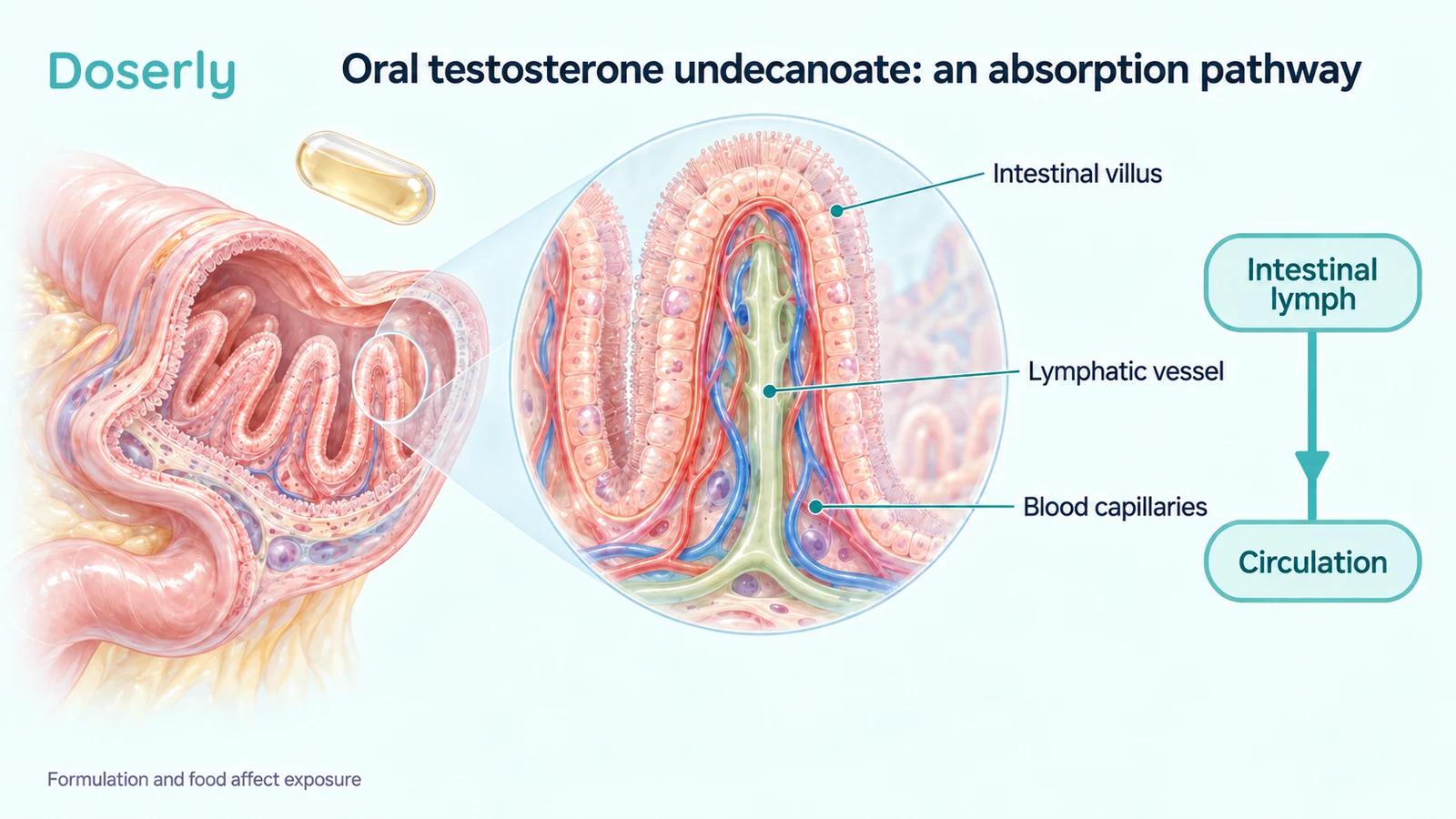
One approach altered the molecule at the 17-alpha position, as with methyltestosterone. Another attached a fatty-acid ester to testosterone, creating testosterone undecanoate, which can be absorbed through intestinal lymphatic pathways. These are chemically and pharmacologically different solutions. Primary oral-formulation report.
That history helps explain apparently contradictory statements about oral testosterone and liver toxicity. A claim concerning one older oral androgen should not automatically be transferred to every newer formulation. Equally, a newer absorption pathway does not make a product free of adverse effects.
The word “undecanoate” identifies the ester attached to testosterone. After absorption, the ester is cleaved to release active testosterone. The formulation surrounding the molecule also matters: delivery is not determined by the ingredient name alone.
What does lymphatic absorption mean?
The small intestine contains villi, tiny projections that increase its absorptive surface. Within them are blood vessels and lymphatic channels. Lipid-associated absorption can direct testosterone undecanoate into the lymphatic system before it reaches the general circulation, reducing the initial passage through the liver that limits ordinary oral testosterone.
This does not mean the liver never encounters the drug or that every swallowed capsule is completely absorbed. It describes an important delivery pathway. The eventual exposure still depends on the formulation and the conditions under which it is taken. Oral testosterone pharmacology.
A useful distinction is between the route into the body and the actions after entry. Once testosterone is circulating, it can act on the same hormone-sensitive systems involved with other replacement routes. Oral delivery changes practical handling and pharmacokinetics; it does not create a hormone that is exempt from testosterone’s wider effects.
Food is part of the treatment instructions
The current US labels for Jatenzo, Tlando and Kyzatrex direct administration with food. That requirement should be treated as part of the prescription, not an optional lifestyle preference. The exact product’s instructions matter when planning a routine around work, travel or irregular meals. Jatenzo label, Tlando label, Kyzatrex label.
It would be a mistake to borrow a meal rule from an older product or assume that a particular high-fat meal is required for every modern capsule. Ask the pharmacist to explain the instructions for the actual formulation you receive.
Consider someone whose breakfast varies from a full meal to coffee alone. The relevant question is not whether capsules are generally convenient; it is whether this person can take the prescribed product consistently as directed. That issue can be discussed before a prescription is selected.
If the schedule becomes impractical, tell the prescriber. Do not compensate for a missed meal, missed capsule or unexpected blood result by inventing a different dosing pattern. The goal is a routine that can be followed and assessed reliably.
How do we know modern oral formulations deliver testosterone?
Development trials generally examine whether treatment produces average testosterone concentrations within a specified range. This is a pharmacokinetic outcome: it describes drug exposure over time. It does not mean every participant’s concentration remained in range at every moment or that every symptom resolved.
For example, Jatenzo’s label reports that 145 of 166 treated men, or 87%, achieved the defined average testosterone endpoint at the end of its approximately four-month study. This establishes that the formulation can deliver replacement exposure in many participants under the trial’s conditions. Jatenzo clinical studies.
The result is not an 87% guarantee of improved energy or sexual function. It also does not establish superiority over other capsules. Different development programs can use different measurement methods, populations and follow-up periods.
For an individual, both exposure and clinical response matter. A product may achieve an appropriate laboratory result while a symptom persists because the symptom has another contributor. Conversely, feeling better does not eliminate the need for routine safety monitoring.
Why the blood-test appointment must match the product
A testosterone result changes meaning depending on when the sample was collected relative to dosing. The labels use product-specific collection windows to guide interpretation: Jatenzo specifies six hours after the morning dose, Tlando eight to nine hours, and Kyzatrex three to five hours. These are monitoring instructions, not interchangeable dose schedules. Jatenzo label, Tlando label, Kyzatrex label.
This is different from the morning testing used to diagnose untreated testosterone deficiency. A person should not assume that “testosterone blood work” always means the same collection procedure.
Confirm the instructions when the appointment is booked. Record the product, the morning dose time and the collection time. If the intended window was missed, tell the clinician rather than presenting the result as though it were collected correctly.
A switch between products deserves a new explanation of testing instructions. The same laboratory number collected under two different conditions may not represent a comparable exposure.
Does avoiding older liver toxicity settle the safety question?
No. Modern testosterone undecanoate should be distinguished from older 17-alpha-alkylated oral androgens, but that is only one safety issue. Product labels still address blood-pressure changes, increased red-cell production, fertility effects and other testosterone-related concerns.
The Jatenzo label discusses serious hepatic adverse effects associated with certain older oral androgens and notes that Jatenzo is not known to produce those effects. That qualified wording should not be rewritten as “cannot affect the liver.” A person with liver disease or new concerning symptoms still needs individualized assessment. Jatenzo safety information.
A treatment route can solve one practical problem while creating another. Capsules avoid the skin-residue transfer issue of gels, but introduce meal-linked administration and product-specific laboratory logistics. Injections avoid the meal requirement but have their own delivery considerations. The useful choice depends on which burdens a person can manage.
Blood pressure remains important
FDA’s February 2025 labeling action followed review of the TRAVERSE cardiovascular trial and ambulatory blood-pressure studies. The agency removed earlier boxed-warning language about increased major cardiovascular outcomes while requiring or strengthening information about blood-pressure increases. Those are separate conclusions. FDA 2025 action.
It is therefore misleading to interpret a changed warning as evidence that blood pressure no longer matters. A medicine can have reassuring evidence for one cardiovascular question while still requiring attention to a measurable effect on pressure.
Ambulatory monitoring records blood pressure repeatedly during ordinary daily activity and sleep. Its findings are not identical to a single office reading. When comparing studies, the measurement method and baseline population affect the interpretation.
Ask how blood pressure will be assessed before and during treatment. Bring a current medication list, including blood-pressure drugs, and follow the clinician’s instructions for any home measurements. A capsule is convenient only if the entire care plan is workable.

What does TRAVERSE tell us about capsules?
TRAVERSE studied testosterone gel against placebo in men with hypogonadism and established cardiovascular disease or elevated cardiovascular risk. It found noninferiority for the primary major cardiovascular event outcome under the trial conditions. It was not a direct comparison of Jatenzo, Tlando and Kyzatrex. TRAVERSE primary report.
That distinction limits what can be promised about an oral product. A major trial can inform a broader regulatory assessment without becoming a head-to-head test of every formulation. It also does not establish lifelong safety for all patients.
FDA’s current information page describes additional requested labeling updates in June 2026, including removal of the age-related hypogonadism limitation and revisions concerning prostate safety information. Requested class-wide changes and the wording currently supplied with an individual product should be checked separately. FDA testosterone information.
This evolving context makes publication dates important. An older article may accurately describe an earlier warning but fail to describe current labeling. Conversely, a new announcement should not be treated as though every product insert has already changed.
A convenient route still interacts with other care
Testosterone treatment can affect red-cell production. Hematocrit measures the proportion of blood volume occupied by red cells, and product labels include monitoring because excessive increases may require a change in treatment. A testosterone concentration within the desired range does not demonstrate that hematocrit is acceptable; these are separate measurements. Kyzatrex prescribing information.
Medication review matters as well. Tlando’s label describes potential changes in insulin requirements and anticoagulant activity during androgen treatment. Someone taking diabetes medication or an oral anticoagulant should make sure the clinicians managing those medicines know that testosterone is being started or changed. This is a reason for coordinated monitoring, not an instruction to alter those medicines independently. Tlando prescribing information.
These practical details can be missed when a consultation focuses only on avoiding needles. A workable plan should identify who orders follow-up blood tests, who reviews them and how unexpected results are communicated. If the prescription comes from one clinic and general medical care from another, sharing the product name and treatment changes helps prevent an incomplete medication record.
It also helps to separate convenience from adherence. Swallowing a capsule may be easy, while consistently taking it with food and arranging correctly timed testing may be difficult. Neither preference is unreasonable. Discussing those constraints beforehand gives the prescriber information that a laboratory value cannot provide.
What should be discussed before choosing an oral product?
Start with the reason for treatment and the outcome you hope to improve. A convenient formulation does not replace an appropriate diagnosis. Then discuss the practical requirements: food, schedule, testing access, cost and availability.
Fertility deserves a separate conversation. Oral testosterone remains external testosterone, and the labels warn about effects on sperm production. Swallowing the hormone does not establish preservation of fertility. If pregnancy is a current or future goal, raise that before selecting the formulation. Kyzatrex prescribing information.
Finally, ask what happens if the product does not fit your routine or produces an unwanted effect. The answer may involve reassessment or a clinician-directed change rather than persevering with an impractical plan.
Modern oral testosterone is a meaningful delivery option, not a single uniform solution. Knowing the exact product name lets you ask the right questions about absorption, meals, monitoring and follow-up. The oral testosterone guide can help you prepare for that conversation.
Sources
- Tlando US Prescribing Information
- A New Oral Testosterone Undecanoate Formulation Restores Testosterone to Normal Concentrations in Hypogonadal Men
- Jatenzo US Prescribing Information
- Kyzatrex US Prescribing Information
- FDA Issues Class-Wide Labeling Changes for Testosterone Products
- Cardiovascular Safety of Testosterone-Replacement Therapy
- FDA Testosterone Information