
Supplements
October 16, 2026
Oral rehydration salts: why the formula matters
On this page
Oral rehydration salts are used to make a drink that replaces water and electrolytes lost through diarrhea. Their effectiveness depends on a specific combination: glucose and salts in an appropriate amount of water. That is why an oral rehydration solution, often called ORS, isn't interchangeable with any powder that advertises hydration.
The distinction matters when someone is ill. A sports drink may be designed for taste and exercise fuel; a wellness powder may contain little or no glucose. ORS is built around intestinal absorption and has been tested in people with diarrheal dehydration. WHO recommends it as a central treatment tool, while recognizing that severe dehydration may require intravenous fluid. WHO: oral rehydration salts
We'll explain how that works, what formulation trials actually found and how to avoid confusing replacement therapy with a daily health drink. Our oral rehydration salts guide provides additional background on the category.
Why drinking can still work during diarrhea
Diarrhea involves an imbalance between fluid entering the intestine and fluid being absorbed. Someone can lose water and salts faster than they replace them. The intestine may still retain an important absorption pathway even while diarrhea continues.
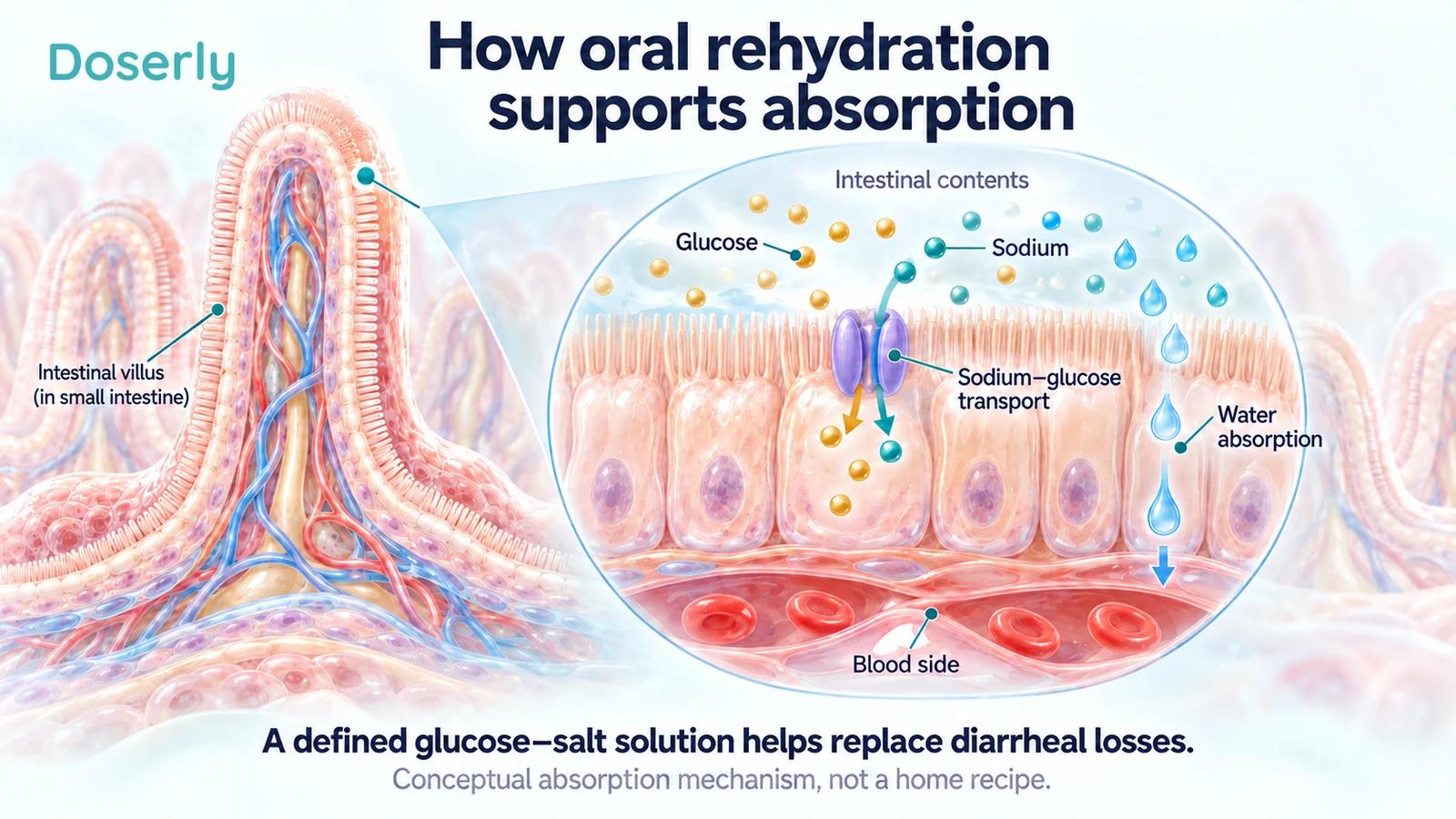
Cells lining the small intestine have a transport system that brings sodium and glucose into the cells together. Movement of these dissolved substances supports water absorption. This is the physiological basis of glucose–electrolyte rehydration, described in CDC's clinical guidance. It doesn't require the diarrhea to stop before fluid can be absorbed. CDC gastroenteritis guidance
This helps explain a common concern: “If the person still has diarrhea, is the drink doing anything?” Rehydration and stopping diarrhea are different outcomes. A patient can benefit from absorbing fluid while still passing loose stools. Conversely, fewer trips to the toilet don't establish that a fluid deficit has been corrected.
What reduced osmolarity means
Osmolarity describes the concentration of dissolved particles in a solution. It matters because water movement depends partly on the concentration of those particles. Adding more powder doesn't simply make a rehydration drink more effective.
The reduced-osmolarity WHO formulation studied in a major pediatric trial contained 75 mmol/L sodium and 75 mmol/L glucose, with potassium, chloride and citrate also included. Its total osmolarity was 245 mOsm/L. These are concentrations after correct preparation, not instructions to measure raw ingredients at home. CHOICE trial
The older standard WHO formula was more concentrated. Trials comparing the formulas asked whether adjusting that concentration could improve treatment without creating new electrolyte problems. They did not compare “minerals” with “no minerals,” and they were not testing whether a healthy adult should drink ORS each morning.
The difference between an ingredient list and a prepared solution is crucial. Two powders may list sodium and glucose but supply different amounts per litre. Even the right packet produces the wrong concentration if it is mixed with the wrong volume of water.
What the larger pediatric trial found
The CHOICE Study Group trial, published in 2001, enrolled 675 children aged 1–24 months with acute diarrhea and dehydration in five countries. Researchers randomly assigned 341 to reduced-osmolarity ORS and 334 to the older standard WHO solution, with treatment blinded.
Unscheduled intravenous fluid was needed in 10% versus 15%, respectively. The paper reported an odds ratio of 0.6, with a 95% confidence interval of 0.4–1.0. Stool output, vomiting and diarrhea duration were not clearly different in this individual trial. CHOICE primary report
The rounded percentages represent about five fewer children needing unplanned IV therapy per 100 treated under those trial conditions. They do not mean that dehydration was corrected 5% faster or that intravenous care was eliminated. Some children in both groups still needed it.
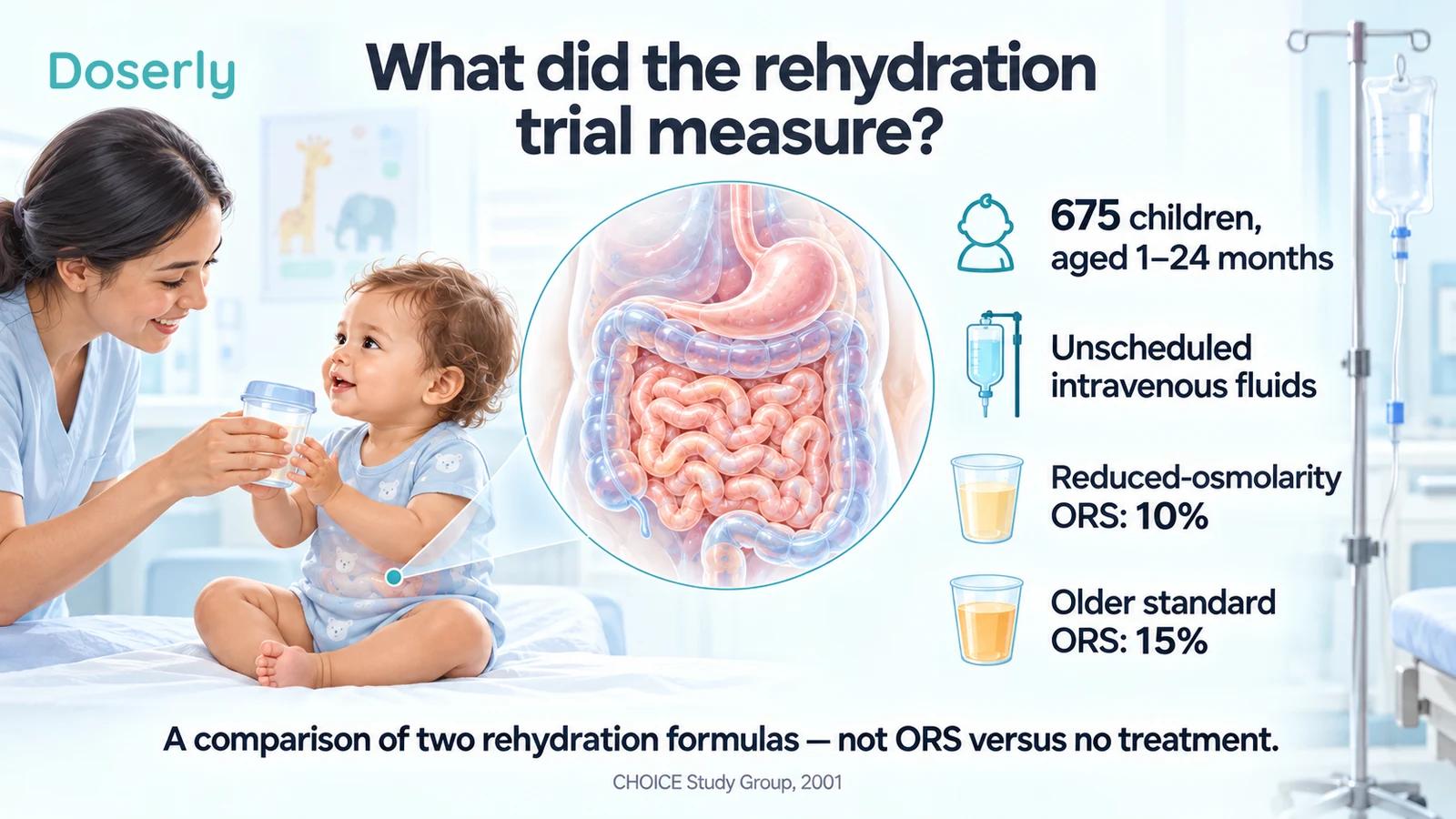
Image sources: Source: CHOICE
This is a clinically meaningful type of endpoint because it concerns the need to escalate treatment. It is also more precise than saying the new formula “worked better” in every respect. The findings differed by outcome.
A second trial measured a different IV-fluid result
A 2007 Chinese multicenter trial studied 125 children aged 1–17 years with acute diarrhea and mild-to-moderate dehydration. Sixty-two received reduced-osmolarity ORS and 63 received ORS II.
The number needing intravenous fluid was 41 versus 39, without a significant difference. However, the reported average IV-fluid volume was approximately 451 mL versus 597 mL, a 24.5% reduction in the reduced-osmolarity group. Symptom and dehydration recovery measures were generally similar. Yang and colleagues, 2007
It would be incorrect to turn this into “24.5% fewer children needed an IV.” The measurement was fluid volume, and the number requiring IV treatment did not decrease. The English abstract also does not provide enough detail to turn its average volume into an individual treatment rule.
The distinction illustrates how rehydration studies can assess several useful but separate questions: how much fluid is lost in stool, whether vomiting occurs, whether rescue treatment is required, and how much rescue fluid is used. A summary should identify which one actually improved.
Why the wider evidence matters
A 2001 systematic review collected 15 randomized trials involving 2,397 children. In the nine trials contributing to its main pooled analysis, reduced-osmolarity ORS was associated with fewer unplanned IV infusions: odds ratio 0.61, 95% confidence interval 0.47–0.81. Other analyses suggested less vomiting and lower stool output. Hahn and colleagues
This review helps explain why one trial with no clear stool-output difference doesn't settle the entire question. Pooling studies can provide a more precise estimate, although the contributing trials still differ in their participants and conditions.
The review is a synthesis, not an additional independent trial, and its odds ratio is not a percentage-point reduction. Its evidence concerns children admitted with diarrheal dehydration. It doesn't establish that the same relative advantage applies to every adult, every cause of diarrhea or a newer branded drink with a different formulation.
WHO subsequently adopted reduced-osmolarity ORS as the recommended formulation. Its production guidance describes the formula as a medical rehydration tool, not a general wellness upgrade. WHO formulation guidance
Why sugar-free electrolyte water isn't equivalent
Glucose has a functional role in standard ORS. Removing it changes the absorption strategy being discussed, even if sodium and potassium remain in the bottle. On the other hand, increasing sugar far beyond a validated formulation is not an improvement either.
CDC's pediatric guidance distinguishes ORS from other beverages and warns that overly concentrated solutions can impair rather than improve net fluid transport. Where suitable commercial preparations are available, it favors them over improvised mixtures because mixing errors can be serious. CDC gastroenteritis guidance
So the choice isn't “sugar is always good” or “sugar is always bad.” The question is whether the drink has the composition appropriate to its purpose. A standard ORS can contain glucose for treatment while a large sugary beverage remains an unsuitable substitute.
For someone with diabetes, the word glucose on the ingredient list is a reason to ask how rehydration fits their sick-day plan, not a reason to silently substitute a different formulation. Illness, fluid losses and diabetes medicines need to be considered together by the treating team.
Preparation is part of the treatment
Read the instructions on the actual packet. Products can be intended for different water volumes, so don't assume that every sachet belongs in a one-litre bottle. Use the specified amount of safe water and the specified packet quantity. A ready-to-drink product has already been prepared and should be used according to its label.
For cholera, CDC describes using prepackaged ORS mixed with appropriately treated or boiled water and urges immediate medical attention for suspected illness. It specifically cautions against high-sugar substitutes such as soft drinks and sports drinks. CDC: treating cholera
Don't strengthen a drink because the person looks more dehydrated. The amount a person needs to receive and the concentration of the prepared solution are separate decisions. More severe dehydration calls for assessment and possibly a different route of treatment, rather than a stronger homemade mixture.
Also check storage and discard instructions for the prepared product. Keep the packet available so a pharmacist or clinician can identify what was used. If preparation is unclear, ask before improvising with a scoop from another product.
What if the person is vomiting?
Nausea can make drinking difficult. NHS guidance suggests beginning with small sips and gradually increasing intake when someone feels sick, and recommends asking a pharmacist about a suitable oral rehydration product. NHS: dehydration
That general approach is not a substitute for a child's weight-based treatment plan. Age, ongoing losses, severity and medical history affect what is appropriate. A child who cannot keep fluid down may need supervised treatment rather than repeated attempts at a large drink.
ORS also doesn't replace nutrition. NHS advice is to continue breast or bottle feeding during ordinary gastroenteritis and not dilute infant formula. Eating can resume as tolerated; the details should follow the child's clinical advice. NHS: diarrhea and vomiting
When caring for someone, a brief record can help: when vomiting or diarrhea began, what fluid they can keep down, changes in urine or wet diapers, and medicines used. That information describes the course of illness more usefully than reporting only the number of packets opened.
When home rehydration is not enough
Babies, young children and older adults can become dehydrated more readily. Markedly reduced urination, persistent dizziness on standing, unusual drowsiness or fast breathing warrant prompt assessment. Confusion, difficulty waking, cold or mottled skin, or breathing difficulty can indicate a medical emergency. NHS dehydration warning signs
Seek medical help for persistent inability to keep fluids down, bloody diarrhea or a young child with signs of dehydration. The presence of ORS in the home should not delay that decision. NHS illness guidance
WHO describes intravenous treatment for severe dehydration or shock. Suspected cholera is especially urgent because fluid loss can be rapid. Rehydration can begin while arranging care when the person can safely drink, but it doesn't remove the need for assessment. WHO diarrhoeal disease
People with conditions requiring restricted fluid or electrolyte intake also need individualized advice. A standard product's established purpose doesn't make unlimited use appropriate in every medical situation.
Does ORS belong in an everyday wellness routine?
The trials above address a real deficit caused by illness. They establish a role for correctly formulated rehydration therapy and clarify differences between formulas. They do not show that routinely drinking ORS makes a well-hydrated person healthier, more energetic or better able to concentrate.
For daily fluids or sweat replacement, start with that different question. Our electrolyte powders guide explains the broader category, but the same label word doesn't make the products equivalent.
ORS is valuable because its purpose is specific. Knowing that purpose helps you choose the right product, prepare it accurately and recognize when professional care matters more than another drink.
Sources
- WHO: Oral rehydration salts, 2006.
- CDC: Managing acute gastroenteritis among children, 2003.
- CHOICE Study Group trial, 2001.
- Yang et al. multicenter trial, 2007.
- Hahn et al. systematic review, 2001.
- CDC: Treating cholera.
- NHS: Dehydration.
- NHS: Diarrhea and vomiting.
- WHO: Diarrhoeal disease.