
Supplements
October 16, 2026
Oral glutathione: absorption and clinical benefit are different questions
On this page
The debate about oral glutathione is often reduced to two competing claims: either the digestive system destroys it, making supplementation pointless, or a better-absorbed formulation delivers broad antioxidant and immune benefits. Human studies support a more careful interpretation.
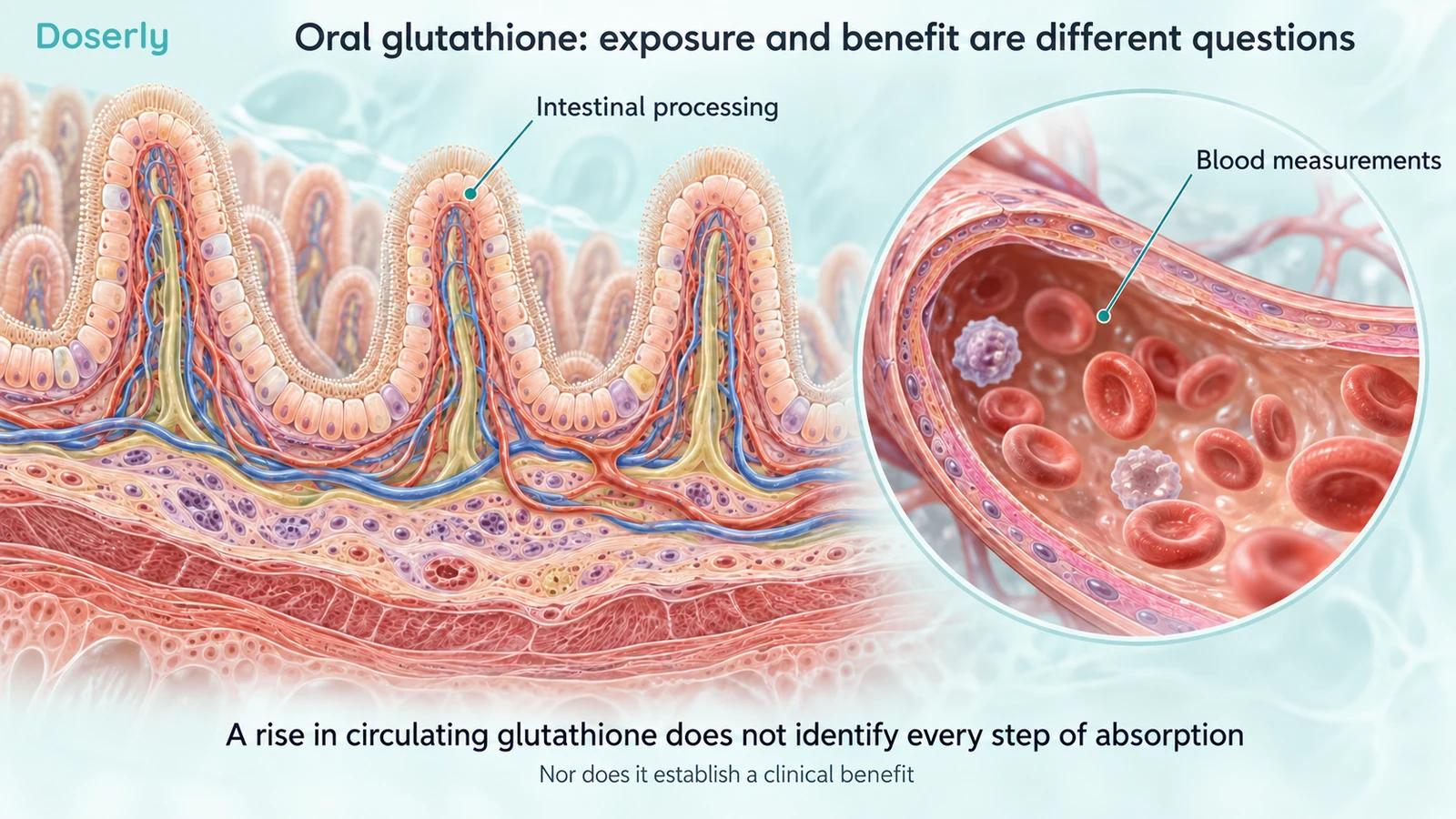
Some preparations have increased glutathione measurements in blood or selected cells. Other trials have found no significant change. Newer formulation studies also show differences in short-term exposure. These findings are useful, but they do not establish that every rise in glutathione improves health or that one delivery method is clinically superior.
The first question is what happens to measured glutathione after a person takes a product. The second is whether that change produces a meaningful benefit. Our L-glutathione guide covers broader context; this article keeps those two questions separate.
What glutathione does—and what a supplement must prove
Glutathione is a small molecule made from three amino-acid components: glutamate, cysteine and glycine. It participates in antioxidant defense and other cellular processes. The body can synthesize it, use it and recycle it between different chemical states.
That biological importance does not mean every healthy person needs more from a supplement. The relevant issue is whether an intervention changes a limiting process and improves an outcome. A molecule can be essential while additional intake remains unhelpful for a particular person or condition.
Oral supplementation adds several questions. What happens during digestion? Does the preparation alter circulating glutathione, its components or subsequent synthesis? Which tissues change, for how long, and does any change matter clinically? A concentration measured after swallowing a product does not independently identify every step along that pathway. Recent formulation research
Why “body stores” needs a precise definition
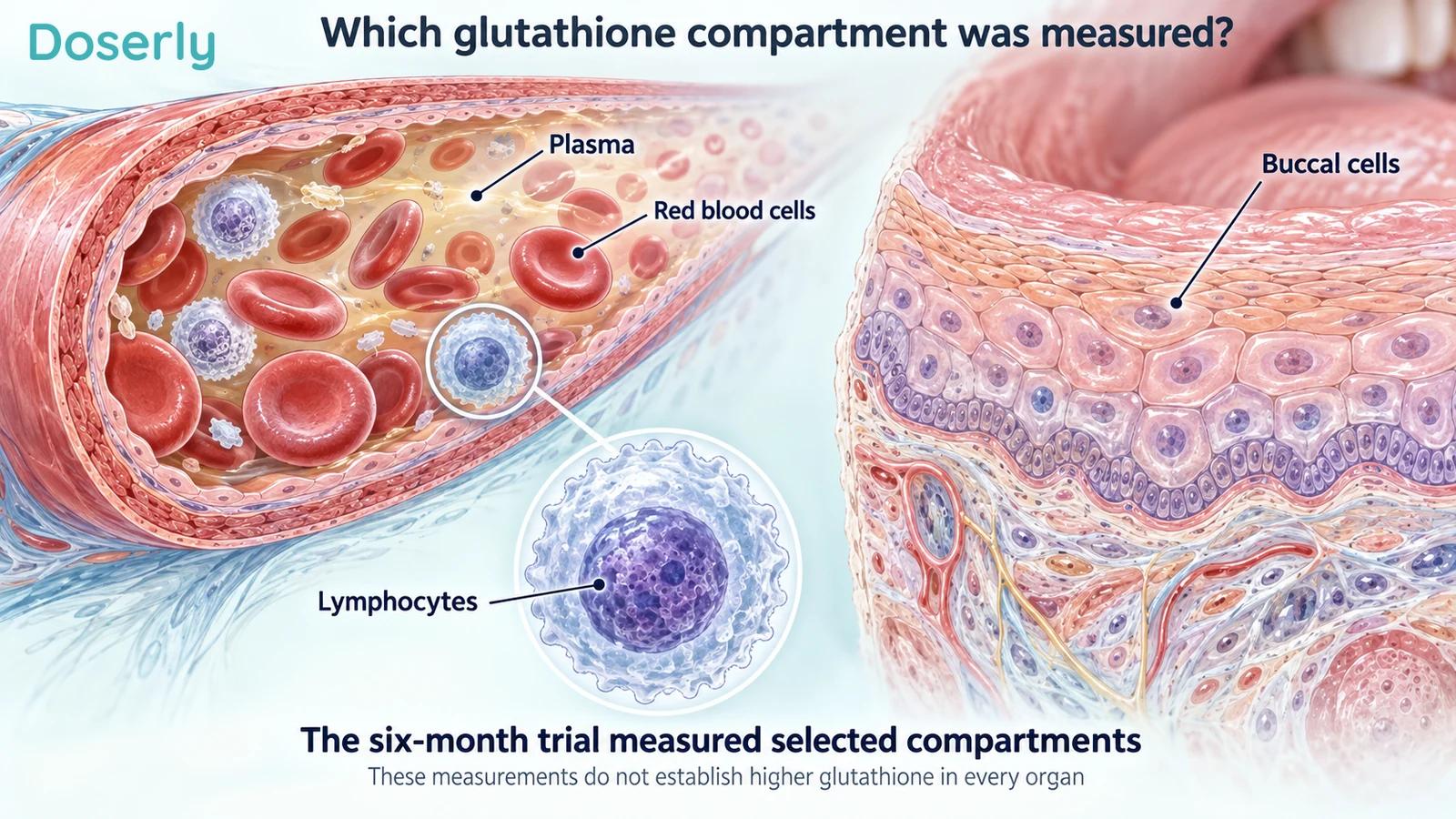
Blood is not a single compartment. Researchers can measure glutathione in plasma, red blood cells, immune cells or whole blood. They can also sample other accessible cells, such as cells shed from the lining of the mouth.
Those measurements are valuable, but they do not constitute a direct inventory of glutathione in every organ. A rise in red blood cells cannot simply be relabeled as improved brain or liver glutathione. Different tissues have different regulation and clinical relevance.
The chemical form matters too. Reduced glutathione and oxidized glutathione are related but distinct measurements; their ratio can provide information about redox conditions. A study's conclusion depends on which form, compartment and time point it assessed, as well as how samples were handled.
This is why a product claim based on “a percentage increase in glutathione” needs its denominator and context. A large relative change in one accessible cell type is not a whole-body percentage improvement in antioxidant protection.
The four-week trial found no significant benefit in its measurements
A 2011 randomized, double-blind, placebo-controlled trial enrolled 40 healthy adults. Participants took 500 mg oral glutathione twice daily or placebo for four weeks. The investigators found no significant between-group changes in glutathione status or the assessed oxidative-stress biomarkers. Allen and Bradley
This finding challenges the assumption that ordinary oral glutathione must reliably raise every relevant measurement within a month. It does not prove that no formulation can ever affect glutathione status, because formulation, duration, starting status and sampling methods can differ.
The distinction is important for both sides of the debate. It is inaccurate to ignore the negative study because a later study was positive. It is also inaccurate to treat this one experiment as proof that all oral glutathione is useless under all conditions.
The study measured biomarkers in healthy volunteers. It did not test a treatment for a defined glutathione-related disease or compare every available delivery system. Its conclusion should remain attached to that scope.
The six-month trial found increases in selected compartments
A 2015 randomized, double-blind trial studied 54 nonsmoking adults assigned to 250 mg daily, 1,000 mg daily or placebo for six months. Researchers measured glutathione in several blood compartments and in exfoliated buccal cells from the mouth. They reported increases with supplementation, with many results depending on amount and duration. Levels generally returned toward baseline after a one-month washout. Richie and colleagues
This is evidence against the blanket claim that swallowed glutathione can never affect measured body compartments. It is not proof that every person benefits or that every organ receives the same increase.
A subset analysis also found increased natural-killer-cell cytotoxicity at one time point. That laboratory measure describes how sampled cells behaved in an assay. The trial did not establish fewer respiratory infections, less cancer or longer life.
The washout result is also informative. A change that moves back toward baseline after stopping a product is different from a permanent alteration of the body's antioxidant system. It does not, however, establish that indefinite supplementation is necessary or beneficial; that would require a separate clinical argument.
Why the two classic trials need not have identical results
The studies differed in duration and in aspects of measurement and participant context. A four-week experiment and a six-month experiment can detect different patterns. Baseline values, sample processing and the compartment analyzed can also affect interpretation.
These differences offer plausible explanations for disagreement, but they should not be used to invent a definitive reason after the fact. A direct comparison using standardized methods would provide stronger evidence about which factor accounts for the difference.
For readers, the most useful conclusion is modest: oral glutathione has produced measurable increases in some controlled human research, but the effect is not uniform across studies. The evidence does not support either absolute position—universal nonabsorption or guaranteed benefit.
What the liposomal pilot did and did not show
A one-month pilot study tested 500 or 1,000 mg daily of a liposomal glutathione preparation in 12 adults. Researchers reported increases in several glutathione compartments and changes in oxidative-stress and immune-function markers. Liposomal pilot
The study did not include a placebo group or a conventional-glutathione comparison group. It therefore cannot establish that the liposomal preparation was better than ordinary glutathione. Comparing its percentage increases with those in a different study does not supply that missing head-to-head comparison.
The small sample also limited the ability to distinguish the two amounts. An absence of a statistically significant difference between them does not prove that the doses are equivalent.
Liposomal delivery is a formulation strategy, not a clinical outcome. The useful questions remain whether it changes exposure reproducibly, whether the change is clinically valuable, and whether benefits justify any additional cost or inconvenience.
New 2026 studies add formulation evidence, not a universal winner
A 2026 crossover pilot in 14 healthy adults compared a micellar formulation with standard and liposomal preparations. The micellar product produced greater baseline-adjusted whole-blood glutathione exposure than the standard preparation at the administered amounts. Those amounts were unequal, and the paper also presented dose-normalized analyses. Micellar crossover study
The distinction matters when interpreting promotional multiples. An observed comparison at different amounts and a mathematically normalized comparison answer different questions. Neither is equivalent to a long-term trial demonstrating better symptoms or disease outcomes.
A subsequent 30-day single-arm phase assessed the micellar product's tolerability and clinical laboratory markers. It was not a long-term placebo-controlled safety study. The paper disclosed product-related commercial and patent relationships, adding a reason to seek independent replication rather than dismissing or accepting the findings automatically.
Another 2026 study compared an orally dissolving film with tablets. It found a different time course of plasma glutathione, with trends toward greater overall exposure for the film. During four weeks of supplementation, both forms increased circulating glutathione, without significant changes in the measured oxidative-stress biomarkers. Film-versus-tablet study
Together, these studies show why formulation is worth investigating. They also show why “more bioavailable” and “better for health” must remain separate statements.
A clinical trial can test whether the hoped-for benefit follows
The 2020 GROW trial studied oral glutathione in children aged 2–10 with cystic fibrosis and pancreatic insufficiency. Over 24 weeks, researchers examined growth and inflammatory outcomes. Fifty-eight children completed the study, with 30 in the glutathione group and 28 in the placebo group. GROW trial
Glutathione did not significantly improve the primary weight-for-age outcome or the other reported growth and inflammatory measures. This was a specific clinical population, so the result does not establish what happens in every other condition. It does demonstrate why a plausible antioxidant or intestinal mechanism needs a clinical test.
A product can be biologically interesting and still fail to deliver the intended patient benefit. That isn't a contradiction. It is the reason randomized clinical outcomes matter alongside absorption studies.
For families managing cystic fibrosis, this result is not a reason to alter prescribed nutrition or medicines independently. The trial concerns an adjunctive intervention within specialist care, not an alternative to that care.
Oral, inhaled and injected glutathione are different interventions
Evidence from an oral product does not establish the safety or effectiveness of injection. Bypassing digestion changes exposure and introduces additional risks related to sterility, contaminants and administration. Higher delivery alone is not an argument for changing route.
In an August 2026 alert, the FDA described adverse-event reports involving compounded intravenous glutathione made from dietary-supplement-grade material and emphasized that such ingredients are inappropriate for injectable drugs. The concern involved endotoxin contamination and route-specific quality requirements. FDA alert
This should not be misrepresented as evidence that ordinary oral use causes the same contamination-related reactions. It is a clear reason not to turn oral research into an endorsement of injections or to improvise injectable preparations.
Similarly, a short oral trial reporting acceptable tolerability cannot establish safety during pregnancy, with every medicine or over years of use. The actual formulation and the person's medical context remain relevant.
What would make a product claim convincing?
First, look for a comparison using the actual formulation. A general glutathione paper does not necessarily support a different liposomal, micellar, tablet or film product. Product names and ingredient amounts should be clear enough to match the claim to the experiment.
Second, identify the endpoint. Blood exposure, a redox ratio, immune-cell activity, symptom improvement and disease prevention are not interchangeable. Ask whether the trial measured the outcome that motivated your interest in the supplement.
Third, examine the design and time frame. A crossover pharmacokinetic study can compare exposure efficiently, but it does not establish years of clinical benefit. A single-arm pilot can identify a signal, but it cannot separate treatment effects from other changes as reliably as a blinded placebo comparison.
Finally, distinguish a statistically detectable difference from a meaningful one. A concentration can rise without crossing any validated threshold for better health. The studies discussed here do not define a universal glutathione target that every healthy adult should pursue.
Keeping expectations proportionate
If a supplement is used within an agreed care plan, record the exact formulation, reason for use and outcome being followed. A switch from a capsule to a film or liposomal liquid is a change in the intervention, not simply a new package.
Avoid interpreting every change in energy, skin appearance or frequency of illness as confirmation of improved glutathione. Those experiences have many possible influences. Tracking can help organize a conversation, but it cannot replace a controlled comparison or diagnose a deficiency.
Oral glutathione research now supports a more nuanced statement than “it cannot be absorbed.” Some preparations can alter measured glutathione status, and formulations can differ. Whether those changes provide a worthwhile clinical benefit remains a separate, condition-specific question.
Sources
- Four-week placebo-controlled study
- Six-month body-compartment trial
- Liposomal pilot
- 2026 micellar crossover study
- 2026 film-versus-tablet study
- GROW clinical trial
- FDA injectable-glutathione alert