
HRT
October 16, 2026
Menopause weight gain: what HRT can and cannot change
On this page
A changing waistline around menopause can be unsettling, especially when your meals and activity seem much the same. Sometimes the scale rises; sometimes clothes fit differently with little change in weight. Both experiences deserve a thoughtful explanation. Neither means that you have suddenly lost willpower.
Hormonal changes contribute to the context, but hormone replacement therapy is not a weight-loss treatment. Trials suggest that some hormone regimens modestly limit weight gain or influence body composition. Those findings are different from demonstrating substantial weight loss, restoring a previous body shape or treating obesity. The Menopause Society makes the same distinction in its patient guidance. Weight gain and menopause
The useful starting point is to separate three questions: what changes during the menopause transition, what HRT actually changes in trials, and what kind of care fits your goal. Our menopause weight and body-composition guide provides broader background on the measurements used in that conversation.
Weight, fat distribution and muscle are not interchangeable
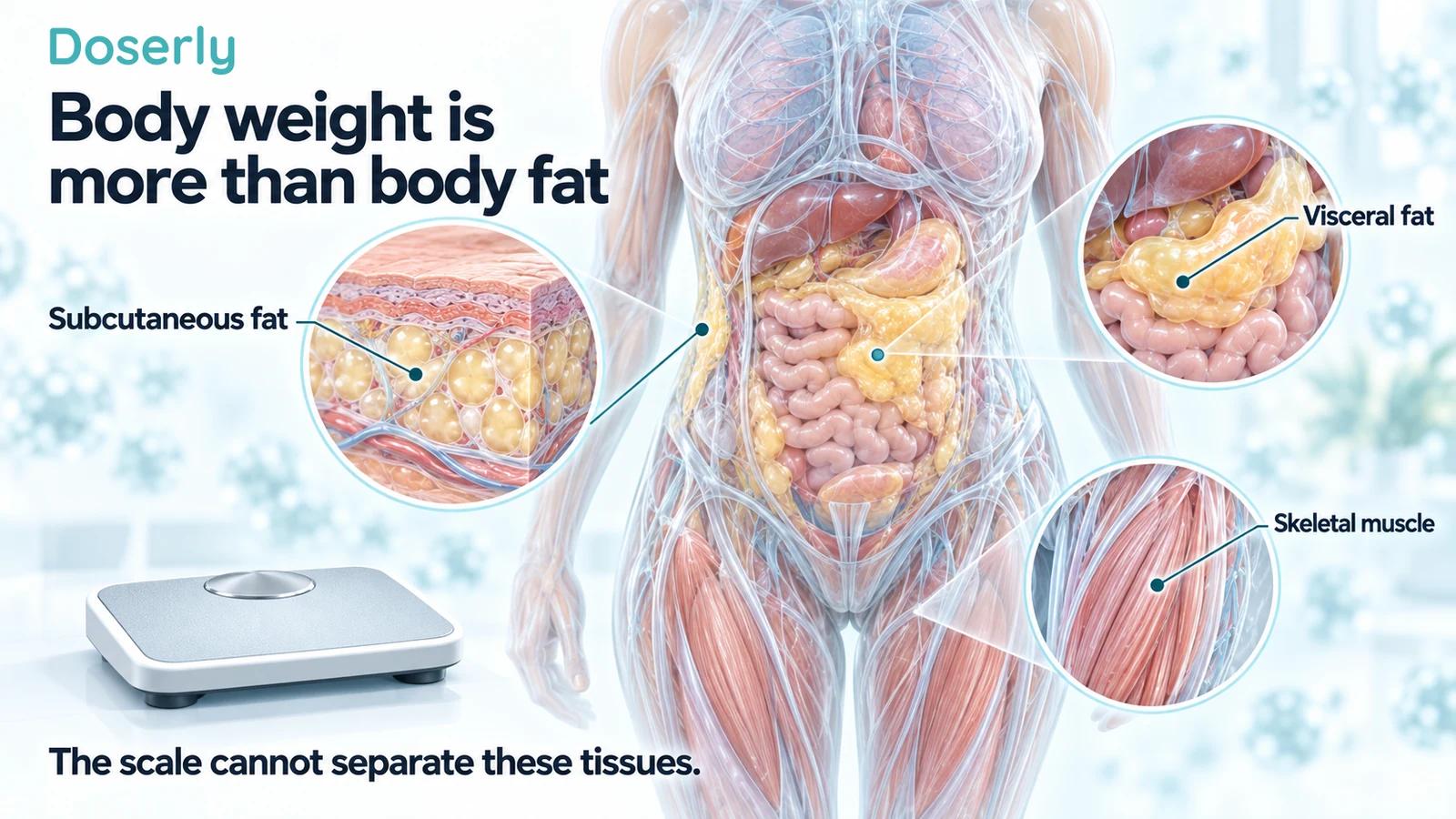
Body weight includes fat, muscle, organs, bone, water and other tissues. A bathroom scale adds them together. It cannot tell you whether a change represents body fat, fluid or muscle, and it does not locate fat within the body.
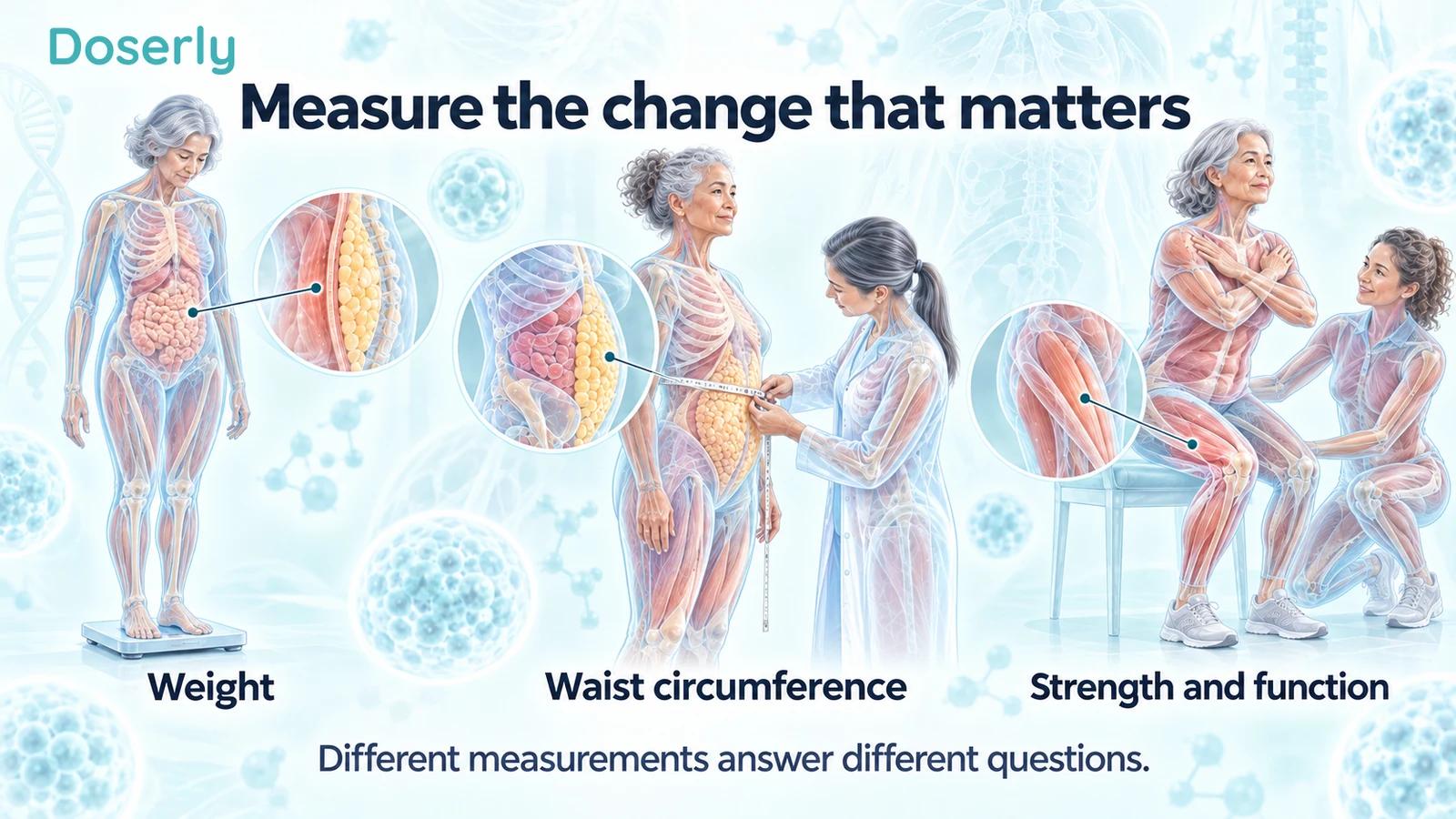
Subcutaneous fat lies beneath the skin. Visceral fat sits deeper in the abdomen around organs. Waist circumference offers information about abdominal size, but it is not a direct scan of visceral fat. Likewise, a body-composition scan reporting “lean mass” is not measuring strength: lean tissue includes more than skeletal muscle, and the ability to lift, walk or rise from a chair is a separate outcome.
These distinctions help explain why two people with the same weight can have different health needs. One may want help managing a rising waist measurement and metabolic risk. Another may be losing weight unintentionally and struggling to carry groceries. A plan aimed only at lowering the scale can miss the second person's more pressing concern.
What changes around the final menstrual period?
The Study of Women's Health Across the Nation, or SWAN, followed women through midlife rather than comparing unrelated younger and older groups at a single visit. A 2019 analysis included 1,246 women with repeated body-composition measurements and a known final menstrual period.
The investigators found an acceleration of fat gain and a shift toward lean-mass loss around the menopause transition. Importantly, the rate of body-weight gain did not show the same clear acceleration. Gains in one component and losses in another can partly offset each other on the scale. The modeled body-composition transition extended from roughly two years before to one and a half years after the final menstrual period, with differences between racial and ethnic groups. SWAN body-composition analysis
This was observational research. It supports a relationship between the transition and changes in tissue composition; it does not show that every woman will follow the average trajectory or that starting HRT during a particular window prevents abdominal fat accumulation. The latter would require an intervention study designed to test that claim.
It is therefore too simple to say that menopause has nothing to do with body changes. It is also too simple to attribute every kilogram gained at midlife exclusively to estrogen. Aging, medications, health conditions and changing opportunities for sleep and activity can coexist with the hormonal transition.
What hormone trials actually measured
The Postmenopausal Estrogen/Progestin Interventions trial, known as PEPI, randomized 875 women to placebo or one of four oral estrogen regimens, with or without a progestogen, for three years. Women assigned active hormone treatment averaged 1.0 kg less weight gain and 1.2 cm less increase in waist circumference than those assigned placebo.
That is less gain, not a promise of losing 1 kg after starting HRT. Differences in waist measurements were no longer statistically significant when the analysis accounted for weight change. There were no significant differences in weight or girth changes among the four active regimens. PEPI weight analysis
The size and direction of the finding both matter. It argues against assuming that those hormone regimens inevitably caused extra weight gain. It does not support marketing estrogen as a treatment that reliably produces substantial weight loss. The trial also used particular oral formulations; it cannot rank every patch, gel, capsule or compounded preparation available today.
A person can still experience an unwanted change after starting treatment. That experience deserves review, including the timing and the actual product. Population averages neither prove that a medicine caused an individual's change nor rule out an individual tolerability problem.
What about preserving lean tissue?
A Women's Health Initiative substudy randomized 835 women to conjugated estrogens plus medroxyprogesterone acetate or placebo and used body-composition scans. After three years, average lean soft-tissue loss was 0.04 kg with active treatment and 0.44 kg with placebo. The study also examined fat distribution. WHI body-composition substudy
The lean-tissue difference was about 0.40 kg over three years. It should not be translated into a claim that HRT builds strong muscles or replaces resistance exercise. A scan-derived amount of tissue and a functional outcome are different measurements. Nor does this specific estrogen–progestin regimen establish the effects of every modern formulation.
For someone worried about strength, the practical question is whether daily tasks are becoming harder and what assessment or training would help. If climbing stairs improves, that is useful information even when body weight changes little. If weight falls while function deteriorates, a lower number alone is not an adequate sign of success.
Symptom relief can help without being a weight-loss mechanism
Better control of night sweats may make a morning walk or exercise session more manageable. Someone who feels less disrupted may find it easier to plan meals or sustain a routine. These are plausible, personally meaningful pathways by which menopause treatment can support broader care. They do not guarantee weight loss and should not be presented as a measured metabolic benefit in everyone who starts HRT.
The Menopause Society describes HRT's body-composition effects as modest and emphasizes that its role is treatment of menopause symptoms rather than direct weight reduction. Menopause Society patient guidance
This distinction protects against two disappointments. You do not need to regard effective treatment for disabling sweats as a failure because the scale stayed the same. Equally, persistent weight-related health concerns should not be left untreated while waiting for HRT to solve them. It is reasonable to have a symptom plan and a weight-management plan, each with its own goal.
Weight-management studies ask a different question
A year-long randomized trial enrolled 439 sedentary postmenopausal women with overweight or obesity. It compared a structured dietary program, aerobic exercise, both together and a control group. Mean weight changes were −8.5% with diet, −2.4% with exercise, −10.8% with both and −0.8% in the control group. Waist circumference and body-fat measures also improved. Nutrition and Exercise in Women trial
Those results show that meaningful change remains possible after menopause. They are not a forecast for an individual or proof that a particular diet is uniquely necessary. The study provided an organized intervention, enrolled a selected population and had predominantly non-Hispanic white participants. A person offered only a vague instruction to “eat less” has not received the same support.
The relevant lesson is the difference in study purpose. This trial was designed to change weight through a sustained program. The hormone trials above tested hormone regimens and found modest differences in weight or tissue measures. Comparing the numbers does not create a head-to-head trial, but it makes clear why HRT should not be sold as a substitute for weight-management care.
Choosing measurements that fit your priorities
Before adding more tracking, decide what you need to learn. If the concern is a gradual rise in weight, measurements under reasonably consistent conditions may show a trend more clearly than an isolated reading. If the concern is abdominal size, a clinician can discuss waist measurement. If it is weakness or mobility, function needs attention directly.
A body-composition scan is not automatically required because your clothes fit differently. Ask whether the result would change care. Home devices also produce estimates rather than perfect tissue inventories, so an unexpected result should not become a reason for abrupt treatment changes.
Health measures such as blood pressure or glucose may be relevant depending on your history. These should be selected because they address a clinical question, not because a commercial package promises to measure a complete “metabolic reset.” You can ask what each test adds and what action would follow an abnormal result.
When additional treatment belongs in the discussion
Obesity treatment may include structured behavioral support, medicines or procedures, depending on health status and preferences. NIDDK describes these as parts of long-term care rather than evidence of a personal failure. Medication suitability depends on the product's indication, health conditions, other treatments and potential adverse effects. NIDDK treatment overview
Menopause alone does not automatically make someone eligible for a weight-management medicine, and using HRT does not remove the need to assess eligibility. Someone with obesity and related complications may need a more active treatment plan than someone whose primary concern is a modest change in appearance with stable health and function.
Conversely, unexplained or rapid weight change should not simply be labeled “menopause.” Bring the pattern to a clinician, particularly if there are other new symptoms. The goal is to consider relevant causes rather than assume that every change requires either more hormones or a stricter diet.
A more useful conversation about your next step
Start with the change you have noticed and what you want to be able to do. “My waist has changed and I want to understand my health risks” is a different request from “I cannot sleep because of sweats” or “I am losing strength.” You can raise all three, but separating them makes it easier to choose and judge treatment.
Ask your clinician what HRT is intended to treat in your case, what benefit is realistic and how it will be reviewed. For weight or body composition, ask what support is available and how to protect physical function while pursuing your goal. A plan needs to fit your resources, medical history and relationship with food—not just a theoretical program.
Our menopause nutrition and lifestyle guide offers background for that discussion. The most useful outcome is not proving that hormones explain every change. It is finding a sustainable plan that addresses symptoms, health and function with treatments supported for those purposes.
Explore the research
- SWAN body-composition analysis, 2019: longitudinal observations aligned to the final menstrual period.
- PEPI weight and girth analysis, 1997: three-year randomized hormone comparison.
- WHI body-composition substudy, 2005: lean tissue and fat distribution with a specific estrogen–progestin regimen.
- Nutrition and Exercise in Women trial, 2012: year-long dietary and exercise interventions; published online in 2011.
- The Menopause Society: weight gain: practical distinction between symptom treatment and weight treatment.
- NIDDK: treatment for overweight and obesity: long-term care options.