
HRT
October 16, 2026
Menopause supplement claims: the evidence gap behind “hormone balance”
On this page
“Hormone balance” sounds like an explanation and a solution at the same time. It can be attached to hot flushes, sleep problems, fatigue, weight changes, or low mood without specifying what is being measured.
That makes it a poor clinical outcome. A product can claim to support balance even when it has not been shown to improve the symptom that matters to the person buying it.
The useful questions are more concrete. Which ingredient and preparation were studied? In whom? Compared with what? Did symptoms improve more than they did with placebo, and by an amount people would notice? What is known about adverse effects and interactions?
These questions do not require dismissing every supplement. They require keeping a nutritional indication, a plausible biological mechanism, and a demonstrated menopause treatment benefit separate.
Start with the symptom, not the slogan
A person seeking help with frequent night sweats has a different treatment question from someone with a documented nutrient deficiency. A study of bone density cannot automatically support a claim about sleep. A change in a blood marker does not necessarily mean that a person feels or functions better.
For a vasomotor-symptom claim, useful outcomes include the frequency, severity, or interference caused by hot flushes and night sweats. For a sleep claim, the study should actually assess sleep. The duration matters too: a short trial cannot establish years of benefit or long-term safety.
The advertisement should make it possible to identify the relevant study, rather than relying on phrases such as “clinically researched ingredients.” An ingredient may have been studied in a different dose, extract, population, or combination from the product being sold. NICE discussion of preparation variability.
That is particularly important for a multi-ingredient blend. Evidence about one component does not establish that the complete mixture works, and a result from the mixture cannot reveal which component caused it.
A more answerable question is “Does this exact preparation reduce disruptive hot flushes compared with placebo?” It may be less reassuring than a promise of balance, but it gives both the seller and the evidence a clear standard to meet.
Black cohosh: a substantial trial with a specific result
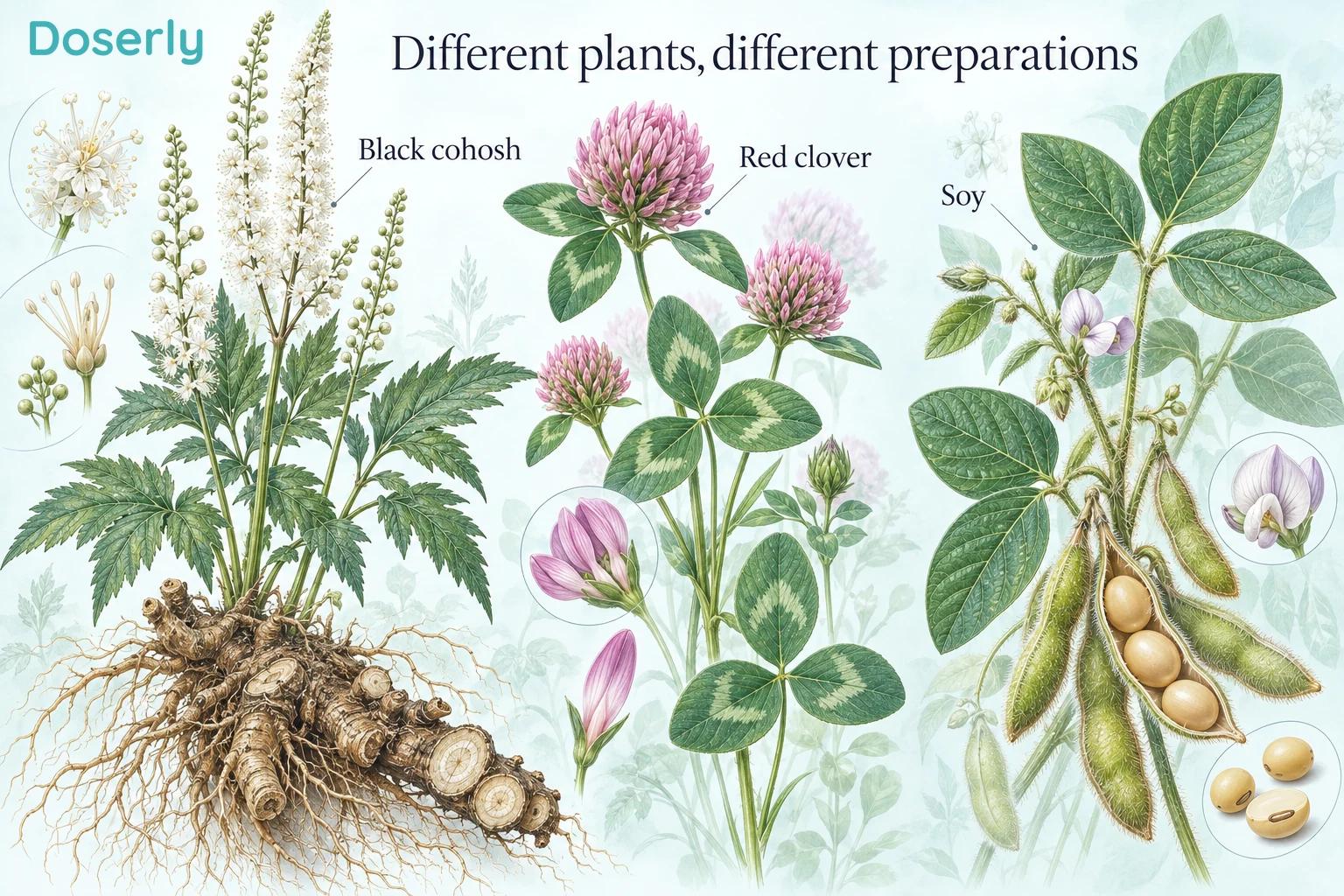
The Herbal Alternatives for Menopause trial randomized 351 women aged 45–55 who were having at least two vasomotor symptoms a day. Participants received black cohosh, a multibotanical preparation, the multibotanical plus dietary soy counseling, hormone therapy, or placebo for one year. Newton and colleagues
The herbal regimens did not improve the main vasomotor-symptom outcomes compared with placebo across follow-up. There was one unfavorable exception: symptom intensity was worse in the multibotanical-plus-soy group at twelve months. The trial therefore does not support presenting those preparations as reliably effective substitutes for symptom treatment.
It also does not prove that every black cohosh extract ever made is identical. Botanical products can differ. The appropriate conclusion remains attached to the preparations and outcomes tested.
Current NCCIH information acknowledges a 2023 review suggesting potential benefit from products containing black cohosh extracts for overall menopause symptoms and hot flushes. It also notes uncertainty for other uses and important safety limitations. NCCIH black cohosh information
This mixed picture is more useful than selecting only a positive review or only a negative trial. It explains why a broad guarantee is not justified and why the precise preparation, research quality, and intended outcome matter.
Red clover shows why placebo comparison is essential
The Isoflavone Clover Extract study randomized 252 symptomatic menopausal women to two red-clover-derived products or placebo after a placebo run-in. Of these, 246 completed the twelve-week protocol. Tice and colleagues
Average daily hot-flush counts fell by 5.1 in one extract group, 5.4 in the other, and 5.0 in the placebo group. One extract produced a faster early reduction, but the investigators did not find a clinically important overall benefit for either supplement.
A testimonial reporting five fewer hot flushes a day would sound impressive. In this trial, a similar improvement occurred without the active extracts. Looking only at change from the beginning of treatment would therefore give the wrong impression of the products' added effect.
Placebo-group improvement does not mean participants invented their symptoms or their relief. Symptoms can fluctuate, people may enter a study during a particularly difficult period, and expectations and the experience of care can affect reported outcomes. The randomized comparison helps separate the specific treatment effect from changes that happen in both groups.
The study also lasted only twelve weeks. Comparable adverse events during that period do not establish the safety of every red clover product taken for years.
Soy tablets are not the same question as soy foods
A two-year randomized trial tested soy isoflavone tablets in 248 women within five years of menopause. The primary outcome was bone mineral density at the spine and hip. The tablet group did not have a significant advantage over placebo at those sites; a larger proportion reported hot flushes and constipation. Levis and colleagues
The trial used a concentrated daily isoflavone preparation, not an ordinary serving of tofu or soybeans. Its result should not be turned into advice to avoid soy foods, nor should the general nutritional value of a food be used to validate a concentrated supplement.
It also illustrates the importance of separating endpoints. A supplement promoted for “menopause support” might imply both symptom relief and bone protection. Those claims need their own evidence. Neither follows simply from the presence of compounds described as phytoestrogens.
The word phytoestrogen refers to plant compounds with estrogen-related biological activity. It does not mean a product supplies an interchangeable form of prescribed estrogen, reliably replaces ovarian hormone production, or produces the same effects in every tissue.
Laboratory activity can suggest a reason to investigate a compound. A clinical trial is still needed to show whether a particular product improves an outcome people care about.
Why reputable guidance can use different wording
The 2023 North American Menopause Society position statement does not recommend supplements or herbal remedies as treatments for vasomotor symptoms because the evidence is negative or insufficient. It identifies other nonhormone options with better supporting evidence, including CBT and selected prescription treatments. NAMS position statement
NICE uses more qualified language: some evidence suggests that isoflavones or black cohosh may relieve vasomotor symptoms, while preparations vary, safety is uncertain, and interactions have been reported. That complementary-therapy recommendation is dated 2015 within the currently maintained guideline. NICE recommendations
These statements should not be flattened into “all experts agree supplements work” or “no positive study exists.” They reflect different recommendation wording and evidence assessments. Neither provides a blanket endorsement of an unidentified blend advertised as restoring hormonal balance.
A product-specific positive finding could be relevant, but its credibility depends on the study design, size, comparator, duration, and whether the product actually matches. A professional recommendation considers the wider body of evidence and whether a treatment can be recommended reliably in practice.
The honest message is that there are uncertainties worth discussing. Uncertainty is not evidence that a product is effective, and it is not a reason to leave significant symptoms untreated.
“Natural” does not answer the safety question
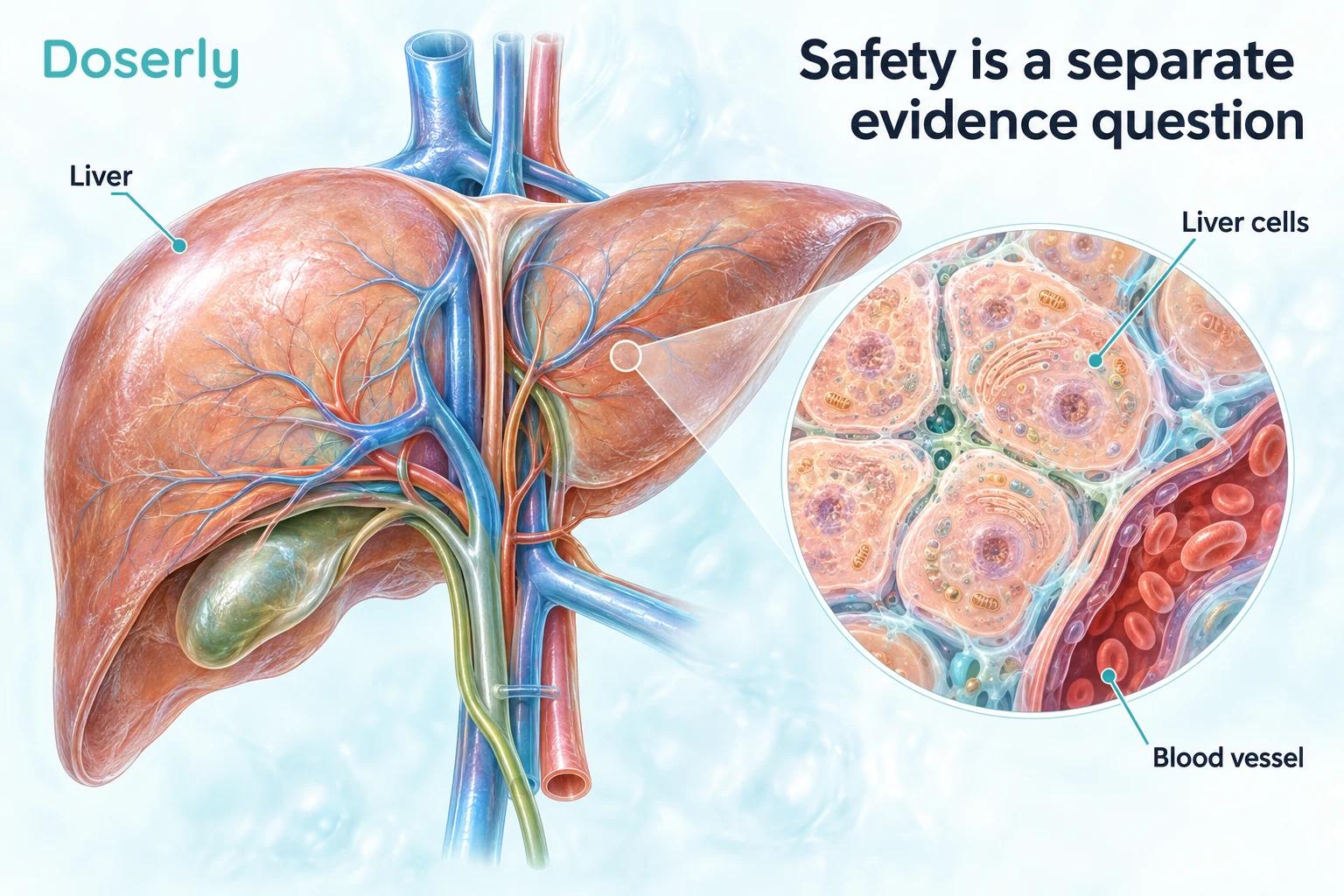
NCCIH reports rare cases of liver damage, including serious cases, in people taking products labeled as black cohosh. Whether black cohosh itself caused those problems remains uncertain. Some commercial products have contained the wrong herb or unlisted mixtures, which complicates interpretation. NCCIH safety assessment
That distinction should remain visible. “Black cohosh always damages the liver” would be inaccurate. So would “there are no safety concerns because it is a plant.”
A small trial is often poorly equipped to detect a rare adverse event. Short follow-up cannot establish long-term safety, and excluding people with complex medical histories limits what can be inferred for those groups.
Interaction risk also belongs in the discussion. Bring all supplements into a medication review, including occasional products, powders, teas, and combination blends. The actual ingredients matter more than the marketing category “menopause support.”
People with a history of hormone-sensitive cancer should not assume that a plant-derived product is automatically an appropriate alternative to HRT. NCCIH specifically notes uncertainty about black cohosh safety in hormone-sensitive conditions. The relevant clinical team should be involved in evaluating the actual product.
Unexplained symptoms after starting a supplement deserve attention. NCCIH advises seeking medical advice for possible liver-related symptoms such as dark urine and fatigue. A concerning reaction should not be reinterpreted as evidence that a “detox” is working.
Regulation and quality are not the same as demonstrated benefit
In the United States, FDA does not approve dietary supplements for safety and effectiveness before they are marketed. Manufacturers still have legal responsibilities, and FDA can act against unsafe or unlawful products. “Not approved before sale” is more accurate than saying supplements are completely unregulated. FDA consumer information
Rules differ between jurisdictions and product categories. A label, registration, or quality mark needs to be interpreted according to what it actually verifies.
Even a product that accurately contains the listed ingredients may not improve hot flushes. Identity and manufacturing quality answer whether the contents meet a standard. Clinical efficacy answers whether taking them produces a useful benefit compared with an appropriate control.
This distinction also applies to “standardized” extracts. Standardization can improve consistency of selected constituents; the word alone does not establish symptom relief, long-term safety, or equivalence to the preparation used in a trial.
A bottle's professional appearance and a long bibliography cannot replace checking those links. The evidence needs to support the claim made for the product in front of you.
Keep nutritional needs separate from a menopause cure claim
Some supplements have a legitimate role in providing essential nutrients or correcting an identified need. FDA explicitly recognizes that nutritional role. It is different from claiming that an all-purpose blend treats the menopausal transition.
Someone may need a particular nutrient because of diet, absorption, a medical condition, or a clinician's assessment. The indication should be named. Meeting that need does not establish that the same supplement will reduce night sweats in someone without it.
Likewise, food, physical activity, and sleep support can matter for overall health without being presented as a guaranteed cure for every menopause symptom. The Doserly menopause nutrition and lifestyle guide discusses that wider context.
Avoid using a negative hot-flush trial to dismiss all nutrition care. Avoid the opposite move too: using general nutritional benefits to imply that an expensive menopause blend has proven therapeutic effects.
This separation makes decisions easier. It allows someone to retain a supplement with a clear clinical purpose while questioning another product whose promised outcome has never been defined.
A practical way to examine the next claim
Before buying, write down the symptom you want to change and the product's complete name and ingredient list. Then look for evidence about that preparation, rather than accepting a citation about a vaguely related plant.
Ask whether the study involved people like you, used a control group, and reported a difference that was meaningful. Check whether the headline concerns the main planned outcome or a favorable result selected from many measurements. Note the follow-up period and how many participants completed it.
For safety, consider other medicines, medical history, and who will review a new symptom. A pharmacist or clinician can help with this assessment. No amount of symptom tracking can rule out an interaction that has not been considered.
If several products are started together, any improvement or adverse effect becomes harder to interpret. A personal experience can help inform a discussion, but it cannot establish that a product caused the change or that someone else will respond similarly.
The final question is whether the purchase delays a more useful conversation about symptoms. Choosing not to use HRT does not mean the only remaining options are supplements. Evidence-supported nonhormone care can be discussed according to the symptom, preferences, and medical circumstances. The 2023 nonhormone therapy position statement.
A credible claim names what improves and shows evidence that the product contributes to that improvement. “Hormone balance” leaves too much of that work undone.
Sources
- Newton et al. Black cohosh, multibotanicals, soy counseling, hormone therapy or placebo (2006).
- Tice et al. Isoflavone Clover Extract trial (2003).
- Levis et al. Soy isoflavones for bone loss and menopausal symptoms (2011).
- NAMS 2023 nonhormone therapy position statement (2023).
- NICE NG23 menopause recommendations (2026).
- NCCIH black cohosh usefulness and safety (2024).
- FDA information for consumers using dietary supplements (2026).