
HRT
October 16, 2026
Menopause at work: measure the impact, not a hormone number
On this page
A person who wakes repeatedly with night sweats may describe the next working day as “brain fog.” That phrase can cover several different problems: losing a word in a meeting, struggling to concentrate on a detailed task, or feeling exhausted before a shift has properly started.
A hormone result cannot describe those experiences. Nor can it show whether a warm uniform, limited access to breaks, or an unpredictable schedule makes them harder to manage.
Work is a useful part of a menopause consultation because it reveals what symptoms actually interrupt. It should not become a reason to assume that everyone in midlife is less capable. Some people experience little disruption; others need substantial support. The aim is to understand the individual pattern and respond to it without demanding a laboratory number as proof.
What workplace studies show—and what their numbers mean
A Mayo Clinic survey included 4,440 women aged 45–60 who reported current employment information. Of those included, 13.4% reported at least one adverse work outcome attributed to menopause symptoms, and 10.8% reported missing work in the preceding year. Greater symptom severity was associated with more adverse work outcomes. Faubion and colleagues
Those figures describe this survey population. Only 16.1% of the people invited responded, and 93% of included participants were White. Symptoms and work outcomes were self-reported. The results identify a real burden among respondents, but cannot establish that the same percentages apply to every workplace or that menopause alone caused every reported difficulty.
A Dutch study provides another perspective. Researchers surveyed 4,010 female employees, including 743 classified as perimenopausal. Eighty percent of that perimenopausal subgroup reported symptoms sometimes or often. More symptoms were associated with lower self-rated work ability, poorer health, and greater emotional exhaustion. Oude Hengel and colleagues
The denominator is important: the 80% figure concerned the perimenopausal subgroup, not all 4,010 workers. This was also a cross-sectional study, so it could not establish the direction of cause and effect. Menopausal stage was self-reported, and the survey did not ask about medication use.
Together, the studies support asking about work. They do not justify predicting an individual's performance from age or menopausal status.
Different work outcomes answer different questions
“Productivity” can sound precise while hiding several measurements. Absence means time away from work. Presenteeism refers to difficulty functioning while at work. A person's rating of work ability is another outcome, and intending to leave a job is different from actually leaving it.
These distinctions matter when interpreting a treatment study. If an intervention reduces the distress caused by hot flushes, that is valuable. It does not automatically mean it reduces sick days, prevents job loss, or improves every aspect of performance.
In the Dutch study, workers rated their current work ability compared with their lifetime best. That captures an important personal assessment, but it is not an objective tally of errors or an employer performance review. The interpretation should stay close to the measure used. Dutch study.
For an individual conversation, a concrete description is often more useful than a global score. “I need to pause twice during a warm presentation because of flushing” identifies a different problem from “I cannot concentrate after repeated nighttime awakenings.” Each suggests different questions about symptom treatment and the working environment.
Neither account needs to be exaggerated to deserve attention. A manageable difficulty may call for a small practical change. A severe or persistent problem may need broader clinical assessment and support.
Why the working environment belongs in the discussion
The Menopause Society's 2024 consensus describes a relationship that can run in both directions. Symptoms may affect work, while working conditions can make symptoms harder to manage. Examples include heat, poor ventilation, restricted breaks, limited restroom access, and unpredictable hours. Workplace consensus recommendations
A warm room does not establish the cause of a hot flush. It may nevertheless make the experience less tolerable. Likewise, access to a restroom does not treat the cause of bleeding or urinary symptoms, but restricted access can greatly increase their practical impact.
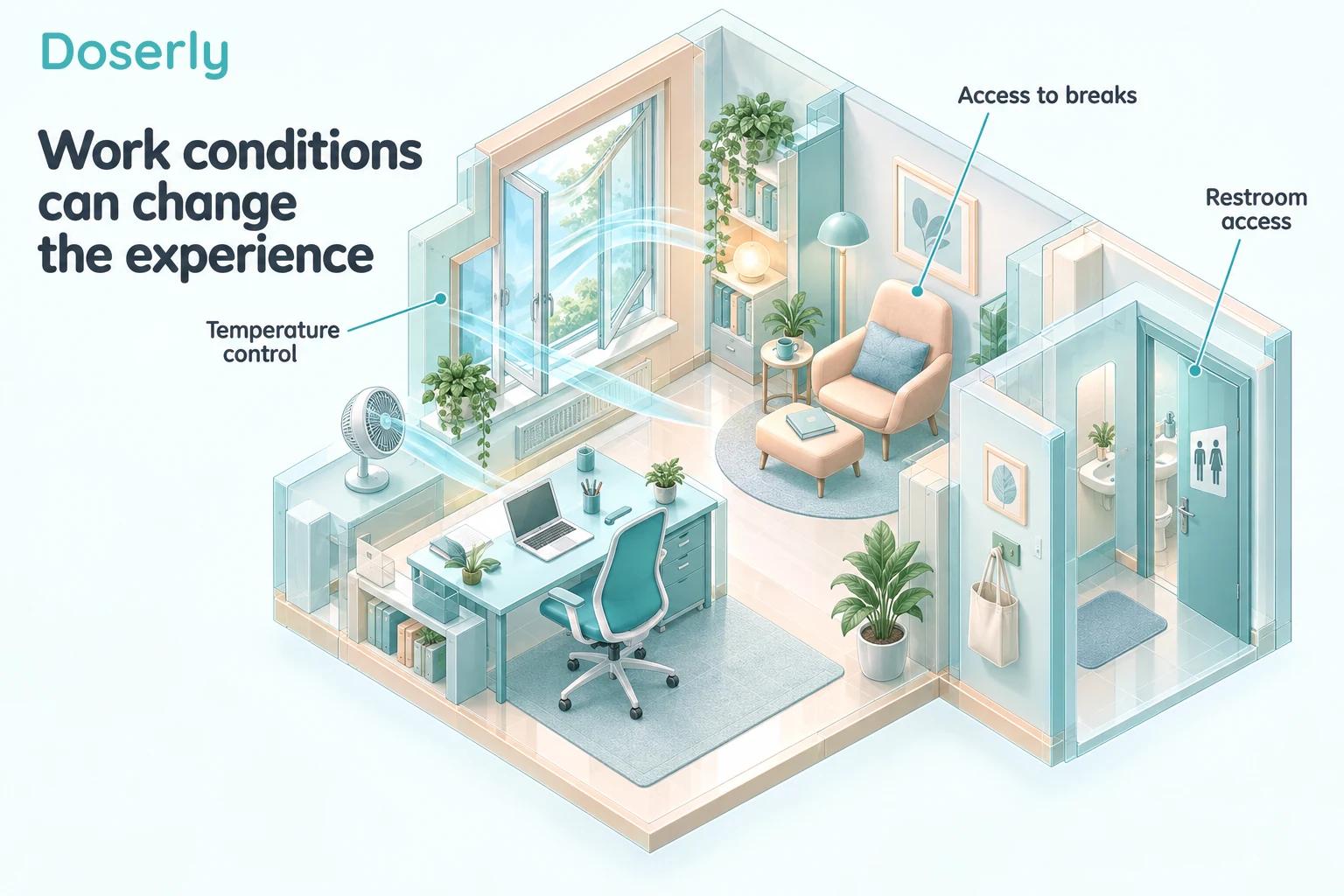
This is why support needs to reflect the job. A desk worker may be able to alter room temperature or take a brief break independently. A classroom teacher, production worker, driver, or clinician may need cover, a schedule adjustment, or a different practical arrangement. Advice to “just step away” can be unrealistic when someone is responsible for other people's safety.
The illustration shows possibilities, not a universal solution. A particular fan, chair, or office layout has not been proven to resolve menopause symptoms. The goal is to identify a barrier and test a feasible response.
Practical changes can also help people with other health needs. They need not depend on identifying or publicly labeling every employee going through menopause.
Symptoms, sleep, and concentration can overlap
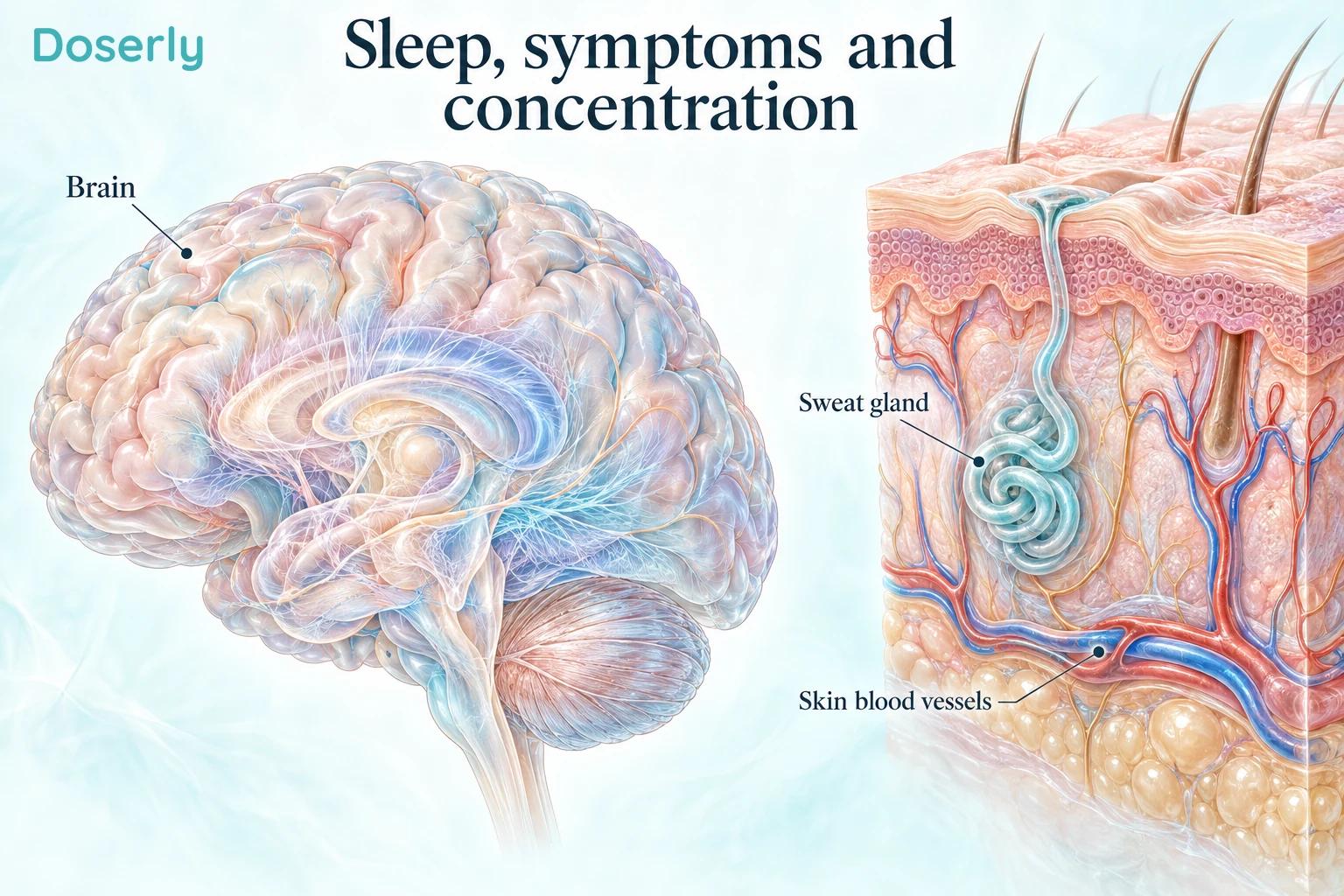
Night sweats and disrupted sleep may be part of the pattern a person brings to a consultation. Concentration difficulties can coexist with them. That does not mean every lapse at work is caused by estrogen, or that a scan would reveal a distinct “menopause brain” lesion.
A helpful history separates the experiences. Is the problem falling asleep, waking with heat and sweating, waking for another reason, or feeling sleepy despite adequate time in bed? Does concentration worsen after a particular shift? Are symptoms present outside work as well? These questions help a clinician decide what needs assessment.
Fatigue, mood changes, sleep disorders, medication effects, other illness, and demands outside work can overlap with menopause symptoms. A medical discussion should allow those possibilities rather than forcing all difficulties into one explanation. Severe, unusual, or progressive symptoms should not be dismissed as a normal transition.
The practical treatment target might be fewer disruptive awakenings, less interference from hot flushes, or improved ability to complete ordinary tasks. It should be something the person recognizes as meaningful.
The Doserly menopause in the workplace guide offers broader background. Its most useful role is to help organize the conversation, not to assign a diagnosis from a job description.
A trial shows why symptom burden and work outcomes must stay separate
MENOS@Work randomized 124 working women with problematic hot flushes and night sweats to a self-help cognitive behavioural therapy booklet or a no-treatment waiting list. The study's primary outcome was how problematic the symptoms felt. At six weeks, the adjusted between-group difference favored CBT by 1.49 points; at twenty weeks, by 1.09 points. Hardy and colleagues
The intervention also improved several symptom and sleep measures. Menopause-related presenteeism improved at twenty weeks, but other work-related outcomes did not differ between groups. It would therefore be inaccurate to describe the trial as proving fewer absences or preventing people from leaving employment.
The study was small, follow-up was relatively short, and the comparison group did not receive an alternative active intervention. At six weeks, 104 participants contributed to the primary-outcome assessment, and 102 did so at twenty weeks. These limitations matter when applying the findings widely.
The result does not imply that symptoms are imaginary or that someone should simply change their attitude. CBT is an intervention aimed at how symptoms are experienced and managed. It can be discussed alongside other options.
It also offers a model for evaluating improvement: name the outcome, assess it, and avoid claiming benefits that were not demonstrated.
Clinical care should fit the person, not an employer target
NICE generally recommends identifying perimenopause and menopause clinically in otherwise healthy people aged 45 or over with an appropriate symptom and menstrual history, without routine hormone testing. Younger people and those with atypical features may need a different assessment. A blood test is therefore not a universal gateway to having symptoms taken seriously. NICE menopause guidance
This is a clinical recommendation, not a statement about every employer's documentation process. Employment requirements and available support vary. A clinician can help describe functional needs where appropriate without turning a hormone concentration into a measure of competence.
Treatment choices may include HRT for suitable people, menopause-specific CBT, or other options matched to the symptoms and medical history. The person should be able to consider benefits, adverse effects, contraindications, and preferences. Medication should not be presented as a condition for remaining a valued employee.
A review also needs to ask whether treatment helps the life the person is trying to lead. Fewer hot flushes may be a useful result, but persistent poor sleep or a new unwanted effect still matters. Treatment outcomes and workplace conditions should be reviewed together where relevant, while keeping responsibility for prescribing with the clinical team.
Make a short record that answers a useful question
A private symptom record does not need to become another job. A few observations can be enough:
- The symptom and when it occurred, such as waking with sweating before an early shift.
- The task affected, such as difficulty maintaining attention during a long meeting.
- The context, such as heat, limited breaks, or an unusually demanding day.
- What changed and whether it helped, including treatment changes or practical adjustments.
The point is to make a pattern easier to discuss. It is not to calculate an unofficial diagnosis or prove causation from a few days of observations.
Choose a review interval that makes sense with the clinician or workplace contact. If several changes happen at once, acknowledge that it may be unclear which helped. If nothing improves, revisit the explanation instead of continuing an ineffective strategy indefinitely.
An illustrative example is a worker whose main difficulty is overheating during presentations. They might discuss symptom treatment clinically and request access to a cooler room at work. Another worker with disrupted sleep and early starts may need a different conversation. The examples are possibilities, not patient stories or guarantees.
Keep the record under the person's control. A clinical diary can include intimate health information that is unnecessary for a discussion about ventilation or break access.
Disclosure and support should not become another burden
A small Welsh NHS focus-group study involved fourteen women across four groups. Participants described varied experiences and management strategies. Some were reluctant to ask for support even when they thought the response would be positive. The researchers also noted that peer-support opportunities are only useful when staff can actually step away from their duties to attend. Hobson and Dennis
This qualitative study cannot tell us how common those experiences are across the entire workforce. It does make an easily missed point visible: having a policy or lunchtime session is different from being able to use it.
A person may choose to discuss menopause explicitly, speak only about a functional difficulty, or seek advice through occupational health or another confidential route where available. Preferences differ, and the working relationship matters.
A practical request can focus on the task: access to drinking water, a way to arrange cover for breaks, or a discussion of an environmental barrier. That is different from giving a manager access to an entire medication or symptom history.
Employers should avoid guessing who is menopausal, interpreting ordinary disagreement as a symptom, or treating support as a reason to reduce opportunities. The conversation should preserve the person's expertise and agency.
Judge support by whether it helps
For a worker, useful progress may mean sleeping more reliably, completing a difficult task with less disruption, or being able to request a break without embarrassment. For an organization, it may mean making a support process accessible and checking whether people can use it.
Those goals do not require assuming that all menopause symptoms need medication, or that a workplace adjustment can replace appropriate medical care. Different parts of the problem may need different responses.
Before a major career decision is made during a difficult period, it can be worth exploring the available clinical and workplace options. That is not a promise that a particular intervention will resolve every concern. It is a way to make the decision with more support and better information.
A hormone number cannot measure the significance of a disrupted night or the difficulty of an overheated shift. The person's account, the task involved, and the response to a considered plan provide a more useful basis for help.
Sources
- Faubion et al. Impact of menopause symptoms on women in the workplace (2023).
- Oude Hengel et al. Symptoms, work ability and health among4010 Dutch workers (2023).
- Hardy et al. MENOS@Work randomized self-help CBT trial (2018).
- The Menopause Society workplace consensus recommendations (2024).
- Hobson and Dennis. Experiences of menopause in the Welsh NHS workplace (2023).
- NICE NG23 menopause identification and management (2026).