
Supplements
October 16, 2026
Melatonin: a body-clock signal is not the same as a stronger sleeping pill
On this page
When melatonin does not seem to work, the obvious response can be to take more. That assumes the problem is insufficient sedation. Sometimes the more important issue is timing, the type of sleep problem, or whether the product contains the amount its label promises.
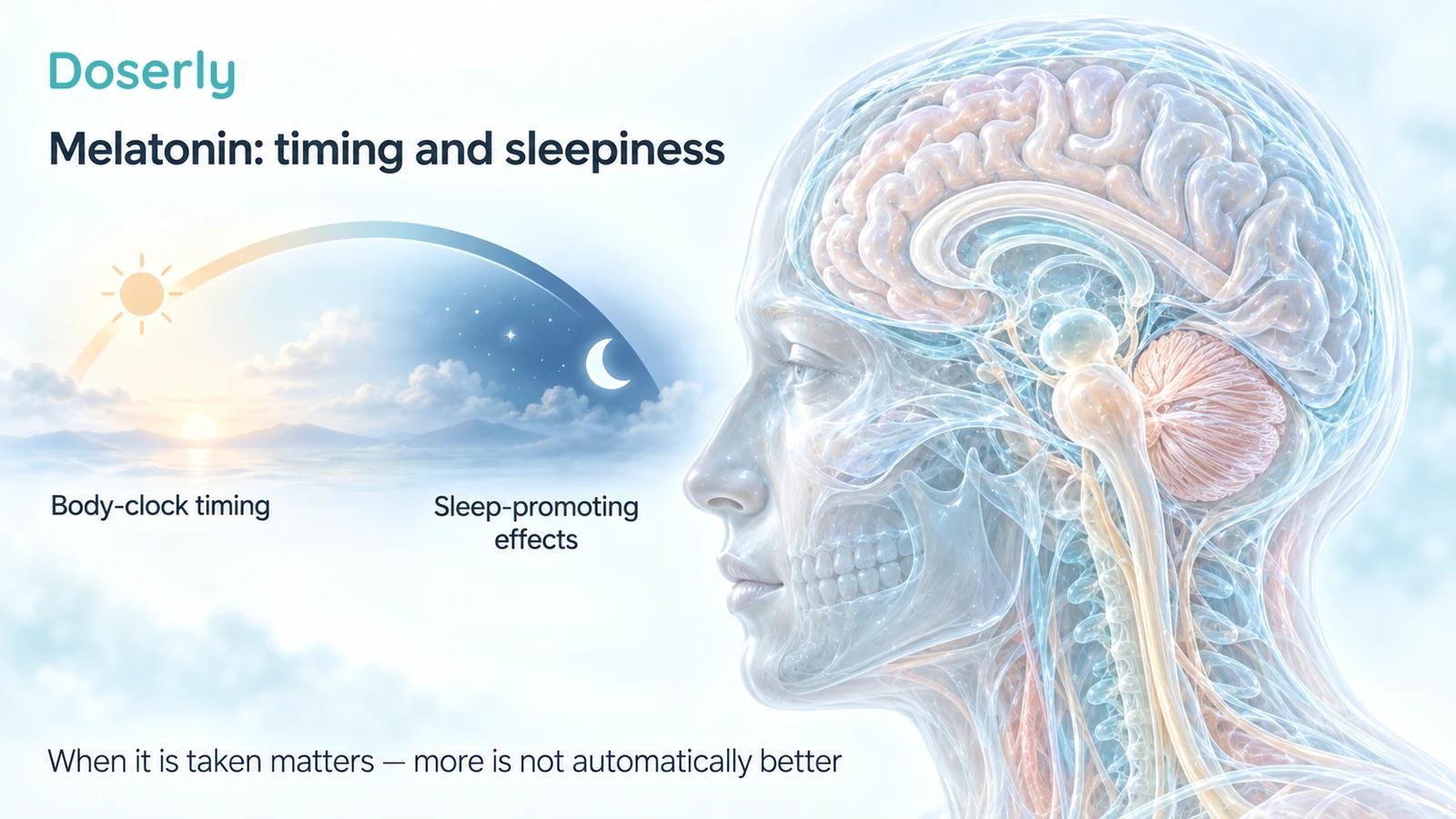
Melatonin participates in the body's timing system and can also promote sleepiness. Those effects overlap, but they are not identical. A person can fall asleep earlier without a study demonstrating that their internal clock shifted by the same amount.
A well-designed 2018 trial makes the distinction concrete. In people with delayed sleep-wake phase disorder and confirmed delayed melatonin timing, a low-dose, fast-release preparation combined with sleep scheduling improved sleep onset. The measured body-clock change in a smaller subset did not differ significantly from placebo. The result supports a particular clinical approach, not a universal instruction to take melatonin whenever sleep is difficult.
What “body-clock signal” means
The body produces melatonin in a daily pattern associated with darkness. Its timing helps signal biological night; exposure to light at night can suppress production. Supplemental melatonin introduces an external signal whose effect depends partly on when it arrives.
There are two useful questions. Does a dose make sleep more likely around the time it is taken? Does it shift the timing of the circadian system earlier or later over subsequent days? The first is a sleep-promoting effect; the second is a phase-shifting effect.
The NCCIH melatonin overview describes this timing role and the different conditions in which supplements have been studied. It does not imply that every difficulty falling asleep reflects too little melatonin.
That distinction matters for product expectations. A hormone involved in sleep timing is not simply a weak version of a sedative that becomes predictably better as the dose rises. The sleep problem and the timing of exposure need to fit the intended effect.
Delayed sleep timing differs from ordinary sleeplessness
Someone with delayed sleep-wake phase disorder may struggle to sleep at the socially required hour and struggle to wake for morning commitments. Their sleep can be better when they are allowed a later schedule. That pattern is different from every form of chronic insomnia, although symptoms can overlap.
The 2018 randomized trial did more than recruit people who said they were night owls. A sleep physician assessed the disorder, and researchers measured the timing of each person's own melatonin rise relative to their desired or required bedtime.
They used dim-light melatonin onset, or DLMO: the time at which melatonin in serial saliva samples crossed a defined threshold under controlled dim lighting. This is a marker of circadian timing, not simply a single “melatonin level.”
About one-third of those completing the phase assessment did not have the specified delayed relationship between DLMO and desired bedtime and were excluded from randomization. That is a major boundary on the result. Similar complaints about late sleep did not always correspond to the same measured circadian pattern.
The four-week trial tested a combined approach
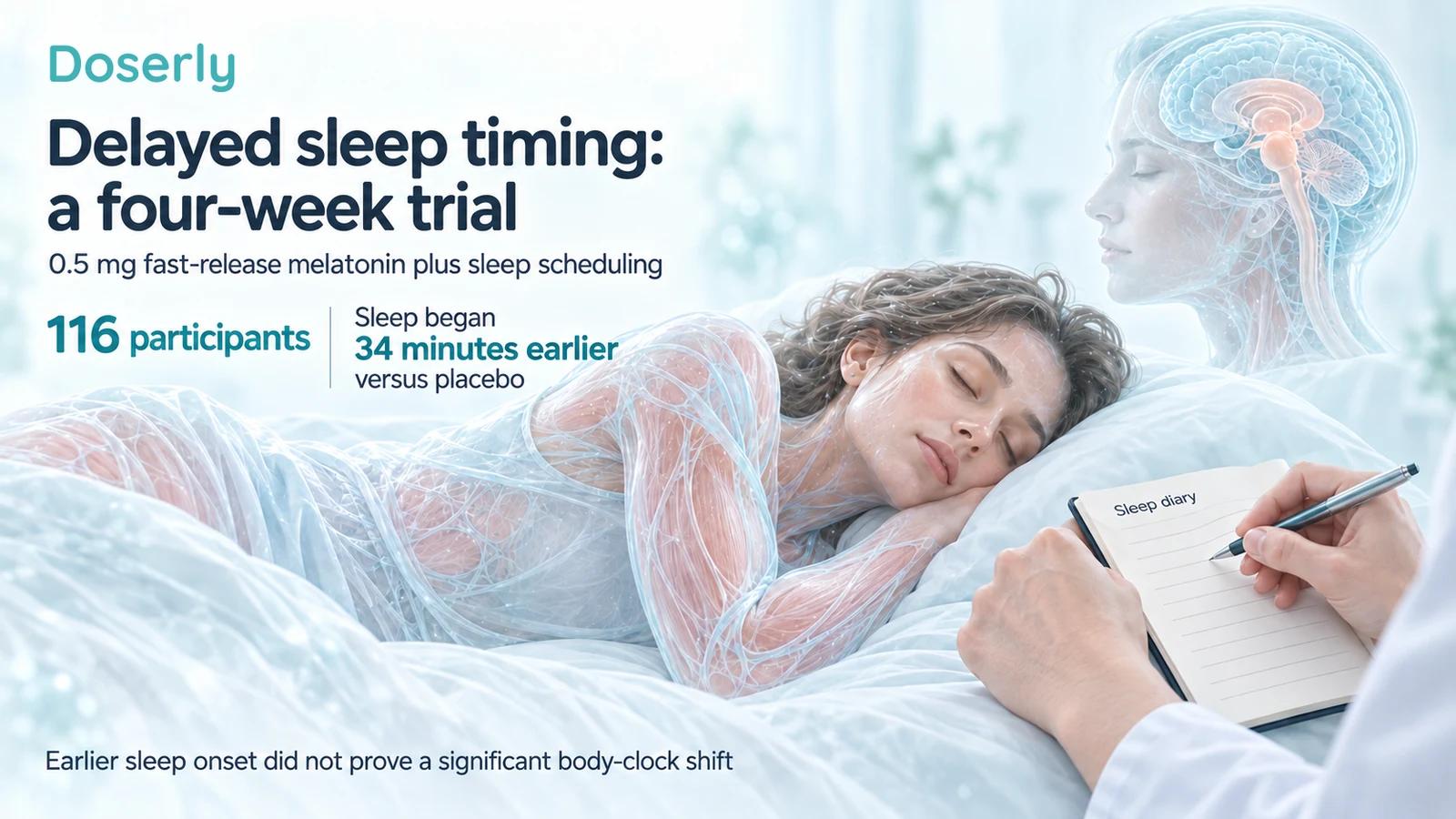
The trial randomized 116 participants; eligibility covered ages 16–65, and the mean age was approximately 29. Participants received 0.5 mg fast-release melatonin or matching placebo for four weeks.
Both groups followed behavioral sleep-wake scheduling. They were instructed to take the capsule one hour before a fixed desired bedtime and attempt sleep at that bedtime on at least five consecutive nights per week. The study therefore tested melatonin added to a scheduling approach, not an isolated capsule taken at any convenient hour.
Relative to baseline, actigraphy-measured sleep onset was 34 minutes earlier with melatonin than placebo, with a 95% confidence interval of approximately 8–60 minutes earlier. Sleep efficiency in the first part of the night and several reported sleep-related difficulties also improved.
Actigraphy uses wrist movement to estimate sleep and wake. It provides information beyond a person's recollection, but it does not directly measure sleep stages in the way laboratory polysomnography does. The finding concerns earlier sleep onset, not a demonstrated increase in deep sleep.
The 34-minute result is also an average treatment comparison. It does not mean every participant gained exactly 34 minutes, nor does it mean everyone slept 34 minutes longer. Sleep onset time and total sleep duration are different outcomes.
Earlier sleep did not prove a clock reset
Follow-up DLMO measurements were usable in 43 participants. The average shift was earlier in both groups and numerically larger with melatonin, but the between-group difference was not statistically significant.
That finding should be preserved even though it complicates an appealing explanation. The study demonstrated an earlier sleep-onset result. It did not demonstrate a significant circadian phase shift in the measured subset.
The smaller subset may have limited statistical power. The shared schedule could also have affected timing in both groups, and participants did not follow the intervention every night. These are plausible explanations for uncertainty, not permission to report the unconfirmed outcome as established.
The authors emphasized that their near-bedtime regimen was intended substantially to use melatonin's direct sleep-promoting effect. Other protocols designed specifically to shift circadian timing may use a different relationship to the person's biological night. Those approaches should not be merged into one rule based only on the number of milligrams.
Timing research explains why more is not automatically better
A controlled human phase-response study examined 0.5 mg melatonin in 34 healthy adults and compared its response pattern with an earlier 3 mg study using the same protocol. Participants underwent tightly controlled laboratory sessions with repeated circadian-phase measurements.
The timing of administration influenced whether the circadian rhythm advanced or delayed. When each amount was given at its most effective timing, the two doses produced similarly sized shifts. This was not a general insomnia treatment trial, and the 3 mg comparison came from a previously studied group.
The experiment nonetheless illustrates why dose alone is an incomplete description of an intervention. A larger amount is not guaranteed to produce a proportionally larger or more useful clock shift. The relevant timing is relative to a person's circadian phase, which is not identical for everyone at the same wall-clock hour.
This does not justify constructing a personal schedule from a laboratory graph. It explains why a clinician may first clarify the sleep pattern, desired outcome, light exposure, and formulation instead of simply escalating the dose.
Guidelines ask different clinical questions
The American Academy of Sleep Medicine's 2015 circadian-disorder guideline supported strategically timed melatonin for delayed sleep-wake phase disorder with a weak recommendation. “Weak” reflects uncertainty in the evidence and the need for individual clinical judgment; it does not mean the treatment has no possible value.
The society's 2017 chronic-insomnia guideline made a weak recommendation against melatonin for sleep-onset or sleep-maintenance insomnia in adults. Its melatonin assessment relied on a limited evidence base, including studies of 2 mg in older adults.
These recommendations are not a contradiction. They concern different diagnoses, study populations, and treatment objectives. Neither should be expanded into “melatonin always works” or “melatonin never works.”
For persistent insomnia, cognitive behavioral therapy for insomnia is an established initial treatment discussed in NIH guidance. A delayed body clock may require a different assessment and timing strategy. Sorting out that distinction is more useful than treating all sleeplessness as the same condition.
Formulation is part of the intervention
The delayed-phase trial used fast-release melatonin. A prolonged-release product has a different exposure profile. Gummies, liquids, tablets, and combination sleep products may also differ in their ingredients and actual content.
A label's milligram amount therefore tells only part of the story. Matching a trial requires attention to release characteristics, timing, and the accompanying behavioral intervention. A product marketed as “maximum strength” does not automatically reproduce a more effective version of the studied approach.
The Doserly melatonin guide provides broader ingredient context. When evaluating an individual trial, keep its exact formulation attached to the finding rather than transferring the result to any product that shares the hormone name.
The same caution applies to combinations. If a sleep gummy contains additional sedating ingredients, a change in alertness cannot automatically be attributed to melatonin. A multi-ingredient product also requires its own medication and safety review.
The label can be an uncertain measurement
A 2023 laboratory analysis tested 25 melatonin gummy products sold in the United States. Twenty-two were outside a ±10% margin of their labeled melatonin amount. One contained no detectable melatonin; among those containing it, the measured amount ranged from 74% to 347% of the label claim.
Those percentages describe that sample at that time. They do not establish the current content of every gummy brand or every production batch. The study also did not measure clinical sleep outcomes or determine the harm caused by a particular discrepancy.
Its relevance is practical: precise timing and low-dose trial results are difficult to reproduce when the actual amount is uncertain. It also makes comparing one person's experience with another's less straightforward than comparing the numbers printed on their bottles.
The tested study formulation had quality controls that may not map neatly onto retail products. A pharmacist can help review formulation and available quality documentation. Quality assurance improves confidence in contents; it does not establish that melatonin is the right treatment for the sleep problem.
Short-term reassurance has limits
The four-week delayed-phase trial reported no serious adverse events and no discontinuations because of adverse events. That is reassuring within its duration and selected population. It did not assess years of treatment or what happened after treatment stopped.
NCCIH describes headache, dizziness, nausea, and sleepiness among reported short-term adverse effects and notes uncertainty about long-term safety. People taking medicines should review possible interactions; those with epilepsy or taking blood thinners particularly need medical supervision. Pregnancy and breastfeeding safety data are limited.
Daytime sleepiness matters even if nights improve. An intervention that makes the morning commute unsafe is not a successful sleep strategy. Avoid driving or operating machinery when drowsy, and discuss persistent next-day effects rather than repeatedly increasing the amount.
Adult trial findings should not be turned into a dosing plan for a child. Keep melatonin, especially candy-like gummies, securely out of children's reach and sight.
A sleep record can answer a better question
Before changing products, it can help to document when sleep is attempted, when it seems to begin, when waking occurs, and how daytime functioning feels. Note differences between workdays and free days, as well as the timing and formulation of any supplement.
These observations can reveal whether the main concern is a consistently late schedule, difficulty sleeping despite adequate opportunity, repeated awakenings, or excessive daytime sleepiness. They do not diagnose a circadian disorder, but they make a clinical assessment more informative.
If melatonin is used within a treatment plan, define the outcome in advance. Earlier sleep onset, easier morning waking, and improved daytime functioning are more useful targets than feeling heavily sedated. Keep other changes visible so their contributions are not mistaken for a capsule effect.
The strongest lesson from the delayed-phase trial is the specificity of its success: selected participants, a defined fast-release preparation, deliberate timing, and a shared schedule. Melatonin can be useful in the right setting. Treating it as a stronger-and-stronger sleeping pill loses the part of the evidence that makes its use make sense.
Explore the research
- 2018 delayed sleep-wake phase trial — scheduling, earlier sleep onset, and the nonsignificant DLMO comparison.
- Human melatonin phase-response study — timing-dependent effects and dose comparison.
- 2015 AASM circadian-disorder guideline — strategically timed melatonin for selected disorders.
- 2017 AASM chronic-insomnia guideline — a different clinical question and weak recommendation.
- 2023 melatonin gummy analysis — measured contents versus labels.
- NCCIH melatonin overview — physiology, safety, and practical limitations.