
Longevity
October 17, 2026
A useful longevity checkup: which measurements can change your care?
On this page
A longevity checkup can produce an impressive report without changing anything important. The report may include dozens of blood markers, an estimated biological age and several colored risk scores. The harder question comes afterward: which result should change a decision, and what evidence suggests that decision will help?
That question gives preventive care a practical direction. A useful measurement can uncover a treatable problem, refine a risk estimate enough to alter treatment, identify a loss of function, or show whether an existing plan is working safely. Its value comes from the connection between information and action. Novelty, precision and a long list of reference ranges do not establish that connection by themselves.
This article uses current U.S. recommendations and international kidney guidance as examples, not as a personalized screening schedule. Local recommendations, symptoms, family history, existing conditions and prior results all matter. Someone with a new symptom needs an assessment of that symptom; a reassuring wellness panel should not substitute for it.
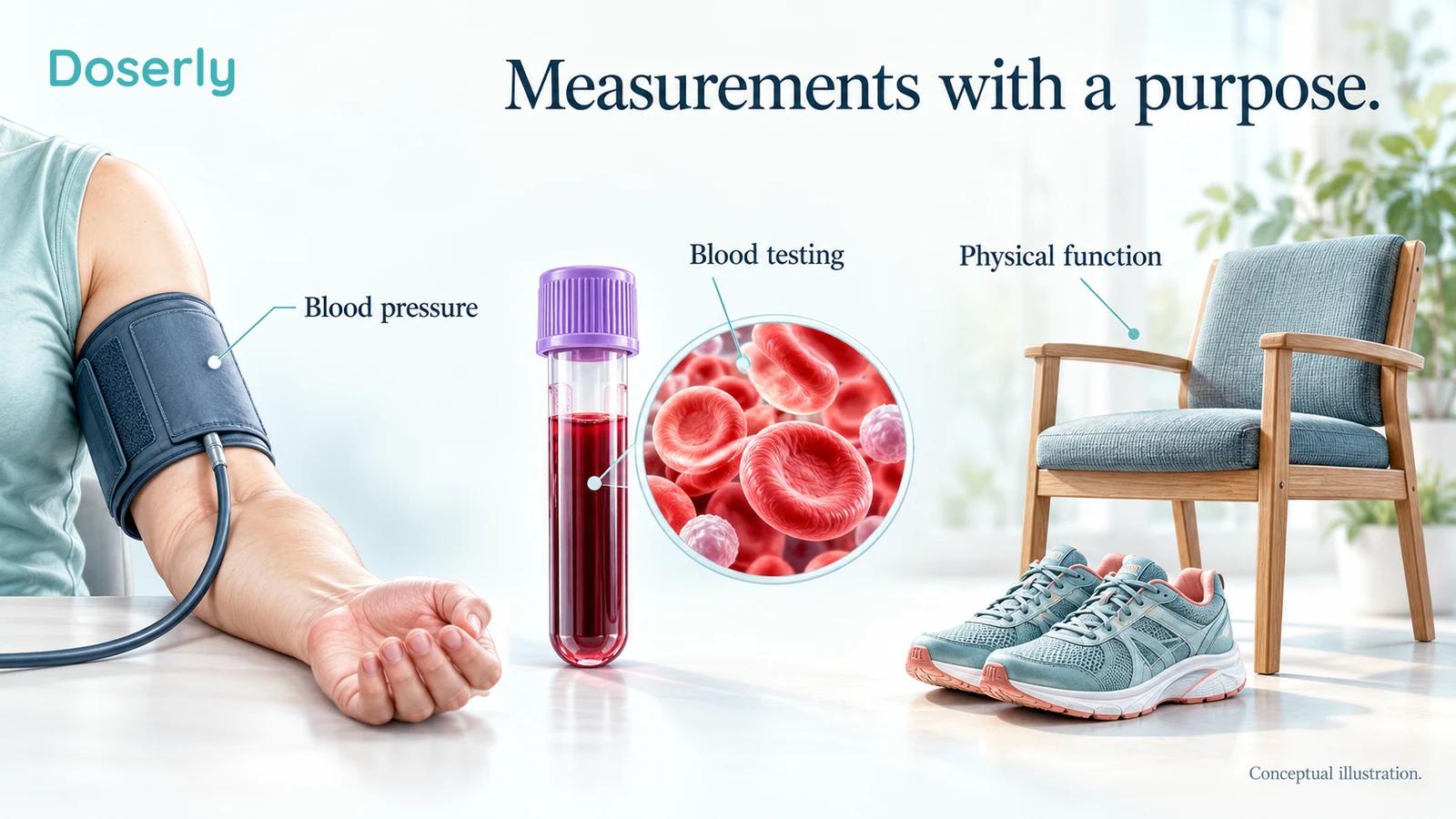
Conceptual assessment illustration; these examples connect measurements to care and do not prescribe a universal test panel.
Start with the decision, before choosing the test
Imagine two people offered the same expanded blood panel. One has established cardiovascular disease and uncertainty about whether lipid treatment is sufficient. The other has no relevant symptoms or risk factors and wants a younger biological-age score. The laboratory can measure the same molecule accurately in both people, but the result may have very different clinical value.
For the first person, an additional measurement might resolve a specific treatment question. For the second, it may create a number without an agreed response. This distinction is why a test should have a purpose before blood is drawn. Useful purposes include deciding whether to investigate further, selecting among reasonable treatments, or checking a known treatment effect.
A simple question makes that purpose concrete: what would we do differently if the result were high, low or unchanged? If every answer leads to the same advice, testing may add little at that moment. If an unexpected result would require confirmation, the plan should say so. If it could lead to an invasive procedure, that possibility belongs in the original discussion.
The same reasoning applies to repeating a test. Monitoring makes sense when enough time has passed for a meaningful change, when the result can affect management, and when the method can detect that change reliably. A calendar reminder alone does not establish the right interval.
Blood pressure: reliability comes before optimization
Blood pressure is useful because it sits within a well-developed pathway from detection to treatment. The U.S. Preventive Services Task Force recommends screening adults for hypertension and obtaining measurements outside the clinical setting to confirm a diagnosis before starting treatment. Home or ambulatory measurement helps distinguish sustained hypertension from a result specific to the clinic visit. USPSTF hypertension recommendation
That pathway depends on measurement quality. A reading taken with an unsuitable cuff or inconsistent technique can look precise while answering the wrong question. A clinician can help establish a validated device and a consistent approach to recording results. The aim is a representative pattern that can support a decision, not the lowest isolated value someone can obtain.
Wearable convenience does not automatically solve this problem. A 2025 American Heart Association scientific statement concluded that cuffless blood-pressure technologies were not yet sufficiently reliable for diagnosing hypertension or directing treatment. The organization emphasized validated upper-arm cuff devices for those purposes. A watch estimate and a clinical blood-pressure assessment should not be treated as interchangeable simply because both display millimeters of mercury. AHA cuffless-device statement
Treatment evidence also needs its population attached. SPRINT randomized 9,361 people at increased cardiovascular risk who did not have diabetes or a previous stroke. During the intervention period, the primary cardiovascular outcome occurred at 1.77% per year with intensive treatment versus 2.40% per year with standard treatment. Some adverse events, including hypotension, electrolyte abnormalities and acute kidney injury, were more frequent with intensive treatment. SPRINT final report
The trial supports taking blood pressure seriously. It does not turn its study target into a universal self-management instruction. The clinical decision includes overall risk, measurement conditions, symptoms, treatment tolerance and monitoring. A lower number is useful when it represents a safer, more effective plan for the person who has to live with that plan.
Lipids: standard results, particle information and inherited risk
A conventional lipid panel remains a starting point for cardiovascular risk assessment. Additional markers can help when they answer a more specific question. The 2026 ACC/AHA dyslipidemia guideline recommends measuring lipoprotein(a), or Lp(a), at least once in adulthood. It also supports selective apolipoprotein B, or apoB, testing to clarify residual risk in relevant clinical settings. These are different uses, not interchangeable additions to every repeated panel. 2026 ACC/AHA guideline announcement
LDL cholesterol describes the cholesterol carried within LDL particles. ApoB provides information about the number of atherogenic particles, including LDL and other apoB-containing particles. Cholesterol content and particle number usually track together, but they can disagree in an individual. The National Lipid Association's clinical consensus explains why apoB can clarify risk when that disagreement matters. NLA apoB consensus
This does not make a standard panel obsolete. It gives the clinician another way to examine a particular uncertainty. For example, someone receiving lipid-lowering treatment may have LDL cholesterol at the agreed goal while the overall metabolic context leaves concern about particle-related risk. ApoB may help decide whether the current treatment is enough. The 2026 guideline specifically discusses its use after LDL and non-HDL goals are reached in selected people with cardiovascular disease, diabetes, elevated triglycerides or cardiovascular-kidney-metabolic syndrome. Guideline recommendation on apoB
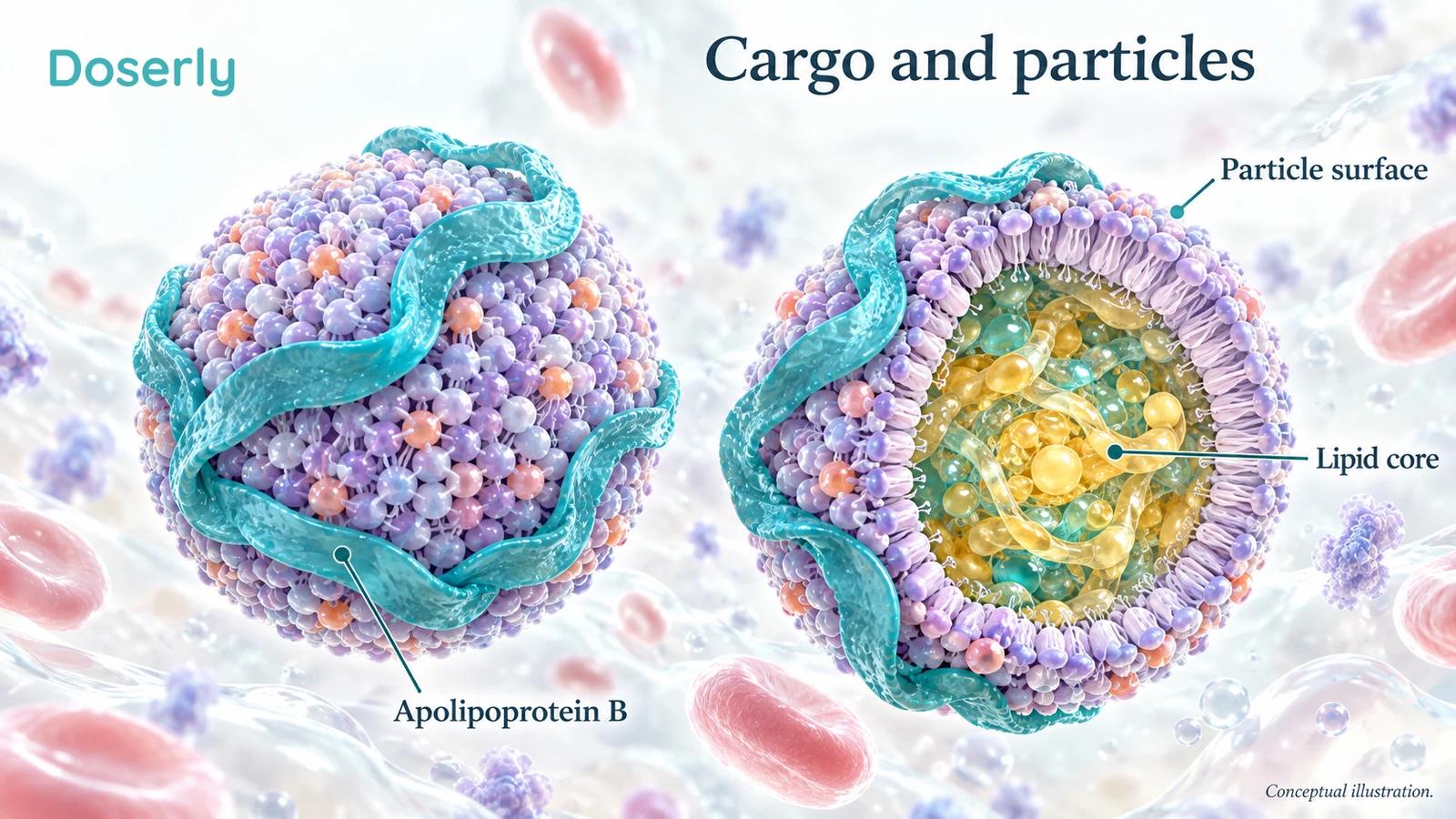
Conceptual lipoprotein structure; cholesterol content and particle number describe different features, with no patient values depicted.
Lp(a) answers a different question. Its level is largely genetically determined and generally stable, so repeated testing usually has less value than recognizing the risk information and incorporating it into care. A high result is not a verdict about how well someone has behaved. It can change the context for managing modifiable risk factors and discussing family history. 2026 ACC/AHA guideline announcement
The report should therefore explain the purpose of each lipid measure. Is this test estimating baseline risk, clarifying disagreement between measures, or monitoring a treatment? Those questions are more useful than assuming that every available lipid-related number needs its own independent optimization project.
Glycemia: connect detection to support that works
Glucose testing becomes useful when it identifies diabetes or an increased risk for which a practical response is available. In the United States, the USPSTF recommends screening nonpregnant adults aged 35 to 70 who have overweight or obesity, with individual considerations that may support earlier assessment. It also recommends offering or referring people with prediabetes to effective preventive interventions. USPSTF prediabetes and diabetes recommendation
The response matters as much as the label. In the Diabetes Prevention Program, 3,234 adults with elevated fasting and post-load glucose were randomized to an intensive lifestyle program, metformin or placebo. Over an average of 2.8 years, diabetes incidence was 4.8, 7.8 and 11.0 cases per 100 person-years, respectively. Those are rates, not the percentage of all participants diagnosed during the entire trial. The study demonstrated prevention or delay of diabetes in a selected high-risk population. Original DPP trial
An abnormal screening result can therefore be an entry point to support, rather than merely a warning on a dashboard. The useful conversation includes access to an appropriate program, barriers to participation and the role of medication when clinically indicated. It should also distinguish preventing diabetes from proving that a treatment extends life in people with normal glucose regulation.
HbA1c is convenient, but its interpretation is not independent of blood biology. Altered red-cell survival, some anemias and hemoglobin variants can affect results; kidney failure and other conditions can also complicate interpretation. A mismatch between HbA1c and other glucose information deserves assessment rather than automatic escalation of treatment. NIDDK explanation of HbA1c limitations
The broader principle is to use the test that answers the clinical question in that person. More frequent sampling does not repair a misleading measure. Nor does a pleasing glucose trace establish that all aspects of metabolic health have improved. The result needs to be interpreted alongside the diagnosis, treatment and outcomes being pursued.
Kidney health: two measurements can tell different stories
Kidney assessment illustrates why a familiar blood result may leave an important gap. Estimated glomerular filtration rate, or eGFR, describes filtration using a calculation based on blood markers and other inputs. Urine albumin testing examines a different feature: whether albumin is appearing in urine in a way that may signal kidney damage.
KDIGO's 2024 guideline recommends using both urine albumin and assessment of GFR in people at risk for, or with, chronic kidney disease. It also emphasizes repeating incidentally abnormal results to confirm the finding and establishing chronicity rather than assuming one unusual result represents chronic disease. The guideline remains the current global standard while a focused treatment update is underway. KDIGO guideline and current status, KDIGO summary of detection recommendations
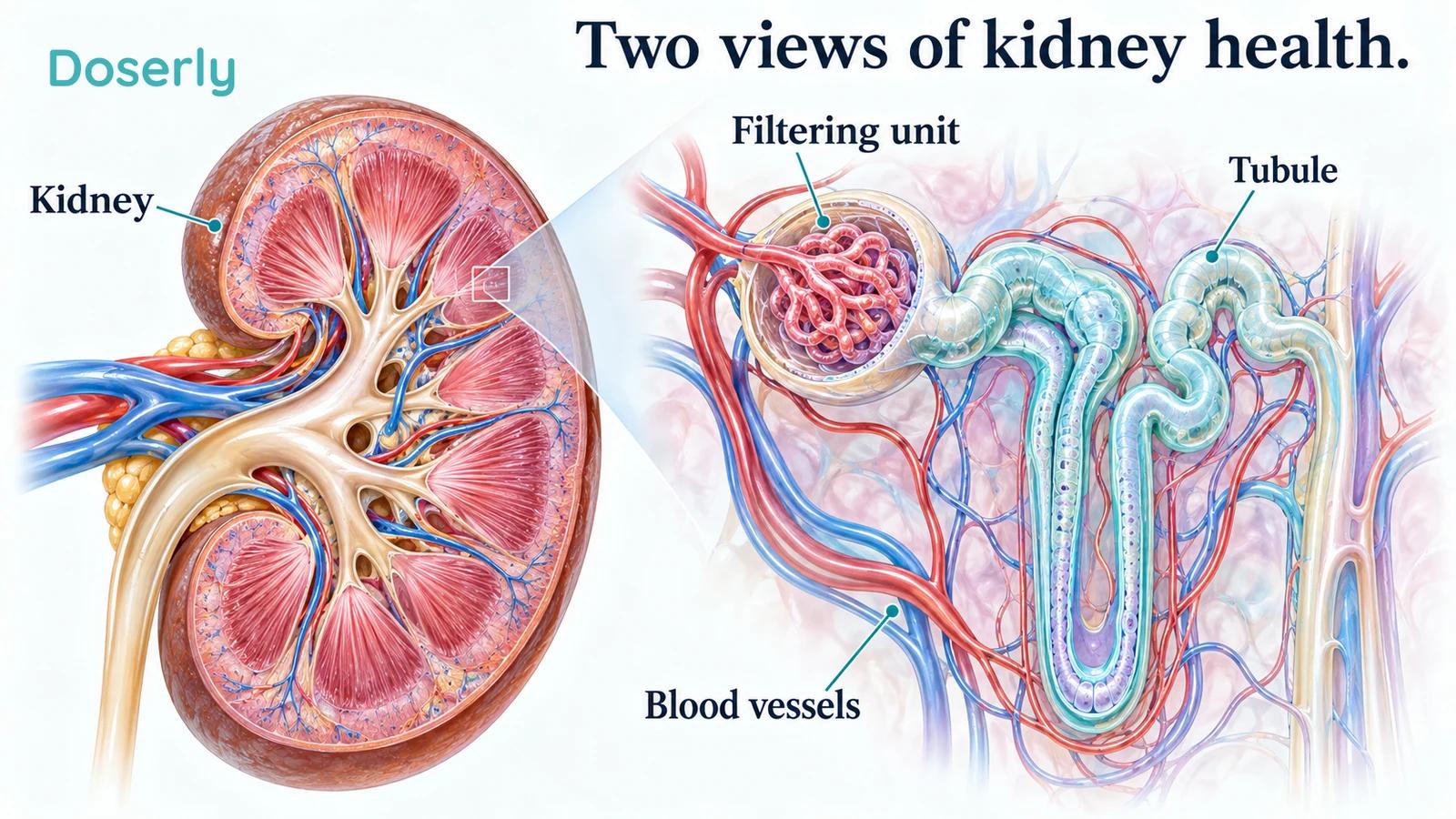
Conceptual kidney anatomy; filtration and urine albumin testing provide different information, with no diagnostic result depicted.
The reason to identify kidney disease is not to add another age-related score. A confirmed finding can change risk assessment, medication choices, monitoring and referral. Conversely, a single unexpected value may need clarification before it changes someone's understanding of their health. Clinical context determines which of those situations applies.
For a checkup, the useful question is whether kidney assessment fits the person's risks and whether both relevant dimensions have been considered. The answer need not be the same for a healthy person without risk factors and someone with diabetes, hypertension or known kidney disease. A universally expanded package obscures those differences.
Function deserves a place beside the laboratory report
A person can have reassuring blood results while finding it harder to rise from a chair, climb stairs or walk outside confidently. Those changes matter directly. They affect independence and participation, not just an estimate of future risk. Asking about them creates a different kind of baseline: what the person can actually do and what they want to preserve.
The CDC's STEADI resources include standardized chair-stand, balance and Timed Up and Go assessments for older-adult fall prevention. These tools examine aspects of strength, endurance, balance and mobility. Their value lies in the clinical assessment and response around them, not in converting one performance into a biological-age label. CDC STEADI clinical resources
Standardization matters here too. Chair height, instructions, assistance and the testing environment can affect interpretation. Someone who needs support should not remove it to compete with an online benchmark. A clinician or appropriately trained professional can choose an assessment that is safe and relevant, including how to interpret a result affected by pain or disability.
There is also human trial evidence for addressing function. The LIFE trial enrolled 1,635 older adults who were sedentary and at risk for mobility disability. A structured physical-activity program reduced major mobility disability compared with health education: 30.1% versus 35.5% over an average of 2.6 years. This supports a practical outcome in that population, rather than a claim that a particular test score reverses aging. LIFE randomized trial
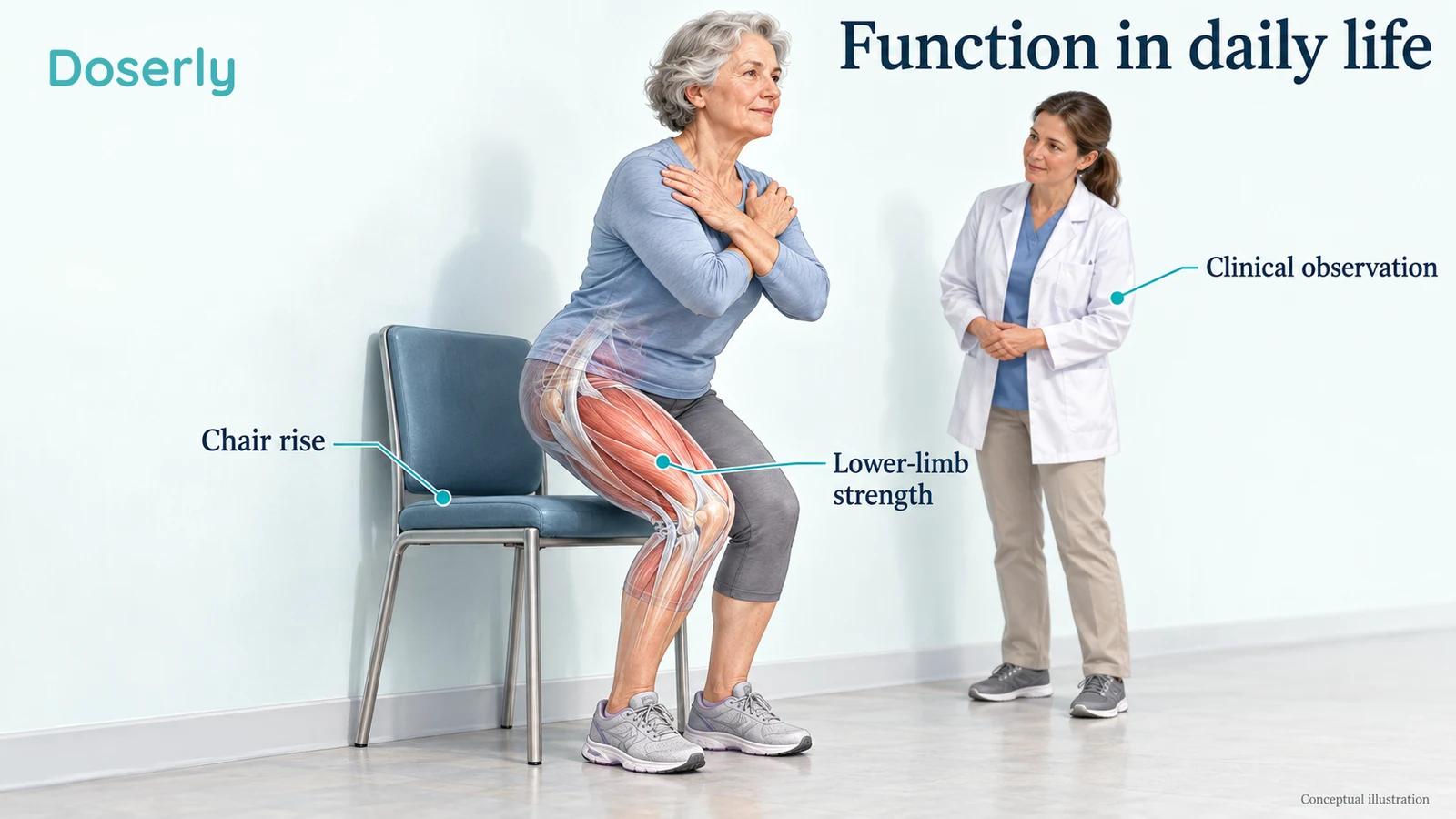
Conceptual movement assessment; the illustration shows observation of function, not a performance score or treatment outcome.
A useful follow-up can be expressed in ordinary language: getting up more comfortably, walking to a local destination, or feeling safer during everyday movement. The measurement helps describe the problem and evaluate the plan. It should remain connected to the activity that made the assessment worthwhile in the first place.
Screening works through a complete pathway
Preventive screening has an unusually demanding job. It examines people without symptoms, so benefits must outweigh the consequences of false alarms, overdiagnosis and follow-up procedures. Finding an abnormality is only the beginning of the evidence question. What matters is whether the entire pathway produces a better outcome for the population being screened.
Osteoporosis screening provides a concrete example. The 2025 USPSTF recommendation supports screening women aged 65 or older and younger postmenopausal women whose clinical risk assessment indicates increased fracture risk. For men, it finds the screening evidence insufficient; that is not the same as saying no man should receive bone assessment. Known osteoporosis, fragility fractures and secondary causes require their own clinical approach. USPSTF osteoporosis recommendation
The intended outcome is fewer fractures through appropriate evaluation and management. A bone-density result filed away without follow-up does not deliver that pathway. Similarly, the decision to test should account for the person's history rather than treating a commercial body-composition scan as a complete substitute for a fracture-risk assessment.
Colorectal screening is another example of a defined pathway, with choices about method and subsequent evaluation. U.S. recommendations support screening average-risk adults from age 45 through 75, with selective decisions at ages 76 to 85 based on factors including health, prior screening and preferences. An abnormal stool-based result requires appropriate follow-up rather than being treated as a finished screening episode. USPSTF colorectal screening recommendation
These examples are not a complete preventive-care menu. They show why keeping established screening current can be more consequential than adding an unfamiliar biomarker. A checkup should establish which recommended services are due, what has already been completed, and who will act on an abnormal result.
More detection is not automatically more benefit
Whole-body imaging can feel like the logical conclusion of comprehensive prevention: look everywhere before anything becomes a problem. But a more extensive search can also uncover findings that are unclear or would never have caused harm. Those findings may lead to more imaging, procedures, expense and anxiety without improving the outcome that motivated the scan.
The American College of Radiology states that evidence is insufficient to recommend total-body MRI screening for people without relevant symptoms, risk factors or a family history suggesting disease. Its statement notes the absence of documented evidence that this strategy prolongs life and the potential for unnecessary follow-up. This is a statement about broad screening, not about MRI ordered for a specific medical indication. ACR statement on total-body MRI screening
A useful discussion therefore includes the possibility of an ambiguous result. Who interprets it? Which findings justify further investigation? What happens if different specialists disagree? A test package may advertise the initial scan while leaving those decisions to the person receiving the report.
The same decision test can be applied to an aging score or an expanded molecular panel without assuming all such technologies are identical. What has been validated: repeatable measurement, prediction of future events, or better outcomes when care is guided by the result? Those are separate achievements. Evidence for the first does not automatically establish the last.
Ask how much an answer changes the odds
Risk estimates need a time horizon and an outcome. A statement about the chance of a heart attack over ten years is different from a statement about the chance of any illness over a lifetime. A report that omits those details makes comparisons difficult, even if it uses an apparently precise percentage.
Consider a hypothetical treatment that reduces an event risk by one quarter. If the untreated risk is 20% over a specified period, that reduction would bring it to 15%, an absolute difference of five percentage points. If the untreated risk is 4% over the same period, it would fall to 3%, an absolute difference of one point. These are illustrative calculations, not estimates for a particular treatment or person.
This is why baseline risk can change the practical meaning of the same laboratory value. It is also why a treatment discussion should include potential harms and burdens, not just a relative reduction from a study headline. Two people may reasonably value the same possible benefit differently when daily treatment, side effects, costs or other priorities enter the decision.
A test that moves someone across a meaningful decision boundary can be useful. A test that adds another decimal place without changing any reasonable choice may be less useful. Asking for the expected consequence of the result helps keep the assessment connected to care.
Leave with a plan that can survive the next appointment
A useful checkup ends with a manageable set of decisions. That might mean confirming a blood-pressure pattern, completing an overdue screening pathway, clarifying lipid risk, or getting help with declining function. It can also mean deciding that another test would not change care right now. The explanation should be clear enough to revisit later.
Preparation can be simple: bring prior results, a current medication and supplement list, relevant family history, and the changes in daily life that concern you. Existing information may answer a question that a new test would otherwise duplicate. It also helps distinguish a new finding from a longstanding pattern.
For each agreed next step, establish its purpose, who is responsible and how the result will be reviewed. If treatment changes, ask what would count as benefit and what would signal a problem. If a result needs confirmation, record that uncertainty rather than turning it prematurely into a diagnosis. If no action is needed, understanding why can be reassuring in its own right.
The most useful longevity checkup is one that improves the next decision about health. Its success is visible in care that is better targeted, problems that receive appropriate follow-up, and abilities that remain meaningful in everyday life. The report supports that work; it does not replace it.