
Supplements
October 16, 2026
Lion’s mane and brain fog: the gap between a mechanism and a useful trial
On this page
Lion’s mane has an unusually persuasive scientific story. A distinctive edible mushroom contains compounds studied for effects on nerve-growth signaling. Small human trials report changes in cognitive tests. It is easy for those observations to become a much larger promise: take a capsule, grow healthier neurons, and clear brain fog.
The evidence does not yet support that chain of certainty. Human studies are small, use different preparations, and enroll people whose problems are not interchangeable. The most familiar trial involved older adults with mild cognitive impairment, not a general population with fatigue or difficulty concentrating. A younger-adult pilot produced mixed findings, including unfavorable memory results.
There is enough here to justify careful research. There is not enough to treat lion’s mane as a proven remedy for brain fog, a dementia-prevention strategy, or a way to repair a human brain. The distinctions become clearer when the biology, products, and actual trial outcomes are examined separately.
“Brain fog” does not identify one condition
Someone using this phrase might mean slow thinking, distractibility, word-finding difficulty, forgetfulness, or mental fatigue. Those experiences can overlap, but a study must define which problem it intends to improve.
Mild cognitive impairment, or MCI, is a clinical description involving more difficulty with memory or thinking than expected for age, while everyday independence is largely preserved. It is not synonymous with occasional poor concentration. Nor does every person with MCI develop Alzheimer’s disease.
The National Institute on Aging describes multiple contributors to memory problems, including sleep difficulties, medication effects, depression, thyroid problems, and low vitamin B12. A supplement trial in one selected group cannot tell someone which explanation applies to them.
This is why the population in a paper matters as much as the ingredient. Improving a test score in older adults with diagnosed MCI would be useful evidence for that setting. It would not automatically establish improved concentration in a healthy student, recovery after an infection, or treatment of a progressive neurological disorder.
What the often-cited MCI trial found
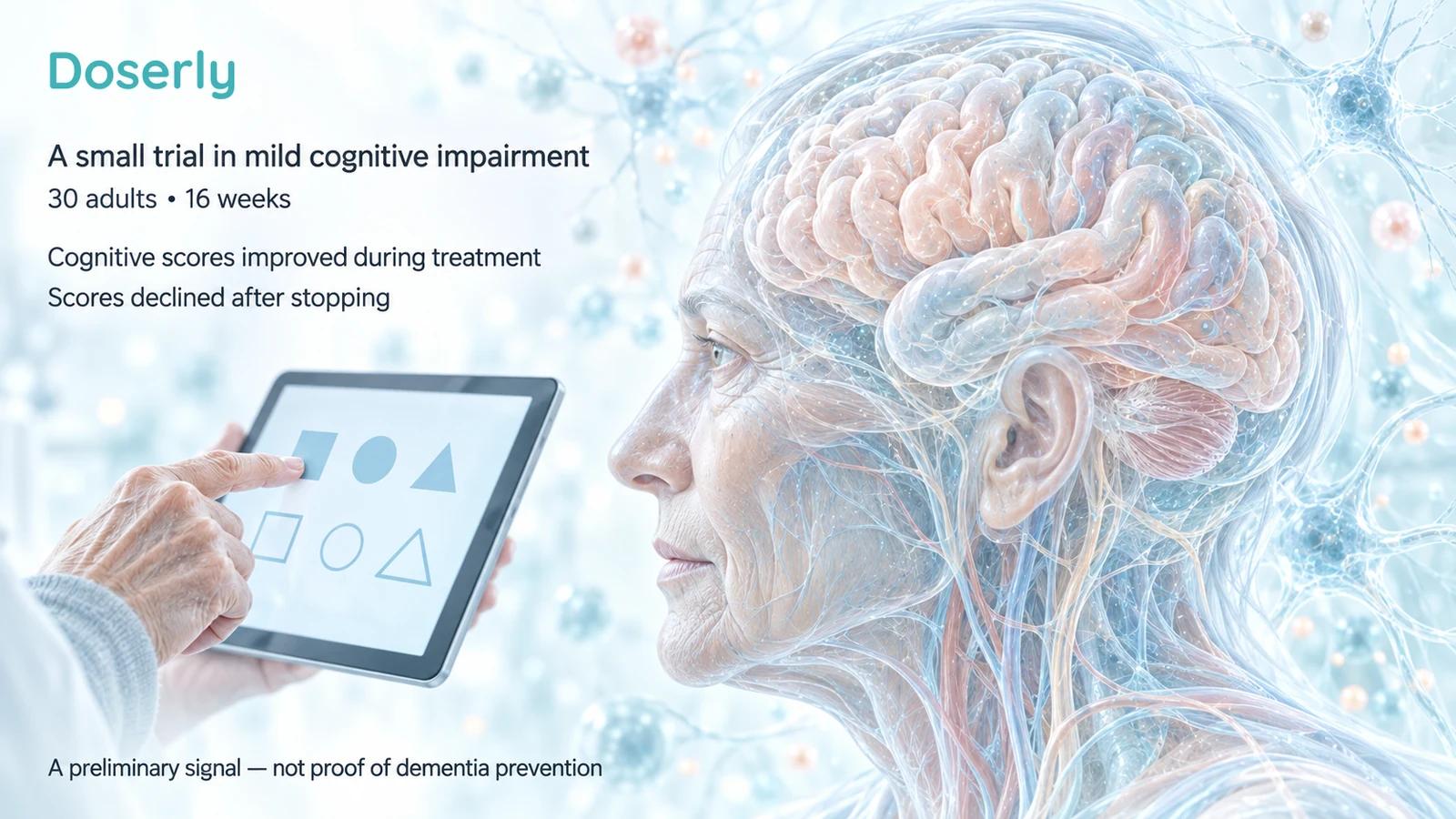
The 2009 placebo-controlled trial enrolled 30 Japanese adults aged 50–80 with mild cognitive impairment. They were randomized into two groups of 15. The active group took four 250 mg tablets three times daily for 16 weeks; the tablets contained 96% dried mushroom powder.
That is 3 g of tablet product daily, containing approximately 2.88 g of mushroom powder. It is a description of the tested preparation, not an established dose for every extract sold today.
Researchers assessed cognition using a scale based on the Revised Hasegawa Dementia Scale. Scores were higher in the mushroom group than placebo at weeks 8, 12, and 16. After treatment stopped, the active group's scores declined during the four-week follow-up.
That pattern is worth investigating. It does not prove a lasting change in disease progression. The study did not establish reduced dementia incidence, preservation of independence over years, or a benefit in people without MCI. With only 15 participants per group, estimates are also vulnerable to sampling variation and need replication.
The post-treatment decline should not be turned into a claim of withdrawal damage or dependence. The observation was a decrease in scores after discontinuation. It does not establish a withdrawal syndrome, a result worse than an untreated trajectory, or a need to take the supplement indefinitely.
The younger-adult pilot was not uniformly positive
A 2023 randomized pilot studied 41 healthy adults aged 18–45. It tested 1.8 g of a lion’s mane preparation, looking both at performance one hour after a single dose and after 28 days of supplementation.
The attention-grabbing result was faster performance on the Stroop task after the acute dose. This task challenges a person's ability to handle competing information. The study also reported a possible reduction in subjective stress after repeated use, but the overall main-effect result on that measure narrowly missed the conventional significance threshold, with P = 0.051.
The rest of the paper matters. Immediate word recall was less accurate after lion’s mane in an acute comparison. In the longer comparison, the placebo group improved on delayed word recall. The investigators did not find treatment effects on the other individual task outcomes or the global cognitive-domain scores.
That mixture does not prove lion’s mane harms memory generally. A small exploratory study with many tests can produce unstable positive and negative findings. It does mean that selecting the faster Stroop result while omitting unfavorable or null outcomes gives a distorted impression of the evidence.
For a person seeking dependable help with everyday concentration, the unanswered question is larger than whether one laboratory task changed at one time point. A useful trial should show a reproducible improvement in a defined problem, ideally with evidence that the change matters in daily life.
A longer Alzheimer’s pilot needs careful reading
A 2020 pilot study tested an erinacine A-enriched mycelium preparation in patients who already had mild Alzheimer’s disease. Forty-nine participants were randomized, and 41 completed the 49-week study.
The preparation differed substantially from the dried-powder tablets in the earlier MCI trial. Participants received three 350 mg capsules daily, with the mycelium standardized to 5 mg of erinacine A per gram. These details do not allow an ordinary fruiting-body powder to inherit the result.
The paper reported a significant between-group difference in instrumental activities of daily living at week 49. However, the full text states that between-group differences on the Cognitive Abilities Screening Instrument and Mini-Mental State Examination were not statistically significant. Some favorable descriptions involved changes within one group from its own baseline.
This distinction is fundamental. If the active group changes significantly and the placebo group does not, it does not automatically follow that the groups changed significantly differently. The direct comparison is what tests the treatment advantage.
Despite “prevention” appearing in the paper's title, the participants already had mild Alzheimer’s disease. The trial therefore cannot demonstrate prevention of the disease in healthy people. Its small size, attrition, numerous outcomes, and specialized product make it preliminary evidence rather than an established clinical treatment.
Why nerve-growth findings are interesting—and incomplete
One frequently discussed mechanism concerns nerve growth factor, or NGF, a protein involved in neuronal biology. A primary laboratory study examined lion’s mane extracts in cultured human astrocytoma cells and related experimental systems. The extract increased NGF-related measures, and conditioned culture medium promoted neurite outgrowth in PC12 cells. The paper also included mouse work.
These are preclinical observations. “Human cells” means cells of human origin studied in a laboratory; it does not mean a clinical trial in people. PC12 cells are also an experimental cell system, not a person recovering memory after swallowing a supplement.
The chemical story is more nuanced than a simple “hericenones grow nerves” slogan. In that particular study, the tested hericenones C, D, and E did not reproduce the NGF gene-expression effect. An extract's activity cannot automatically be assigned to whichever compound is most prominent on a product label.
Even when an experimental compound changes growth-related signaling, several questions remain: how much is absorbed orally, what reaches relevant tissue, whether the exposure resembles the experiment, and whether a meaningful clinical outcome improves. A mechanism cannot supply those missing measurements.

“Lion’s mane” does not describe a standardized intervention
The visible mushroom is its fruiting body. Mycelium is the network of fungal filaments. Studies have used different materials, extraction methods, and enriched preparations. Milligrams of one product do not necessarily equal milligrams of another in composition or biological exposure.
An extract ratio, beta-glucan figure, or claim about a named compound may help characterize a product. None independently establishes that it matches a cognitive trial. Even a precisely manufactured product can lack evidence for the outcome a customer hopes to improve.
The useful comparison is therefore between the label and the methods section: species, material, preparation, standardization, amount, and other ingredients. If these are missing, it becomes difficult to know which study, if any, is relevant.
The Doserly lion’s mane guide offers broader ingredient context. Keep the guide's general discussion separate from the much narrower question of whether the exact product and population in a particular trial match an intended use.
What a stronger brain-fog trial would look like
A convincing study would first define the symptom group. Healthy adults under high cognitive load, people with MCI, and people with persistent post-illness symptoms should not be pooled merely because all report difficulty thinking.
It would then specify a reproducible preparation and a primary outcome before collecting results. That prevents a long list of tests from becoming a search for whichever result happens to look best. Secondary measures could help explain the finding, but they would not replace a failed primary endpoint.
Duration and function matter too. A transient laboratory-task change is different from sustained improvement in work, study, medication management, or other daily activities. Follow-up after stopping could distinguish a short-lived symptomatic effect from something more durable without assuming either in advance.
Finally, replication should involve enough participants to estimate the size of benefit and detect common harms reliably. Independent confirmation is particularly valuable when the product's manufacturer supplies the intervention or is involved in the research. These are practical requirements for a useful recommendation, not demands that every early pilot answer everything.
Safety evidence remains limited
The older MCI trial reported no adverse laboratory findings. That is reassuring within a small, short study, but it cannot establish that all preparations are safe for all people.
The enriched-mycelium Alzheimer’s pilot reported four withdrawals associated with abdominal discomfort, nausea, or skin rash. The authors also noted the difficulty of attributing symptoms in people taking multiple medicines. Reporting these events does not prove a common serious risk; omitting them would overstate tolerability.
A marketed supplement also has a separate quality question. FDA explains that U.S. dietary supplements are not approved for safety and effectiveness before sale in the same way as medicines. Clear ingredient identification and manufacturing documentation matter, but they cannot substitute for a clinical benefit.
People taking medicines or managing a neurological condition should discuss the actual product with their clinician or pharmacist. Small trials do not establish safety for pregnancy, breastfeeding, children, or every medication combination.
Keep the person’s problem ahead of the product
Persistent or progressive changes in thinking deserve assessment, especially when they interfere with everyday tasks. A mushroom trial should not delay investigating sleep problems, medication effects, nutritional issues, or other treatable contributors.
For a clinician discussion, concrete observations are more helpful than “my brain feels off”: when the problem began, whether it fluctuates, what tasks are harder, how sleep has changed, and which medicines or supplements changed around the same time. These details help define the question that treatment should answer.
If a supplement is tried after that discussion, record the exact formulation and the outcome being watched. Avoid interpreting every better day as proof of nerve growth or every worse day as evidence of withdrawal. Personal experience can guide a conversation, but it cannot identify a cellular mechanism.
Lion’s mane is a legitimate research topic with preliminary human signals and substantial gaps. The most useful promise the evidence currently supports is a reason for better trials—not a reliable prediction that a particular capsule will clear brain fog.
Explore the research
- 2009 MCI randomized trial — 30 participants, 16 weeks, and follow-up after stopping.
- 2023 young-adult pilot — favorable, null, and unfavorable cognitive outcomes.
- 2020 enriched-mycelium Alzheimer’s pilot — between-group versus within-group findings.
- NGF-related laboratory study — preclinical mechanisms and limits of compound attribution.
- NIA memory problems guidance — assessment and possible contributors.
- FDA supplement questions and answers — product and regulatory context.