
Peptides
October 16, 2026
Lente or NPH insulin for a diabetic dog?
On this page
When a dog is diagnosed with diabetes, the first treatment discussion often includes an unfamiliar insulin name. Owners may hear about porcine lente, NPH, different concentrations and different syringes, then wonder whether one choice is clearly best.
A randomized study of thirty newly diagnosed diabetic dogs found improvement with both lente and NPH insulin over twelve weeks. Good overall control was recorded in nine of fifteen dogs receiving lente and eleven of fifteen receiving NPH; the difference was not statistically significant. 2018 comparison
That is useful evidence for having more than one reasonable option. It does not mean every dog will respond identically, or that owners can substitute products without a new veterinary plan. The practical choice includes the dog's glucose pattern, other illnesses, feeding routine, monitoring and the exact device used to deliver treatment.
What insulin is doing for the dog
Insulin helps regulate the movement and storage of glucose and other fuels. When there is not enough effective insulin, glucose can remain excessive in the blood while the body breaks down stored tissue. Increased thirst, urination and weight loss are common reasons owners first seek help. AVMA explanation of diabetes
Treatment aims to relieve those clinical problems while avoiding glucose that becomes too low. A successful plan therefore cannot be judged only by finding the lowest possible reading.
The 2026 AAHA guidance describes diabetic dogs as insulin deficient and identifies both porcine insulin zinc suspension and NPH as good first-choice options. It also discusses other formulations, reflecting that treatment selection continues to evolve. AAHA insulin guidance
A dog's treatment needs should not be inferred from a diabetic cat's experience. Feline remission stories can be encouraging, but the species differ in their typical clinical course and treatment priorities. The dog comparison discussed here evaluated ongoing control, not a programme designed to make dogs stop needing insulin.
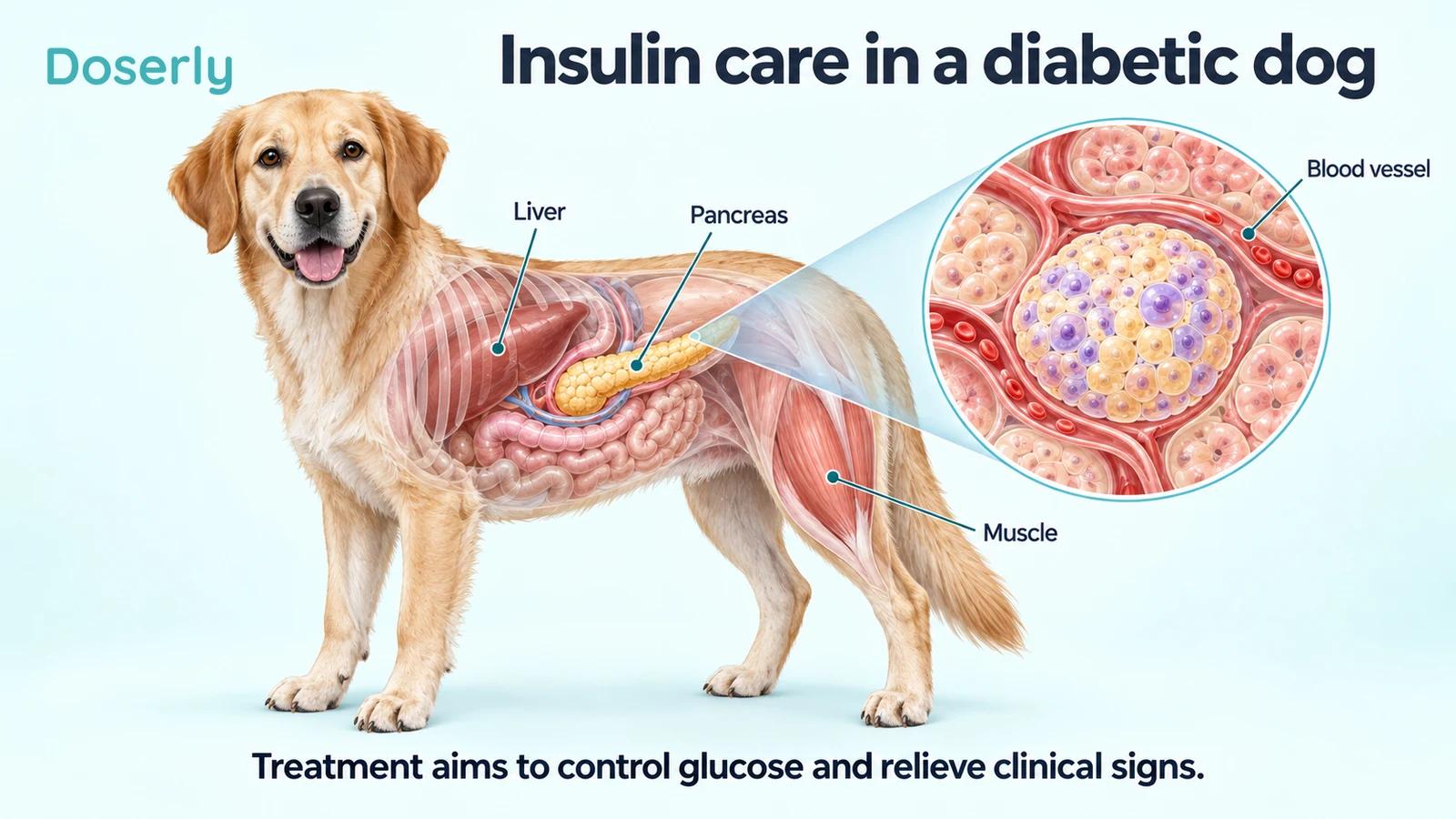
These tissues participate in glucose regulation. The conceptual illustration does not show that either insulin regenerates the pancreas or cures diabetes.
What are lente and NPH?
Lente insulin is an insulin zinc suspension. The veterinary porcine product Vetsulin contains 40 units per millilitre, commonly written U-40. Its formulation influences how insulin becomes available after injection. Vetsulin prescribing information
NPH stands for neutral protamine Hagedorn. It is an insulin suspension containing protamine, which alters absorption. Humulin N is a human NPH product supplied at 100 units per millilitre, or U-100. Its human label establishes the formulation and device requirements; it does not provide a canine treatment schedule. Humulin N label
The names describe different preparations, not a simple ranking from weak to strong. Concentration tells you how many units are in a volume. It is distinct from how long a product acts in an individual dog and from the total number of units that dog needs.
That distinction becomes especially important when discussing price or availability. Two vials can look similar while containing different concentrations and requiring different handling. A decision to change products must include instructions for the new product, rather than carrying over assumptions from the old one.
How was the comparison conducted?
The study randomly assigned fifteen dogs to each treatment using a computer-generated sequence. Both groups received injections every twelve hours, a consistent prescription diet and scheduled reassessments. Veterinarians adjusted treatment using clinical observations and laboratory information.
Follow-up included physical examinations, glucose curves and fructosamine, a marker of recent average glucose exposure. The final assessment occurred at twelve weeks. Trial methods
This was a comparison of supervised treatment strategies. The investigators did not select a fixed dose and leave it unchanged regardless of the response. The benefit of follow-up and adjustment is therefore part of the setting in which the results were obtained.
The dogs were newly diagnosed and screened for important concurrent disorders. That makes the findings most directly relevant to starting treatment in similar animals. A dog that has been difficult to regulate for years, or has another illness affecting insulin response, presents additional questions.
What did “good control” mean?
The investigators combined several features into a clinical score, including drinking and urination, body weight, glucose-curve findings and fructosamine. Good control was not defined by a single laboratory value. Outcome assessment
That approach makes sense for an owner. The point of treatment is not simply to improve a test report; it is to help the dog live comfortably while keeping treatment safe.
A composite score also has limits. Two dogs can receive similar totals for different reasons. One may have better clinical signs but less satisfactory glucose measurements; another may show the reverse. A favourable overall category does not erase the need to inspect its components.
When discussing your dog's progress, ask which parts are improving and which remain problematic. “Better controlled” becomes more useful when translated into concrete observations such as less excessive drinking, stable appropriate weight and a glucose pattern without concerning lows.
Is 73% better than 60%?
Eleven of fifteen is approximately 73%, and nine of fifteen is 60%. Those observed proportions differ by about thirteen percentage points. With only fifteen animals in each group, however, the study did not establish superiority.
The distinction is between an observed result and a dependable estimate of what would happen in a larger population. Random variation and differences between individual dogs can influence small-group percentages considerably.
Nor does a nonsignificant difference prove equivalence. A study designed to establish that two treatments are sufficiently similar would need a predefined acceptable margin and enough participants to estimate the difference precisely.
For the veterinarian, these results support considering both preparations. For an owner, they do not provide a reliable reason to switch a stable dog solely because one published percentage is larger.
A more relevant question is whether the current insulin meets the dog's needs across the dosing interval without unacceptable low glucose or persistent clinical signs. The answer comes from that dog's follow-up, not from assigning it the average result of a small trial.
Why a smaller insulin dose is not automatically an advantage
Dose requirements differed between groups in the study. That is a pharmacological observation, not a direct measure of better health. Primary report
An individual can require fewer units of one preparation without having better symptom control or fewer adverse effects. Different products have different action profiles, and clinicians adjust them to the response.
It is also unsafe to confuse dose with volume. A concentration change alters the volume containing a given number of units. A syringe calibrated for another concentration can therefore deliver the wrong amount even if the owner reads the same marking.
Cost comparisons should account for the prescribed product, wastage, device supplies and monitoring. A cheaper vial is not necessarily a cheaper overall treatment plan if a switch creates confusion or requires substantial reassessment. These are reasonable concerns to discuss openly with the veterinary team.
The device is part of the prescription
Vetsulin's label specifically requires a U-40 syringe when using its vials. Humulin N's vial instructions call for a U-100 syringe. These are product-specific requirements. Vetsulin label, Humulin N label
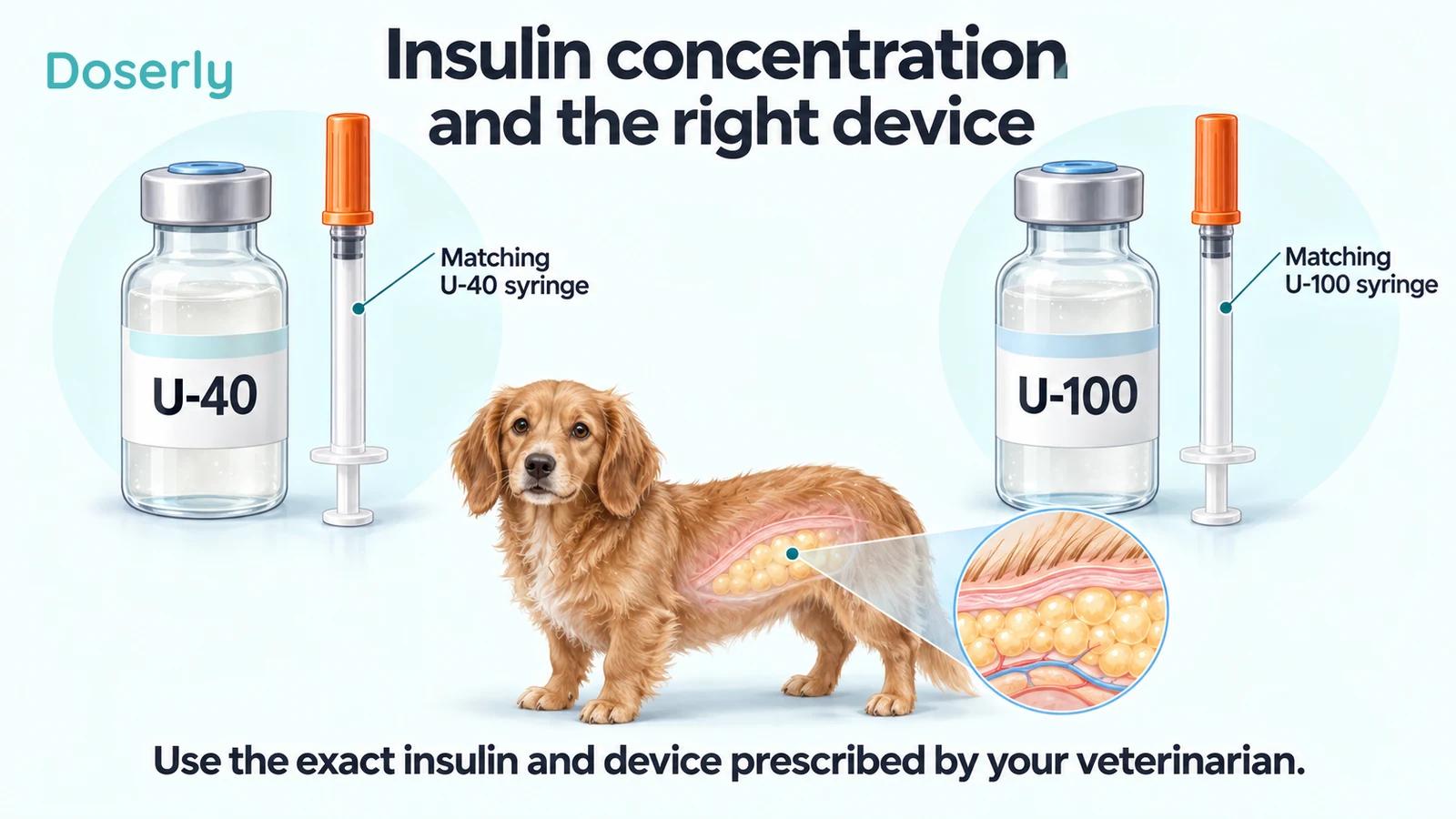
The illustration explains matching concentrations and devices. Syringe graduations and dose conversions are intentionally absent; the exact product and device must be prescribed together.
At a dispensing visit, it is useful to confirm the full product name, concentration and delivery device. If a refill looks different, pause and contact the prescriber or dispensing team before assuming it is an interchangeable version.
Ask for a demonstration with the equipment you will actually use. Written instructions are particularly valuable when more than one person provides care, because they reduce reliance on memory or descriptions such as “the usual syringe.”
Storage, preparation and in-use limits also belong to the specific product. Follow the current package instructions and the veterinarian's directions rather than a generic internet rule for all insulin.
What does the safety evidence tell us?
The trial detected low-glucose readings on some curves in both groups, without a significant difference between treatments. No symptomatic hypoglycemia was recorded during the study. Safety findings
The distinction between a biochemical low and visible symptoms matters. A dog may not show an obvious change at the time a low value is captured. Conversely, weakness or abnormal behaviour may need urgent assessment even before a measurement is available.
Thirty dogs followed for three months cannot define every uncommon or delayed risk. The absence of a severe event in that sample does not remove the need for a response plan.
AVMA advises prompt veterinary or emergency contact for concerning signs such as weakness, tremors, seizures or uncoordinated movement. It also emphasizes that similar outward signs can accompany different problems, so medication changes should be directed by the veterinarian. AVMA owner guidance
What if the first insulin is not working well?
Before assuming the molecule is wrong, the team may need to clarify what “not working” means. Persistent thirst, a high isolated reading and a low point followed by later high glucose are different patterns.
A dated record can help: prescribed doses actually given, food eaten, unusual activity, illness and symptoms. Bring the medication and device details to the review, especially after a refill or change in caregiver.
The veterinarian can then decide whether the concern involves dose, timing, duration of effect, administration or another medical problem. Increasing a dose without knowing the low point can create risk when the real issue is an unsuitable action profile.
Other approved veterinary insulins also exist. The FDA's canine ProZinc approval announcement confirms that treatment selection is not limited to this two-product comparison. FDA approval information
That broader choice does not make the older trial obsolete. It makes it one part of a current, individualized discussion.
What should guide the choice?
The strongest practical conclusion is that both lente and NPH can be useful starting options for diabetic dogs under veterinary supervision. The small randomized comparison did not establish a universally better product.
Ask what response is expected, when it will be reviewed, which observations to record and what to do if the dog does not eat normally or becomes unwell. Confirm the exact concentration and device each time treatment changes.
A good choice is one that controls the dog's clinical problems safely and can be carried out consistently at home. It is assessed over time, with the dog's response providing the information that a group average cannot.
Sources
- Fracassi and colleagues, randomized dog comparison, 2018.
- AAHA canine insulin-treatment guidance, 2026.
- Vetsulin prescribing information.
- Humulin N prescribing information.
- FDA canine ProZinc approval announcement.
- AVMA, diabetes in pets.