
Supplements
October 16, 2026
Lactoferrin for low iron: what comparisons with iron treatment show
On this page
Lactoferrin is an iron-binding protein found in milk and other secretions. Researchers have investigated whether bovine lactoferrin can improve iron status, potentially through effects on iron handling and inflammation. It is an appealing idea for someone who has experienced nausea, constipation or abdominal discomfort with an iron supplement.
But binding iron is not the same as supplying enough usable iron to correct a deficiency. A 2026 randomized trial found that lactoferrin was inferior to ferrous sulfate for improving hemoglobin in nonpregnant Bangladeshi women with iron-deficiency anemia. That result changes how confidently older favorable comparisons should be presented. 2026 primary trial
The practical question is not simply whether lactoferrin is biologically active. It is whether a specific preparation can safely achieve the treatment goal in the person considering it. Our lactoferrin guide provides broader background; here we will focus on anemia, the comparator and the measurements that matter.
Low iron and low hemoglobin are related, but different
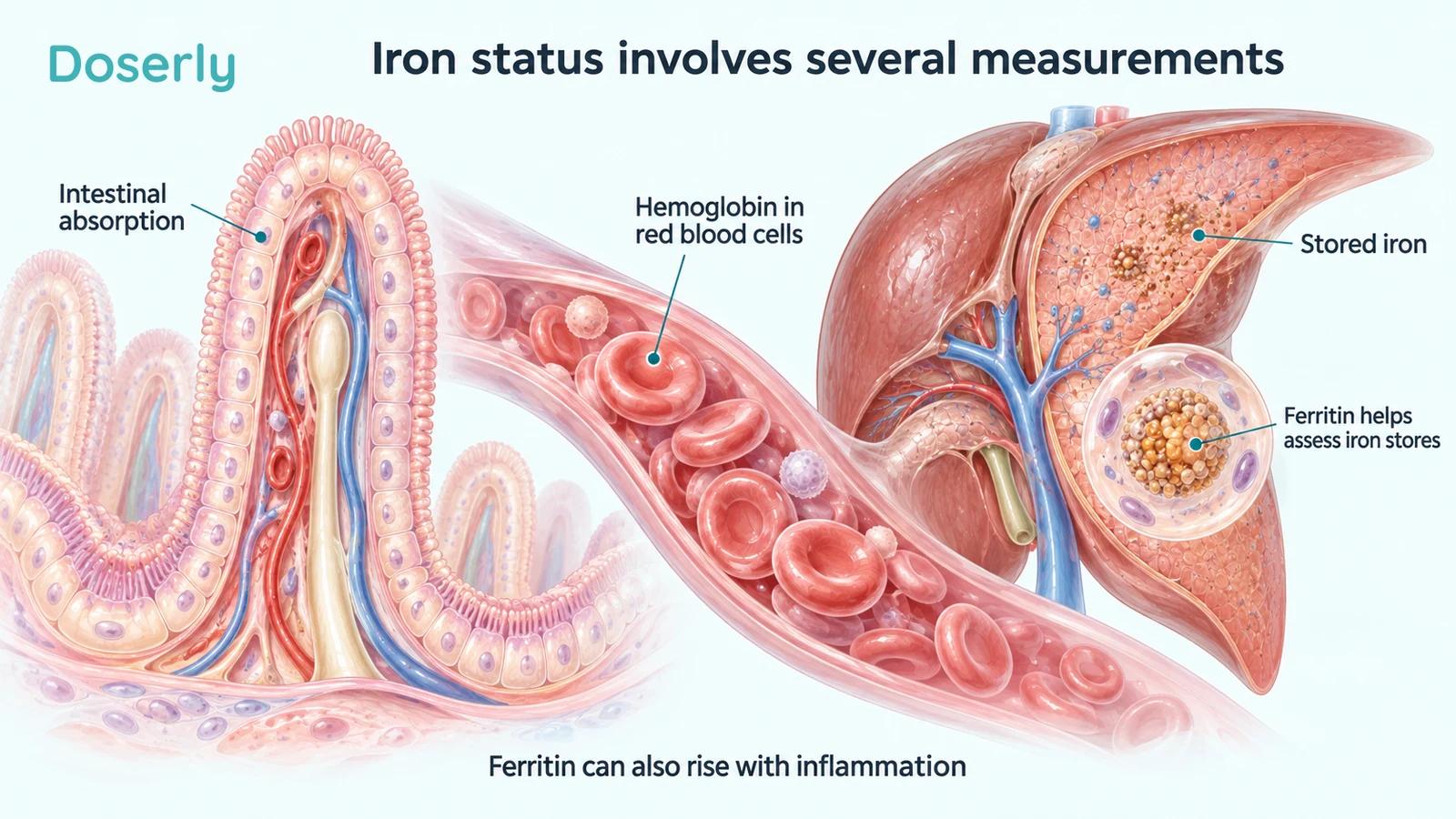
Iron is needed to make hemoglobin, the protein in red blood cells that carries oxygen. Iron stores can become depleted before hemoglobin falls. Once inadequate iron limits red-cell production enough to lower hemoglobin, the problem is described as iron-deficiency anemia.
Ferritin is commonly used to assess stored iron, but inflammation can raise it. Hemoglobin describes a different aspect of the problem, and a low value can have causes other than iron deficiency. Clinicians often interpret several laboratory measurements together with symptoms, diet, blood loss and medical history. NIH iron fact sheet
This distinction prevents a common misunderstanding. If a product changes ferritin, that does not automatically mean it has corrected anemia. If hemoglobin improves, that does not necessarily mean iron stores are fully replenished or the reason for the deficiency has been addressed.
For example, someone with ongoing blood loss may need both replacement and investigation of the loss. Someone with inflammation may need a different interpretation of ferritin. The diagnosis determines which outcome a treatment should achieve and how urgently it needs to work.
Why lactoferrin was proposed as an alternative
Lactoferrin has been studied because of its iron-binding properties and possible effects on inflammatory signaling. Inflammation can influence the body's regulation of iron availability, including through the hormone hepcidin. A preparation that altered that regulation might have an effect beyond simply adding iron to the diet.
A 2022 review reported favorable pooled comparisons with ferrous sulfate for several iron-related measurements and proposed an anti-inflammatory explanation. However, the review also found lower fractional iron absorption with lactoferrin in the relevant pooled analysis. Its proposed mechanism was therefore an interpretation of the evidence, not proof that lactoferrin simply makes all dietary iron easier to absorb. Comparative review
The formulation matters as well. Milligrams of lactoferrin describe the amount of a protein. Milligrams of elemental iron describe the amount of the mineral. These are not equivalent quantities. A front-label comparison of “200 mg lactoferrin” with “60 mg iron” cannot be interpreted as a larger versus smaller dose of the same treatment.
The clinical trials are useful precisely because a mechanism alone cannot answer whether the alternative works well enough.
What did the earlier pregnancy trial find?
A 2009 randomized, double-blind study recruited 100 pregnant women with iron-deficiency anemia. The reported treatment groups included 49 women receiving bovine lactoferrin and 48 receiving ferrous sulfate. Researchers assessed hemoglobin, ferritin, serum iron and total iron-binding capacity after 30 days, and participants recorded gastrointestinal symptoms. Nappi and colleagues
Both groups improved their blood measurements, without a significant difference between groups. Abdominal-pain and constipation scores were higher in the ferrous-sulfate group. That provides a reason to investigate tolerability as well as hematologic effects.
It does not prove that the treatments are interchangeable in all patients. A nonsignificant difference in a relatively small trial is not automatically proof of equivalent efficacy. The study concerned pregnancy, lasted about a month and compared particular available preparations. It cannot by itself establish how lactoferrin performs in nonpregnant adults, severe anemia or prolonged treatment.
For someone who cannot tolerate a prescribed iron product, the tolerability result is worth discussing. But it should be considered alongside the strength of evidence for correcting the deficiency, rather than allowing fewer symptoms to stand in for adequate treatment.
Why older pooled conclusions need rechecking
A 2024 review identified 19 trials involving people with low hemoglobin, with seven contributing to its pooled lactoferrin-versus-ferrous-sulfate hemoglobin comparison. The pooled result favored lactoferrin, but the heterogeneity statistic was 95.8%, indicating very large variation among the study estimates. The populations and interventions were not uniform. Christofi and colleagues
There is also a research-integrity issue. A frequently cited pregnancy trial by Rezk and colleagues was retracted in 2023. The publisher described unresolved concerns about data integrity and inability to obtain sufficient supporting information to verify the work. That trial should not continue to be treated as reliable positive evidence. Publisher's retraction notice
A pooled result can look precise while depending on studies that differ substantially or are no longer trustworthy. The sensible response is to reassess the underlying evidence, including subsequent trials. It is not necessary to conclude that every earlier lactoferrin study is invalid; the concern applies to the evidence actually affected.
The publication date of a review also does not guarantee that it incorporates every recent result or correction. The 2024 review's search ended in June 2022, before the 2023 retraction and the newer Bangladesh trial.
What did the 2026 Bangladesh trial test?
The newer study randomized 555 nonpregnant women aged 18–49 with iron-deficiency anemia in Dhaka. It compared daily bovine lactoferrin at 200 mg, bovine lactoferrin at 400 mg, and ferrous sulfate supplying 60 mg elemental iron. All groups also received 400 micrograms of folic acid. Treatment lasted 12 weeks. These are study details, not a recommended self-treatment schedule. Primary trial
The study was designed as a noninferiority trial. Instead of asking whether lactoferrin was superior, it asked whether its hemoglobin improvement was no more than an acceptable amount below the established comparator. The prespecified margin was −0.25 g/dL for the treatment difference.
The primary analysis used participants with the required outcome data. Mean hemoglobin changes were approximately −0.2 g/dL in the 200 mg lactoferrin group, 0.0 g/dL in the 400 mg group and +1.1 g/dL with ferrous sulfate. The treatment differences relative to ferrous sulfate were −1.2 g/dL and −1.1 g/dL, with confidence intervals entirely below zero. Results and analysis
This was more than a failure to prove equivalence. Both lactoferrin groups performed worse for the hemoglobin outcome under the conditions tested. Doubling the lactoferrin amount did not reproduce the response to elemental iron.
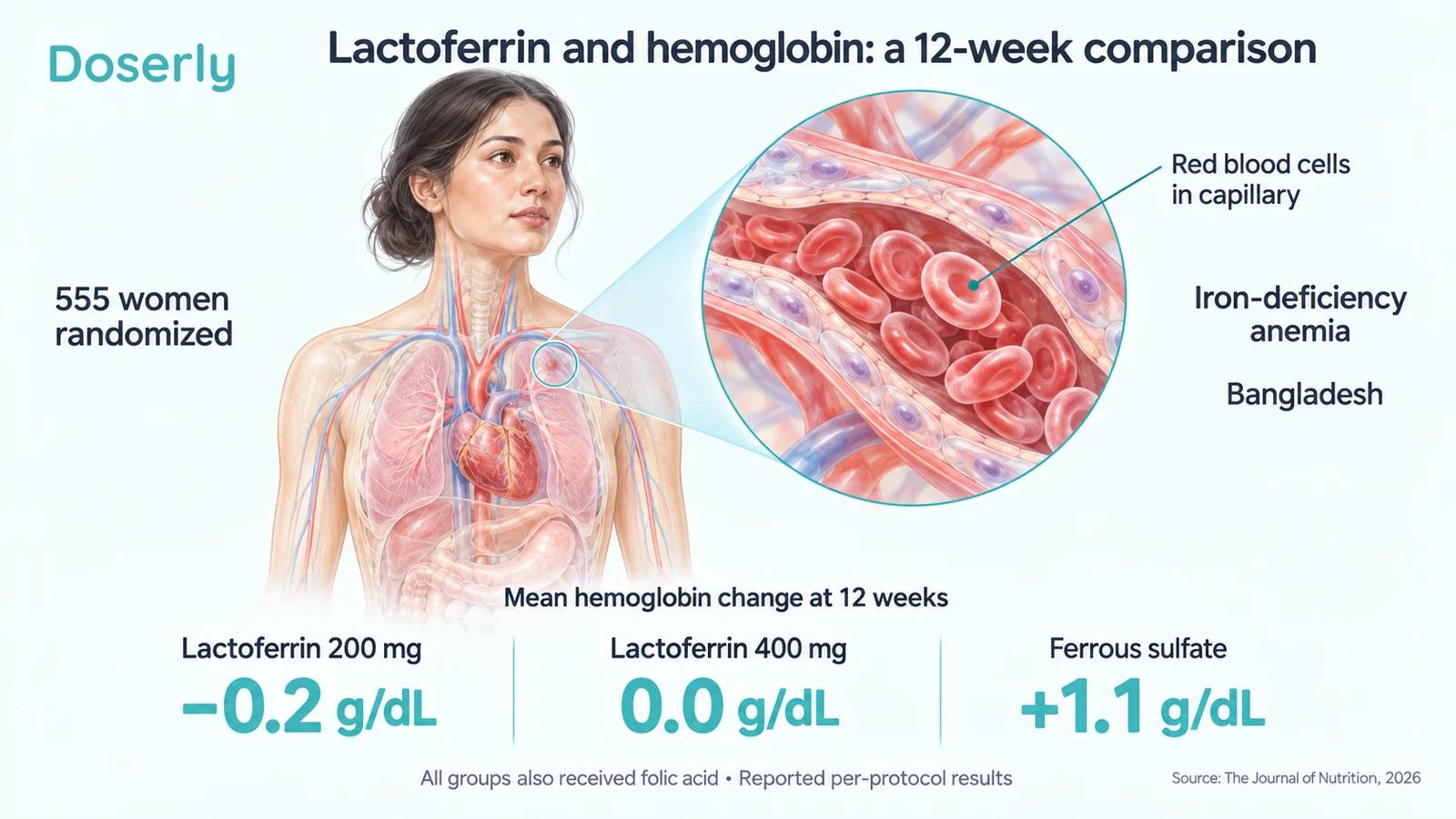
The trial randomized 555 women; the displayed changes come from its per-protocol analysis. All groups also received folic acid. The person and anatomy are conceptual, and study doses are not prescribing advice. Source.
How much confidence should we place in that finding?
The trial had an important limitation: attendance at the week-12 visit was about 63%, so a substantial proportion of randomized participants lacked final follow-up. Attrition can introduce bias if those who remain differ in important ways from those who leave.
The investigators therefore also analyzed the intention-to-treat population using statistical imputation for missing outcomes. That sensitivity analysis again favored ferrous sulfate. It does not make the missing information disappear, but it provides a check that the main conclusion was not limited to one analysis method. Adverse events were comparable among groups. Full report
The result applies most directly to women with similar characteristics and iron deficiency in a similar setting. It does not test every lactoferrin preparation, every cause of anemia or adding lactoferrin to an otherwise effective iron regimen.
Those limits should not obscure its clinical message. For comparable patients, the evidence does not support substituting lactoferrin for ferrous sulfate and expecting the same hemoglobin response. A plausible effect on inflammation did not compensate for the difference in treatment performance.
Why the comparator matters in daily care
“Compared with iron” is incomplete information. Which iron preparation was used? How much elemental iron did it supply? How frequently was it taken, and did people actually tolerate and continue it? Was the alternative tested alone or added to iron?
These details matter because an unfavorable experience with one schedule does not establish that every conventional iron approach will be intolerable. The American Gastroenterological Association's 2024 clinical practice update discusses oral-iron frequency, tolerability and the role of intravenous iron when oral treatment is unsuitable or ineffective. It advises oral iron no more than once daily and notes that some patients may tolerate alternate-day dosing better. These are clinician-directed options to discuss, not instructions to change a prescription independently. AGA practice update
An appropriate comparison therefore includes effective care that can be adjusted to the patient. It should not assume the only choices are enduring an intolerable regimen or replacing it with lactoferrin.
Is adding lactoferrin to iron a different question?
Yes. A trial of lactoferrin instead of ferrous sulfate does not establish what happens when the two are combined. An add-on trial would need to compare otherwise similar iron treatment with and without lactoferrin, measuring both response and adverse effects.
The Bangladesh investigators discussed combined approaches as a possible direction for future research. That discussion should remain a research proposal. It is not an outcome demonstrated by their three-arm trial.
The distinction is especially useful when reading testimonials. Someone may report improvement while taking lactoferrin, an iron supplement and other nutrients together. Even if their laboratory values improved, that history cannot isolate the contribution of lactoferrin. It also cannot determine whether the same response would have occurred with iron alone.
What should you monitor if iron treatment is difficult?
Tell the clinician which symptoms interfere with treatment and when they occur. Bring the product label so the amount of elemental iron and any additional ingredients can be identified. Explain missed doses honestly; a regimen that cannot be followed may need adjustment rather than a stronger claim about willpower or absorption.
Ask which laboratory changes are expected and when follow-up should occur. Hemoglobin response, restoration of stores, symptom improvement and investigation of the underlying cause are related goals, but they are not interchangeable. A treatment plan should specify what would lead to reassessment if progress is inadequate.
If lactoferrin is proposed, ask whether it is intended as a substitute or an adjunct, which study supports that role, and how a poor response would be detected. Pregnancy, significant anemia and ongoing blood loss make timely medical management particularly important.
The Doserly lactoferrin guide can help prepare that discussion. The current evidence supports taking the comparator seriously: an iron-binding protein may be interesting, but correcting iron-deficiency anemia requires a treatment that demonstrably restores the relevant blood measurements in the patient being treated.
An additional detail is worth taking to an appointment: milligrams of a protein and milligrams of elemental iron are not equivalent quantities. The lactoferrin arms were defined by the mass of lactoferrin, while the ferrous sulfate arm supplied 60 mg of elemental iron. Reading those labels as competing amounts of the same ingredient would misdescribe the trial. A product list should preserve the ingredient name, salt or formulation, serving size and elemental iron amount where applicable. That helps the clinician distinguish a replacement proposal from an adjunct and check what was actually taken. Trial formulations
Sources
- Bangladesh randomized trial, 2026: lactoferrin inferior to ferrous sulfate for hemoglobin response.
- Nappi et al., 2009: short pregnancy comparison and tolerability.
- Comparative review, 2022: older pooled findings and proposed mechanisms.
- Christofi et al., 2024: heterogeneous low-hemoglobin literature.
- Publisher retraction notice, 2023: retracted pregnancy trial.
- AGA practice update, 2024: oral and intravenous iron management.
- NIH iron fact sheet: iron status and laboratory interpretation.