
Supplements
October 16, 2026
Krill oil versus fish oil: does better absorption justify more?
On this page
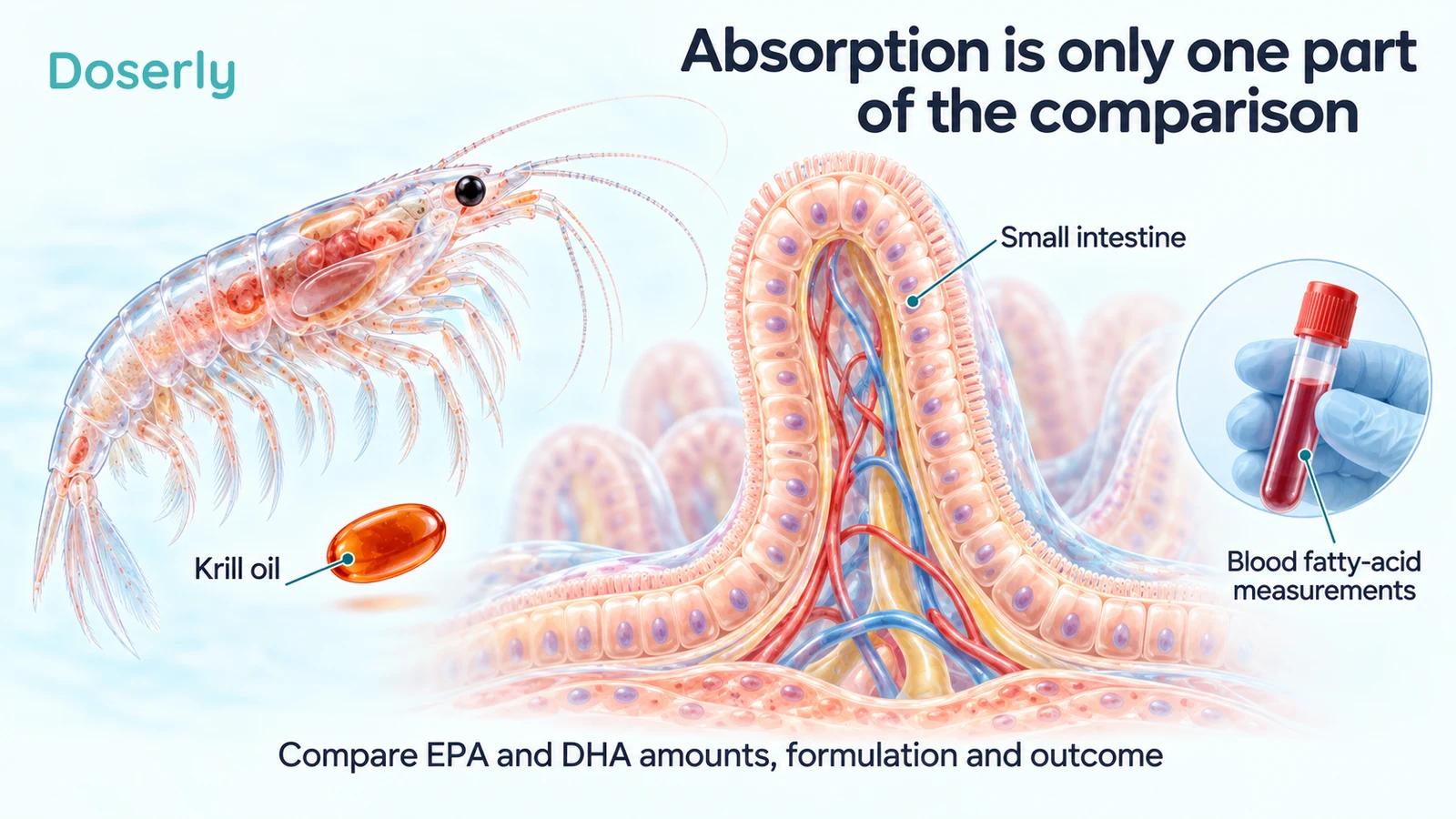
Krill oil supplies EPA and DHA, the same long-chain omega-3 fatty acids found in fish oil. Its distinguishing feature is how much of those fatty acids are carried in phospholipids, a class of fats involved in cell membranes. That difference has prompted a persuasive marketing argument: if krill oil is absorbed better, perhaps a smaller amount delivers more benefit.
Human research gives a more qualified answer. Some studies report larger blood fatty-acid changes with krill oil; others find broadly similar changes when EPA and DHA amounts are closely matched. None of those absorption comparisons, by themselves, establishes that a higher-priced krill product will improve your health more than a suitable fish-oil product. Dose-matched randomized comparison.
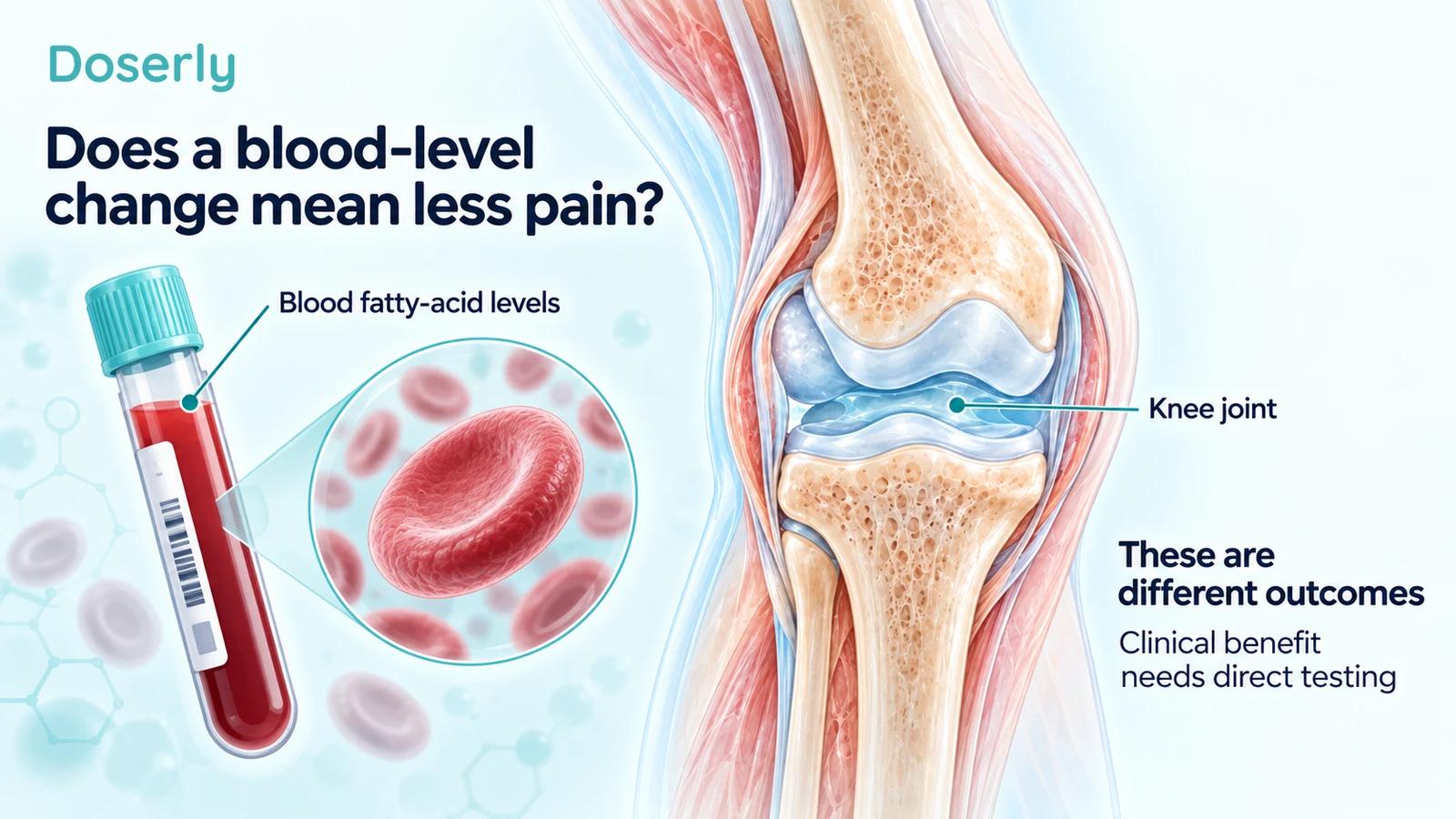
The sensible comparison starts with the nutrient amounts and the outcome you care about. A higher blood level, a lower triglyceride result and less knee pain are three different findings. An absorption story can help explain a result, but it can't substitute for measuring it.
What is different about the oil?
Krill are small marine crustaceans. Their oil contains omega-3 fatty acids in a mixture that includes phospholipids. Fish oils can contain omega-3s in triglyceride, re-esterified triglyceride or ethyl-ester forms, depending on processing. The finished preparation matters, so “fish oil” isn't one chemically identical comparator in every trial. NIH omega-3 overview.
Digestion releases and processes fatty acids before they enter circulating lipid pools. The form of the oil, the meal consumed with it and the amount given can influence measurements. Researchers may also sample different blood compartments at different times. A four-hour response after one dose is not the same experiment as a red-blood-cell measurement after several weeks.
The total mass of oil is another source of confusion. A capsule containing 1,000 mg of krill oil does not necessarily contain 1,000 mg of EPA plus DHA. The same applies to fish oil. Comparing the large oil-weight number on two labels can therefore conceal a substantial difference in the nutrients under discussion.
The strongest comparison matches EPA and DHA separately
A 2015 randomized, double-blind trial enrolled 66 healthy adults, 22 per group, to compare fish oil in ethyl-ester form, fish oil in triglyceride form and krill oil. The researchers matched the daily amounts at approximately 816 mg EPA and 522 mg DHA, about 1.3 g combined, for 28 days. Primary trial.
At four weeks, average total plasma EPA plus DHA was 90.9 micrograms/mL with fish-oil ethyl esters, 108 with triglyceride fish oil and 118.5 with krill oil. The overall comparison did not reach conventional statistical significance, with P=0.052. Red-blood-cell EPA plus DHA also did not differ significantly between groups, P=0.19.
The numerical ordering may look like a clear winner if the uncertainty is removed. It isn't. This study did not establish a statistically clear difference at the chosen endpoint. At the same time, a nonsignificant result isn't proof that the preparations are perfectly identical; the sample was relatively small and blood measurements varied between people.
What makes the trial useful is the close matching of EPA and DHA. It reduces the chance that an apparent formulation advantage simply reflects one group receiving more of a particular fatty acid. It supports a restrained conclusion: these products produced broadly similar blood exposure over four weeks under the tested conditions.
Why do other studies favor krill oil?
A 2013 crossover study recruited 24 healthy volunteers. Participants received krill oil, fish oil and corn-oil control in separate four-week periods, with eight-week washouts. The active treatments each supplied 600 mg of total omega-3 polyunsaturated fatty acids daily. Krill oil produced larger increases in plasma and red-cell omega-3 measurements, including the omega-3 index. Crossover trial.
This is a real positive absorption finding. Its interpretation still depends on the small sample, the specific formulations and how the nutrient amounts were matched. Matching total omega-3 does not necessarily match EPA and DHA individually as closely as the 2015 comparison did. The studies also used different designs, which affects how variation is handled.
Importantly, triglycerides and HDL cholesterol did not change with the treatments in the 2013 trial. Total and LDL cholesterol increased with both active oils compared with control. A favorable omega-3 index therefore did not mean that every lipid marker improved. That is exactly why the measured outcome should remain attached to the claim.
A 2011 seven-week trial in 113 adults compared krill oil supplying 543 mg EPA plus DHA daily with fish oil supplying 864 mg, alongside a group receiving no supplement. Blood EPA and DHA increased in both active groups, with no significant difference between them. Lipids and measured inflammation or oxidative-stress markers did not significantly differ between groups. Seven-week trial.
That lower nutrient exposure with a similar measured response is interesting. It doesn't establish a universal conversion factor, such as replacing every gram of fish oil with a fixed smaller amount of krill oil. The trial didn't test all doses, formulations, meals and clinical purposes, and its control group received no matching placebo.
What does the network meta-analysis contribute?
A 2024 network meta-analysis, indexed in 2025, brought together 26 studies of omega-3 bioavailability. It compared sources, molecular forms and dose ranges, and reported advantages for krill oil in some lower-dose comparisons. The review also acknowledged substantial heterogeneity and limited statistical significance for some analyses. Network meta-analysis.
A network analysis can combine direct comparisons with indirect ones. For example, two preparations tested against a common comparator can be compared statistically even when they weren't tested together in the same trial. That approach is useful when direct evidence is sparse, but it relies on the studies being sufficiently comparable.
Here, dose categories, formulations, sampling schedules and endpoints differed. The resulting ranking is a summary of that research network, not a certification that the most expensive krill capsule on a shelf is the best choice. The review's absorption findings also cannot establish a lower rate of side effects without adequate direct safety evidence.
This is where an appealing headline often goes too far. “Better absorption in some studies” is a defensible description of part of the evidence. “Better health at a lower dose for everyone” requires additional assumptions about how blood levels relate to outcomes and whether those assumptions hold for the person taking it.
Different absorption measurements answer different questions
A study may report the highest concentration after a dose, the time taken to reach that peak, or exposure accumulated over a sampling period. These are often called Cmax, Tmax and area under the curve. A product can perform differently on those measures without producing a clear difference after weeks of use.
The omega-3 index is different again: it describes EPA plus DHA as a proportion of red-blood-cell fatty acids. It is not the percentage of a capsule absorbed and not a direct measurement of brain omega-3 content. A rise tells researchers that fatty-acid composition changed in the measured compartment. Dose-matched trial methods.
For an everyday decision, first identify which result a product claim refers to. If your goal is a triglyceride reduction, a short study of peak blood concentration is less directly informative than a trial measuring triglycerides. If your goal is less pain, the relevant trial should assess pain and function. Better characterization of exposure is useful science, but it is not the final clinical answer.
Knee-pain trials show why direct outcomes matter
A 2022 randomized trial in 235 adults with mild-to-moderate knee osteoarthritis compared 4 g krill oil daily with mixed vegetable-oil placebo for six months. The krill group had a modestly greater improvement in pain: the adjusted between-group difference was −5.18 points on a normalized 0–100 scale, with a 95% confidence interval from −10.0 to −0.32. Knee osteoarthritis trial.
The omega-3 index increased substantially with krill oil, but the pain difference was much smaller than the changes within either treatment group. Anti-inflammatory medicine use, lipid results and inflammatory markers did not differ between groups. This is a useful reminder that a strong blood-level response doesn't imply an equally large symptom response.
A 2024 trial randomized 262 people with knee osteoarthritis, substantial pain and MRI evidence of effusion-synovitis, meaning fluid and inflammation around the joint. It compared 2 g krill oil daily with placebo for 24 weeks. Pain improved by about 20 points in both groups, with no meaningful separation attributable to krill oil. JAMA randomized trial.
The studies used different amounts and populations. Their disagreement doesn't identify which individual will benefit or establish that the higher amount is the solution. It does show why an absorption argument cannot settle a symptom question. Neither study compared krill oil directly with a matched fish-oil treatment for pain, so neither proves that paying more for krill produces better pain relief than fish oil.
How to compare value without pretending to know the perfect dose
Start with the reason for using an omega-3 product. Filling a dietary gap, treating a high triglyceride result and trying to relieve knee pain are different goals. The evidence and acceptable uncertainty differ. A supplement that is convenient for one purpose may not be an appropriate treatment for another.
Next, compare the daily serving's EPA and DHA separately. Then calculate the number of capsules and cost required to supply that serving. The calculation doesn't tell you what amount you should take; it tells you whether two advertised servings actually deliver similar nutrients. This avoids mistaking a small capsule or a high total oil weight for a pharmacological advantage.
Suppose two hypothetical bottles cost the same but one supplies half as much EPA plus DHA per labeled serving. Calling it “twice as absorbable” would need robust evidence at those doses and formulations before treating the servings as equivalent. A general claim about phospholipids isn't enough to complete that calculation. These are hypothetical purchasing comparisons, not a recommendation for a nutrient target.
Also consider whether the product is tolerable and practical. A theoretically favorable formulation won't achieve its intended exposure if someone rarely takes it because of taste, gastrointestinal discomfort or capsule burden. The best available choice for a person includes adherence and product quality as well as a laboratory absorption estimate.
Safety belongs in the comparison too
Krill is a crustacean, so shellfish allergy deserves specific attention rather than assuming all omega-3 products have the same allergen context. Discuss the full ingredient and allergen label with a healthcare professional if that applies to you. The source name alone is not a guarantee of safety after processing.
NIH notes that omega-3 supplements can cause gastrointestinal effects and that high-dose trials in some cardiovascular-risk populations found increased atrial fibrillation. Medication use, bleeding concerns and a history of rhythm problems should be discussed before substantial supplementation. These findings don't prove that every retail krill serving has the same risk; they do undermine the idea that a “natural” source makes escalating amounts automatically safe. NIH safety discussion.
Our krill oil guide offers broader preparation and safety background. The current comparison is most useful when it stays concrete: EPA and DHA amounts, the actual formulation, the measurement used and the health goal. Krill oil is a legitimate omega-3 source, but its absorption story alone does not establish a clinical advantage worth any particular price premium.
Sources
- 2015 dose-matched three-formulation trial.
- 2013 crossover absorption trial.
- 2011 seven-week comparison.
- 2024 network meta-analysis.
- 2022 knee osteoarthritis trial.
- 2024 JAMA knee osteoarthritis trial.
- NIH omega-3 fact sheet.