
Peptides
October 16, 2026
KPV in a peptide blend: what can you learn from feeling better?
On this page
KPV is a three-amino-acid peptide being investigated for its effects on inflammatory signaling. Much of the interest concerns the intestinal lining, where epithelial cells and immune cells help determine how the gut responds to injury. For someone living with persistent digestive symptoms, the possibility of reducing inflammation is understandably appealing.
But KPV is often discussed as one ingredient in a mixture. If someone begins several peptides together and then feels better, did KPV help? Did another ingredient account for the change? Would the same improvement have happened with their usual care alone?
Those are different questions from whether the experience was real. A change after starting a blend cannot, by itself, identify the ingredient responsible. To understand why, it helps to look at what KPV experiments actually tested, how the formulation changes the question, and what a useful combination study would need to measure. Our KPV research guide provides broader background on the peptide and its experimental status.
Why researchers are interested in KPV and the gut
KPV stands for lysine, proline and valine, the three amino acids in its sequence. It corresponds to the end of a larger signaling peptide called alpha-melanocyte-stimulating hormone, or alpha-MSH. Being related to that hormone does not mean the small fragment reproduces all of its effects.
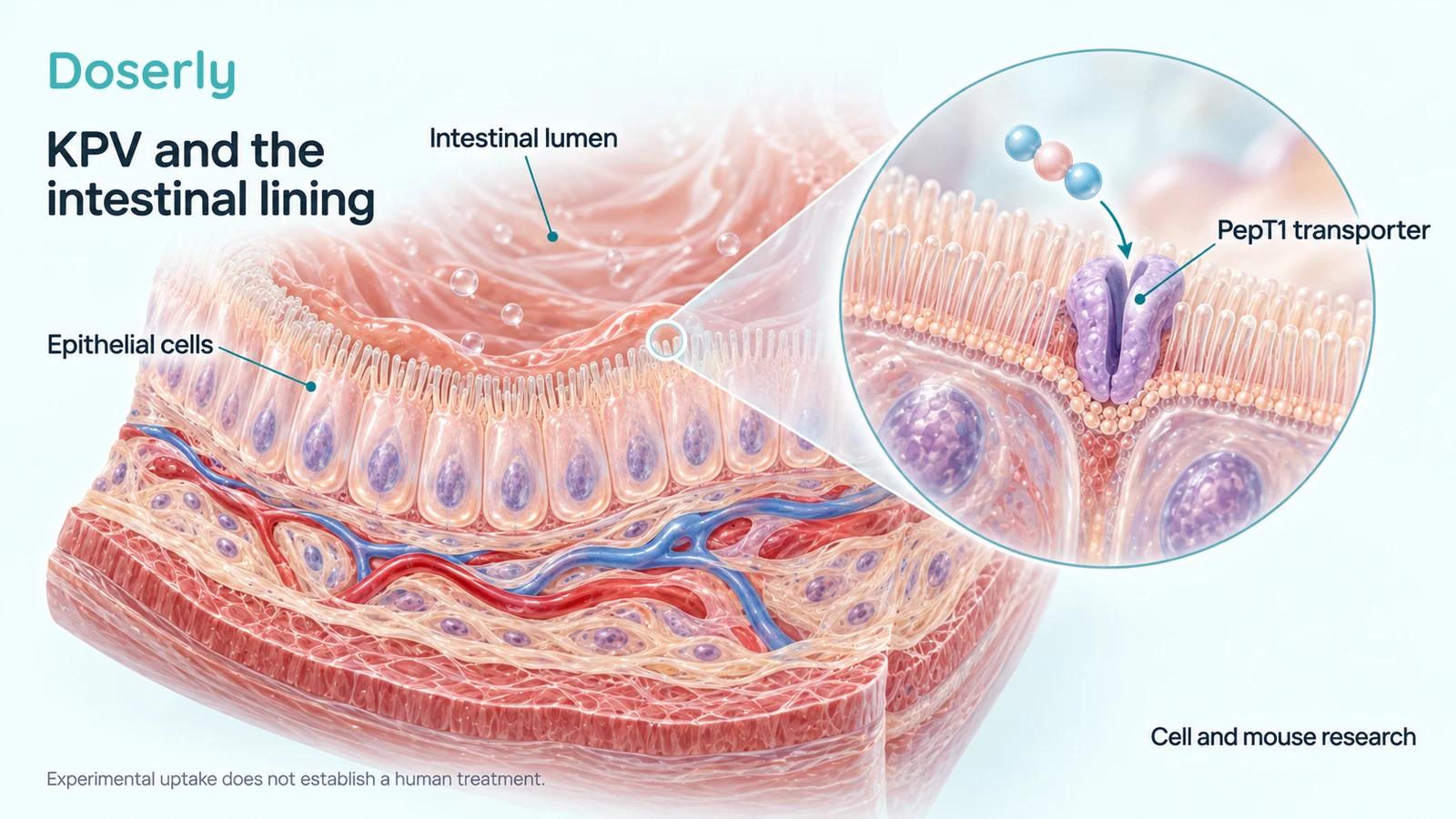
An influential study by Dalmasso and colleagues examined KPV in intestinal epithelial cell lines, an immune-cell line, and mice with experimentally induced colitis. Colitis means inflammation of the colon. Researchers found that a transporter called PepT1 could carry KPV into cells. Inside those experimental systems, KPV reduced activity in inflammatory signaling pathways called NF-kappaB and MAPK and reduced secretion of inflammatory signals. Dalmasso and colleagues, 2008.
A transporter is a protein that helps substances cross a cell membrane. This matters because an interesting molecule outside a cell may never reach the location where researchers expect it to act. The experiment connected delivery into cells with a biological response, giving researchers a more specific question than simply asking whether KPV is “anti-inflammatory.”
What the animal experiments found
In the Dalmasso study, KPV was supplied in drinking water during two chemically induced mouse-colitis models. The investigators examined tissue inflammation and inflammatory markers, alongside measures such as body weight. In one model, there were five mice per group, and the colon's myeloperoxidase activity, a marker related to inflammatory-cell infiltration, was approximately halved relative to the colitis group without KPV. These were small experimental groups, not patients taking a marketed blend. Original methods and results.
A separate study by Kannengiesser and colleagues also investigated KPV in mouse models, including chemically induced colitis and a model involving transfer of immune cells. The researchers examined animals with a nonfunctional melanocortin-1 receptor as part of exploring how the effect occurred. That work broadened the preclinical rationale, but remained research in mice. Kannengiesser and colleagues, 2008.
An earlier experiment studied swelling in mouse ears after an inflammatory challenge. It helps explain the history of interest in the alpha-MSH fragment, but ear swelling, intestinal inflammation and a person's day-to-day digestive symptoms are different outcomes. The old study also should not be used to imply that every modern product sold as KPV contains the same chemically characterized substance. Hiltz and Lipton, 1989.
The useful lesson from these experiments is specific: KPV-related molecules deserve investigation in particular inflammatory settings. They do not establish that an injected mixture improves inflammatory bowel disease, a skin condition or an unexplained symptom in people.
The delivery system is part of the treatment
Imagine two products with the same ingredient name. One releases its contents into the stomach. Another protects those contents during digestion and is designed to deliver them to particular cells in the colon. Even before another peptide is added, these products present different scientific questions.
Xiao and colleagues studied an engineered KPV formulation involving hyaluronic-acid-functionalized nanoparticles within a chitosan/alginate hydrogel. The approach sought to deliver KPV to relevant intestinal cells and was tested in a mouse model. Results favored the targeted formulation over a comparison nanoparticle system on several experimental measures. This was a study of a delivery system as well as a peptide. Xiao and colleagues, 2017.
That distinction prevents an easy but misleading inference: a positive paper about an oral nanoparticle formulation does not validate a vial intended for injection. The route changes which barriers the substance encounters, where it distributes, and what researchers need to measure. An ingredient list alone does not answer those questions.
Skin research makes the same point in a different tissue. Pawar and colleagues examined KPV transport across human skin samples outside the body. Passive passage was below the assay's detection limit, while microneedles and electrical delivery increased transport. This was a laboratory delivery experiment using human tissue, not a clinical trial demonstrating symptom relief in living patients. Pawar and colleagues, 2017.
So “studied in human skin” and “shown to treat people” are not interchangeable. Before borrowing a result for a blend, match the formulation, route, tissue and outcome, not just the peptide's name.
Which KPV is actually in the mixture?
FDA's 2026 briefing separately evaluated KPV free base and KPV acetate and highlighted inconsistent naming and inadequate characterization in the submitted material. Its review did not identify human clinical studies or human exposure data for the evaluated substances. That is a dated statement about the agency's evidence review, not proof that nobody anywhere has used a product labeled KPV. FDA KPV briefing.
A salt form and a chemically modified peptide are also different kinds of change. “Acetate” should not casually be treated as equivalent to adding an acetyl group to the peptide itself. The names may look similar to a nonspecialist while describing different chemical situations.
For a combination study, researchers need to know what went into every batch. A claim of high purity is not a complete description of identity, strength, stability or microbiological quality. If those basic features are uncertain, a later symptom change becomes harder to interpret: the question is no longer just which ingredient helped, but what exposure actually occurred.
This does not mean a reader needs to become an analytical chemist. It means that reliable identification belongs upstream of a clinical claim. A recognizable marketing name cannot do the work of product characterization.
Why improvement does not reveal the active ingredient
Suppose a person starts a blend during a particularly difficult week and reports less discomfort two weeks later. Several explanations remain possible. One component might have helped. The components might have interacted. A simultaneous change in food, sleep or prescribed treatment might have mattered. Symptoms might also have fluctuated independently of the mixture.
The difficulty is that the person experiences only one course of events. We cannot observe the same person over the same two weeks both receiving and not receiving the blend. A carefully chosen comparison group helps estimate what would otherwise have happened.
Starting during an unusually bad spell creates another interpretive problem. A later measurement may move closer to the person's usual level even without an effective new treatment. That pattern does not imply symptoms were imagined. It means the starting point can exaggerate how persuasive an improvement looks.
Stopping and restarting a product does not automatically solve this. Symptoms, expectations and other care may change between periods, and an exposure can have effects that outlast its administration. Unsupervised experimentation also cannot establish product quality or reveal uncommon harms. A personal diary can document timing, but it cannot supply every missing comparison.
What would a study need to show?
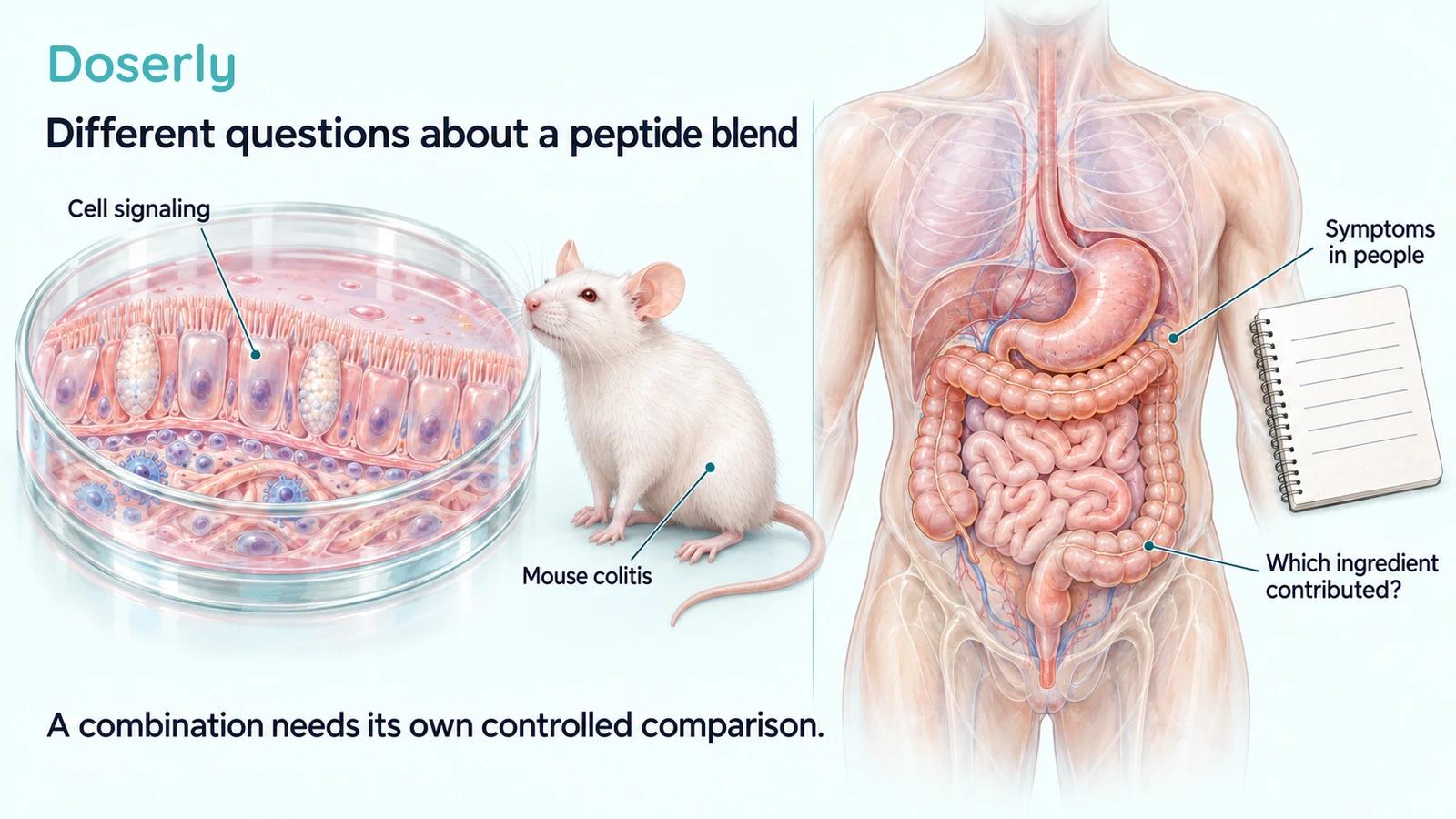
For a simplified two-ingredient combination, researchers might compare KPV alone, the other ingredient alone, the combination, and an appropriate control. This is an illustrative research design, not a proposed self-experiment or treatment schedule. FDA's guidance on developing new investigational drugs together emphasizes establishing each component's contribution. FDA combination-development guidance.
These comparisons answer different practical questions. Combination versus control asks whether the package provides benefit. Combination versus the other ingredient asks whether adding KPV contributes anything. Comparing the ingredients separately helps assess whether a claimed interaction is supported rather than merely assumed.
A study could find that the blend works better than control but no better than one ingredient alone. That would matter to someone paying for extra ingredients or accepting additional uncertainty. Alternatively, it might find an added benefit accompanied by more adverse effects. The relevant question is then the size and importance of that tradeoff.
More ingredients make this harder. A mixture with several peptides has many potential component combinations and interactions. Researchers may use staged development or focused comparisons instead of testing every possible mixture, but the final claim must remain within what those comparisons can establish.
“Synergy” needs a defined meaning
In everyday conversation, synergy often means that two things seem complementary. In an experiment, it needs a clearer definition: how does the combined effect compare with the effect expected from the individual treatments on a specified measurement scale?
Two ingredients acting through different pathways might complement each other. They could also overlap, interfere with one another, or add adverse effects. A colorful mechanism diagram cannot distinguish among these possibilities. Nor does a larger response to a mixture automatically prove a special interaction; receiving more active treatment may be enough to explain it.
For the reader, a useful translation is: what extra benefit did the combination provide, compared with which alternative, and how confidently was that measured? If there is no controlled comparison, synergy remains a hypothesis about the blend rather than a demonstrated advantage for patients.
Choose the outcome before choosing the explanation
“Gut health” is too broad to function as a single trial outcome. Reduced pain, fewer urgent bowel movements, improvement in a laboratory marker and healing seen during an endoscopy are related possibilities, but they are not the same result.
A meaningful trial would specify the condition and the main outcome before examining the data. It would keep background care comparable, report how many participants stopped treatment, and explain whether apparent differences were large enough to matter in daily life. Safety assessment would need its own plan; an efficacy result cannot stand in for it.
For someone already keeping a health record, the practical contribution is more modest and still useful. Record what changed, when it changed, and what else was happening. Include prescribed medicines and relevant test results so a clinician can understand the timeline. Avoid retrospectively assigning a mechanism to every symptom fluctuation.
Bringing the question to a clinician
Start with the problem you want help with: a diagnosed inflammatory condition, persistent symptoms, or concern about a particular test result. Ask what evidence supports the exact product and route being discussed, and whether any study can separate KPV's contribution from the other ingredients.
It is also reasonable to ask why a combination is being proposed before the individual components have an established role for that problem, and what would lead to a change in the plan. These questions make the conversation more concrete than asking whether KPV is simply “good for inflammation.”
At present, the most useful KPV findings concern experimental signaling and delivery. They explain why research continues. They do not let us identify KPV as the active contributor when someone feels better after a multi-peptide blend. For a fuller account of the compound's identity and evidence limits, continue with the Doserly KPV guide.
Explore the research
- Dalmasso et al., PepT1-mediated KPV uptake, 2008: cell experiments and chemically induced mouse colitis.
- Kannengiesser et al., murine inflammatory bowel disease models, 2008: additional preclinical inflammation research.
- Hiltz and Lipton, alpha-MSH fragment and mouse-ear inflammation, 1989: historical experimental context.
- Xiao et al., targeted oral KPV nanoparticles, 2017: formulation-specific mouse research.
- Pawar et al., KPV delivery across human skin samples, 2017: ex vivo delivery, not clinical effectiveness.
- FDA KPV-related substances briefing, 2026: identity and human-evidence gaps.
- FDA combination-development guidance, 2013: contribution of individual investigational components.