
Peptides
October 16, 2026
KPV and gut health: what counts as human evidence, and what does not?
On this page
A paper can contain human cells, a human tissue sample or the word “clinical” in a database without showing that KPV improves anyone’s digestive symptoms. This is the central difficulty in reading the KPV literature. Several interesting experiments exist, but they answer different questions from the one most readers bring: would this particular product safely help my particular gut problem?
KPV is shorthand for lysine–proline–valine, a three-amino-acid peptide. Its gut-health reputation draws heavily on experiments involving inflammatory signaling, peptide transport and mouse colitis. Those findings support further investigation. They do not supply a demonstrated human treatment benefit, a validated oral dose or a reliable account of longer-term safety.
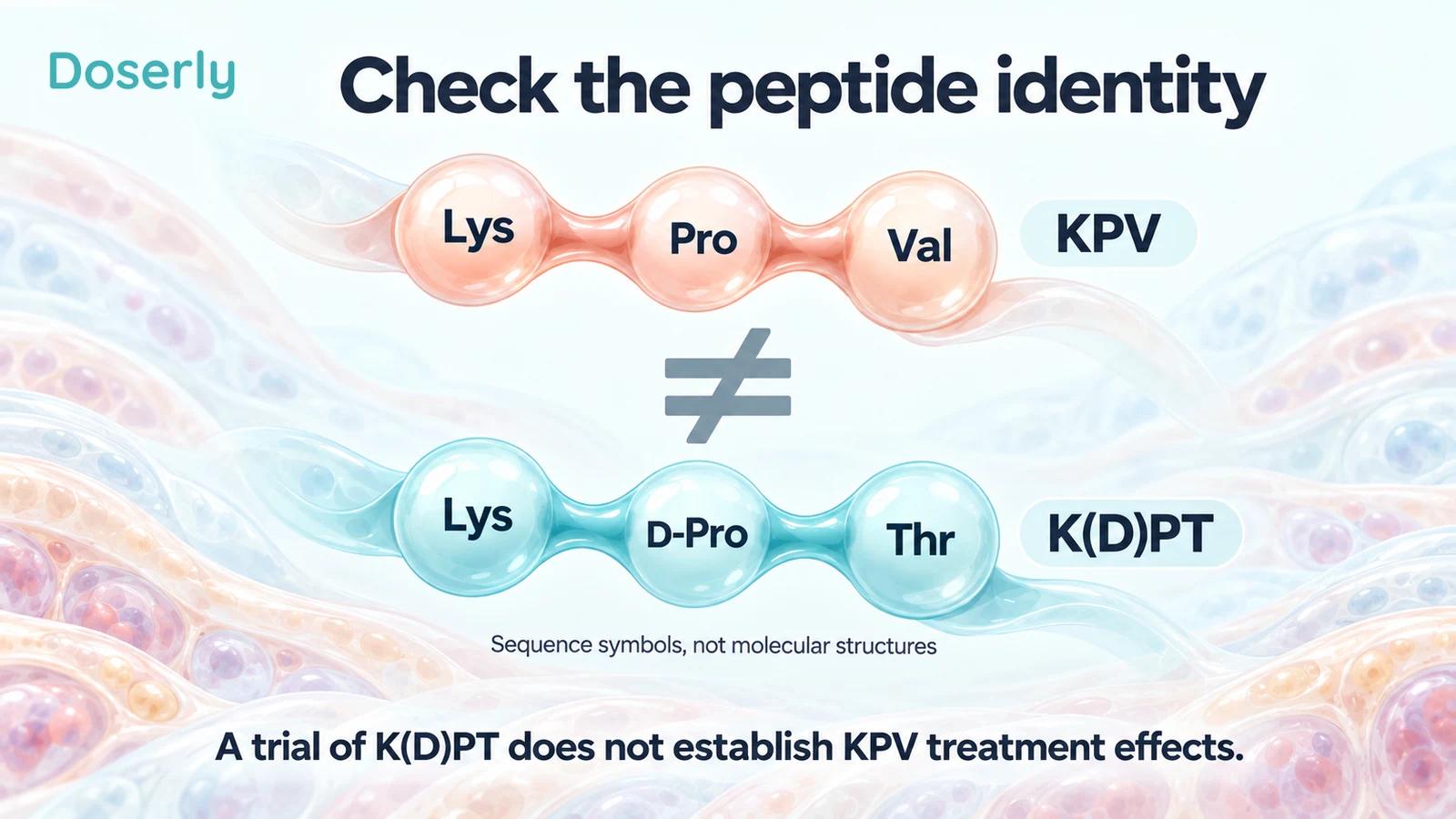
The distinction is especially important because a real human ulcerative-colitis trial studied a similarly named peptide, K(D)PT. Another human study used a CKPV dimer in a vaginal formulation. Neither can simply be relabeled a KPV gut trial. Our KPV guide introduces the compound; this article explains how to sort the evidence behind the claims.
Start by asking what received the peptide
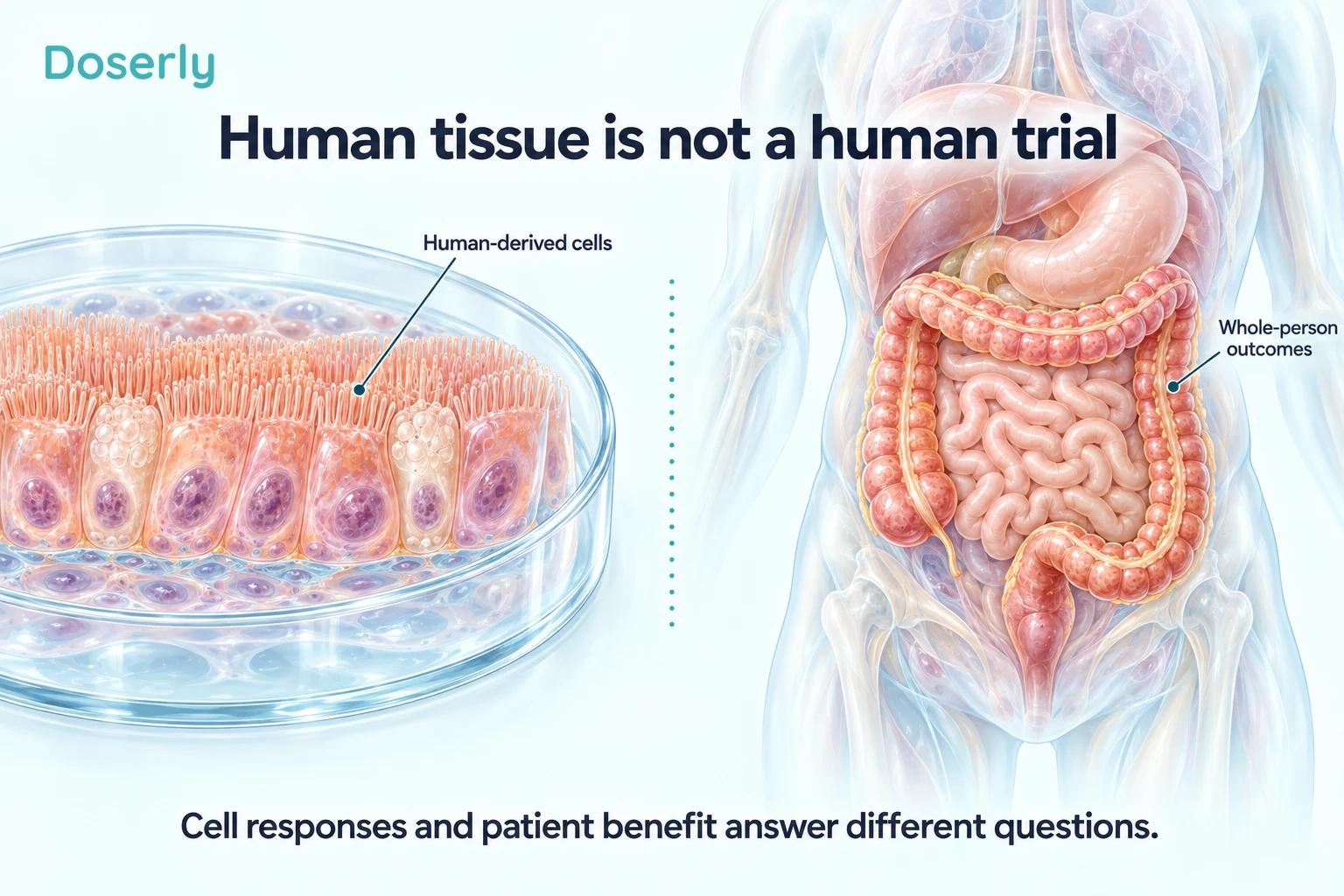
“Human evidence” is an imprecise phrase. Human-derived cells in a laboratory can show that a substance enters those cells or changes a measurable signal. Excised human tissue can help researchers study movement across a biological barrier. A study that administers a defined product to people can examine exposure, tolerability and clinical outcomes. These are distinct research designs.
A cell experiment does not recreate digestion, circulating metabolites, the nervous system, other medications or the entire immune response. That limitation does not make it worthless. Removing some of those variables is often exactly how researchers identify a mechanism. It means that the result should be described as a cell finding, with its usefulness and its boundaries intact.
For a gut-treatment claim, look for participants with a defined condition, an administered formulation, a comparison group and outcomes that matter in that condition. “Human intestinal cells” supplies only the origin of the experimental material. It does not mean people with inflammatory bowel disease received the peptide.
What the frequently cited gut experiment actually did
Dalmasso and colleagues studied KPV in human intestinal epithelial cell lines and a human T-cell line. They examined inflammatory signaling and peptide uptake, then used two chemically induced mouse-colitis models. KPV reduced selected inflammatory responses in the laboratory systems; mice receiving KPV in drinking water showed reduced inflammatory findings. The paper linked cellular uptake to PepT1, a transporter for small peptides. Original 2008 study.
The study therefore contains both human-derived laboratory work and animal treatment experiments. It does not contain a treatment trial in human patients. Its cell-signaling outcomes and mouse-colon observations cannot provide a human remission rate or tell someone how likely their abdominal pain is to improve.
The pairing of mechanisms and animal observations is scientifically useful: researchers did more than notice a change in one isolated assay. However, the next question remains open. A preparation that reaches the relevant cells in a controlled experiment may behave differently in a person, and a chemically induced animal condition is not a full substitute for a human disease.
This also limits the phrase “heals the gut.” Which injury, in which part of the intestine, measured how? Reduced inflammatory gene expression, a better-looking tissue section and sustained clinical remission are not interchangeable outcomes. A precise description makes the original research more informative than an expansive healing claim.
The ulcerative-colitis trial was K(D)PT
A randomized, double-blind phase IIa study did test an oral tripeptide in people with mild-to-moderate active ulcerative colitis. The compound was K(D)PT, given as an addition to background medication. The published abstract reports a high placebo response, favorable findings on some outcomes and a primary endpoint met after additional analyses. That qualification matters when describing this preliminary trial. Kucharzik and colleagues, 2017.
The trial’s registry identifies the substance as L-lysyl-D-prolyl-L-threonine acetate. KPV ends in valine; K(D)PT ends in threonine and specifies D-proline. These are chemical identity differences, not alternate spellings for the same tested ingredient. Original trial registration.
That is why the trial cannot establish that a KPV capsule treats ulcerative colitis. Even a convincing result for K(D)PT would first be a result for K(D)PT under the tested conditions. Here, the preliminary design and analysis qualifications also deserve attention on their own terms.
Two common shortcuts compound the error. One substitutes KPV for K(D)PT in the study title or summary. Another describes the experiment as evidence for replacing established treatment, despite its add-on design. The original publication supports neither substitution. No dose from that trial should be carried over to a different peptide merely because both names begin with K and contain P.
A CKPV dimer trial asks another question again
The European register also contains a completed study of a product called CKPV DIMER, with the code ABIO12/01. Its stated condition was vulvovaginal candidiasis, and its formulation was a vaginal gel. The registration describes a dose-finding comparison after five days of vaginal administration. Original CKPV trial record.
This is relevant when checking claims that “related peptides have been tested in people.” It is not direct evidence that oral KPV improves gut inflammation. The compound, delivery route, tissue being treated and clinical condition all differ. A registration also needs to be distinguished from a full results publication: a protocol tells us what researchers intended to investigate, not automatically what they demonstrated.
For a reader evaluating a product page, this provides a practical test. Follow the cited study far enough to find the intervention and route. If the supporting trial used a vaginal dimer formulation, a claim about an oral KPV product still needs its own evidence. The shared letters are a starting point for checking identity, not a reason to merge the results.
Human skin experiments are not digestive-treatment trials
A 2017 study investigated delivery of KPV across dermatomed human skin using microneedles, iontophoresis and their combination. Passive passage was below the study’s detection limit; the enhancement techniques increased measured delivery under the experimental conditions. This was a tissue-permeation experiment, not a trial showing symptom improvement in people. Pawar and colleagues.
The distinction remains even though the material was human skin. A skin sample cannot report abdominal pain, experience a drug interaction or provide a person’s whole-body exposure profile. It can help answer whether a molecule moves through that sample under a defined set of conditions.
It also cannot establish oral delivery. Skin and intestine are different barriers, and a device-assisted skin experiment does not test what happens after swallowing a capsule. Treating the word “human” as a universal stamp of clinical validation obscures both the study’s actual value and the questions it leaves unanswered.
What the current human-data search supports
The FDA’s briefing for its July 2026 Pharmacy Compounding Advisory Committee evaluated KPV free base and KPV acetate. The agency reported that it had not identified clinical studies or human exposure data for either form through any administration route, including human pharmacokinetic or pharmacodynamic studies. This is a documented search conclusion, not proof that nobody anywhere has ever used KPV. FDA briefing.
Our October 15, 2026 check of the ClinicalTrials.gov API also returned no studies for the exact search term KPV. That search is supplementary: registry coverage, synonyms and indexing can limit what one query finds. It should not be presented as a complete search of all possible international records. ClinicalTrials.gov query.
The useful conclusion is appropriately bounded: the primary sources checked here do not establish a human KPV treatment benefit for digestive disease. They also do not establish a validated human exposure profile. A claim that the evidence is simply “promising” should say which of these missing questions it is referring to.
Safety cannot be inferred from silence
A trial designed to assess tolerability records exposure, follow-up, withdrawals and adverse events in a defined group. Without those elements, there is no reliable denominator for a safety rate. Ten positive anecdotes cannot tell us how many people tried a product, who stopped using it or which symptoms went unreported.
The FDA briefing found no KPV adverse-event reports in the searches it described through December 3, 2025, but explicitly explained why reporting limitations prevent a definitive safety conclusion. An empty reporting search does not substitute for a clinical safety study. FDA assessment.
The same caution applies to describing a peptide as “natural” or “only three amino acids.” Those descriptions do not answer what is in a particular formulation, how much reaches the body, whether repeated exposure is safe or what happens alongside another medicine. A small molecule still needs an appropriate clinical evidence base for the use being claimed.
What would make a future KPV gut study informative?
The following are study-design questions, prompted by the gaps in the FDA’s KPV assessment. First, the intervention would need a clear identity. Readers should be able to distinguish KPV from an analog, a dimer, a conjugate or a combination product. The formulation and route should be specified so that a positive finding is not automatically assigned to every product bearing a similar name.
Second, the population should match the question. A study in adults with confirmed ulcerative colitis would not automatically establish a treatment for unexplained bloating, irritable bowel syndrome or Crohn’s disease. Baseline disease activity and other therapies would help readers understand what changed and what remained constant.
Third, outcomes should separate symptoms, objective disease measures and safety. A person may feel better without demonstrating a particular biological mechanism; a laboratory marker may change without a meaningful improvement in daily life. Measuring both can clarify whether a proposed treatment offers something useful.
Finally, the analysis should make uncertainty visible. How many people were enrolled and completed follow-up? Was the main outcome specified beforehand? Were benefits consistent or limited to an exploratory subgroup? Were adverse events actively collected? These questions are more revealing than whether the abstract uses an encouraging adjective.
Bring the distinction into a clinical conversation
If KPV is being suggested for a digestive problem, ask which exact study supports the proposed use. A helpful answer should identify the compound, patients, formulation, comparison and measured outcome. A list of cellular pathways is not a substitute for those details.
A symptom record can still be useful while a diagnosis and treatment plan are being discussed. Note when symptoms occur, what changed in prescribed medicines or supplements, and what has been investigated. That record supports communication; it does not turn a personal sequence of better and worse days into a controlled treatment experiment.
The KPV literature is interesting because it raises specific biological questions. Reading it accurately means keeping those questions specific. Human cells, human tissue, a related-peptide trial and a trial administering KPV to patients each deserve their own description. At present, the last of those remains the crucial missing step for a human gut-treatment claim.
Sources
- Dalmasso et al., intestinal cells and mouse colitis.
- Kucharzik et al., K(D)PT ulcerative-colitis trial.
- K(D)PT trial registry and ingredient identity.
- CKPV dimer vaginal-gel trial registry.
- Pawar et al., human-skin permeation experiment.
- FDA, July 2026 KPV briefing.
- ClinicalTrials.gov exact KPV query.