
Peptides
October 16, 2026
Kisspeptin's desire studies: what brain responses can tell us
On this page
Kisspeptin is a peptide involved in the body's reproductive signaling system. Researchers have also been investigating its effects on how the brain processes sexual and emotional information. That has led to an appealing possibility: could a treatment based on kisspeptin help people whose persistently low sexual desire causes distress?
The human studies provide a serious reason to investigate that question. In carefully controlled laboratory visits, kisspeptin-54 changed brain responses to sexual stimuli, and a study in men also found an increased physiological arousal response. But these were brief infusion experiments, not months-long trials of treatment at home. They do not yet establish a reliable improvement in everyday desire, sexual satisfaction or distress with repeated use. Women’s trial; men’s trial
The distinction is easier to understand when we look at what was measured. A brain response, a genital response, an answer to one questionnaire item and a lasting change in someone's sex life each tell us something different.
Why kisspeptin attracted interest
Kisspeptin acts upstream of gonadotropin-releasing hormone, or GnRH, which helps regulate pituitary release of luteinizing hormone and follicle-stimulating hormone. Those hormones participate in reproductive function. An early crossover study in six healthy male volunteers showed that kisspeptin-54 could stimulate reproductive hormone release. Dhillo and colleagues, 2005
Researchers then asked whether kisspeptin might influence sexual and emotional processing beyond its downstream hormonal effects. That is a distinct hypothesis. Demonstrating an LH rise does not establish increased desire, and demonstrating altered brain responses does not establish that an effect is caused by increased testosterone.
The desire experiments were designed to examine responses during a short period in which investigators could monitor hormones and standardize the stimuli. Our kisspeptin guide explains the reproductive pathway and the different forms used in research.
What an fMRI scan measures
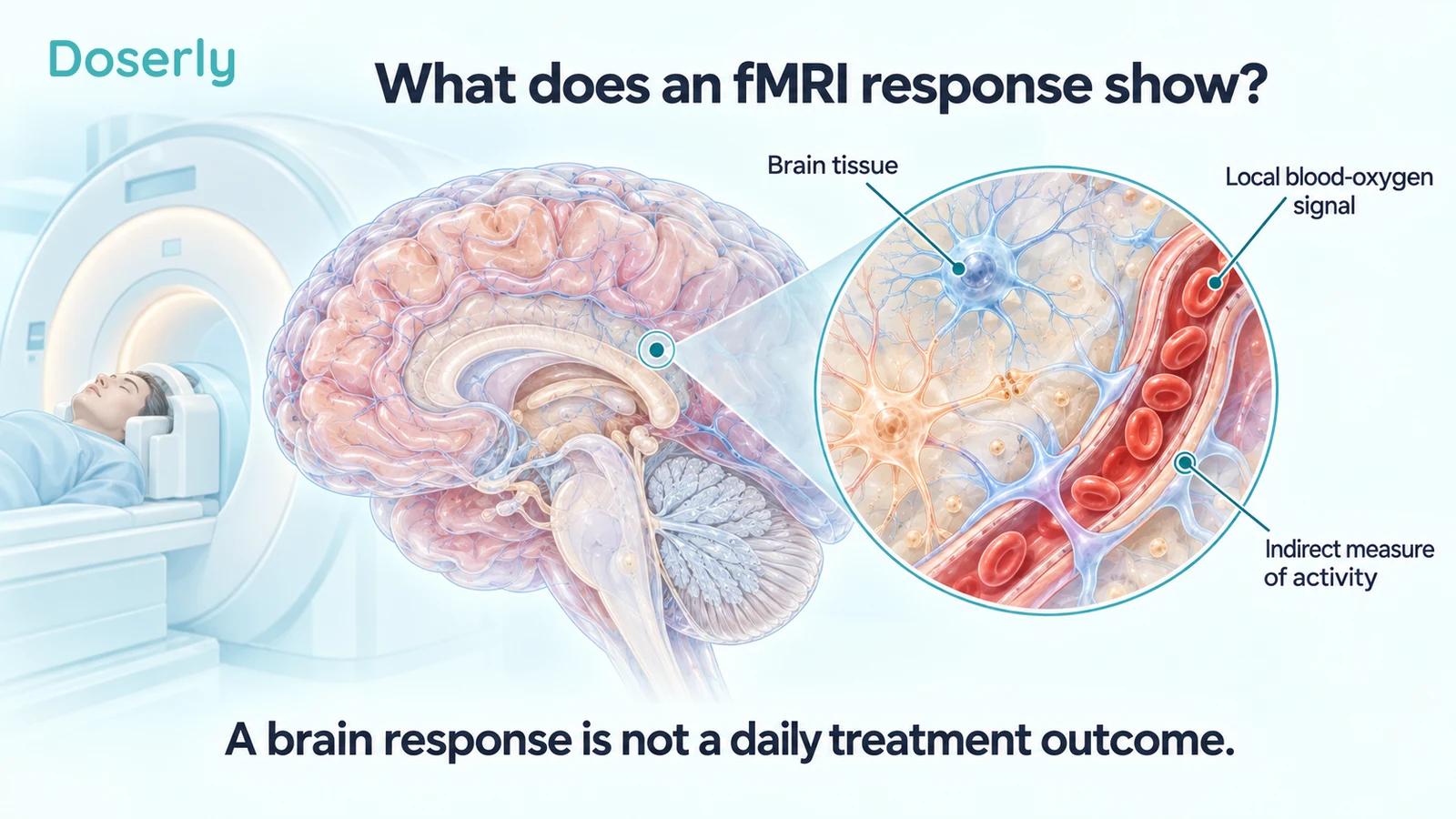
Functional magnetic resonance imaging, or fMRI, measures changes in a signal associated with blood oxygenation. It is used as an indirect indicator of local brain activity. Researchers compare that signal while people perform particular tasks or view particular material, and then compare responses under kisspeptin and placebo conditions.
An activation map is not a direct readout of desire, and a colored region is not a simple “libido center.” Brain regions participate in multiple functions. An increase or decrease in task-related activity needs interpretation within the whole experimental design. In the kisspeptin trials, some areas became more active and others less active; the finding was a change in processing, not a uniform increase across the brain. Women’s primary report
The group map also does not show that every participant experienced the same subjective effect. It summarizes statistical comparisons across people and visits. This is one reason the investigators collected questionnaires and, in the men’s trial, a physiological arousal measure alongside imaging.
What the study in women tested
The 2022 trial recruited premenopausal women with hypoactive sexual desire disorder, or HSDD. This diagnosis concerns distressing low desire, not simply having less interest in sex than another person. Forty women were randomized and 32 completed both visits.
Each participant received a 75-minute kisspeptin-54 infusion on one visit and placebo on another, in randomized order. The visits were at least a month apart and took place during days 1–7 of the menstrual cycle. Standardizing cycle timing helped reduce hormonal variation between visits. Participants viewed erotic videos and completed a facial-attraction task during imaging. Women’s trial methods
The primary outcomes were brain responses during those tasks. Kisspeptin altered activity in several regions, and some regional responses correlated with baseline distress or reported sexual aversion. These associations help generate hypotheses about how the peptide might act, but they do not demonstrate that distress improved over weeks or that a particular brain change caused a therapeutic benefit.
The questionnaire results deserve equal attention. The Sexual Arousal and Desire Inventory, or SADI, did not improve at the overall domain level. An exploratory analysis found an increase of 0.5 points on an item asking how sexy participants felt, with a 95% confidence interval of 0.05–0.95. That individual item was an exploratory finding, not a successful broad measure of sustained desire. Women’s results
What the study in men added
The 2023 trial enrolled men with HSDD, with 37 randomized and 32 completing both visits. Participants were right-handed, heterosexual and had normal reproductive hormone status. The researchers screened for other problems that could complicate interpretation, including underlying erectile dysfunction and active depression.
As in the women’s study, each participant received kisspeptin-54 and placebo during separate 75-minute infusions. Visits were at least seven days apart. Men viewed short and longer sexual-video tasks; during the longer task, researchers measured penile tumescence, meaning the increase in penile size associated with arousal. Men’s trial methods
The primary result was a change in task-related brain activity. Secondary findings included increased penile tumescence and a 0.63-point improvement on an item concerning happiness about sex, with a 95% confidence interval of 0.10–1.15. There was no overall domain-level effect on the SADI questionnaire. The same report found no testosterone change during the 75-minute experimental period. Men’s results
These findings indicate acute biological and some subjective effects under the conditions tested. They do not show that treatment restored normal sexual function at home, improved relationships or produced a durable reduction in distress.
What does the “56%” result actually mean?
The men’s paper reported that penile tumescence was up to 56% greater than placebo during the longer video task, with the maximal response at the end of the eight-minute video. The reported mean difference at that point was 0.28 units, with a 95% confidence interval of 0.04–0.52. Primary report
This was a relative difference in a laboratory physiological response. It was not a 56% rise in a general libido score, a finding that 56% of men were cured or a 56% improvement in relationship satisfaction. “Up to” also identifies a maximum within the measured task, rather than a constant effect throughout daily life.
Physical arousal and subjective desire often interact, but they are not interchangeable. A person can experience a physiological response without wanting sexual activity, or want sexual activity without the physical response they would like. The trial's measurements should therefore retain their actual names.
Why the crossover design is useful
In a crossover experiment, the same person receives both conditions on different visits. That allows the comparison to account for some stable differences between people, such as their usual response to stimuli. Randomizing the order and masking participants and researchers helps reduce expectation and order effects.
The washout interval is intended to reduce carryover from the first visit. In the women’s trial, cycle timing adds another layer of control. These design features strengthen the conclusion that the observed acute differences were associated with the experimental infusion conditions.
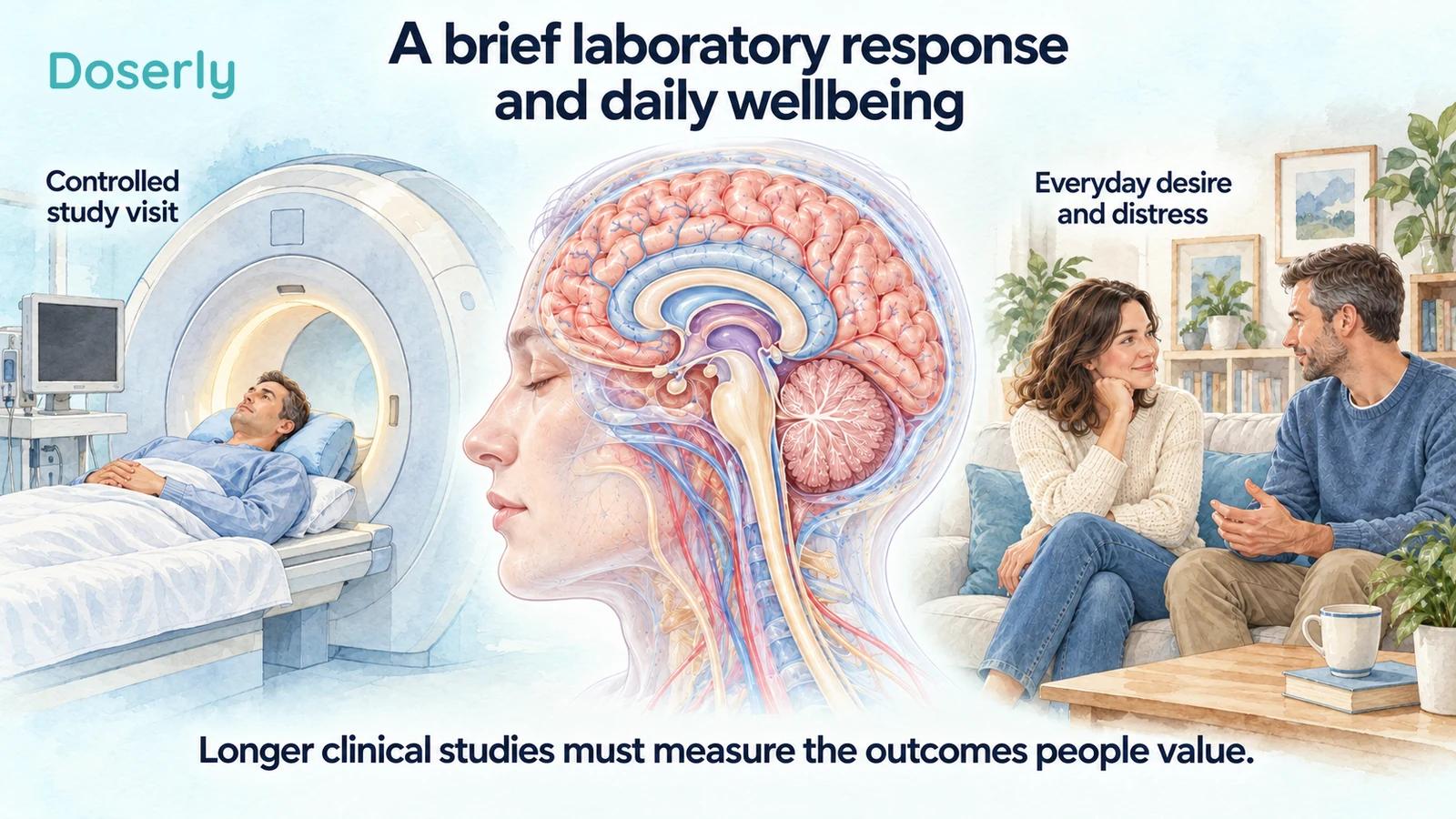
They do not turn the experiment into a daily treatment trial. People were receiving an intravenous infusion, lying in a scanner, viewing standardized material and completing repeated assessments. A treatment intended for ordinary life must work under a different set of circumstances, with acceptable convenience, tolerability and sustained benefit.
What earlier healthy-volunteer research contributes
A 2017 study analyzed 29 healthy heterosexual young men who received kisspeptin-54 and vehicle on separate visits. Kisspeptin altered responses to sexual and couple-bonding images, with some associations involving mood and other psychological measures. Overall sexual arousal and desire questionnaire domains did not differ between conditions. Healthy-volunteer study
This work supported the decision to investigate HSDD. It did not establish treatment benefit for a sexual disorder because the participants did not have that disorder. Nor does a response to couple-bonding pictures prove that a medicine increases romantic attachment or improves a real relationship.
The sequence of research is useful: initial human physiology and healthy-volunteer experiments can identify mechanisms worth testing in selected patients. A later study still needs to show whether those mechanisms translate into patient-valued outcomes over a suitable period.
Are the brain effects simply a testosterone effect?
The acute HSDD experiments did not show increased downstream testosterone during the observation period. The women’s study also did not find changes in estradiol or progesterone. That makes a simple explanation based on an immediate sex-steroid rise less plausible for the observed task effects. Women’s trial; men’s trial
It does not fully identify the mechanism. Kisspeptin could influence several connected signaling systems, and a change in brain activity does not show exactly which receptor pathway produced it. The mechanistic interpretations in the discussion sections remain interpretations, even when grounded in relevant biology.
This is also why the desire studies should not be repurposed as evidence that kisspeptin treats low testosterone. That is a different clinical question, requiring an appropriate patient population, sustained hormone measurements and symptom outcomes.
Why the exact peptide and route matter
The HSDD studies used kisspeptin-54. Products discussed outside these trials may instead contain kisspeptin-10, a shorter peptide, or use a different route. Sharing a receptor pathway does not establish that the formulations produce the same exposure or clinical effects.
FDA's 2024 compounding advisory briefing evaluated kisspeptin-10 for particular proposed uses and routes. It described gaps in product characterization, safety and immunogenicity information. That historical assessment is not a trial of kisspeptin-54 for HSDD, and it should not be mistaken for an approval or a complete current evaluation of every kisspeptin product. FDA briefing
The short HSDD studies reported good acute tolerability, but that cannot establish safety during months of repeated treatment. Questions about repeated exposure, other medicines and uncommon reactions require additional data. A small infusion experiment cannot supply a validated at-home regimen.
What would a useful next treatment study measure?
A clinical trial would need to specify who is being treated and what counts as a worthwhile improvement. Repeated measures of desire and sexual distress over time would be more directly relevant than another isolated brain response. Satisfaction, participant-defined goals, tolerability and treatment discontinuation would also help explain whether a benefit is useful.
The study should not assume that everyone wants more frequent sexual activity. A patient might value less distress, a more comfortable experience or a return of interest in circumstances that matter to them. Low desire has a personal and health context; professional sexual-health guidance recognizes variation in desire and the relevance of medical, medication and relationship factors. ACOG sexual-health information
For now, the kisspeptin studies show that a reproductive peptide can influence acute sexual processing in humans. They provide a research foundation, while leaving the daily treatment question open. If distressing low desire is your concern, the kisspeptin evidence section can help you discuss the findings without confusing a laboratory response with an established treatment result.
Explore the research
- Women with HSDD, 2022: brain outcomes and exploratory questionnaire findings.
- Men with HSDD, 2023: brain responses, tumescence and subjective items.
- Healthy men, 2017: sexual and emotional processing experiment.
- Early kisspeptin-54 physiology, 2005: reproductive hormone responses.
- FDA kisspeptin-10 briefing, 2024: formulation and safety gaps for the proposed uses.
- ACOG: Your Sexual Health: clinical context for desire and distress.