
Peptides
October 16, 2026
Kisspeptin and hormonal feedback: why more is not a simple equation
On this page
Kisspeptin can stimulate the reproductive hormone system, which makes it an appealing subject for research into low hormone levels and infertility. But that system responds to timing, previous exposure and signals returning from the testes or ovaries. Giving more of an upstream signal does not guarantee a larger or longer-lasting response downstream.
Human experiments illustrate the problem unusually well. Some kisspeptin schedules produce sustained stimulation, others produce a response that fades, and prolonged exposure to a modified kisspeptin analogue has deliberately been used to suppress testosterone. Those findings are not interchangeable, but together they explain why a simple “more peptide, more testosterone” prediction is unreliable.
If you're trying to understand a changing hormone result, the useful questions are what was given, how it reached the body, how long exposure lasted and when the sample was collected. We'll work through those questions using the human studies, including results published in 2026. The Doserly kisspeptin guide provides a broader introduction to the peptide and its investigational uses.
Follow the signals in both directions
Kisspeptin acts on signaling upstream of gonadotropin-releasing hormone, or GnRH. GnRH reaches the pituitary gland, which releases luteinizing hormone (LH) and follicle-stimulating hormone (FSH). These hormones then act on the testes or ovaries. They are called gonadotropins because they stimulate the gonads, the reproductive organs that produce eggs or sperm and sex hormones.
The pathway also receives information back from those organs. Testosterone, estradiol and other reproductive signals influence how the brain and pituitary respond. This feedback helps regulate the system rather than allowing hormone production to rise indefinitely. The pathway is therefore a loop with several points of regulation, not just a sequence of one-way switches.
Timing is part of its normal operation. GnRH is released in pulses, and researchers often examine repeated LH samples as an accessible sign of that upstream rhythm. A single blood sample cannot show how often pulses occurred or how much hormone was released across an entire day. Human kisspeptin experiments have measured both average LH concentrations and pulse characteristics. George and colleagues, 2011.
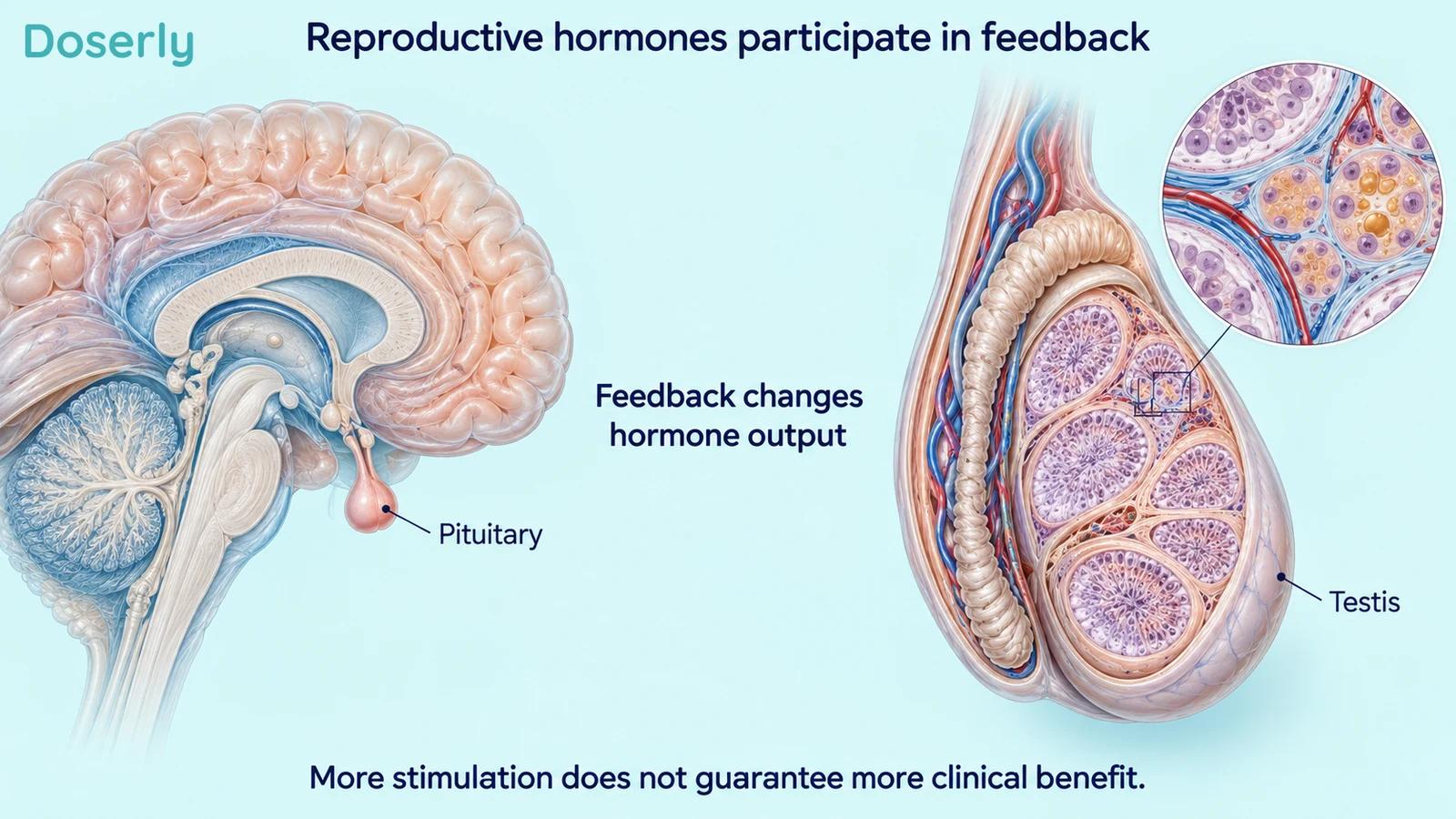
Feedback and desensitization are different processes
Negative feedback describes downstream hormones influencing earlier parts of the system. Desensitization describes a reduced response to a signal after exposure. Both can contribute to a changing hormone result, but the terms do not name the same mechanism.
Researchers sometimes use tachyphylaxis for a response that diminishes relatively quickly with repeated administration. Observing a smaller LH rise is evidence of a smaller measured response; identifying exactly where that reduction originates requires additional testing. It could involve the kisspeptin pathway, GnRH release, pituitary responsiveness or interacting physiological signals.
This distinction matters if a treatment seems to “stop working.” A lower blood value doesn't identify receptor damage, prove permanent suppression or show that increasing the amount will solve the problem. Even when desensitization is a plausible explanation, the clinical goal still needs attention. A laboratory rise can fade without explaining every symptom, and symptoms can change for reasons not captured by the hormone measurement.
What an early dose-response experiment found
In 2011, researchers gave intravenous kisspeptin-10 to healthy men and examined LH responses. In the bolus experiment, the largest tested dose did not produce the largest response. The response to 3 micrograms per kilogram was lower than the response to 1 microgram per kilogram. This was a small physiological experiment, with six men contributing to the reported maximal-response comparison, not a dosing guide.
A separate infusion component found increased LH pulse frequency and pulse size in four participants. At a higher infusion rate, a high background of LH secretion made individual pulses harder to distinguish. George and colleagues.
There are two practical lessons. First, a dose-response curve need not keep rising as the amount increases. Second, a high average concentration can make it harder to characterize the rhythm underneath. “LH went up” and “normal pulsatility was restored” are different claims and require different measurements.
Repeated exposure in women with absent periods
A 2009 study investigated kisspeptin-54 in women with hypothalamic amenorrhea, a condition in which reduced hypothalamic reproductive signaling is associated with absent menstrual periods. An initial subcutaneous injection produced substantial LH and FSH increases. With repeated administration, the response diminished. The paper described this as tachyphylaxis. Jayasena and colleagues, 2009.
That finding was important because it showed why an impressive first response was not enough to establish a continuing treatment. The gland could respond initially, yet repeating the intervention did not simply reproduce the first day indefinitely.
A subsequent 2010 study compared exposure patterns and followed twice-weekly kisspeptin-54 administration for eight weeks. The less frequent pattern produced partial rather than complete desensitization, and reproductive hormone responses remained higher than with saline at the end of the study. With twice-daily administration, FSH responsiveness was nearly abolished by the second day. Jayasena and colleagues, 2010.
The distinction is more precise than saying “breaks prevent tolerance.” A response was retained under one studied schedule in one patient group, and some diminution still occurred. The study did not establish a universal interval for every kisspeptin formulation, for men receiving testosterone or for people using it to improve desire.
The person's hormonal state matters too
A different experiment examined healthy women with regular cycles. Twice-daily kisspeptin-54 for seven days did not abolish menstrual cyclicity. The study reported changes in cycle timing, including an earlier highest recorded LH and earlier luteal-phase onset, rather than the complete loss of reproductive activity that might have been predicted from the amenorrhea studies. Study in healthy female volunteers.
A healthy cycling system and a system affected by hypothalamic amenorrhea begin in different states. Background sex hormones, the stage of the cycle and endogenous signaling can all change the context in which an administered signal is received. The observed difference is a reason to study populations separately, not an invitation to assume one group is immune to desensitization.
For someone looking at their own results, the comparison should therefore include the underlying diagnosis. A schedule investigated in people with reduced hypothalamic signaling cannot automatically be applied to someone whose reproductive hormones are already within their usual range.
What the 2026 continuous-infusion study adds
A 2026 report followed three healthy men during a 24-hour continuous intravenous kisspeptin-10 infusion. LH initially rose, reaching peak concentrations five to eight times baseline. It then declined by 13%–47% from the peak by the end of the infusion, while remaining above baseline. FSH and testosterone rose more modestly. Naveed and colleagues, 2026.
The time course is the finding. An early sample, a peak sample and an end-of-infusion sample would tell different stories about the same exposure. Describing only the peak would miss the later decline; describing the decline as a complete shutdown would also be wrong.
With only three participants, this experiment cannot establish a predictable response for a broader population. It does show why the duration of observation matters when discussing continuous stimulation. The numbers describe supervised research exposure, not targets for self-adjusting an injection schedule.
Twelve days of stimulation: an important qualification
Another 2026 study investigated subcutaneous kisspeptin-10 in healthy men. Fifteen men were recruited across three experiments, with some participants contributing to more than one component; the component sample sizes should not simply be added as if they represented distinct people. Twelve men served as controls.
The researchers examined acute infusion, five days of continuous exposure and daily eight-hour infusions over 12 days. After five days of continuous infusion, testosterone remained elevated while gonadotropin concentrations were similar to vehicle. With the daily intermittent exposure, gonadotropin increases were still present on day 12, and a subsequent bolus could still elicit a response. Yeung and colleagues, 2026.
This provides human evidence that repeated exposure does not inevitably abolish the response. It also reinforces that different hormones can behave differently over the same period. The trial measured endocrine responses in healthy men; it did not demonstrate improved sperm production, pregnancy or relief of symptoms in a patient population.
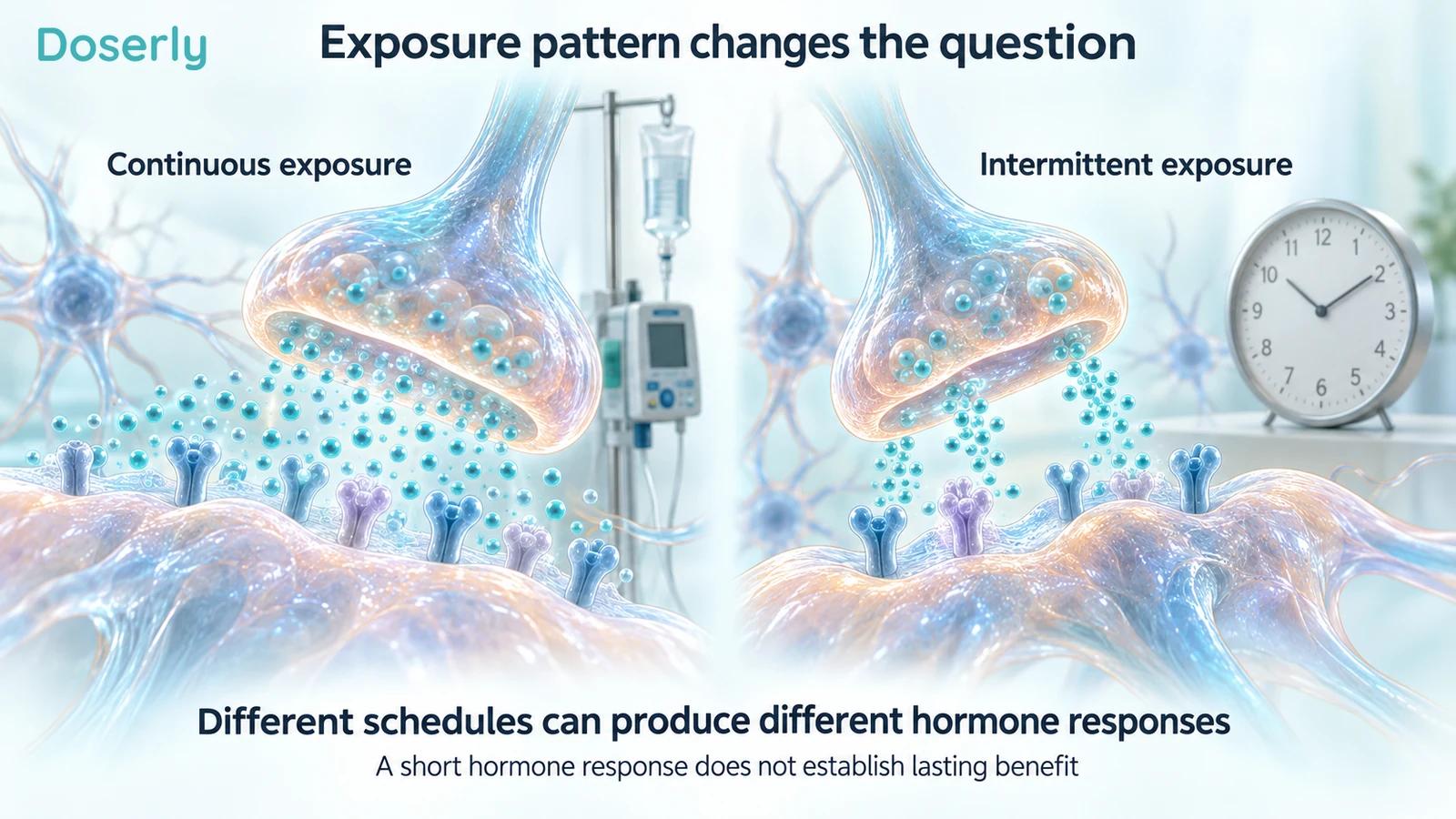
Why analogue studies can show the opposite result
An analogue is a modified molecule designed to change characteristics such as duration of action. TAK-448 is a kisspeptin-related investigational analogue; it is not native kisspeptin-10 or kisspeptin-54.
In phase 1 studies, brief exposure initially increased testosterone, while sustained exposure suppressed it. During a 14-day infusion, higher studied exposures brought testosterone below baseline and subsequently into the range sought for hormonal suppression in prostate cancer. A small depot-formulation study in men with prostate cancer also reduced testosterone. MacLean and colleagues, 2014.
These findings make biological sense as a warning against equating receptor stimulation with permanent downstream stimulation. They do not show that every native kisspeptin schedule causes the same suppression. The molecule, formulation and sustained exposure were central to the intervention. Calling the result simply “what kisspeptin does” would erase the distinctions needed to understand it.
How to make sense of changing blood results
Suppose two blood tests show different LH values after treatment. Before interpreting the difference as improvement or failure, establish the sampling context. Were both collected at a comparable interval after administration? Was the formulation the same? Had treatment been ongoing for the same length of time? Were other hormone medicines changed?
A dated record helps answer these questions without pretending to diagnose the mechanism. It is especially useful to record the time of administration and blood collection separately. “Monday's result” is less informative than knowing whether it was measured before exposure, shortly afterward or near the end of a treatment interval.
The relevant outcome also determines which measurements matter. If the goal is fertility, a temporary LH rise is only part of the picture. If the concern is absent periods, a hormone response doesn't by itself establish regular ovulation. If the concern is low desire, hormone changes need to be connected with the person's experience. Increasing a laboratory number is not automatically the same task as improving the condition that prompted testing.
What these studies mean for treatment claims
The human research supports a careful conclusion: kisspeptin can stimulate reproductive hormones, and the response depends on the exposure pattern and physiological setting. It does not support a rule that more is better, that continuous exposure always shuts the system down, or that a particular break schedule guarantees continued benefit.
A clinician discussing an investigational approach should be able to identify the molecule and population behind the proposed rationale, describe what will be monitored and explain what would lead to changing the plan. If the rationale rests on a first-dose hormone response, ask how sustained benefit has been evaluated.
The kisspeptin human evidence section provides more context on fertility and hormone studies. The central point is not that the pathway is unpredictable in every respect. It is that a regulated reproductive system requires attention to timing, diagnosis and the actual outcome, rather than treating the amount administered as the only important variable.
Explore the research
- George et al., 2011: kisspeptin-10 and LH pulses.
- Jayasena et al., 2009: acute response and tachyphylaxis in hypothalamic amenorrhea.
- Jayasena et al., 2010: twice-weekly kisspeptin-54 over eight weeks.
- Healthy women: repeated kisspeptin-54 and menstrual cyclicity, 2013.
- Naveed et al., 2026: continuous infusion over 24 hours.
- Yeung et al., 2026: subcutaneous exposure through 12 days.
- MacLean et al., 2014: the modified analogue TAK-448.