
Peptides
October 16, 2026
Kisspeptin and fertility research: why the clinical setting matters
On this page
A fertility headline can make kisspeptin sound like a general way to improve the chances of pregnancy. The actual research asks a much more specific question: can kisspeptin-54 help trigger the final maturation of eggs during a carefully managed IVF cycle?
Early human trials show that it can. Eggs matured after a kisspeptin trigger have been retrieved, fertilized and used in pregnancies resulting in live births. Those are meaningful findings. But a successful step within IVF is not evidence that kisspeptin treats every cause of infertility, improves natural conception or outperforms established IVF triggers. Original proof-of-concept study
Understanding the clinical setting changes how these results should be read. The participants were already receiving other fertility medicines. Specialists monitored their ovaries, selected the timing of the trigger, collected eggs and provided laboratory and pregnancy care. Kisspeptin was one part of that process.
Where kisspeptin fits into reproductive signaling
Kisspeptin helps regulate the hypothalamic signals that control reproduction. It stimulates the pathway leading to gonadotropin-releasing hormone, or GnRH, which prompts the pituitary gland to release luteinizing hormone, or LH, and follicle-stimulating hormone, or FSH. These hormones have different, coordinated roles in ovarian function.
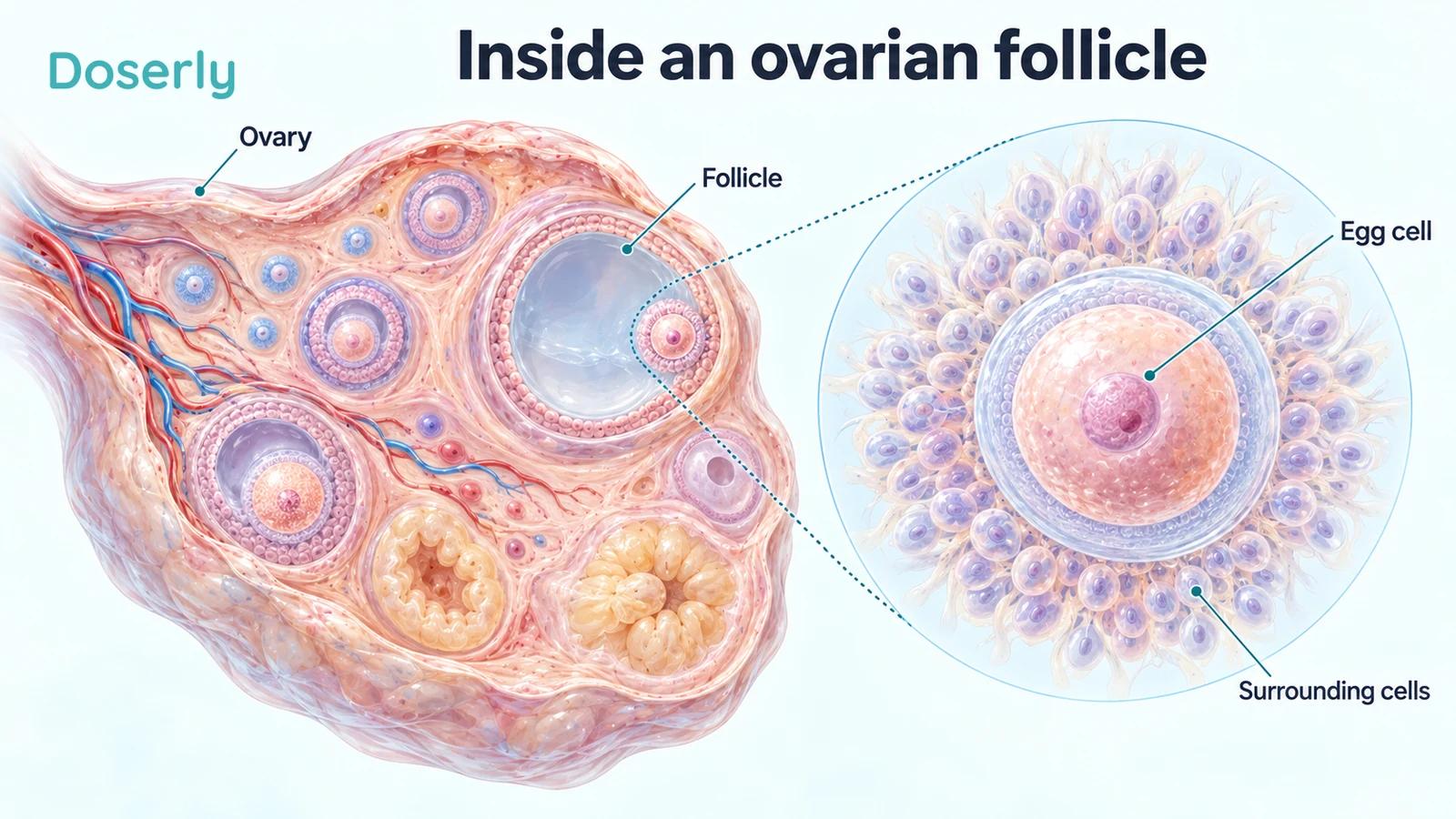
In IVF, clinicians first encourage several ovarian follicles to develop. A follicle is a fluid-filled structure containing an egg; seeing a follicle on ultrasound does not mean that a mature egg will necessarily be recovered from it. The trigger is intended to produce the final maturation signal before egg collection.
Kisspeptin-54 was investigated as a way to recruit the body's own hormonal signaling for that trigger. It was not being used to create eggs, reverse reproductive aging or repair blocked fallopian tubes. The biological target was a particular stage of an already planned treatment cycle. Our kisspeptin guide explains the broader pathway and why the peptide form matters.
What the first IVF study established
The 2014 proof-of-concept study included 53 women undergoing IVF. Before receiving kisspeptin-54, they had ovarian stimulation with recombinant FSH and a GnRH antagonist to prevent a premature ovulatory signal. The investigators then used a kisspeptin-54 trigger and assessed egg maturation after retrieval.
Maturation occurred at each dose studied. Fertilization and embryo transfer were achieved in 49 of the 53 participants, while 12 of 53 had a clinical pregnancy. The study demonstrated that the sequence was biologically and clinically possible. It did not randomly assign participants to kisspeptin versus an established trigger to establish superiority. Jayasena and colleagues, 2014
The distinction between feasibility and comparative effectiveness is central. A first study can establish that a new approach produces eggs that can lead to pregnancy. The next questions are whether the approach works reliably, which patients benefit, what risks accompany it and how it compares with existing care.
It would also be misleading to credit the entire pregnancy outcome to kisspeptin. Ovarian stimulation, sperm factors, embryology procedures, embryo selection, transfer and subsequent care all contribute. In a multistep treatment, showing that one component can be substituted is different from showing that it explains the final outcome.
Why researchers focused on ovarian hyperstimulation
Ovarian hyperstimulation syndrome, or OHSS, is a complication associated with fertility treatment. In more serious cases, increased vascular permeability allows fluid to shift out of the circulation, causing significant illness. Its risk depends on the patient's characteristics, ovarian response and treatment strategy. ASRM prevention guideline
A trigger that produces an adequate maturation signal while limiting excessive stimulation is therefore attractive. That is the rationale behind studying kisspeptin in women at increased OHSS risk. It is a risk-reduction hypothesis, not a guarantee that kisspeptin makes stimulated ovaries risk-free.
Established prevention approaches already exist. ASRM guidance emphasizes risk assessment, individualized treatment and strategies including GnRH agonist triggering where appropriate. Any new trigger must be evaluated against contemporary care, rather than against an assumption that the only alternative is an older, higher-risk approach.
This also explains why clinic supervision is part of the intervention. Ultrasound findings and hormone measurements inform decisions throughout treatment. A peptide cannot reproduce the monitoring, clinical judgment and access to urgent assessment built into a fertility program.
What the high-risk trial found
A 2015 phase 2 study investigated kisspeptin-54 in 60 women at high risk of OHSS. Participants were allocated among different kisspeptin doses in an open-label study. At least one mature egg was obtained in 95% of participants. No moderate, severe or critical OHSS was reported. High-risk IVF study
That combination justified further investigation: egg maturation was achieved, and the observed safety experience was encouraging. But 60 participants cannot establish that a rare complication never occurs. The study also did not include a randomized comparison against an established trigger, so its results cannot settle the comparative safety question.
The pregnancy statistics need their denominators attached. The reported clinical pregnancy rate of 53% and live-birth rate of 45% were per embryo transfer, among 51 transfers. They were not the proportions of all 60 enrolled participants. A patient who does not reach transfer is absent from a per-transfer calculation.
Neither denominator is inherently wrong. They answer different questions. A clinic may want to understand the likelihood of pregnancy once a transfer occurs; a person starting treatment may want the likelihood of a live birth from the entire initiated cycle. A headline that drops the denominator blurs that difference.
What “oocyte yield” actually measures
An oocyte is an egg cell. In these studies, oocyte yield related the number of mature eggs recovered to the number of follicles above a specified ultrasound size threshold. That is not the same as the percentage of retrieved eggs that were mature.
This detail can produce surprising numbers. Because smaller follicles can also contribute eggs, a ratio using only larger follicles as its denominator can exceed 100%. That does not imply that researchers created more than one egg inside every counted follicle or that every egg was successfully fertilized. It reflects the definition of the measurement. 2015 trial methods
When reading an IVF result, pause over the unit: is the paper counting mature eggs, women with at least one mature egg, embryos, transfers, pregnancies or births? All are useful, but they sit at different stages. A large improvement in one measure cannot be substituted for an improvement in the next.
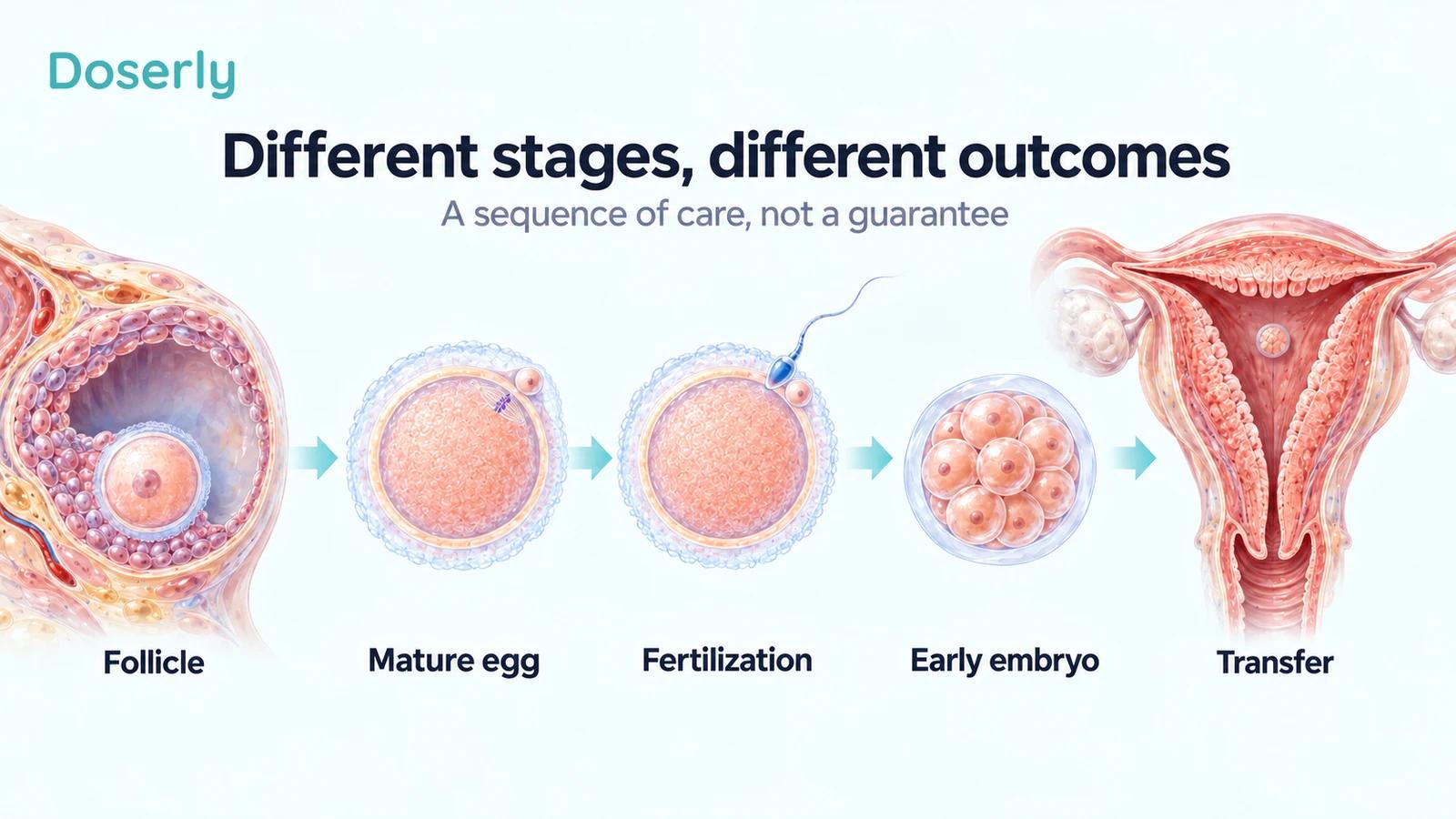
Image sources: metaphase II
What a second-dose experiment added
A 2017 randomized trial enrolled 62 women at high risk of OHSS. Everyone received an initial kisspeptin-54 trigger. Participants then received either a second kisspeptin dose or saline. This design tested the value of an additional dose within a kisspeptin-based regimen; it did not compare kisspeptin with standard trigger medicines.
The primary outcome was the proportion achieving an oocyte yield of at least 60%. That threshold was reached by 71% in the second-dose group and 45% in the single-dose group. The full-text table reports 22 of 31 versus 14 of 31 participants. The abstract contains an inconsistent numerator for the 71% figure, so the table is the clearer source. Second-dose randomized trial
This supports a conclusion about maturation efficiency under the studied conditions. It does not by itself establish a live-birth advantage. Pregnancy and birth results from a small trial can be interesting without being precise enough to determine which strategy produces better reproductive outcomes overall.
One participant in the single-dose group developed moderate OHSS; none in the second-dose group did. With only 31 people per group, that difference cannot establish that the second dose eliminates the complication. It does demonstrate why “no OHSS” is an inaccurate blanket description of the research program.
Why this is not a home fertility protocol
The trial reports contain schedules and amounts because reproducible science requires them. That information is not a complete clinical protocol for someone reading the paper.
The treatment depended on ovarian response, timing relative to other medicines, specialist assessment and access to egg retrieval. A trigger given outside the intended context cannot be assumed to produce the same hormonal response or clinical outcome. Different causes of infertility may also involve problems that stimulating this pathway does not address.
The formulation matters as well. These studies investigated kisspeptin-54 prepared for clinical research. A product marketed simply as “kisspeptin,” particularly kisspeptin-10, is not automatically the same intervention. Sharing a receptor target does not make formulations, exposure patterns or manufacturing quality interchangeable.
For someone already receiving fertility care, the useful question is how a proposed intervention fits the clinic's evidence-based strategy and the individual's diagnosis. A research result should support a specific conversation with the treating team, not replace the information that team has from scans, laboratory tests and treatment history.
What a more decisive study would need
A comparative trial would need an appropriate established trigger in the control group, comparable stimulation and follow-up, and enough participants to evaluate clinically important differences. It should specify whether its main aim is maturation, OHSS prevention, live birth or another outcome before results are known.
Safety and effectiveness also have to be considered together. Obtaining more mature eggs is valuable only in relation to the wider treatment experience. A regimen could improve a laboratory endpoint while adding inconvenience, cost or uncertainty. Conversely, a similar egg yield with a meaningful safety improvement could matter greatly.
Longer follow-up and careful reporting of pregnancy and neonatal outcomes help address questions that an early maturation study cannot. So does reporting results for everyone who began the allocated treatment, rather than only those who reached a favorable later stage.
For patients comparing claims, these are practical reading questions: who was included, what was the comparator, what counted as success, and which participants disappeared from the denominator? They reveal more than a single impressive percentage.
How to bring the evidence into a fertility appointment
A person considering participation in research can ask what question the trial is designed to answer, what established options are available, how OHSS risk is assessed and what happens if the expected response does not occur. These are questions about the whole care pathway.
It is also reasonable to ask whether a proposed benefit concerns eggs, pregnancy or live birth. A statement such as “improved maturation” may be accurate and useful, while still leaving the outcome that matters most to the patient uncertain.
The current studies make kisspeptin-54 a credible subject for fertility research. They show successful egg maturation in monitored IVF and provide encouraging, limited safety observations in selected women. Their value is clearest when kept in that setting. The evidence supports further clinical evaluation of a specific IVF trigger, not a general promise of improved fertility.
For the wider evidence and the distinction between peptide forms, see the kisspeptin research guide.
Explore the research
- 2014 IVF proof-of-concept study
- 2015 study in women at high OHSS risk
- 2017 randomized second-dose study
- ASRM guideline on prevention of moderate and severe OHSS
- ESHRE: The oocyte—From GV to MII, final maturation and fertilization stages, page 6