
Peptides
October 16, 2026
Kisspeptin-10 versus kisspeptin-54: why the form matters
On this page
Two articles can discuss “kisspeptin” while describing different interventions. One may examine a brief kisspeptin-10 infusion and reproductive hormones; another may use kisspeptin-54 during a brain-imaging experiment or an IVF cycle. Leaving off the number makes the research sound more interchangeable than it is.
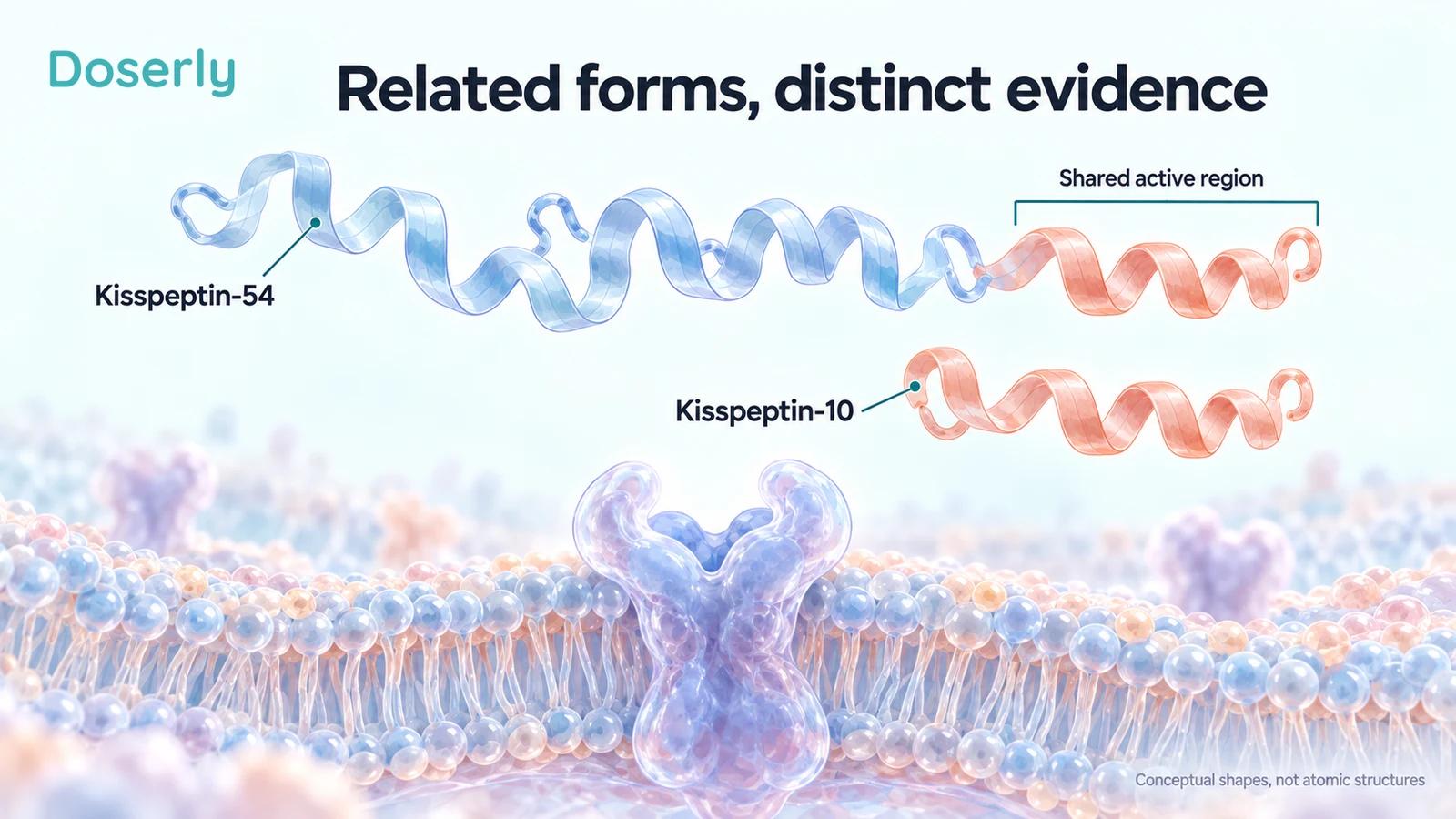
The numbers refer to the lengths of the peptides: 10 or 54 amino acids. Both belong to the kisspeptin family and share an active sequence at one end. That explains their related biological activity. It does not establish identical exposure in the body, identical responses in every population or equivalent clinical benefits. Human comparison study
The useful question is not which form is universally “better.” It is which form was tested, how it was delivered, in whom and for what outcome. Those details determine whether a particular finding applies to the claim being made.
What the two names tell us
Amino acids are the building blocks of peptides. Kisspeptin-54 contains a longer chain, while kisspeptin-10 corresponds to the shorter active sequence shared by the family. The shorter molecule can activate the kisspeptin receptor; it is not simply an inactive fragment. Human experiments confirm that kisspeptin-10 can stimulate reproductive hormone release. George and colleagues, 2011
But receptor activity is only one part of a medicine's behavior. A molecule must reach relevant tissues, remain available long enough and produce a useful response under the conditions in which it is given. The body can process related molecules differently even when they interact with the same receptor.
The numbers also do not describe concentration, potency or an instruction to use one amount rather than another. A 54-amino-acid peptide is not “5.4 times stronger” because its chain is 5.4 times longer. Nor does the smaller number establish a weaker treatment. Such rankings require an actual comparison with a defined outcome.
The same upstream pathway can produce different experiments
Kisspeptin acts upstream in the reproductive signaling system. It helps stimulate gonadotropin-releasing hormone, or GnRH, which regulates pituitary release of luteinizing hormone and follicle-stimulating hormone. LH and FSH are collectively called gonadotropins.
A study can use a kisspeptin form to probe that pathway without testing a treatment for a disease. For example, measuring an LH rise after a short infusion shows that the signaling system responded. It does not demonstrate improved fertility, sexual satisfaction or symptoms of testosterone deficiency.
That difference is especially important when several research areas are combined in one product description. Hormone experiments, desire studies and egg-maturation trials may all involve kisspeptin, but they do not collectively validate every form for every purpose. Our kisspeptin guide provides the wider context for these separate lines of research.
Half-life is useful, but it is not an effect timer
Half-life describes how long it takes for a measured concentration to fall by half under specified conditions. In an early human kisspeptin-54 study, the estimated plasma half-life was approximately 28 minutes. A later human kisspeptin-10 study estimated approximately four minutes. Kisspeptin-54 study; kisspeptin-10 study
These values help explain why researchers pay attention to formulation and delivery. They do not mean that a hormonal response lasts exactly four or 28 minutes. Downstream signaling can continue after the concentration of the administered peptide changes. An infusion can also continue supplying peptide while the body clears it.
Nor should the figures be used to calculate a home administration schedule. They were measured within particular experiments, using particular routes and assays. Absorption from tissue, continuous delivery and individual physiology can change the exposure pattern. A half-life is one pharmacokinetic observation, not a complete clinical regimen.
It is therefore misleading to describe the longer-lived form as automatically more effective. Longer exposure might help with one research objective and be unnecessary or unhelpful for another. A useful comparison needs to connect exposure with the desired outcome and with safety.
Route and pattern are part of the intervention
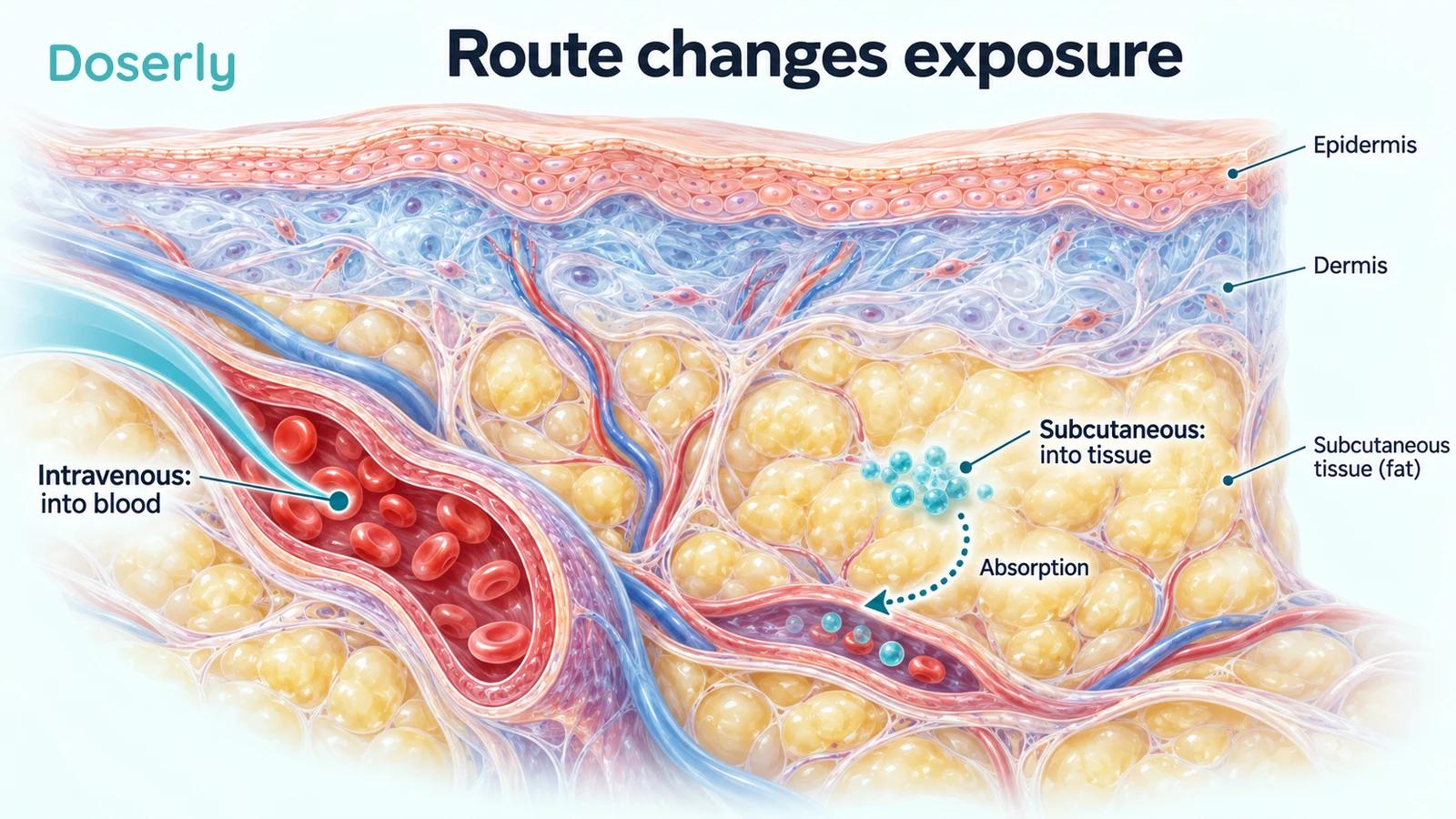
Intravenous administration delivers a substance into the circulation. Subcutaneous administration places it beneath the skin, from where it must be absorbed. A bolus supplies a discrete amount, while an infusion supplies it over time. These differences matter even when the peptide name stays the same.
The 2011 kisspeptin-10 experiments in healthy men used both boluses and infusions. They demonstrated hormone responses, including changes in LH pulsatility. One higher bolus produced a smaller LH response than a lower one, illustrating why “more peptide means more effect” is not a reliable rule. Primary report
The dosing pattern may also affect how the system responds after repeated stimulation. This is not a peculiarity that can be resolved by looking at chain length alone. Duration, breaks in exposure and the biological state of the participants must be considered together.
For a reader checking a claim, “injected kisspeptin” is therefore incomplete information. An hours-long research infusion is not equivalent to a brief injection simply because both use a needle. The relevant match is the whole intervention, not the delivery equipment.
Sex and hormonal context change the response
A small human study compared kisspeptin-10 responses in men and women at different menstrual-cycle stages. Men showed gonadotropin responses, as did women studied near ovulation. Women studied in the follicular phase did not show the same response under the tested kisspeptin-10 conditions.
The study also found that kisspeptin-54 could stimulate gonadotropins in follicular-phase women under the conditions examined. Groups were small, generally four or five participants, so the findings should not become a universal prescribing rule. They demonstrate that related peptides can behave differently in a particular biological setting. Human form and cycle-phase study
This is why “it raises LH in men” cannot settle a question about ovulation in women. Likewise, a response near ovulation does not establish the same response throughout the cycle. The endocrine system is already changing before any study intervention is introduced.
A paper's participant criteria are therefore part of its result. Healthy volunteers, people with reproductive disorders and patients receiving ovarian stimulation are not interchangeable test populations. The form must be interpreted alongside that context.
What the 2026 subcutaneous study adds
An older summary that says human kisspeptin-10 research consists only of brief intravenous experiments is now incomplete. A 2026 randomized, single-blinded, placebo-controlled study examined subcutaneous kisspeptin-10 in healthy men, including repeated exposure over 12 days.
The overall program recruited 15 men, with small, partly overlapping groups in its component studies. It compared acute exposure, continuous exposure over five days and intermittent daily infusions over 12 days. With continuous exposure, gonadotropin concentrations at day five were similar to vehicle even though testosterone remained elevated. Intermittent exposure maintained gonadotropin responses through day 12. Yeung and colleagues, 2026
This is useful evidence that exposure pattern matters. It also extends research beyond a single laboratory visit. However, healthy men's hormone measurements over 12 days do not establish treatment of hypogonadism, improved fertility or relief of sexual distress. The paper's abstract supports physiological conclusions, not a broad therapeutic guarantee.
The new findings should update our understanding without erasing earlier limitations. There is a large difference between demonstrating a sustained hormonal signal during a small experiment and establishing a practical treatment with durable benefits and adequately characterized risks.
Why desire and IVF findings cannot be transferred between forms
The randomized desire studies in women and men with hypoactive sexual desire disorder used kisspeptin-54 infusions. Their principal outcomes involved brain responses to sexual stimuli; the men's study also measured penile tumescence. Those are not kisspeptin-10 treatment trials. Women's study; men's study
Similarly, the early IVF proof-of-concept research used kisspeptin-54 as a trigger within a monitored fertility cycle. It demonstrated egg maturation and the possibility of subsequent pregnancy, not equivalent performance of any product bearing the kisspeptin name. IVF study
A shared active sequence makes related effects biologically plausible. It does not remove the need to test the other form. If a claim cites the 54-amino-acid form while offering the 10-amino-acid form, that substitution needs its own evidence.
This is a common place where accurate facts create an inaccurate overall impression. Each cited paper may be real, yet the assembled claim can be stronger than any study supports. Checking the form against the proposed use often exposes the gap immediately.
What regulatory discussion can and cannot establish
FDA's October 2024 advisory materials evaluated kisspeptin-10 for proposed compounding uses. The review raised questions about the available clinical evidence and safety information, including the proposed administration routes. That document is specific to kisspeptin-10 and to the regulatory question under consideration. FDA evaluation
It should not be described as approval of a kisspeptin treatment or as an assessment of every possible kisspeptin-54 use. It also predates the 2026 subcutaneous study. A careful account can recognize newer research while preserving the distinction between a published experiment and a regulatory decision.
For the same reason, an ingredient's name does not establish that a marketed preparation matches the material used in a trial. Identity, formulation, quality and the clinical evidence for the intended use are separate questions. A publication about a research preparation cannot answer them all.
How to read a claim without losing the distinctions
Start by finding the exact peptide form in the methods. Then identify the route and whether exposure was a single bolus, a continuous infusion or repeated treatment. Next, check the participants and the outcome. Finally, compare those details with what the headline or product claim promises.
For example, an LH response during a kisspeptin-10 infusion in healthy men supports an endocrine effect in that experiment. It does not establish improved daily desire from intermittent use in a different population. A kisspeptin-54 IVF result supports a fertility research application under specialist care, not a general reproductive enhancement claim.
The forms are related enough to belong in the same scientific conversation and different enough that their evidence should remain identifiable. Keep the number attached to the name, and keep the clinical question attached to the result. That makes promising research easier to appreciate without turning plausible biology into unsupported equivalence.
See the kisspeptin evidence guide for the broader research landscape.
Explore the research
- Human kisspeptin-10 responses by sex and menstrual phase
- Kisspeptin-54 human hormone and half-life study
- Kisspeptin-10 hormone and pulse-frequency study
- Repeated subcutaneous kisspeptin-10 research, 2026
- Kisspeptin-54 desire study in women
- Kisspeptin-54 desire study in men
- Kisspeptin-54 IVF proof of concept
- FDA's 2024 kisspeptin-10 advisory evaluation