
Supplements
October 16, 2026
Iodine and thyroid health: why more can make things worse
On this page
Iodine is essential for making thyroid hormones. That makes an iodine supplement sound like an obvious response to fatigue, an underactive thyroid or a bottle promising “thyroid support.” The missing step is establishing whether inadequate iodine is actually the problem.
An enlarged thyroid, a high thyroid-stimulating hormone result and a low dietary iodine intake are different findings. They can overlap, but they do not mean the same thing. Giving more iodine to someone who already gets enough can produce thyroid dysfunction rather than correct it. The underlying thyroid condition helps determine who is vulnerable. American Thyroid Association guidance
The useful goal is adequate intake with an understood reason for supplementation. It is not the largest dose, the strongest kelp extract or the highest urinary iodine number. Here is how the nutritional role, human studies and product details fit together.
A raw material does not identify the cause of disease
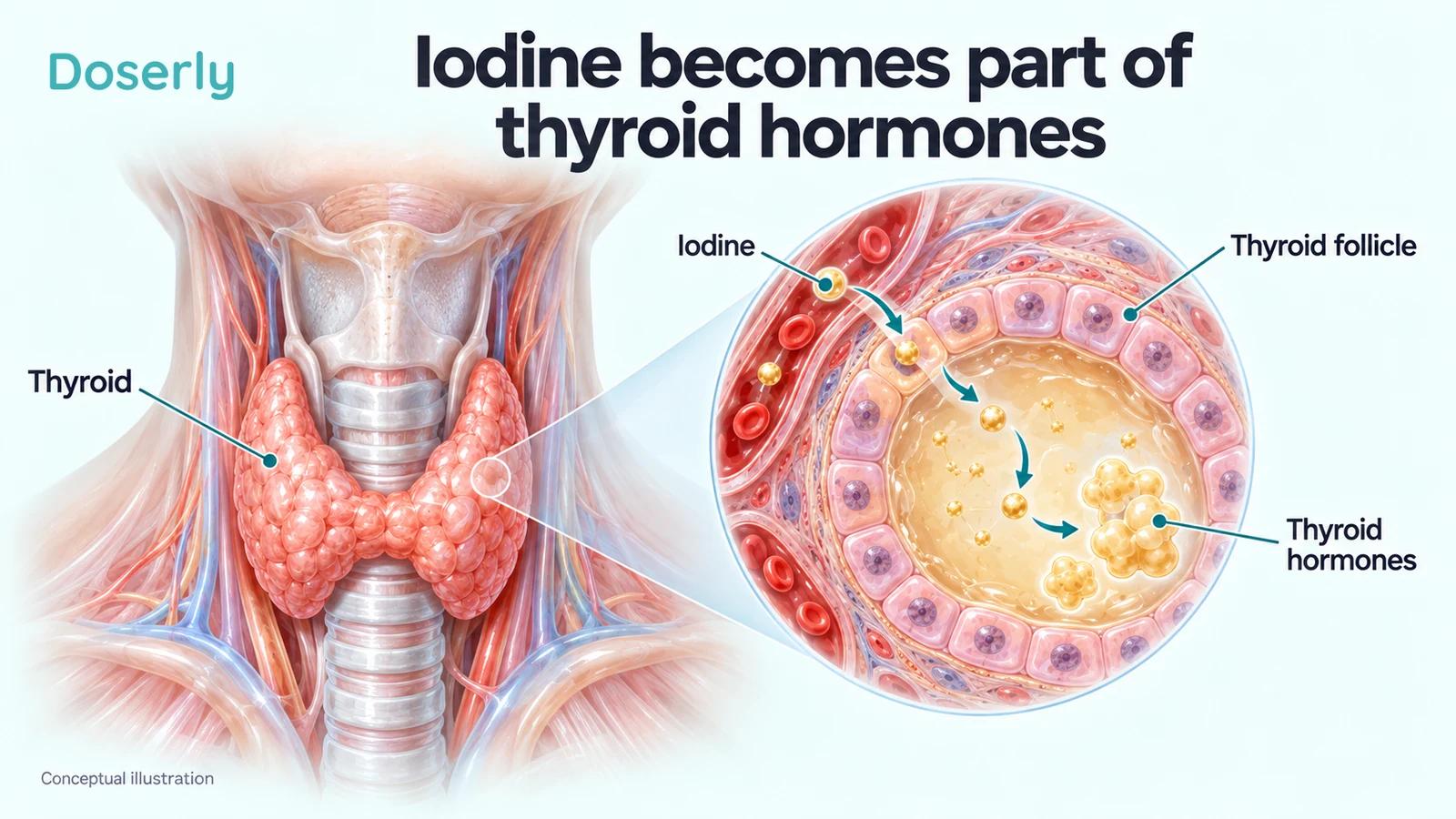
The thyroid uses iodine to produce thyroxine, or T4, and triiodothyronine, or T3. These hormones participate in metabolism, growth and development. Their production is regulated; adding raw material does not simply turn the system up in a helpful way. NIH iodine fact sheet
Consider two people who have been told that their thyroid is enlarged. One might have inadequate iodine intake. Another might have Hashimoto's thyroiditis, an autoimmune condition. The American Thyroid Association explains that treatment of a goiter depends on its cause: iodine replacement may be appropriate for deficiency, while hypothyroidism associated with Hashimoto's can require thyroid hormone replacement. The same visible finding can lead to different treatment. ATA: goiter
This is why “supports thyroid hormone production” is not a complete treatment argument. It describes a nutrient's normal function. It does not establish that a specific symptom came from insufficient intake or that extra iodine will improve it.
Our iodine guide covers the nutrient more broadly. For a thyroid-related decision, the important starting point is the diagnosis and the existing intake, including food and supplements.
Excess can disturb the system in more than one direction
A high iodine exposure can be associated with either underactive or overactive thyroid function. People with existing thyroid disease may be particularly susceptible. The ATA's thyroid hormone replacement guideline specifically identifies underlying thyroid autonomy, Hashimoto's thyroiditis and multinodular glands as settings where excess iodine can precipitate dysfunction. ATA hypothyroidism guideline
That does not mean every serving of an iodine-containing food is dangerous, or that everyone with thyroid disease needs an iodine-free diet. It means “my thyroid is underactive” is not enough information to choose a high-dose supplement. The direction of the laboratory abnormality does not reliably reveal the direction in which iodine intake should change.
Nor is an iodine supplement interchangeable with prescribed levothyroxine. One supplies a nutrient used in hormone synthesis; the other supplies thyroid hormone. Stopping one and replacing it with the other is a treatment change, not a simple brand substitution. The ATA advises discussing supplements and dietary changes with the clinician managing thyroid treatment before altering prescribed medication. ATA complementary medicine guidance
This distinction is especially useful when a product combines iodine with selenium, herbs and other ingredients. A thyroid-themed label can make the mixture look like a unified treatment. In practice, each ingredient introduces a separate exposure, and the diagnosis still has to explain why the mixture is being used.
What a controlled iodine study actually found
A 2012 randomized, double-blind trial studied 256 adults in China who initially had normal thyroid function. For four weeks, participants received different supplemental iodine amounts, ranging from none to 2,000 micrograms daily. Researchers also considered iodine supplied by food and salt. This matters because the supplement amount was only part of total exposure. Iodine dose trial
Subclinical hypothyroidism appeared in 5% of the group receiving a 400-microgram supplement, with higher percentages in several higher-dose groups. The investigators estimated total intake at approximately 800 micrograms daily in that 400-microgram group. Subclinical hypothyroidism is a laboratory pattern, not proof that every affected participant developed noticeable symptoms.
The trial provides a concrete counterexample to the idea that extra iodine is harmless because it is essential. It does not establish a universal personal threshold: the study was short, divided participants among many dose groups and involved a particular population with its own background intake. An individual cannot use the lowest affected study group as a precise line between safety and harm.
The practical lesson is to count what was added to what was already there. A product can appear moderate when viewed alone while substantially increasing the person's total exposure.
Requirements, supplement cautions and upper limits are different numbers
The U.S. recommended dietary allowance is 150 micrograms daily for most adults, rising to 220 during pregnancy and 290 during lactation. These are total-intake reference values. They are not instructions to add that entire amount as a supplement on top of a diet that already supplies it. The U.S. adult upper limit is 1,100 micrograms daily from all sources. NIH iodine reference values
Separately, the ATA advises against iodine or kelp supplements providing more than 500 micrograms daily. Its statement also explains that routine intake above nutritional requirements has no established thyroid benefit. The supplement caution and the total-intake upper limit address different questions; they should not be treated as conflicting targets. ATA excess iodine statement
An upper limit is not a goal, and remaining below it does not guarantee that an individual with thyroid disease will tolerate a particular exposure. Conversely, a clinician's use of iodine for a specific medical indication should not be generalized into a daily wellness routine.
Pay attention to units. One milligram equals 1,000 micrograms. A small-looking number on a liquid product can represent a large amount when the label uses milligrams. Also check whether the stated amount applies to one drop, several drops or a full dropper; those are different serving descriptions.
A salty diet does not necessarily supply enough iodine
The type of salt matters. In the United States, processed foods generally use salt that is not iodized. Sea salt, kosher salt and Himalayan salt are also usually not iodized unless the label says otherwise. A salty meal therefore cannot establish that iodine needs have been met. NIH iodine food guidance
Other regular sources include seafood, dairy products and eggs. A person who avoids most of these foods has a different intake pattern from someone who eats them routinely. That makes a brief food history more useful than guessing from the salt shaker alone. This is a reason to review existing sources, not to increase salt intake. Bring the actual salt label, usual foods and any supplements to the discussion so an apparent gap can be assessed without automatically adding a high-dose product.
Kelp makes the label question harder
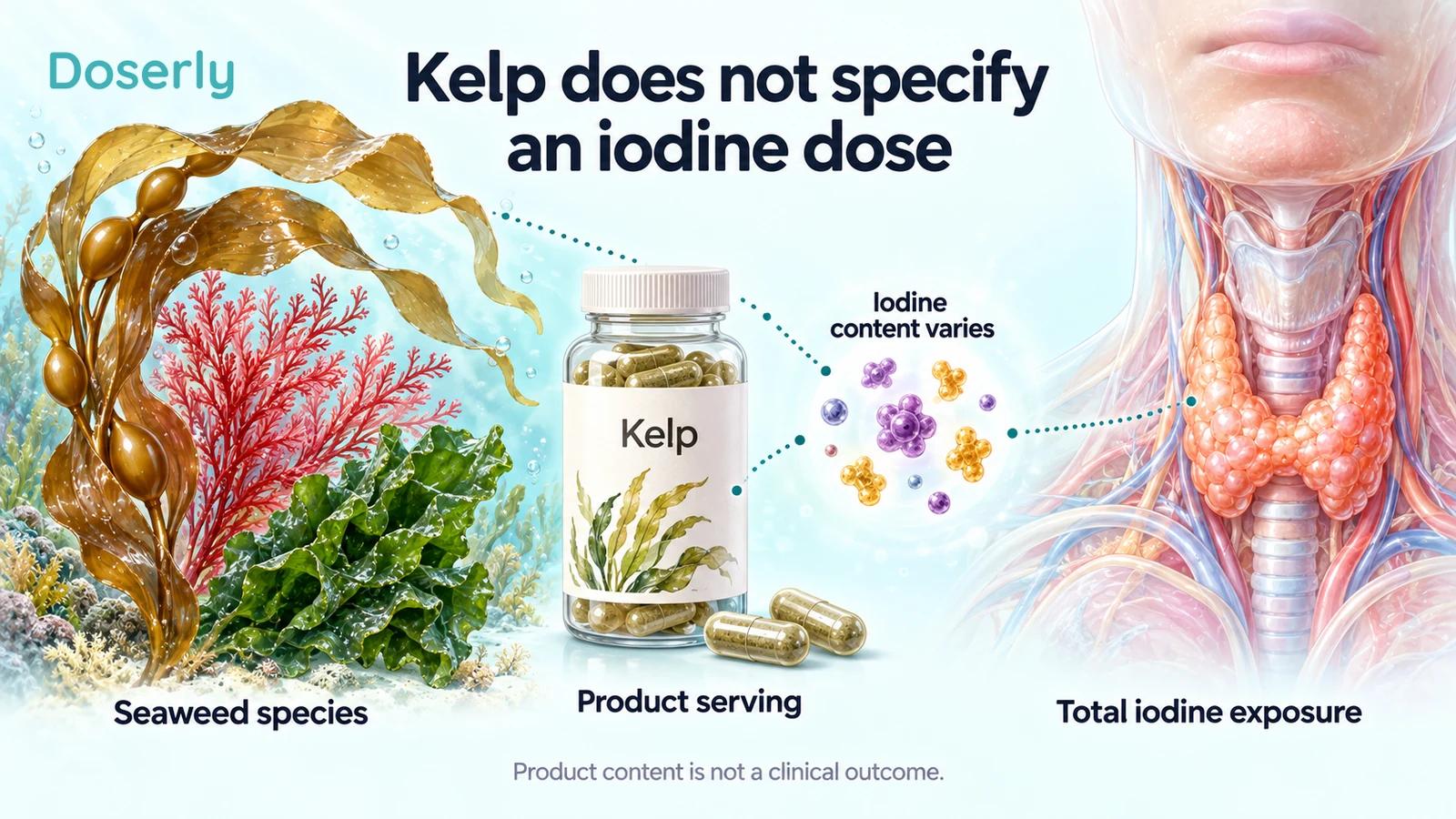
Seaweed is not one standardized ingredient. Species, growing conditions and processing affect iodine content. A laboratory analysis of 96 commercially available Norwegian seaweed products illustrates the problem. It included whole seaweeds, foods containing seaweed and 14 supplements. Seaweed product analysis
Measured iodine in the supplements ranged from 5 to 5,600 micrograms per recommended daily dose. The investigators also found substantial differences among foods and imperfect agreement between measured content and some declarations. This was a product-composition study, not a trial showing that every product caused thyroid disease.
Its value is more specific: the word “kelp” cannot tell you the dose. A natural source can supply very little, a nutritional amount or a much larger exposure. The results describe the sampled market and products at that time; they cannot certify or condemn a bottle sold today.
For a current product, record the declared iodine amount and serving size, not only the weight of kelp powder. A label saying “kelp 500 mg” does not mean “iodine 500 mg,” and it does not by itself tell you the iodine content. If that content is unclear, the uncertainty belongs in the decision rather than being replaced with an estimate based on a different product.
Pregnancy is a separate nutritional question
Iodine requirements rise during pregnancy and lactation. The ATA recommends a multivitamin supplying 150 micrograms of iodine as potassium iodide during preconception, pregnancy and lactation, alongside dietary intake. That recommendation is different from taking a high-dose kelp product to treat a suspected thyroid problem. ATA iodine statement
The evidence also requires a distinction between preventing severe deficiency and demonstrating an additional benefit in mildly deficient populations. A 2017 trial randomized 832 pregnant women in India and Thailand to 200 micrograms of iodine daily or placebo until delivery. Enrollment occurred at an average of about 11 weeks of pregnancy, and the population was mildly iodine deficient. Pregnancy iodine trial
At age five to six, the study found no improvement in the assessed child neurodevelopmental outcomes. Only 313 children contributed to the IQ analysis, which limits how confidently the result represents everyone originally enrolled. The trial does not show that iodine is unnecessary in pregnancy, nor does it establish that high doses are better. It addresses a specific intervention, starting time and degree of deficiency.
For someone already taking a prenatal product, the first practical step is checking its actual iodine content. Adding a separate supplement without checking the prenatal can turn an attempt to meet a requirement into an unintended overlap.
A single urine result is easy to overinterpret
Urinary iodine can help researchers assess a population's recent intake. A single spot sample is much less useful for diagnosing an individual's long-term deficiency because intake and excretion vary. NIH notes that multiple collections are more informative for individual assessment. NIH iodine status assessment
A low result from one collection should therefore not be translated automatically into a high-dose regimen. Likewise, an increased urine value after starting a supplement mainly confirms that the exposure changed. It does not demonstrate improved energy, corrected thyroid disease or a better pregnancy outcome.
The same caution applies to symptoms. If fatigue improves after several simultaneous changes, a timeline can document the improvement without proving which change caused it. That uncertainty is useful to preserve, particularly when thyroid medication, sleep, diet or another supplement also changed.
Make the next conversation specific
A useful record brings the diagnosis, product and timeline together. Include the iodine amount per serving, actual servings used, start date, kelp or seaweed products, prenatal or multivitamin overlap, and any recent changes in thyroid medication. If the concern began after an imaging procedure or a new medicine, mention that exposure too; iodine can enter the clinical picture outside the supplement aisle. ATA hypothyroidism information
The key questions become concrete: Is deficiency plausible from the diet and context? What diagnosis explains the thyroid findings? What total intake is being targeted? What finding would lead the clinician to continue, change or stop the supplement?
Doserly can help keep supplement amounts and dates together with the rest of a medication routine. That record is most useful as a shared history. It does not diagnose iodine deficiency or determine a thyroid treatment dose.
Iodine has an essential place in nutrition. A thyroid concern makes understanding that place more important, not a reason to assume that more will help.
Sources
- NIH Office of Dietary Supplements: Iodine
- NIH: Iodine food sources and iodized salt
- American Thyroid Association: Goiter
- ATA: Complementary and Alternative Medicine in Thyroid Disease
- ATA guideline for treatment of hypothyroidism, 2014
- Sang and colleagues: Iodine intake randomized trial, 2012
- ATA statement on excess iodine, 2013
- Aakre and colleagues: Commercial seaweed product analysis, 2021
- Gowachirapant and colleagues: Pregnancy supplementation trial, 2017
- ATA: Hypothyroidism booklet