
Supplements
October 16, 2026
Inulin fiber: why the label cannot predict your gut response
On this page
Inulin can help some people have more frequent bowel movements. It can also cause enough gas or discomfort that the benefit is not worth the tradeoff. Those are not contradictory descriptions of a fiber. They are two outcomes that need to be measured separately.
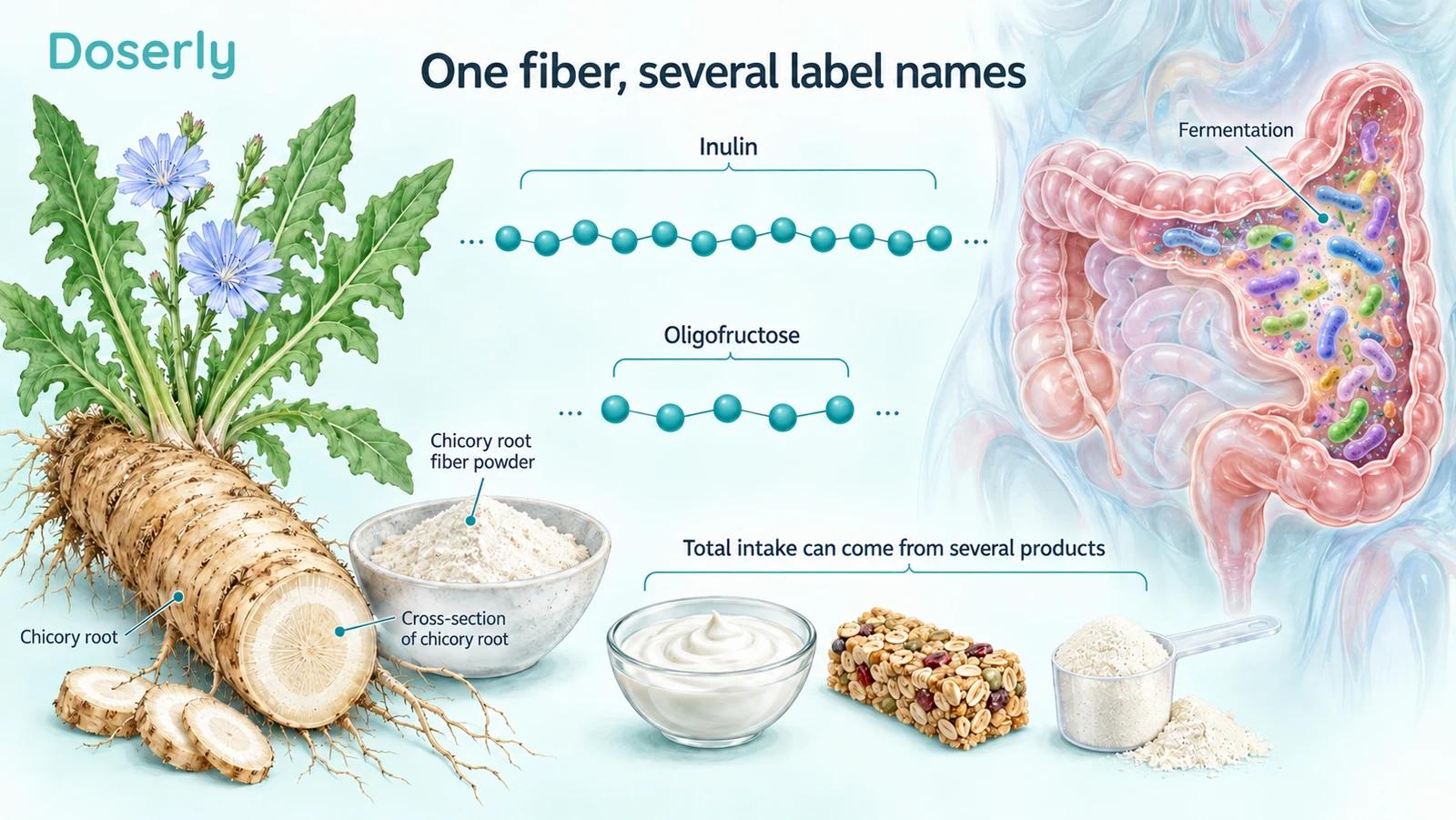
The label often makes the choice look simpler than it is. Chicory root fiber, inulin, oligofructose, and an inulin-type fructan blend can appear in supplements and fortified foods. The ingredient name is a starting point, but preparation, amount, background diet, and the person taking it all affect how closely a product resembles the research.
A useful approach is to ask two questions: what benefit was shown with this preparation, and how well was it tolerated? The answer should not require you to accept worsening symptoms as proof that a prebiotic is working. Our prebiotic fibers guide covers the broader category; this article examines the practical differences within the inulin family.
Inulin and oligofructose are related, but trials distinguish them
Inulin-type fructans are fermentable carbohydrates. Products can contain longer chains, shorter fractions such as oligofructose, or mixtures. That family resemblance does not mean their digestive effects are identical at the same stated amount.
A randomized crossover study in 26 healthy adults compared challenges containing native inulin or shorter-chain oligofructose. Ten grams of oligofructose produced substantially more gastrointestinal symptoms, while the investigators described native inulin up to ten grams and oligofructose up to five grams as well tolerated in that study. Participants were observed after specific test meals; this was not a universal dose limit or a trial in people with IBS. Tolerance study
The important lesson is not to memorize those amounts as a personal prescription. It is that a single category label can conceal differences that matter. If a previous product was comfortable and a new one is not, compare the formulation and actual daily exposure before concluding that your gut has become unpredictably “unhealthy.”
It also matters whether a study used a single challenge or repeated intake. A meal test describes what happened after that exposure. A four-week trial can tell more about sustained use, but only in its participants and with its preparation. Neither design supplies a guarantee about a different product used indefinitely.
There is direct evidence for bowel frequency
In a randomized crossover trial, 44 adults with constipation received chicory inulin or placebo for four weeks per period. The inulin amount was 12 grams daily, divided into three servings. Median stool frequency was four per week with inulin and three with placebo. Stool consistency also softened. This was a measurable bowel-function result, rather than a conclusion drawn solely from bacterial counts. Constipation trial
The size and meaning of that result need to stay visible. An extra weekly bowel movement may be helpful for some people, but it is not a promise that every symptom of constipation will resolve. Frequency alone does not tell the whole story of straining, incomplete evacuation, pain, or satisfaction. Nor does this trial establish that a small amount hidden in a snack produces the same effect. Constipation trial
A later study in 39 adults with functional constipation also reported improvements after 12 grams daily of chicory inulin for four weeks. However, the crossover analysis showed carryover, and the trial was registered retrospectively. Those limitations reduce confidence in treating the result as a clean, definitive confirmation. Its microbiome findings remain interesting associations within the experiment, not a test that identifies who should buy inulin. Later trial
Taken together, these studies make inulin a reasonable ingredient to discuss for a specific bowel-function goal. They do not establish it as the best fiber for every person with constipation, and they do not answer whether it will be comfortable for someone whose main problem is bloating.
Gas and benefit can move in different directions
Fermentation is part of why inulin attracts interest, and it is also part of the tolerability question. A person can have a microbial response without feeling better. A person can notice improved bowel frequency while still finding gas troublesome. Counting only one of those outcomes can make a product look more successful than it feels in daily life.
An MRI crossover study in 19 people with IBS examined inulin, psyllium, their combination, and a control. Adding psyllium reduced the colonic gas response to inulin during the six-hour experiment. The study used substantial single challenges, including 20 grams of inulin, and was designed to explore physiology. It was not a validated everyday mixing recipe or a long-term symptom treatment trial. MRI study
That experiment is useful because it shows why “fiber” is too broad a description of an effect. Different fibers can behave differently in the gut, and a combination can change the response. It would be a mistake, however, to convert an acute laboratory finding into advice to add more products whenever a fiber causes discomfort.
For a consumer, the relevant endpoint is not maximum fermentation. It is a worthwhile improvement that remains tolerable. If the product is being used for constipation, note whether stools are easier to pass as well as how often they occur. If it is being used for vague “gut health,” define what improvement would actually be noticeable before starting.

Your usual diet is part of the experiment
A 2024 study gave 40 healthy adults either an oligofructose-enriched inulin preparation or control in snack bars over five days. The active amount was 18 grams daily. Body weight, habitual fiber intake, and microbiome features were associated with tolerability. These were exploratory findings from a small, short study, not a clinical prediction tool or a reason to order a commercial stool test. Tolerance-prediction study
Another crossover trial in 34 healthy adults studied 16 grams daily of an inulin-type fructan for three weeks. Participants with higher habitual fiber intake had a greater microbiota response to the intervention. That result concerns bacterial measurements; it does not mean that greater change necessarily produced greater symptom relief. Habitual-fiber study
These findings help explain why another person's experience is an imperfect guide. The same added product enters different diets. It may also be taken alongside other fermentable ingredients. A useful comparison therefore includes what changed around the supplement, not just the name on the container.
This is a reason to keep a simple record, not to pursue a perfectly controlled diet. Record major changes that could plausibly alter the experience: a new fiber-enriched cereal, a second supplement, or a substantial change in the foods you usually eat. The aim is to make a conversation with a clinician or dietitian clearer, rather than to blame every symptom on one ingredient.
The supplement scoop may not be your total exposure
Imagine someone who starts an inulin powder in the morning while also switching to a fiber-enriched snack bar. Later, they add a fortified yogurt because it carries a digestive-health claim. If discomfort develops, the powder may receive all the blame even though several products changed together.
This is an illustrative scenario, not a trial result. Its purpose is to show why a label audit is useful. Look at ingredient lists across the day for inulin, chicory root fiber, oligofructose, and related descriptions. The nutrition panel may report total fiber without identifying how much comes from each ingredient, so exact accounting is not always possible.
Do not invent precision where the label does not provide it. If a blend gives only a combined amount, note that limitation. A clinician or dietitian may still be able to help simplify the pattern without knowing every gram. What matters is recognizing that a “small” serving in several places can be a different exposure from one isolated product.
This also explains why a capsule, powder, and fortified food are not automatically equivalent. The amount and surrounding ingredients can differ. A research citation on the package is useful only if it applies to the preparation and outcome being advertised.
How to read an inulin claim without dismissing the evidence
Start with the actual problem. “Supports digestive health” could refer to stool frequency, consistency, discomfort, or a bacterial measurement. Ask which of those was tested. A product cannot make the answer clearer by using a broader phrase.
Then look at who participated. Healthy volunteers with infrequent stools are not the same population as people with IBS and abdominal pain. A tolerance experiment in healthy adults cannot establish that an amount will be comfortable in someone with a sensitive gut. Conversely, an uncomfortable experience in one setting does not prove that no one can benefit.
The comparator matters too. Improvement from a person's starting point can happen for several reasons, including attention to diet and ordinary symptom fluctuation. A placebo-controlled comparison helps distinguish an intervention effect from those changes. When reading a trial, prioritize the difference between groups rather than a large improvement reported only within the supplement group.
Finally, check whether the claimed benefit was measured directly. Increased stool frequency is a bowel outcome. Increased relative abundance of a bacterium is a microbiome outcome. Both may be worth studying, but the second does not automatically establish the first. This is especially important when a product's marketing combines a human symptom trial with unrelated laboratory research.
A practical record that remains manageable
A short baseline record can make later changes easier to interpret. Note approximate bowel frequency, whether stools are hard or difficult to pass, discomfort, and any treatments already being used. There is no need to count every sensation or repeatedly inspect a microbiome report.
If a clinician agrees that trying a fiber product is appropriate, record the exact preparation and the amount actually taken. Keep the rest of the routine reasonably stable where practical. Research amounts are descriptions of experiments, not instructions to jump immediately to the highest studied serving.
Decide in advance what would make the trial worthwhile. That might be easier bowel movements without troublesome bloating, rather than simply reaching a target number. Also decide when to review the result. Continuing indefinitely because the ingredient is described as beneficial can obscure the fact that the intended problem has not improved.
Persistent constipation, significant pain, or a new change in bowel habits deserves clinical attention rather than repeated supplement substitutions. Seek prompt care for constipation with constant abdominal pain, blood in the stool, vomiting, or inability to pass gas. A diary can help describe the pattern, but it cannot establish the cause. NIDDK symptom guidance If symptoms worsen after introducing a product, that is information to discuss, not a reason to assume you need to tolerate more discomfort to reach a healthier microbiome.
Inulin's evidence is most useful when it stays attached to a defined preparation and a concrete outcome. The ingredient can improve bowel function for some people. Whether it is a good fit for you also depends on the experience of taking it, the rest of your intake, and whether the improvement is worth the tradeoff.
Sources
- Bonnema and colleagues: gastrointestinal tolerance of chicory inulin products, 2010
- Chicory inulin and bowel function in adults with constipation, 2017
- Inulin and functional constipation, 2025
- Psyllium, inulin, and colonic gas measured by MRI, 2022
- Weight, habitual fiber, and tolerance to fructan supplementation, 2024
- Habitual fiber intake and microbiota response to inulin-type fructans, 2018
- NIDDK: symptoms and causes of constipation