
Peptides
October 16, 2026
Intranasal oxytocin: delivery does not settle clinical benefit
On this page
“Nose to brain” is a delivery claim, not a treatment outcome. For intranasal oxytocin, there is evidence relevant to delivery into the nervous system, including human cerebrospinal-fluid measurements and labeled-drug experiments in nonhuman primates. Those findings do not establish that a particular nasal product improves a particular person's symptoms.
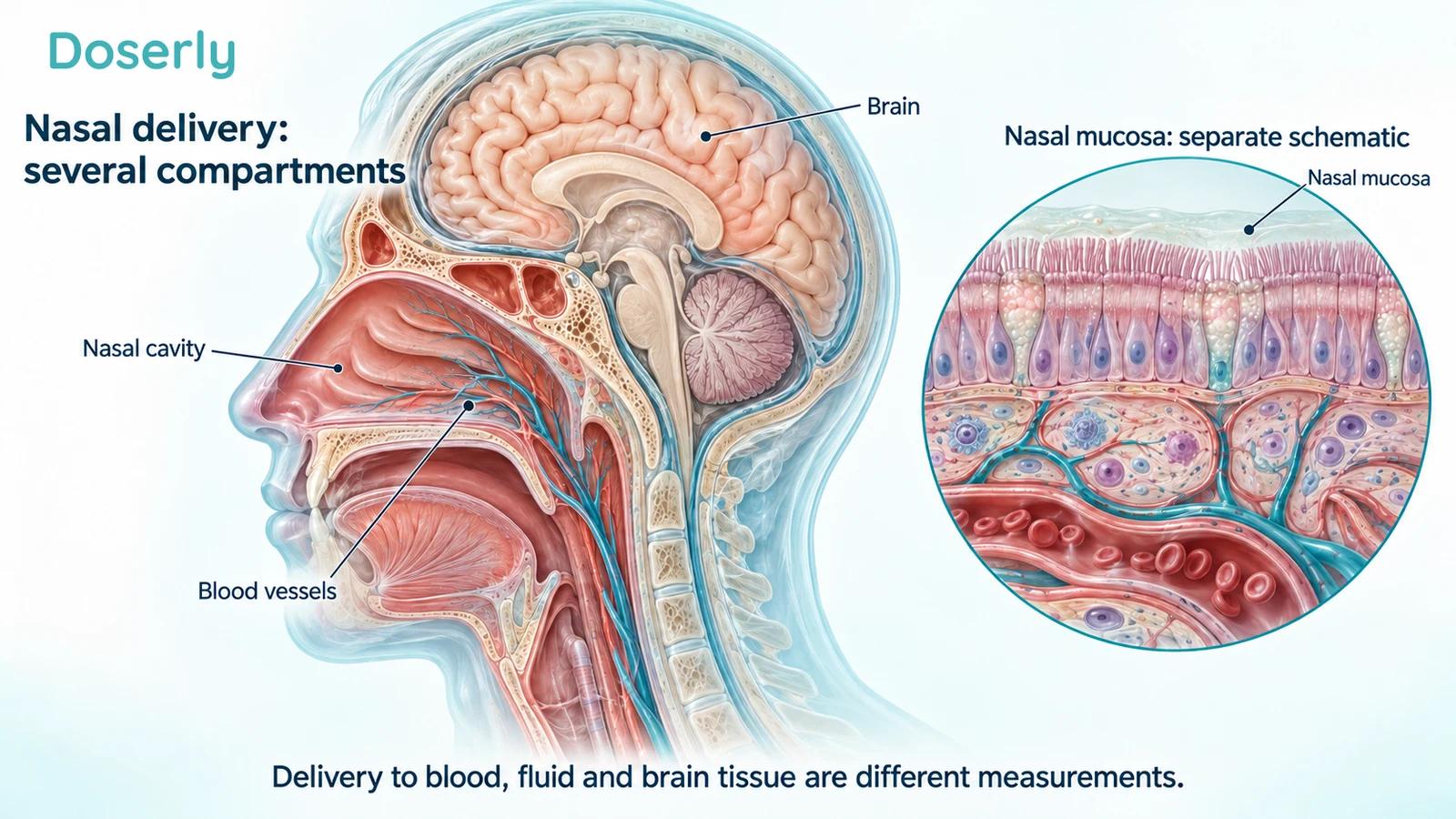
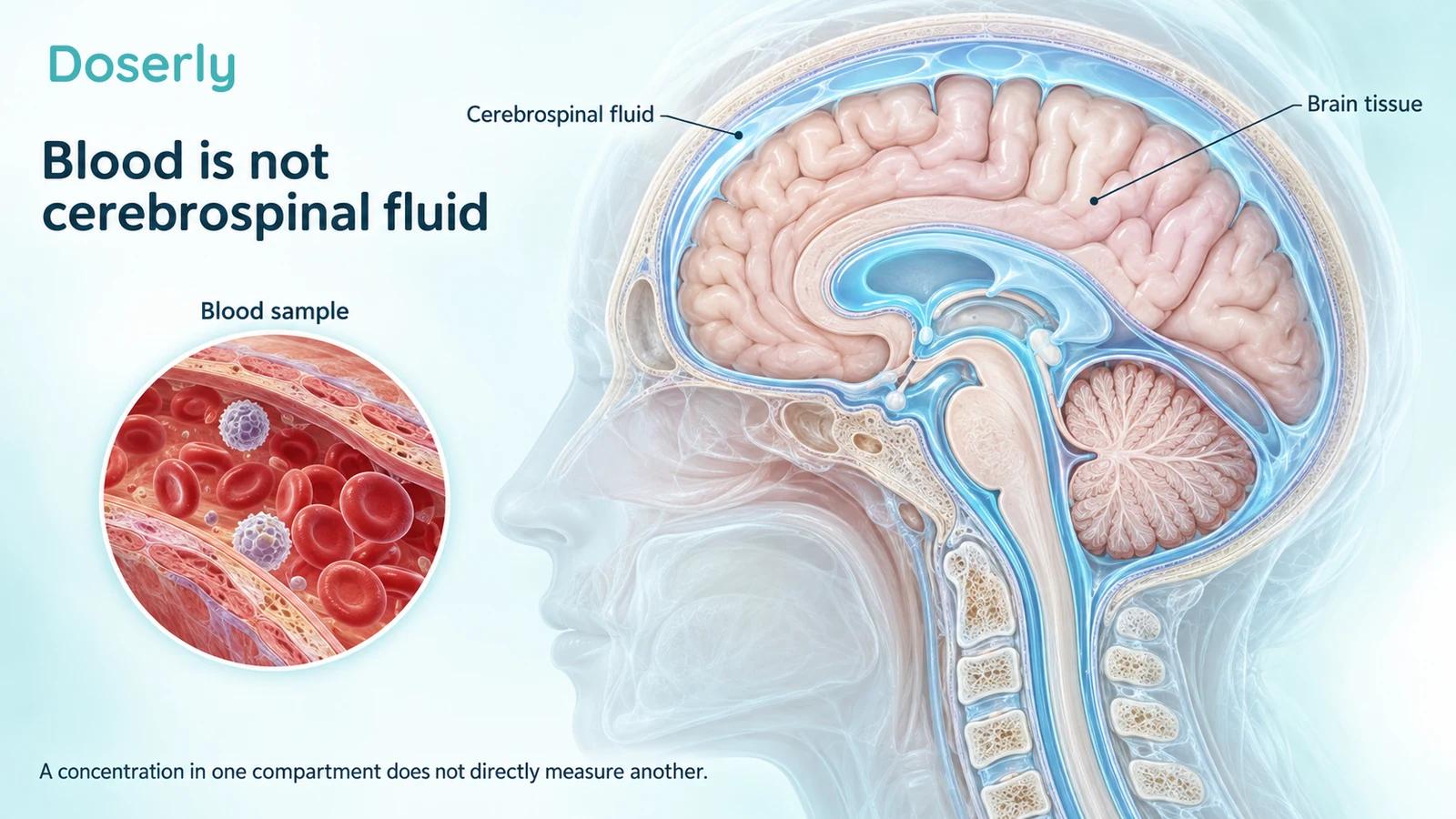
The research becomes clearer when each measurement keeps its proper meaning. Blood exposure, cerebrospinal-fluid concentration, drug detected in brain tissue, changes in brain blood flow, and improvement in daily life are different outcomes. They can inform one another, but none automatically supplies the answer to all the others.
This distinction also prevents an opposite mistake. Low blood bioavailability does not by itself prove that a nasal treatment cannot reach the brain through another route. The evidence needs to be interpreted in both directions, without turning either a promising mechanism or a disappointing measurement into a universal verdict. The Doserly oxytocin guide provides the wider clinical context.
What researchers mean by delivery
A medicine placed in the nose first encounters a local biological surface. The formulation and delivery method influence where it is deposited. Researchers then ask whether the substance reaches systemic circulation, central fluid compartments, or specific tissues, and how concentrations change with time. These are pharmacokinetic questions: what happens to the administered substance in the body.
A clinical question comes later. Does the intervention improve a defined problem, by a meaningful amount, in the people being studied? Does the benefit last? What unwanted effects occur? A delivery study may help design a clinical trial, but it does not replace one.
Consider an analogy limited to the research logic: confirming that a letter reached a building does not establish that it reached the intended person, was read, or produced the desired action. For oxytocin, the corresponding steps include relevant tissue exposure, receptor engagement, physiological effects, and outcomes that matter to patients. The analogy is not a biological model; it simply explains why a delivery result is an intermediate finding.
A small human study measured blood and cerebrospinal fluid
In a 2013 study, 11 participants received intranasal oxytocin and four received placebo. The investigators measured both plasma and cerebrospinal fluid, or CSF. Plasma concentrations rose earlier; a significant CSF increase was detected at the later 75-minute sampling point. The study did not find a significant correlation between the two compartments. Original human CSF study
That result supports the importance of looking beyond blood alone. It also has clear limits. The sample was small, CSF is not the same thing as brain tissue, and a CSF measurement does not map concentrations at every receptor or brain region. The study was about concentrations after administration, not proof that a behavioral disorder improved.
The timing cannot be converted into a universal instruction to take a spray a particular number of minutes before a social situation. Sampling schedules describe an experiment. A clinically useful timing recommendation would need support from studies of the actual formulation, population, and intended outcome.
Nor does the absence of a correlation in this small study mean blood and central biology can never be related. It means the observed plasma concentration could not simply stand in for the observed CSF concentration in that experiment. That narrower interpretation is already enough to challenge claims that a single blood value directly reports how much oxytocin is acting in the brain.
Labeled oxytocin reached brain tissue in rhesus macaques
A 2020 nonhuman-primate study used deuterated oxytocin, allowing researchers to distinguish administered oxytocin from the animals' own hormone. They measured labeled and endogenous oxytocin in 12 brain regions two hours after administration. Labeled oxytocin was quantified after intranasal administration in several regions, including the orbitofrontal cortex, striatum, brainstem, and thalamus; the same finding was not observed after intravenous administration under those study conditions. Original macaque study
This is more direct evidence of tissue delivery than inferring it from a change in a blood sample. The labeling method addresses an important ambiguity: whether the measured substance came from the administered treatment or from endogenous production. The anatomical pattern was consistent with proposed nose-to-brain pathways.
The species and experiment still matter. These were rhesus macaques, not people receiving treatment for a clinical condition. Detection at one experimental time point does not establish the optimal human schedule, the duration of receptor engagement, or the clinical benefit of any retail spray. The study strengthens a delivery hypothesis; it does not finish the treatment-efficacy argument.
It also does not show that every nasal formulation deposits the same amount in the same location. A route is a broad category. The formulation, device, administration conditions, and study population remain part of the intervention being evaluated.
Brain blood-flow changes do not identify a single route
Another 2020 human study compared a standard nasal spray, a nebulizer, and intravenous oxytocin using regional cerebral blood flow as an outcome. Some effects, including reduced amygdala perfusion, were explained by increased systemic oxytocin exposure after both nasal and intravenous administration. Other findings supported the ability of intranasal administration to target particular brain regions. Route-comparison study
This is a useful corrective to an overly simple story in which any brain change after nasal dosing must have resulted from direct transport through the nose. Peripheral exposure and central effects need not be mutually exclusive explanations. The study's comparisons were designed to help distinguish them.
Blood flow is nevertheless a physiological measurement. A change in perfusion does not inherently mean that a person feels better, functions better, or experiences a desirable behavioral change. More or less activity in a named region is not a universal sign of improvement. Clinical significance depends on an outcome measured in an appropriate treatment study.
The method comparison also explains why a device should not be treated as an incidental accessory. Different delivery systems can be part of the scientific question. Evidence from one does not automatically validate another simply because both are described as intranasal.
The newer plasma study found low, variable systemic bioavailability
A 2025 pharmacokinetic study in healthy adult men and nonpregnant women used a specific liquid chromatography–mass spectrometry assay to measure plasma oxytocin after intravenous and intranasal administration. The reported nasal bioavailability was 0.7%, with substantial variation between individuals. This figure refers to systemic exposure under that study's conditions. It is not a measured percentage reaching the brain. Original plasma pharmacokinetic study
The distinction is essential. Saying “only 0.7% reaches the brain” would misstate what the investigators measured. Saying “0.7% proves the spray cannot affect the brain” would also go beyond the result. The study helps describe blood exposure and its variability; it does not directly quantify every proposed central delivery route.
Variation is relevant to future trials because the same administered amount may not produce the same systemic exposure in every participant. It is not a reason for a person to increase a dose until they notice an effect. The investigators developed pharmacokinetic models to inform research, not a validated self-treatment calculator for social or psychiatric symptoms.
The study also found differences between measurements obtained using mass spectrometry and an antibody-based assay. That observation leads to another reason for caution: disagreement between reported concentrations can reflect how the measurement was made, not just differences between the people or formulations being studied.
Measurement quality is part of the biological question
A 2023 laboratory investigation examined problems with oxytocin extraction and enzyme immunoassay techniques. It tested pure oxytocin solutions to separate some procedural effects from interference by other plasma components. The investigators found that preparation methods and assay characteristics could affect recovery and readings, and emphasized validation before clinical interpretation. Original assay investigation
This does not mean that every oxytocin measurement is meaningless. It means a concentration is not self-explanatory. Readers need to know the sample type, handling, assay method, and evidence that the method measures what it claims to measure. Comparing numbers from different methods without that context can create false precision.
The 2025 plasma study and the 2023 assay investigation used different designs and should not be compressed into a claim that one named assay technology is always correct while another is always wrong. Their shared lesson is methodological: analytical performance needs to be demonstrated in the relevant setting.
For a clinical consumer, this is a reason to be skeptical of a hormone result presented as a simple explanation for a complex social problem. The delivery studies discussed here do not establish a diagnostic blood threshold for loneliness, relationship difficulty, or a need for intranasal oxytocin. A laboratory number requires a validated clinical interpretation, not just a plausible story.
Nasal, intravenous, and sublingual products are not equivalents
An older pharmacokinetic study evaluated sublingual oxytocin in six male volunteers. It reported very low, variable bioavailability, ranging from 0.007% to 0.07%. That small study concerned a particular preparation and research setting. It does not validate every modern troche, nor does it establish a behavioral treatment effect. Original sublingual study
The result reinforces the need to name the formulation and route when discussing evidence. A nasal concentration, an intravenous exposure, and an amount placed under the tongue are not interchangeable quantities. There is no justified dose-conversion rule in these papers that a reader can use to substitute one product for another.
The established injectable product Pitocin belongs to a different clinical context. Its prescribing information describes obstetric uses, supervision requirements, and route-specific risks. Those facts do not establish a psychiatric indication for a nasal spray, and adverse-event rates from an obstetric infusion cannot simply be assigned to a nasal research protocol. Pitocin prescribing information
A careful comparison therefore names both the product and the purpose. “Oxytocin has medical uses” is true but incomplete. The relevant question is whether this formulation, delivered this way, has demonstrated a worthwhile benefit for this problem in this population.
What would turn a delivery finding into useful treatment evidence?
A persuasive clinical program would connect the delivery work to a clear patient-centered question. It would specify who is being treated, the formulation and device, a comparator, the duration, and an outcome that reflects a meaningful improvement. It would report tolerability and discontinuation as well as the desired outcome.
The connection must be tested rather than assumed. If a formulation changes blood exposure, researchers need to determine whether that change predicts better outcomes or merely changes a laboratory measurement. If a device alters regional delivery, its clinical consequences still need study. A technically successful delivery system can carry a treatment that does not improve the condition being targeted.
Conversely, a negative clinical trial does not identify the reason for failure by itself. The explanation could involve delivery, the biological target, the population, the outcome, or several factors together. Delivery studies help investigate those possibilities. They do not license selecting whichever explanation preserves a preferred treatment claim.
Questions that keep the discussion grounded
When someone cites “nose-to-brain oxytocin,” ask what was actually measured and in whom. Was it blood in healthy adults, CSF in a small human sample, labeled brain tissue in macaques, or a clinical outcome in patients? Was the administered formulation the same as the one being proposed? These questions locate the evidence before judging its strength.
Then ask what remains unknown. A source can provide a credible delivery finding while leaving duration, individual variability, repeated-use safety, and clinical usefulness unresolved. An honest explanation should identify those gaps without pretending the study was worthless.
For personal decisions, discuss the intended goal and product with a qualified clinician, including current medicines and relevant medical circumstances. The oxytocin risk discussion is a starting point for that conversation. Neither a delivery percentage nor a compelling brain illustration is a treatment recommendation.
Intranasal oxytocin has a real pharmacology research story. The strongest reading preserves its separate chapters: delivery, measurement, physiological effects, and clinical benefit. Evidence in the first chapters makes the later questions worth asking; it does not answer them in advance.
Sources
- Human CSF study
- Labeled oxytocin in rhesus macaques
- Human administration-route and cerebral-blood-flow study
- Plasma pharmacokinetics, 2025
- Assay investigation, 2023
- Sublingual pharmacokinetics, 1995
- Pitocin prescribing information