
Peptides
October 16, 2026
Insulin research in feline ketoacidosis: hospital evidence, not a home protocol
On this page
A study showing that veterinarians can use a different insulin regimen during feline diabetic ketoacidosis can sound reassuringly simple. If the cat already receives insulin at home, perhaps the emergency is just a matter of using that insulin differently.
The actual evidence says something more demanding. In a randomized trial of 20 hospitalized cats, investigators compared two complete, closely monitored treatment protocols. One used regular insulin by intravenous infusion. The other used glargine through a combination of subcutaneous and intramuscular administration. Both groups received fluids, repeated laboratory testing, electrolyte management, and other supportive care. 2021 glargine-versus-regular-insulin trial
The findings are relevant to veterinary hospital decisions. They do not turn ketoacidosis into a condition that a caregiver can manage by copying a published injection schedule.
Why ketoacidosis is more than high blood sugar
Diabetes involves inadequate insulin action. In diabetic ketoacidosis, or DKA, the metabolic disturbance includes increased ketone production and blood acidity, often with dehydration and electrolyte abnormalities.
When insulin action is insufficient, the body releases more fatty acids from stored fat. The liver can use those fatty acids to produce ketones. Excessive ketone accumulation contributes to the acid-base disturbance. A glucose reading describes only one part of that process. AAHA explanation of feline DKA
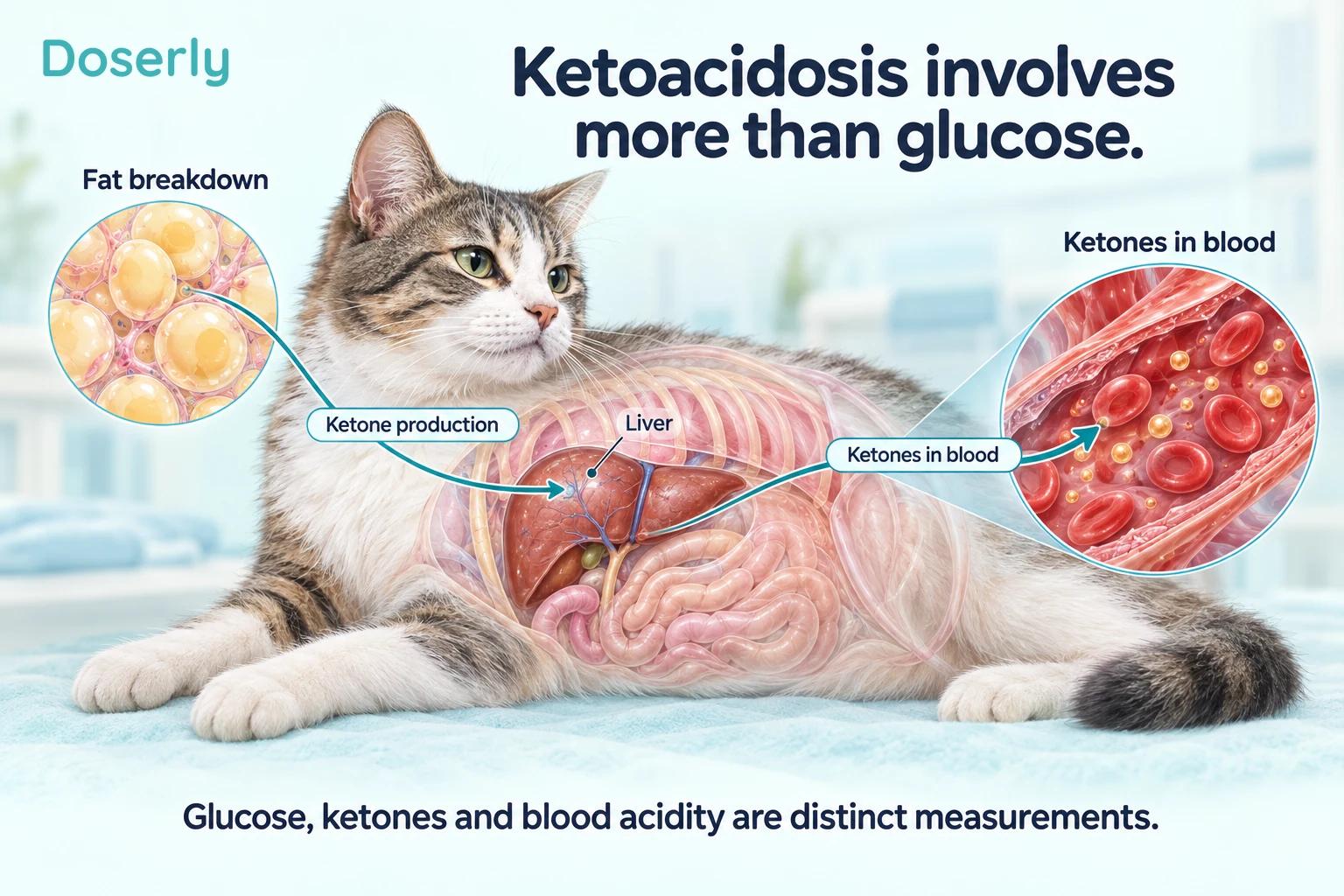
This distinction changes how research results should be read. A treatment might lower glucose sooner without resolving ketonemia sooner. It might improve a laboratory measure without shortening hospitalization. It might shorten hospitalization without demonstrating a survival benefit.
“Worked faster” is therefore incomplete unless the writer specifies what improved, how improvement was defined, and what happened to the other outcomes.
For caregivers, the corresponding lesson is that a better glucose result cannot establish that an unwell cat has recovered. The physical examination, hydration, appetite, ketones, acid-base status, and other laboratory results still matter.
What the randomized trial compared
The 2021 study took place in a university hospital and used block randomization to assign cats to one of two protocols. Twenty cats were included in the final comparison, ten in each group.
The regular-insulin group received a continuous intravenous infusion. The glargine group received a basal-bolus approach combining injections under the skin with intramuscular injections. Those routes are an essential part of the study description. Calling this simply “glargine injections instead of a drip” removes clinically important information.
All cats received hospital care beyond insulin. The methods describe fluid treatment, potassium and phosphorus management, anti-nausea treatment and other therapies when indicated. Feeding tubes were used in some cats with prolonged poor appetite.
The investigators measured capillary blood glucose every two hours and blood beta-hydroxybutyrate, a ketone, every six hours. Blood gas analysis was also repeated every six hours, with additional electrolyte assessments. These are descriptions of research monitoring, not instructions for owners to reproduce.
Time zero was the placement of an intravenous catheter and initiation of infusion therapy. That matters when comparing reported hours: the clock did not begin at the first symptom at home, or at an owner's first high glucose reading. Trial methods
The study evaluated whether different insulin strategies could work inside this care system. It did not test whether intensive support could be removed.
The primary endpoint did not establish faster ketone resolution
The trial's primary endpoint was the time required for blood beta-hydroxybutyrate to fall below a specified study threshold. The median was 42 hours with the regular-insulin infusion and 30 hours with glargine.
Those numbers favored glargine numerically, but the difference was not statistically significant. The study therefore did not establish that glargine resolved ketonemia faster.
This does not prove that the protocols have identical effects. With ten cats per group, a study may miss a clinically meaningful difference or produce an unstable estimate. It does mean that a headline claiming proven faster ketoacidosis resolution goes beyond the primary result.
The publication also contains a small reporting inconsistency: the abstract and results section give different P values for this comparison, although both are nonsignificant. That discrepancy does not change the central interpretation. It is another reason to avoid making a precise superiority claim from the numerical gap. Primary trial report
A reader should be especially wary when a summary mentions only the more favorable secondary outcomes and omits this primary endpoint. The trial was designed around ketone resolution; its answer to that question belongs near the beginning of the story.
Two secondary outcomes were encouraging
Initial improvement in hyperglycemia occurred earlier in the glargine group: a median of two hours versus six hours in the regular-insulin group. This was the first qualifying decrease under the study definition, not the time at which blood glucose became normal.
Median time to hospital discharge was also shorter: 140 hours with glargine versus 174 hours with the regular-insulin infusion. The reported differences for these two secondary outcomes were statistically significant.
A shorter hospital stay matters to the animal, caregiver, and veterinary team. It may reduce time away from home and the burden of inpatient care. But the study did not establish a universal discharge schedule or a guaranteed cost saving.
Discharge depends on more than insulin. The protocol considered eating, vomiting, ketone concentration, hydration, and the clinician's assessment of readiness. Concurrent illness can also keep a cat hospitalized after one metabolic measure has improved.
Seventeen cats survived to discharge: nine of ten in the glargine group and eight of ten in the regular-insulin group. That small difference was not statistically significant. It should not be presented as evidence that glargine saves more lives. Trial outcomes
The deaths or euthanasia decisions also involved serious underlying disease and, in some cases, financial constraints. A simple insulin-versus-insulin mortality story would hide the circumstances that shaped those outcomes.
Why the hospital setting changes the meaning of “safe”
An insulin regimen may be feasible under frequent monitoring because clinicians can respond when glucose, potassium, phosphorus, hydration, or appetite changes. The monitoring is part of how treatment is delivered.
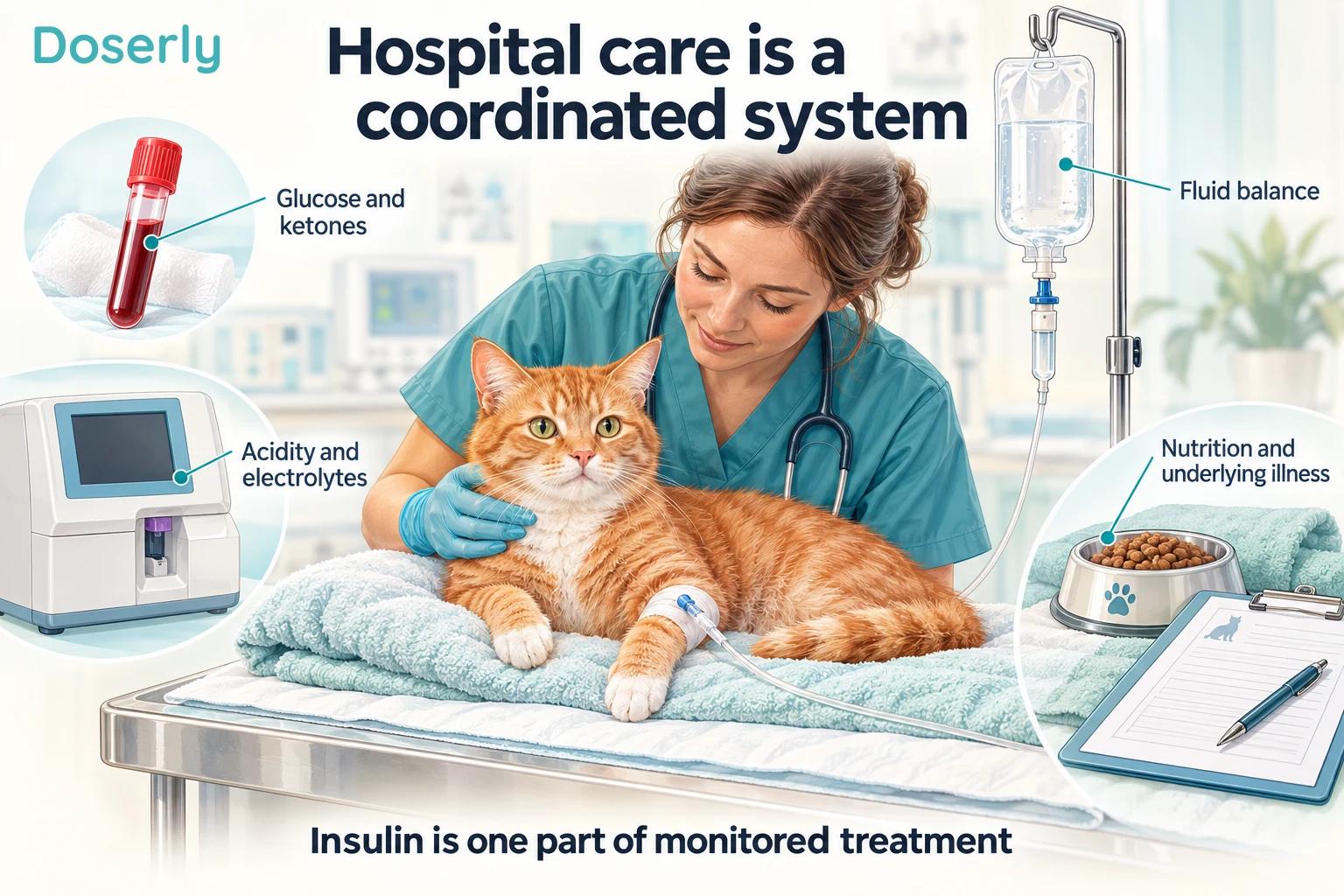
The 2021 methods illustrate this particularly well. Once glucose fell sufficiently, clinicians could add glucose to intravenous fluids while continuing insulin treatment to address the metabolic crisis. That combination can seem counterintuitive if insulin is viewed only as a way to lower sugar.
In DKA, stopping ketone production is also a treatment objective. Supporting glucose while insulin continues is a monitored hospital decision, not evidence that the animal no longer needs insulin or that the emergency can be managed with food alone.
The study also recorded complications and concurrent illness. Two cats in the infusion group developed signs associated with overhydration. The observation does not establish that the alternative protocol prevents fluid complications; it shows why fluid balance requires continuing assessment.
Likewise, the absence of reported clinical hypoglycemic signs is not the same as proving that every measured glucose value stayed within range. Safety reporting should specify which events were assessed rather than compressing everything into “no problems.” Hospital care and adverse-event assessment
A separate lispro trial reinforces the electrolyte lesson
Another randomized feline DKA study, published in 2019, compared intravenous lispro with intravenous regular insulin. It enrolled 12 cats, six in each group. It was a different trial, with a different alternative insulin and protocol.
Glucose fell below the study's threshold sooner with lispro. The investigators also documented that low sodium, potassium, phosphate, and magnesium concentrations remained common despite supplementation. Two cats had biochemical hypoglycemia without clinical signs. 2019 lispro and electrolyte study
These findings should not be pooled informally with the glargine trial to announce that newer insulins are always superior. Their useful shared message is that glucose control and the rest of the metabolic disturbance need parallel attention.
The electrolyte results also explain why a home glucose meter cannot substitute for hospital laboratory monitoring. A meter may show glucose improving while providing no information about potassium or phosphate. Adding more glucose measurements does not fill that particular gap.
Current guidance keeps treatment within veterinary care
The 2026 AAHA feline diabetes guidance recognizes glargine U-100 protocols as an option for some cats with DKA. It also emphasizes supportive treatment and referral when illness severity or a clinic's monitoring capacity requires it.
That guidance is more recent than the trial, and its clinical protocol should not be assumed to reproduce the study word for word. “A guideline cites a trial” does not mean every route, timing decision, or treatment detail is identical.
The owner-facing implication is straightforward: the veterinary team chooses an approach suited to the patient and available hospital support. A familiar insulin name does not remove the need for hospitalization, repeated testing, and nursing care. 2026 AAHA DKA guidance
Longer-term diabetes care resumes after stabilization through a specific discharge plan. It should account for appetite, concurrent disease, the intended insulin product, monitoring, and follow-up. The 2025 iCatCare consensus similarly treats management as an individualized process rather than a fixed recipe that follows from one trial. iCatCare consensus
Normal-looking glucose does not exclude every ketoacidosis risk
Some cats receiving an SGLT2 inhibitor can develop euglycemic ketoacidosis: ketoacidosis without the markedly elevated glucose that people may expect. These medicines lower glucose partly through urinary glucose loss; a reassuring glucose number can therefore coexist with serious illness.
The FDA's owner information for feline SGLT2 medicines warns about ketoacidosis and the need for prompt veterinary assessment when concerning signs develop. This is a separate treatment context from the 2021 insulin trial, but it illustrates the same measurement problem: glucose alone cannot rule out ketoacidosis. FDA feline diabetes medicine guidance
A diabetic cat that stops eating, vomits, becomes unusually weak or lethargic, or otherwise appears ill needs prompt veterinary advice. Severe deterioration, collapse, or difficulty breathing warrants emergency care. Tell the team every diabetes medicine the cat receives, even if a recent glucose result looked acceptable.
Cornell's feline diabetes guidance identifies ketoacidosis as a serious complication requiring intensive veterinary treatment. Waiting for a home glucose reading to become more dramatic can delay the assessment the cat actually needs. Cornell feline diabetes guidance
What a caregiver can usefully bring to the conversation
Bring the exact medication names, concentrations, devices, last administration times, recent appetite history, and available glucose or ketone records. Include missed doses, vomiting, and any other illness without trying to decide which detail caused the crisis.
Useful questions during hospitalization include which problems are improving, whether ketones and acidity are resolving, what is keeping the cat in hospital, and what conditions must be met before discharge. These questions track recovery more faithfully than asking only whether glucose is normal yet.
Before going home, obtain a written plan for medication, meals, monitoring, rechecks, and after-hours contact. Clarify what to do if the cat will not eat or vomits before a scheduled dose. Do not reconstruct that decision from a research protocol.
The randomized trial adds a possible hospital treatment strategy to the evidence. Its most useful lesson for owners is the surrounding care: successful DKA treatment depends on watching several connected problems, responding to their changes, and treating the cat rather than a single glucose number.
Sources
- 2021 glargine-versus-regular-insulin DKA trial
- 2026 AAHA feline DKA guidance
- 2019 lispro and electrolyte trial
- FDA feline diabetes medicine guidance
- 2025 iCatCare consensus
- Cornell feline diabetes guidance