
Longevity
October 17, 2026
Inflammaging: when lowering inflammation changes health outcomes
On this page
An inflammation result can feel like a verdict on how quickly you are aging. A small number beside “high-sensitivity C-reactive protein” becomes a story about damaged arteries, tired immune cells and a future that needs fixing. Then comes an attractive promise: lower the number, slow the process.
Human research supports a more useful, more specific idea. Some treatments that alter inflammation prevent cardiovascular events in selected people. Other treatments lower inflammatory markers without preventing those events. The distinction matters whether the intervention is a prescription medicine, a supplement or a broader attempt to improve health.
This is not a minor disagreement between laboratory purists and practical clinicians. It is the difference between changing a measurement and changing what happens to a person. Recent trials have made that difference unusually clear, including a major negative result reported in 2026.
Inflammaging remains an important scientific framework. It describes patterns of persistent inflammation associated with aging, rather than a diagnosis that automatically calls for an anti-inflammatory drug. To use the science well, we need to connect a particular inflammatory process, a particular patient group and an outcome worth improving.
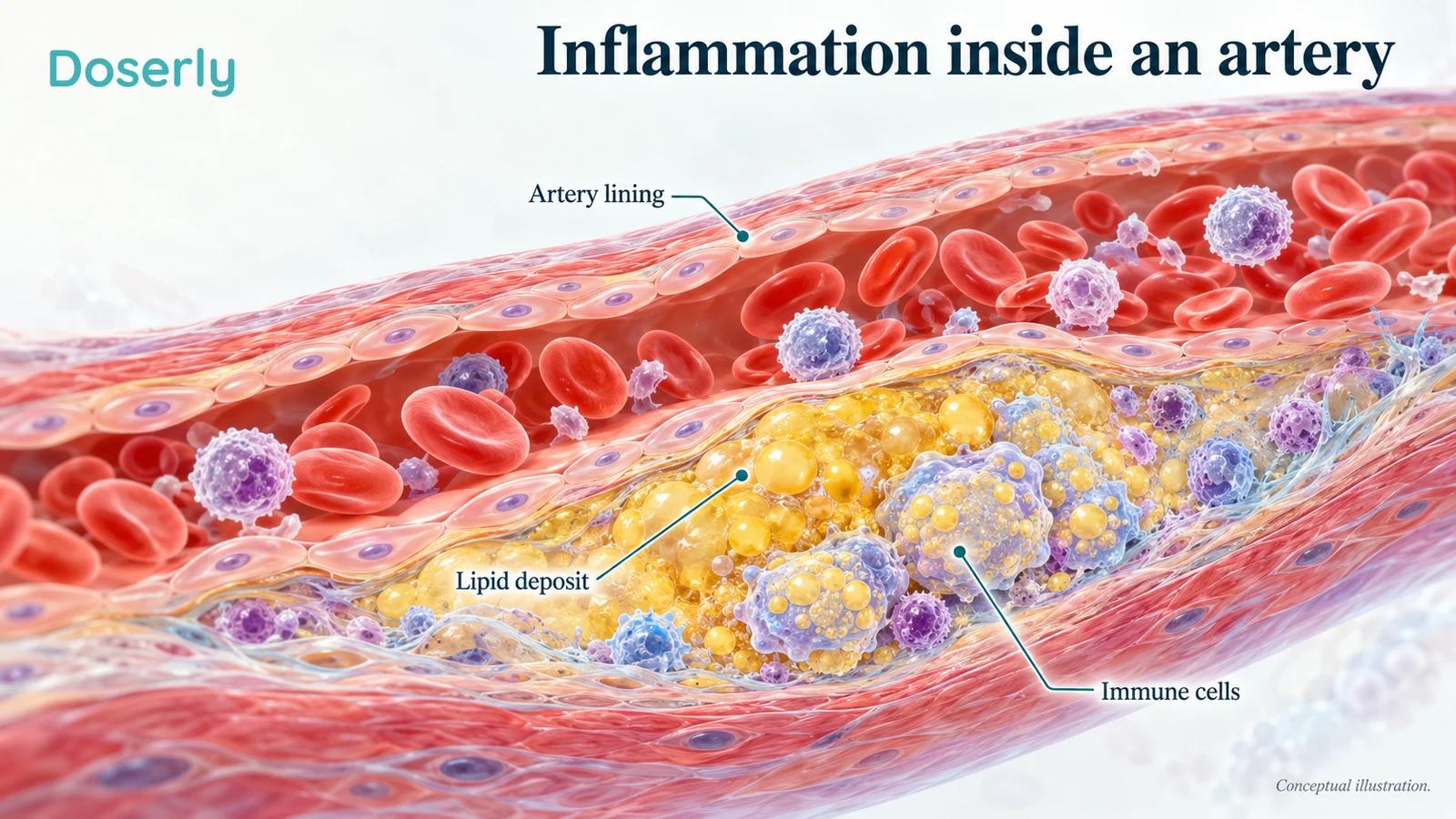
Conceptual artery illustration; it does not show an individual scan or a treatment response.
Inflammation has jobs worth preserving
Inflammation helps the body respond to infection and injury. Immune cells recognize threats, communicate with other cells, remove damaged material and help coordinate repair. A response can be protective in one setting and damaging when it persists or occurs in the wrong tissue. Calling all inflammation harmful loses the reason the system exists.
For cardiovascular disease, the relevant setting is often atherosclerosis: disease within artery walls involving retained lipoproteins, immune activity and changes in the tissue surrounding a plaque. The danger is not simply that a blood marker is elevated. A plaque can contribute to an event when its structure and surrounding clotting processes create a dangerous interruption of blood flow. The success of targeted inflammation trials supports a role for inflammatory pathways within that broader disease process. CANTOS primary report
“Systemic” inflammation means that signals can be detected beyond a single local site, often in blood. It does not mean every organ has the same problem. A blood sample blends information from many tissues and circumstances. That makes it useful for some questions and poorly suited to others.
Think of the practical difference between an unexplained abnormal result and a known condition. Someone recovering from an infection, someone with an inflammatory disease and someone with established coronary disease can all have elevated inflammatory markers. The same laboratory label does not make their next steps interchangeable. The clinical history supplies information the number cannot contain.
There is no universal inflammaging score
A 2025 study compared inflammatory patterns across four populations: cohorts in Italy and Singapore, the Tsimane in Bolivia and the Orang Asli in Malaysia. The pattern identified in the Italian cohort showed some similarity in Singapore but did not generalize in the same way to the two Indigenous populations. Associations with age and age-related disease also differed. The authors explicitly noted the absence of a consensus cytokine-based measure of inflammaging. Franck and colleagues, Nature Aging
This was an observational comparison, not an experiment showing that a specific lifestyle reverses inflammation. Differences in environments, infections, ages, measurements and available disease information complicate interpretation. It would be a mistake to turn the finding into a prescription to copy another population's way of life. It is a strong reason to question claims that one commercial inflammatory score measures a universal biological aging process.
For a reader, the useful question is modest: what was this test validated to tell me? A test can identify a pattern associated with illness without identifying its cause. A score can distinguish groups in a research dataset without reliably choosing a treatment for one individual. An impressive name does not close those gaps.
This also changes how we read an “anti-inflammaging” claim. The claim needs to name what was measured. A change in one circulating protein, a different distribution of immune cells and fewer hospitalizations are three different findings. None should be quietly substituted for another.
What hsCRP can and cannot tell you
High-sensitivity CRP is a sensitive way to measure C-reactive protein at concentrations relevant to cardiovascular risk assessment. It is a marker downstream of inflammatory signaling, not a complete inventory of immune function. Its usefulness as a risk marker does not establish that CRP itself is the correct treatment target.
Human genetic evidence illustrates the distinction. In a study of genetic variants associated with higher CRP, the variants did not produce the increase in ischemic vascular disease expected if CRP concentration itself explained the observational association. That does not make inflammation irrelevant; it questions a simple causal interpretation of this particular marker. Zacho and colleagues, genetic CRP study
A familiar analogy is a smoke alarm. Its signal can help identify a problem, but changing the alarm does not necessarily remove the source. The analogy is incomplete, because biological markers can participate in complex feedback, yet it captures the decision error: a result that moves in a reassuring direction is not automatically a health benefit.
An isolated hsCRP result therefore deserves context. Why was it ordered? Was the person acutely unwell? Is there a known inflammatory condition? Would a persistent finding change cardiovascular risk assessment or another investigation? A clinician may decide to repeat or investigate it, but a universal retesting schedule makes little sense without knowing the question.
The goal is to avoid both extremes: dismissing the result as meaningless, or treating it as an instruction to suppress immunity. A marker becomes useful when it contributes to a decision with evidence behind it.
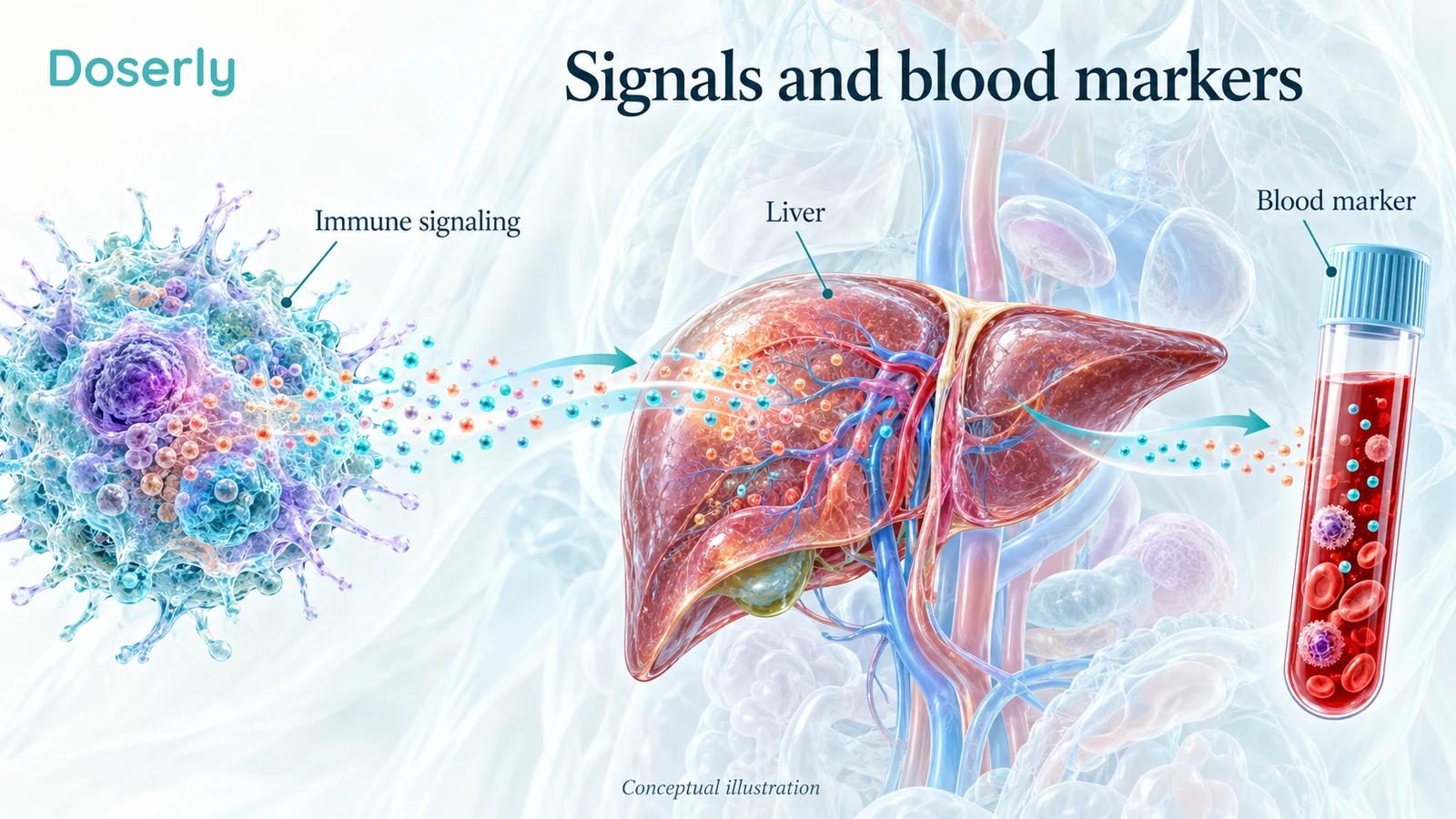
Conceptual signaling overview; a blood marker does not identify every source of inflammation.
CANTOS showed that targeting a pathway can prevent events
CANTOS randomized 10,061 people with a previous myocardial infarction and hsCRP of at least 2 mg/L to placebo or canakinumab, an antibody targeting interleukin-1 beta. In the successful dose group, the primary cardiovascular event rate was 3.86 versus 4.50 per 100 person-years over a median 3.7 years. The hazard ratio was 0.85, a relative reduction of about 15%, without a lipid-lowering explanation. Fatal infection was more frequent with canakinumab, and overall mortality was not significantly lower. CANTOS results
This was an important causal experiment. Researchers changed a specific inflammatory pathway and observed fewer recurrent cardiovascular events. But the experiment was not conducted in healthy adults seeking extra lifespan. Participants already had cardiovascular disease and residual inflammatory risk. The result supports a defined disease mechanism and a possible treatment strategy, with a meaningful tradeoff.
Notice the unit used for the absolute result: events per 100 person-years. That is an event rate incorporating follow-up time, not the percentage of participants who benefited. Subtracting the rates gives 0.64 fewer primary events per 100 person-years in that comparison. It should not be relabeled as a 15-percentage-point reduction or a promise of additional years of life.
The infection finding also belongs beside the benefit, not in small print. A pathway involved in artery disease can also help defend against pathogens. The relevant aim is better health overall, including the consequences of altering that defense.
Colchicine produced benefits in some coronary disease trials
Colchicine affects cellular processes involved in inflammation and has a much longer clinical history than the newer antibody treatments. Its cardiovascular evidence includes two influential positive randomized trials, each testing it alongside usual care rather than as a replacement for established prevention.
In COLCOT, 4,745 people recruited within 30 days of a heart attack received colchicine or placebo. Over a median 22.6 months, the composite cardiovascular outcome occurred in 5.5% versus 7.1%, an absolute difference of 1.6 percentage points. The composite included cardiovascular death, resuscitated cardiac arrest, heart attack, stroke and urgent hospitalization for angina leading to revascularization. Serious pneumonia occurred in 0.9% versus 0.4%; this safety signal needs context rather than an assumption that every infection outcome was increased. COLCOT primary report
LoDoCo2 enrolled 5,522 people with chronic coronary disease. Its primary composite occurred in 6.8% receiving colchicine and 9.6% receiving placebo over a median 28.6 months: 2.8 percentage points apart. Participants had passed a run-in period, which matters because people unable to tolerate treatment early were less likely to reach randomization. Noncardiovascular deaths were numerically more frequent with colchicine, with uncertainty around that estimate. LoDoCo2 primary report
These results are clinically meaningful, but neither composite should be translated into an equivalent reduction in every component. Preventing a revascularization procedure, preventing a heart attack and preventing death are related but different achievements. The overall composite gives the trial a workable statistical endpoint; readers still need to know what it contains.
They also illustrate why an anti-inflammatory supplement cannot borrow the evidence for a prescription medicine. Sharing a broad biological description does not establish the same target, exposure, patient selection, benefit or safety profile. “Reduces inflammation” is too broad to function as a treatment class with interchangeable outcomes.
A larger recent heart-attack trial was negative
CLEAR SYNERGY adds a crucial counterweight. Among 7,062 people treated soon after myocardial infarction, colchicine did not reduce the primary cardiovascular composite over a median three years. Events occurred in 9.1% versus 9.3% with placebo, with a hazard ratio of 0.99. CRP was lower in the measured subgroup, but that laboratory effect did not translate into the expected clinical benefit. Diarrhea was more common, while serious infections did not differ significantly. CLEAR primary report, published online in 2024
A negative trial does not erase earlier positive trials. Equally, earlier positive trials do not justify hiding a larger negative result. Differences in clinical setting, treatment timing, background care, adherence and participant characteristics can matter. Establishing which difference explains discordant findings requires analysis; it cannot be settled by choosing the explanation that best protects a favored treatment.
For someone with coronary disease, this makes the conversation more individualized. Which trial population most resembles the person considering treatment? What care are they already receiving? What outcome is the clinician trying to prevent? How do tolerance and other medicines affect the balance?
For someone without cardiovascular disease, the extrapolation is larger still. A therapy with mixed results in high-risk secondary prevention is not established as a general-purpose longevity treatment. The difference is not skepticism about aging biology. It is respect for the actual clinical question studied.
The 2026 ZEUS result reinforces the biomarker lesson
Ziltivekimab targets interleukin-6. Its earlier phase 2 RESCUE trial enrolled 264 people with chronic kidney disease and elevated hsCRP. Large reductions in hsCRP and other biomarkers justified a larger outcomes study, but RESCUE's primary endpoint was a laboratory change after 12 weeks, not fewer heart attacks or longer survival. It was funded by Novo Nordisk, with industry relationships disclosed by investigators. RESCUE primary report
On July 31, 2026, Novo Nordisk reported that the phase 3 ZEUS trial had not reduced major cardiovascular events in more than 6,300 people with atherosclerotic disease, chronic kidney disease and inflammation. The reported hazard ratio was 0.99, with a 95% confidence interval of 0.88–1.11, despite the expected biological effects. Serious infections were more frequent with treatment. This is a sponsor's headline announcement, not a substitute for a complete peer-reviewed report and detailed safety tables. ZEUS sponsor announcement
The available result is nevertheless too important to omit from a current account. It shows why a persuasive mechanism plus a dramatic biomarker response still needs an outcomes trial. A marker is useful for confirming that a treatment reaches its biological target. Whether reaching that target improves health is a separate question.
Nor does one negative IL-6 trial establish that all approaches to inflammatory signaling must fail. It narrows what can honestly be claimed about this intervention in this population. Progress includes discovering which apparently promising routes do not deliver the hoped-for benefit.

Conceptual immune-defense illustration; it does not quantify any medicine's infection risk.
Other drugs show why the pathway matters
CIRT tested low-dose methotrexate in 4,786 people with prior myocardial infarction or multivessel coronary disease plus diabetes or metabolic syndrome. It did not lower the selected inflammatory markers or reduce cardiovascular events. Liver-enzyme elevations, blood-count changes and more non-basal-cell skin cancers accompanied treatment. An effective drug for some inflammatory diseases was not an effective cardiovascular prevention strategy in that trial. CIRT primary report
JUPITER approached risk differently. It tested rosuvastatin in people without established cardiovascular disease who had elevated hsCRP and relatively low LDL cholesterol by the study's entry criteria. Cardiovascular events were reduced, but the medicine lowered both LDL cholesterol and hsCRP. The trial therefore cannot isolate inflammation reduction as the sole explanation. JUPITER primary report
Together, these trials resist a simple ranking of drugs by how strongly they are described as anti-inflammatory. The same label covers different targets and physiological effects. What matters is whether a particular treatment improves a relevant outcome under conditions close enough to the intended use.
This is also why conventional prevention still belongs in the discussion. A person can have residual risk after good treatment, but “residual” does not mean the established treatment has stopped mattering. New strategies are often tested on top of it. An exciting inflammatory pathway does not cancel the value of addressing other contributors to cardiovascular disease.
Why the same relative benefit can mean different things
Imagine two hypothetical groups followed for the same length of time. In one, 10 out of 100 people would experience an event without an additional treatment. In the other, only one out of 100 would. If a treatment truly reduced relative risk by 20% in both groups, the absolute reduction would be two events per 100 in the first group and 0.2 per 100 in the second. These are arithmetic examples, not estimates for colchicine or any particular person.
The distinction helps explain why a prevention result in people with established disease cannot be casually exported to healthy adults. Even if the relative effect carried over, which needs evidence, the absolute opportunity for benefit could be much smaller. Meanwhile, taking a medicine, experiencing side effects and managing interactions still have consequences. The benefit and burden do not necessarily shrink together.
Follow-up time matters too. A two-year trial does not directly tell us the effect of treatment for twenty years. Benefits might accumulate, adherence might change, and uncommon harms might become clearer. Extending a short-term result into a lifetime forecast requires assumptions that should be visible, especially when the product is marketed for decades of preventive use.
This is why a useful consultation includes an estimate of baseline risk and a time horizon. “It reduces risk” is a starting point. “How much risk might it reduce for someone like me, over what period, with what uncertainty?” is the question that makes the answer usable.
Safety is part of the treatment question
The current US LODOCO label includes cardiovascular risk reduction in adults with established atherosclerotic disease or multiple cardiovascular risk factors. That regulatory indication is not an approval for treating aging itself. The label also describes important interactions and contraindications, including strong CYP3A4 or P-glycoprotein inhibitors, renal failure, severe hepatic impairment and pre-existing blood disorders. Muscle toxicity and blood-cell suppression are among the serious concerns. Current prescribing information
These details explain why a medication review matters before a decision. A medicine that was tolerated previously can become less suitable when kidney function changes or another prescription is added. “Low dose” describes an amount; it does not remove interaction risk. A supplement list belongs in the same conversation because a clinician needs to know what is actually being taken.
Risk is also personal in a less technical sense. Some people place a high value on a possible reduction in recurrent events and accept monitoring or symptoms. Others find the treatment burden unacceptable. Shared decisions require a realistic estimate of benefit, the uncertainties around that estimate and a plan for what happens if problems develop.

Conceptual care illustration; the objects represent information used in decisions, not a recommended test panel.
A useful response to an inflammation result
Start with the reason for testing. If the aim was cardiovascular prevention, the conversation should connect the result with existing disease, blood pressure, lipids, smoking, diabetes and the person's broader history. If symptoms prompted the test, identifying their cause may matter more than assigning an aging score. The same number can lead to different discussions because the question is different.
Ask what would change if the result remained elevated. Sometimes the answer is a more careful risk discussion; sometimes it is further evaluation for a specific condition. Sometimes no additional treatment is justified. Knowing the intended decision before ordering a larger panel helps avoid collecting abnormalities that have no clear interpretation.
If a product claims to lower inflammation, ask which outcome supports using it. A small change in hsCRP may be interesting, but it should not be presented as proof of fewer strokes, preserved memory or longer life. A product's evidence should stand on its own, including the formulation studied and the people who participated.
It can help to bring a short record to the appointment: why the test was ordered, recent illnesses, symptoms, current medicines and the question you want answered. This is more useful than arriving with a target number detached from its clinical setting. It also makes follow-up purposeful: what will be reassessed, and what result would actually alter the plan?
The strongest lesson from inflammation research is that outcomes can improve when the right pathway is targeted in the right setting, but a lower marker does not guarantee that improvement. Protecting health as we age means preserving useful immune function while addressing disease processes that cause harm. The aim is not the quietest possible immune system. It is fewer illnesses, better function and a treatment plan whose benefits justify its costs and risks.