
Peptides
October 16, 2026
Peptide podcasts and the human-evidence gap: reading the Huberman–Bakri interview
On this page
A detailed discussion of a peptide can sound convincing before it answers the question a patient actually has: will this particular treatment help my condition, and what risks would I be accepting?
The June 1, 2026 Huberman Lab interview with Abud Bakri discusses peptide biology, clinical experience and experimental treatments, including BPC-157. Its chapters move from animal injury research to adverse events, angiogenesis and patient experiences. Those are different kinds of evidence, even when they appear within one conversation. Official episode and transcript.
This article uses BPC-157 as a worked example of how to follow those transitions. It does not attempt to judge every peptide or every statement in the episode. The useful task is to identify what an experiment actually measured, what human evidence exists and where the inference becomes larger than the data.
Start by turning an interesting claim into a precise question
“Helps healing” could mean less pain, greater strength, improved imaging, fewer repeat injuries or a faster return to work. A study may measure one of those without demonstrating the others.
A more answerable question would identify the injury, the people being treated, the exact preparation, the route, the comparison and the outcome. For example: does a defined product improve function after a specified tendon injury when both groups receive the same rehabilitation?
That question is deliberately narrower than whether the molecule has interesting biology. It allows evidence to be evaluated against the proposed use, rather than letting favorable findings from unrelated settings accumulate into a general impression.
When listening, write down the claim before looking for the paper. Otherwise, it is easy to accept a study that supports a different, smaller claim.
What the rat Achilles experiment actually studied
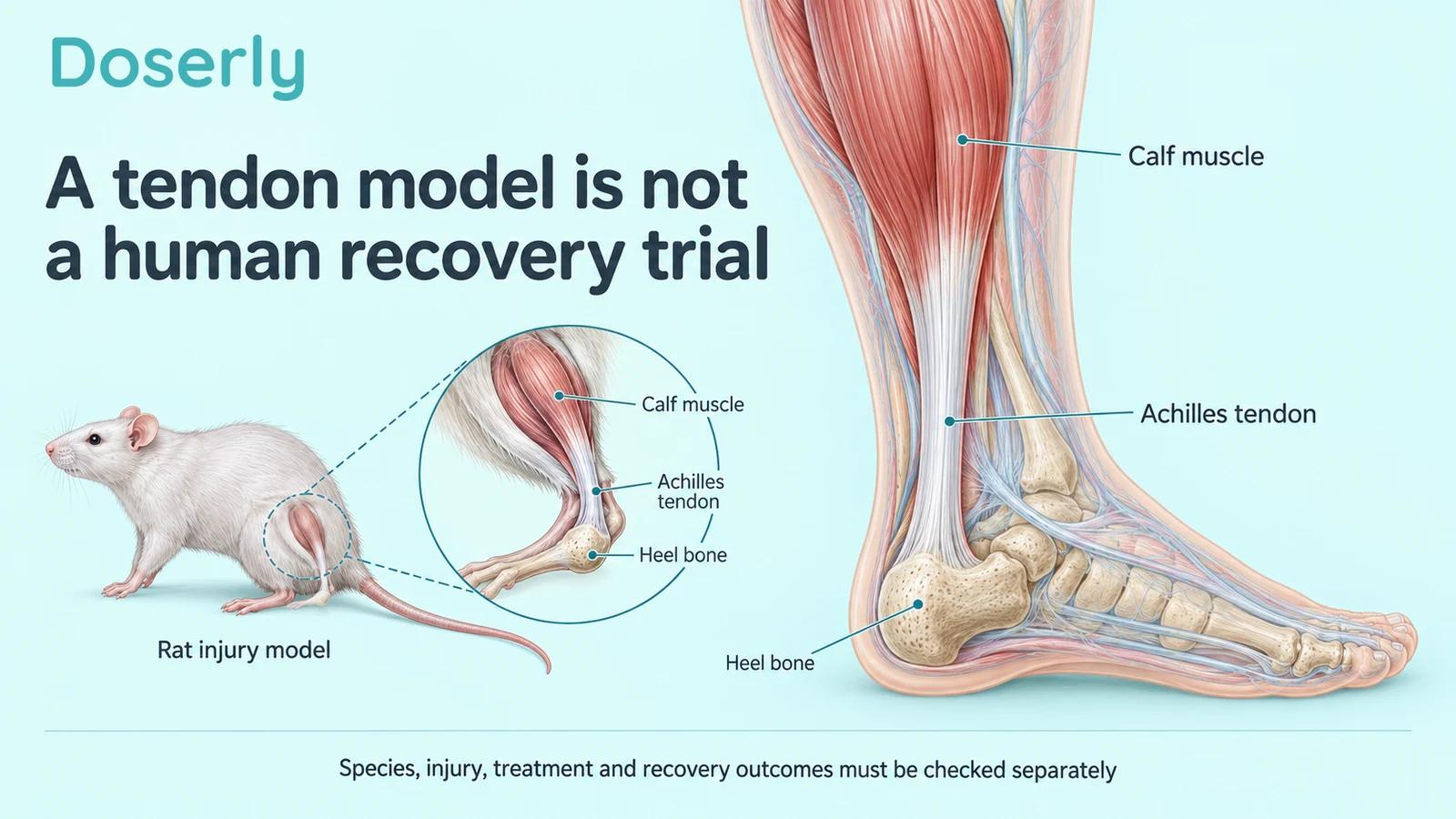
A frequently cited 2003 BPC-157 paper examined surgically transected Achilles tendons in rats. Treatment began shortly after the experimental injury, and researchers assessed function, mechanical properties and tissue findings over the following two weeks. They reported favorable results relative to controls. The paper also included cultured tendon-cell experiments. Original Achilles study.
These were rats with a deliberately created injury, not people with chronic tendinopathy or an older sports injury. The administration route was intraperitoneal, into the abdominal cavity, rather than an injection beside a person's painful tendon.
The experiment provides a reason to investigate further. It does not demonstrate a human treatment benefit, establish a consumer regimen or settle whether local injection improves an outcome. Those questions require evidence that actually compares the proposed human treatment.
A mechanism is a hypothesis about how an effect could occur
Discussions of BPC-157 often invoke blood-vessel growth, inflammatory signaling or tissue repair. A proposed mechanism can help researchers design an experiment and choose measurements. It cannot replace evidence that patients benefit.
FDA's 2026 presentation for its compounding advisory committee described proposed mechanisms while noting that molecular targets had not been identified and the mechanism of action remained unknown. FDA scientific presentation.
That is different from saying nothing biological happens. It means the available observations do not justify a fully resolved account of how the substance works in people.
A pathway can also participate in several processes. Knowing that a signal is involved in repair does not tell us whether changing it with a specific product produces a favorable balance of effects in a patient. “Biologically plausible” is a useful starting description, not a clinical verdict.
There is human research—but its design matters
It would be inaccurate to say BPC-157 has never been studied in people. It would be equally misleading to use the existence of a human paper as though it settled effectiveness.
A 2021 retrospective knee-pain report reviewed 17 patient records and obtained telephone responses from 16 people. Twelve had received BPC-157 alone and four a combination with thymosin beta-4. Fourteen of the 16 respondents reported relief. There was no concurrent control group, and the report did not use specific tools to measure function, quality of life, stiffness or daily activities. Original knee-pain report.
The reported improvement matters as a signal. Without a comparator, it cannot show how much was attributable to BPC-157 rather than other care, the course of symptoms or expectations. Combining two treatment groups also cannot identify the independent effect of either peptide.
Less pain is not a scan of repaired cartilage
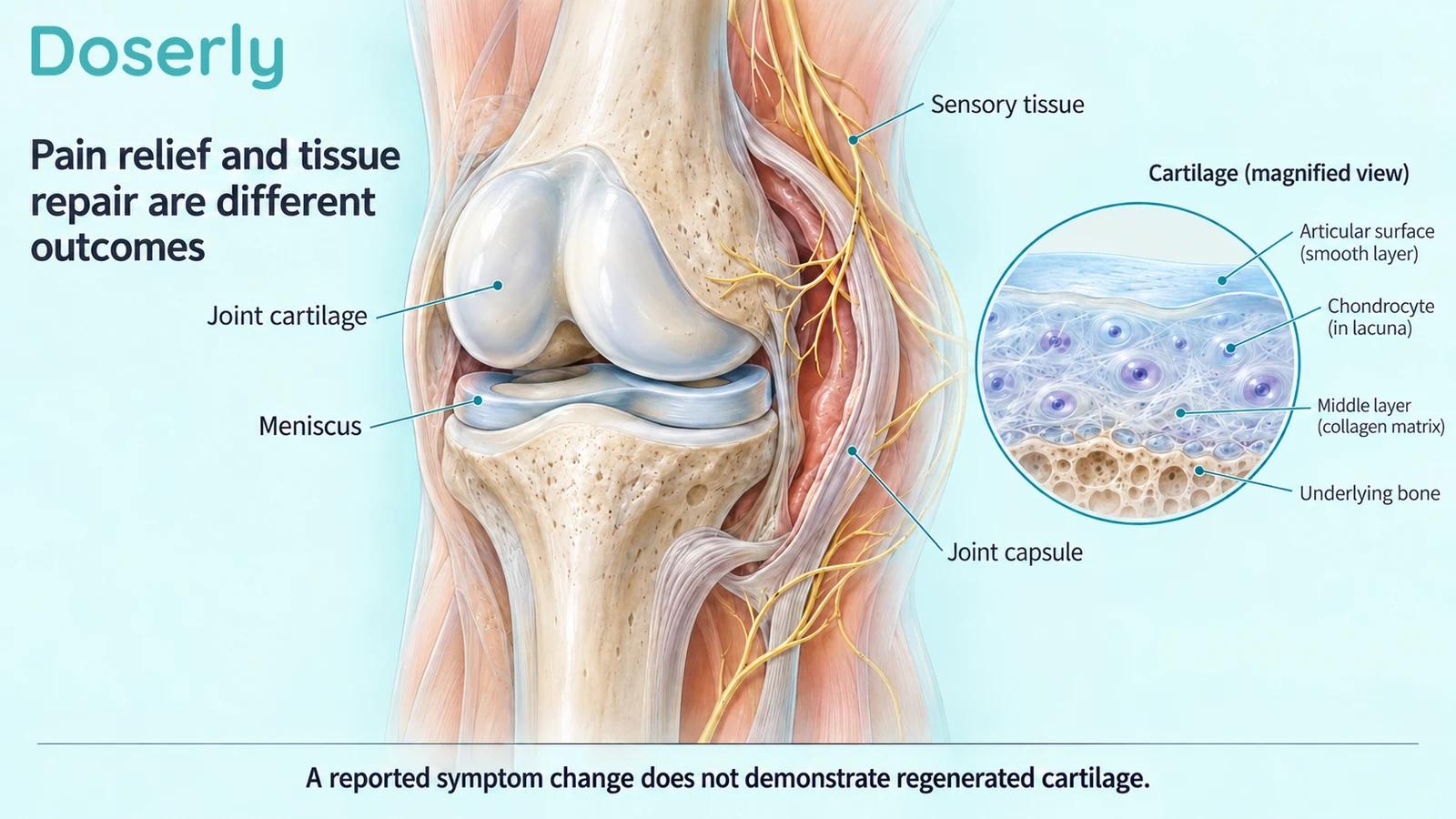
The knee report's authors proposed further studies with follow-up imaging. That proposal should not be rewritten as evidence that imaging had already demonstrated repaired tears or new cartilage.
Pain is a meaningful patient outcome. Structural repair is a different claim requiring appropriate measurements. A person can feel better without a study having established what changed inside the joint.
This distinction is especially important when a podcast moves between someone's experience and an explanation involving regeneration. The experience may be accurately described while the proposed biological explanation remains untested.
A stronger injury study would define the diagnosis, document baseline status, compare treatments prospectively and measure outcomes that match its claims. If structural repair is claimed, the evidence should include a suitable structural assessment rather than rely solely on symptom recall.
A bladder study cannot answer a tendon question
A 2024 pilot treated 12 women with interstitial cystitis using BPC-157 injections during a cystoscopic bladder procedure. The authors reported substantial symptom improvement and no adverse events in that small group. There was no placebo comparison. Original bladder pilot.
This adds a human observation in a specific condition and procedural setting. It does not establish that a capsule, nasal spray or subcutaneous injection will treat an injury elsewhere in the body.
The same principle applies even when several papers concern one molecule. Different routes, tissues and diseases are not interchangeable replications. A collection of promising observations becomes more useful when the differences are preserved rather than averaged into “works for healing.”
The two-person infusion paper is a short observation
A 2025 pilot administered intravenous BPC-157 to two adults on consecutive days, with laboratory measurements and vital-sign assessments extending through the third day. Both participants had received intravenous BPC-157 before the study. The investigators reported no adverse effects and no measurable adverse changes in the tested biomarkers. Original infusion pilot.
That finding supports a limited description of what happened to those two previously exposed people over a brief period. It cannot establish long-term safety, uncommon-event rates or safety in people with different medical conditions.
It was also not an injury-healing trial. Normal results on selected blood tests do not show that a torn tendon recovered, nor do they rule out outcomes the study did not measure.
The paper's broad language about safety should therefore be read alongside its actual sample and observation window. Conclusions are most useful when they stay close to the design.
The older bowel trial prevents another oversimplification
FDA's 2026 materials describe an older randomized, placebo-controlled ulcerative-colitis study reported as a meeting abstract. It randomized 53 people to a rectal preparation or placebo for two weeks. The reported between-group estimate was imprecise, with a confidence interval crossing no difference; important methodological details were missing. FDA scientific presentation, clinical effectiveness section.
This means “there has never been a randomized human study” is too sweeping. It also means the existence of that study does not establish a benefit for tendon injuries or for other routes.
A full report allows readers to examine methods and outcomes more thoroughly than a short abstract. When that detail is unavailable, the uncertainty should remain visible rather than being filled in from an enthusiastic summary.
Registrations are plans or records, not results
The research landscape changes, so dated blanket statements can quickly become misleading. On October 15, 2026, a ClinicalTrials.gov record for recovery after rotator-cuff repair listed a planned study that was not yet recruiting, with no posted results. Rotator-cuff study record.
Another record listed a completed peptide-gummy study with 40 participants but no posted results. A “completed” status describes the submitted study status; it does not provide an effect estimate or let readers inspect safety findings. Gummy-study record.
Registration can help reveal what researchers intend to test. It does not verify that a proposed treatment works, and estimated enrollment should not be counted as people with demonstrated benefit. Read the results section and update dates, not just the study title.
Safety uncertainty is not proof of either harm or safety
A small study reporting no adverse events cannot establish that no important risk exists. Conversely, a theoretical concern does not establish that every exposed person will experience harm.
FDA's BPC-157 briefing identified inadequate clinical safety information, potential immunogenicity concerns related to peptide aggregation or impurities, and missing studies needed to assess carcinogenic potential. Its assessment also discussed limitations in the available nonclinical safety evidence. FDA briefing document.
These are evidence gaps and concerns, not a quantified human cancer-risk estimate. Claims that BPC-157 causes cancer, prevents cancer or is safe because no cancer was observed all require more support than a brief injury experiment or two-person infusion report can provide.
The appropriate response is to retain uncertainty in the treatment discussion, including what monitoring could and could not detect. A normal test result today cannot certify every possible future outcome.
Product quality is a different question from molecular promise
Even a well-designed study evaluates the material actually administered. A product sold under the same common name may differ in composition, impurities, stability or delivery.
FDA's briefing noted inconsistent information about BPC-157 forms and characterization. Separately, the agency explains that compounded drugs are not FDA-approved and do not undergo the same premarket review of safety, effectiveness and quality as approved medicines. FDA briefing, FDA compounding information.
This does not mean every compounded preparation has the same defect. It means a claim about the molecule cannot establish the quality of a particular finished product. A clinic's experience, a product label and a paper each answer different questions.
Likewise, an advisory discussion about compounding is not a drug approval. FDA's July 2026 meeting page explains that advisory recommendations are nonbinding. The scientific presentation cited here records reviewers' analysis, not a final determination or an authorization for an injury indication. Official meeting information.
How to evaluate a clinical story fairly
A clinician's account can suggest a worthwhile question. It is less able to show what would have happened without treatment, especially when rehabilitation, rest or several interventions changed at once.
Ask whether unsuccessful experiences were tracked as systematically as favorable ones. Ask how improvement was defined, when it was measured and whether the original diagnosis was confirmed. These questions concern the information needed to interpret the observation; they are not accusations that the person describing it is dishonest.
Also separate confidence from evidence. A clear explanation may make a mechanism easy to understand while leaving its human clinical relevance uncertain. A hesitant speaker can describe strong data, and a confident speaker can describe an uncontrolled experience.
The useful habit is to follow the source rather than the delivery.
A practical way to listen without losing the distinctions
For a claim that interests you, make a short note of the molecule, product, condition and outcome. Locate the original paper and identify whether it studied cells, animals or people. Then check the comparison group, participant count, duration and adverse-event collection.
If the claim involves “healing,” ask how healing was measured. If it involves “safe,” ask which harms could realistically have been detected. If it involves approval, identify the exact product and indication instead of relying on a general regulatory headline.
The episode's official transcript was still labeled as under human review when checked for this article. That is another reason to avoid treating a transcript fragment as a precise clinical instruction. Official episode.
The Doserly BPC-157 human-evidence guide provides a broader place to compare the records. The central question remains specific: what evidence supports this product, for this problem, measured by this outcome? A compelling conversation can motivate that question; the answer still belongs to the studies.
Sources
- Huberman Lab: official June 2026 Bakri interview.
- Staresinic et al.: rat Achilles tendon experiment.
- Lee and Padgett: retrospective knee-pain report.
- Lee et al.: interstitial-cystitis pilot.
- Lee and Burgess: intravenous pilot.
- FDA: July 2026 scientific presentations.
- FDA: BPC-157 briefing document.
- ClinicalTrials.gov: rotator-cuff recovery record.
- ClinicalTrials.gov: peptide-gummy study record.
- FDA: understanding compounded-drug risks.
- FDA: July 2026 advisory committee information.