
Peptides
October 16, 2026
Reading a human hexarelin study: what the original experiments actually tested
On this page
Hexarelin has been given to people in published research. That makes its evidence different from a compound studied only in cells, but it doesn't tell us what the human experiments established. Many were small physiological studies designed to observe hormone release or cardiac function over minutes and hours.
For a reader considering claims about muscle, recovery or heart health, the useful question is specific: what happened to which people, after which exposure, and what did the researchers measure? The original papers provide several good examples of why those details change the answer.
This article walks through the research as it was conducted, beginning with the 12-person dose-response experiment that is often used to describe hexarelin's potency. It then examines route comparisons, repeated exposure and the surgical cardiac study. The goal is to understand these experiments on their own terms before applying them to a different purpose. For compound background, see the Doserly hexarelin guide.
The first question was whether hexarelin released growth hormone
The 1994 dose-response study included 12 healthy adult men. Each received single intravenous hexarelin exposures and placebo. The active amounts increased across study sessions for safety, while placebo was inserted into the sequence at random. The study was double-blind, meaning treatment identity was concealed from participants and the relevant investigators. Imbimbo and colleagues
Those design details are valuable, but they should be described accurately. “Double-blind” does not mean that every part of the schedule was randomly ordered. Here the rising sequence of active exposures was deliberate. A random placebo position and a fully randomized dose order are different features.
The measured response was circulating growth hormone. It peaked around 30 minutes and returned to baseline within 240 minutes. The result demonstrated hormone-releasing activity. The study did not report a training program, a muscle-strength outcome or months of recovery data. Calling it a human study is correct; calling it proof of a bodybuilding benefit would add an outcome it never measured.
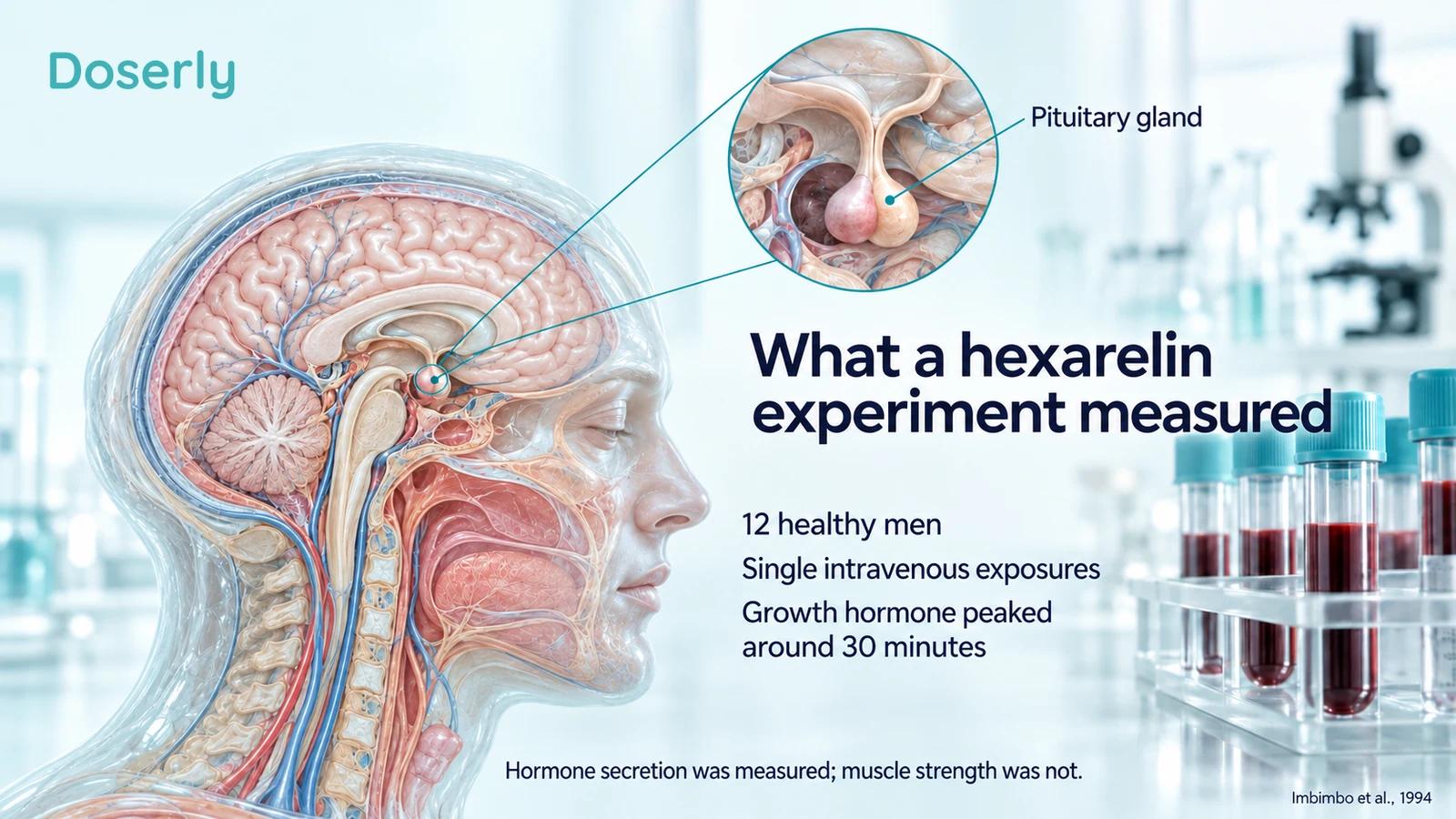
Conceptual anatomy illustrates the measured system. The original experiment measured growth hormone after test exposures, not muscle strength. Source.
Why a taller peak is not a complete description
A peak is the highest measured concentration during an observation period. Another common measurement, area under the curve, summarizes concentration over time. Imagine repeated blood samples being used to describe both how high the response went and how long it persisted. Those are related but different aspects of exposure.
In the dose-response paper, the mean growth hormone peak changed little between the two highest tested amounts, while integrated exposure still differed. The reported approximately 55-minute half-life concerned the declining growth hormone concentration. It was not a direct measurement of hexarelin's elimination from the body. Original dose-response report
This distinction prevents two common errors. First, a near-maximum hormone response does not define an optimal therapeutic amount. A useful treatment would need an intended clinical benefit and an acceptable safety profile, neither of which is captured by maximizing one hormone measurement. Second, the time course of a released hormone cannot automatically be used to calculate the drug's dosing interval.
No amount of precision in a graph changes the identity of what was measured. The units and the label on the vertical axis matter as much as the size of the response.
How the route-comparison study adds context
Another 1994 experiment studied 12 healthy young volunteers using intravenous, subcutaneous, intranasal and oral administration. The investigators used different amounts for different routes and compared the resulting growth hormone responses. All routes showed activity under the conditions studied, but their biological availability differed greatly. Ghigo and colleagues
That paper answers an absorption-and-response question. It does not establish that equal amounts given by different routes create equivalent exposure. Nor does activity from a carefully prepared research formulation validate a marketed product with a similar name.
The term “biological availability” needs attention here. The investigators used a hormone response to assess biological activity. It should not be casually rewritten as a modern direct plasma pharmacokinetic profile of the peptide, complete with a measured half-life or a reliable concentration target. A downstream response is informative, but it is not the same measurement as repeatedly quantifying the drug itself in blood.
For a reader, this means that the route belongs next to the result. “Hexarelin caused a hormone response” leaves out less than “this amount will work the same by mouth,” but the second claim requires evidence the first does not provide.
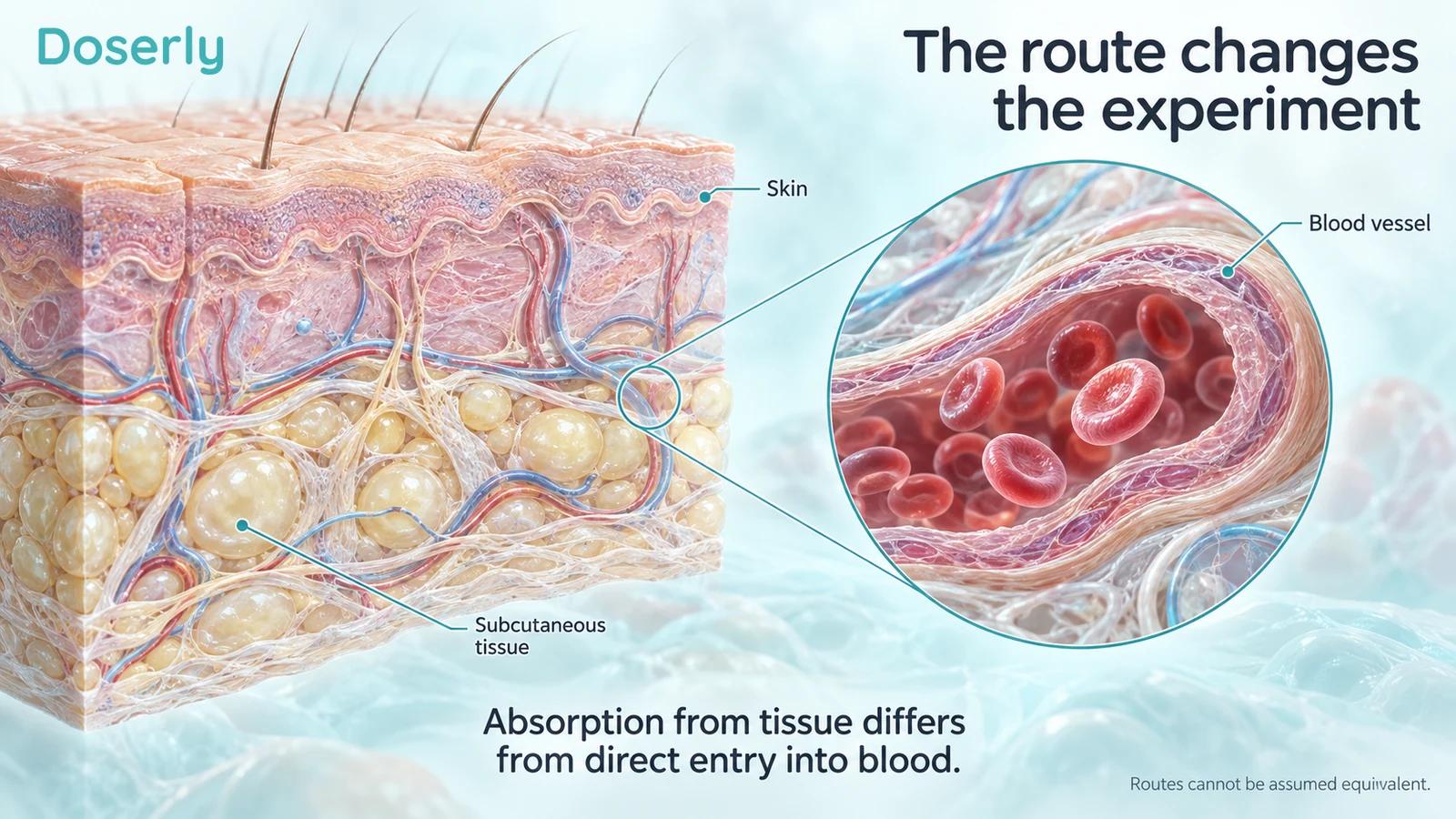
Conceptual tissue anatomy, not injection instructions or a measured absorption rate. The route-comparison study assessed hormone responses, not interchangeable treatment schedules.
The other hormones were part of the experiment too
A separate dose-response study measured prolactin and cortisol alongside growth hormone. In healthy adult men receiving intravenous hexarelin, the hormones responded differently across the tested range. Combining low-dose hexarelin with growth hormone releasing hormone produced a large growth hormone response with a different pattern in the other hormones. Massoud and colleagues, 1996
This makes a practical point about the phrase “strong response.” Strong for which endpoint? An intervention may have the intended physiological action and additional actions that need separate evaluation. Reporting only the most attractive curve can leave the reader with an incomplete understanding of the experiment.
The same study cannot tell us how often someone using hexarelin outside research would experience symptoms, whether those changes persist, or how another medication would interact with them. Those questions require additional observations. The acute endocrine findings are a reason to keep the broader response in view, not a basis for predicting an individual person's complete risk profile.
Repeated exposure changed the answer
The 16-week hexarelin study is especially useful because it shows why one test exposure cannot be projected indefinitely. Participants received twice-daily subcutaneous treatment, with reassessment after treatment and four weeks after stopping. The growth hormone response became smaller during exposure and recovered after withdrawal. IGF-1 and body-composition measurements did not change significantly. Rahim and colleagues, 1998
That result does not contradict the original hormone-release experiment. Both can be true: a substance can trigger a marked initial response and a smaller response after repeated use. The later study asks what the system does over time, which is a different question from whether it can respond at all.
The report also does not establish that a particular cycling routine restores clinical benefits. Recovery of a laboratory response after stopping is not the same as showing that repeated cycles improve strength, symptoms or long-term health. To answer that question, the benefit itself would need to be measured during a comparison of the proposed routines.
The 24-hour study shows why sampling frequency matters
A 2002 study followed six healthy young men over a full day, taking blood every 20 minutes. It compared two and three subcutaneous exposures and analyzed growth hormone, prolactin, ACTH and cortisol secretion. Both schedules increased daily growth hormone secretion similarly, chiefly by increasing the amount released in each pulse. Daily secretion of the other measured hormones did not change significantly. Maccario and colleagues
This intensive sampling could describe a pattern that one blood draw would miss. It also illustrates why six participants can provide useful physiological information without constituting a broad safety study. The investigators had many measurements per person, but they still had only six people. Repeated samples improve the description of those participants; they do not become hundreds of independent participants.
A one-day result also cannot establish what happens across months, in women, in older adults or in people with endocrine disease. The limitations are specific to the design, rather than a reason to disregard the data entirely.
What the surgical heart study can and cannot settle
The 2002 bypass-surgery experiment included 24 men with coronary artery disease under general anesthesia. Investigators compared hexarelin with growth hormone releasing hormone, recombinant growth hormone and placebo, using cardiac imaging and pressure measurements. Hexarelin increased several pumping measures within about 10 minutes, with effects lasting up to 90 minutes. Broglio and colleagues
This is direct human cardiovascular information, but the denominator needs care: 24 was the whole study population across interventions. It is not the number receiving every treatment. The accessible abstract describes a controlled comparison without enough detail to assume every allocation and blinding feature.
Its setting matters too. A person under anesthesia, with invasive monitoring and a planned cardiac procedure, differs from a person taking a compound repeatedly at home. The study did not establish fewer heart attacks, fewer future admissions or longer survival. Those outcomes cannot be inferred by renaming a brief improvement in pumping “cardiac protection.”
A useful way to read the next claim
Start by writing down the substance and the population. Then identify the route, the observation period and the main outcome. That small amount of information usually reveals whether a paper addresses the health question you care about or only one biological step related to it.
Next, check what was compared. A before-and-after change is different from a difference between active treatment and placebo. A related compound is different from the same compound. A healthy volunteer group and a group with diagnosed disease can have different starting physiology and different opportunities for benefit.
Finally, read the size and uncertainty of the result alongside the conclusion. A statistically significant hormone response can be real without being a clinically useful effect. A nonsignificant clinical result may remain uncertain if the study is small. Neither statement should be turned into a confident promise or a universal rejection beyond what was tested.
For hexarelin, the original human research provides credible observations about hormone release, adaptation and brief cardiac physiology. It does not supply a single validated protocol for the wide range of benefits now associated with the compound. Understanding that difference makes the papers more useful: you can appreciate what the researchers learned while recognizing which personal health questions still need an answer.
Sources
- Imbimbo et al., dose-response physiology, 1994.
- Ghigo et al., administration routes, 1994.
- Massoud et al., GH, prolactin and cortisol, 1996.
- Rahim et al., repeated exposure, 1998.
- Maccario et al., 24-hour hormone sampling, 2002.
- Broglio et al., bypass-surgery physiology, 2002.