
Supplements
October 16, 2026
HMB and muscle loss: who might benefit, and what has been tested?
On this page
HMB is a substance the body makes while processing leucine, an amino acid found in protein. Researchers study it because it can affect the balance between making muscle protein and breaking it down. That makes it interesting when someone is at risk of losing muscle, whether through inactivity, inadequate nutrition or illness. It also explains why HMB appears in products marketed to people who want to build more muscle in the gym.
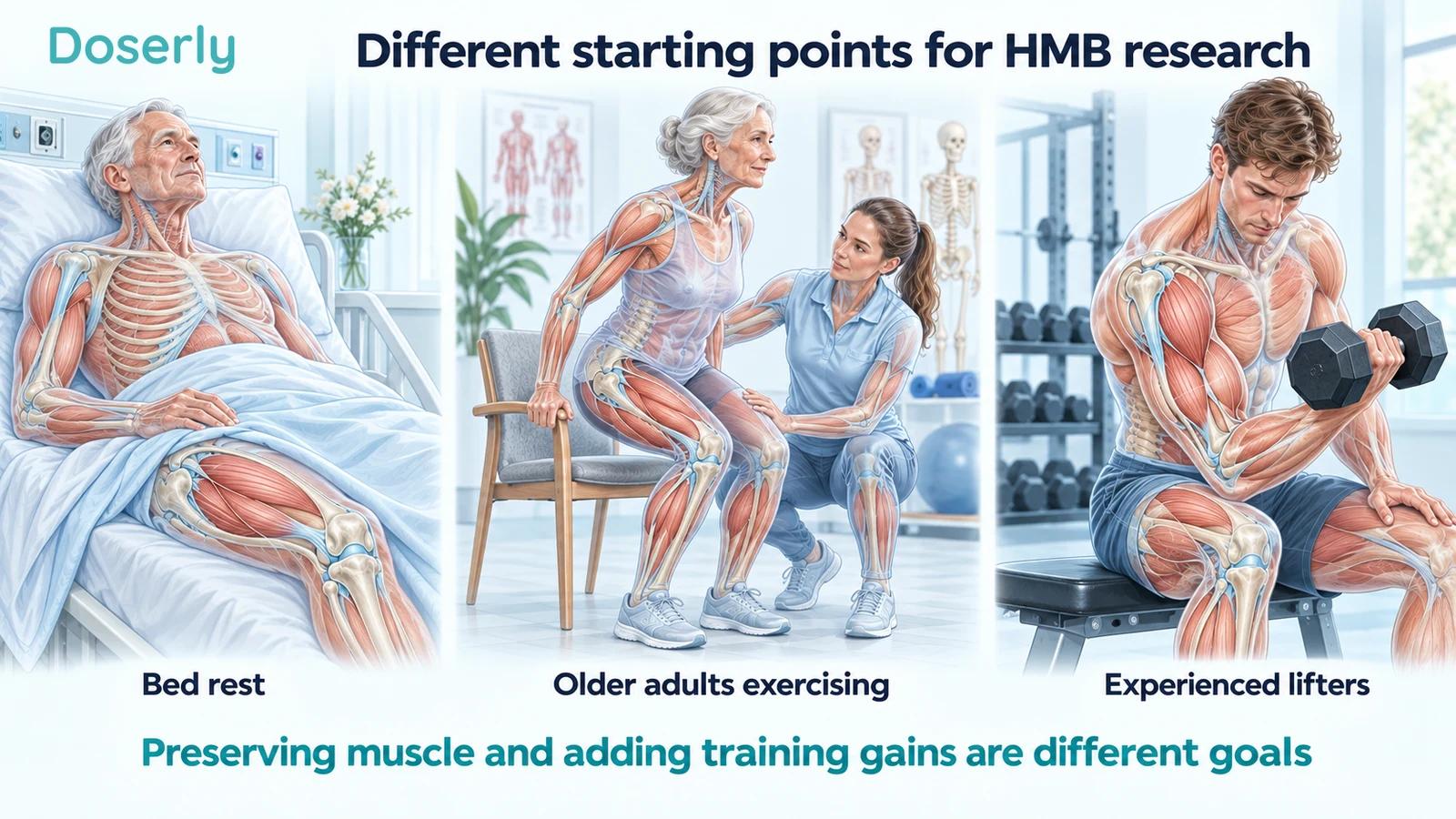
Those are different situations. Preserving tissue during bed rest and adding to the gains of a well-fed, experienced lifter are not the same job. Human studies provide some encouraging findings in selected circumstances, alongside trials in which HMB adds little to exercise. The useful question is therefore more specific than whether HMB “works”: what problem was the person facing, what else did they receive, and what improved?
Our HMB guide introduces its forms and broader research. Here we'll concentrate on the distinction between muscle preservation, physical function and training gains, including a 2026 study combining HMB with creatine.
What HMB can change inside muscle
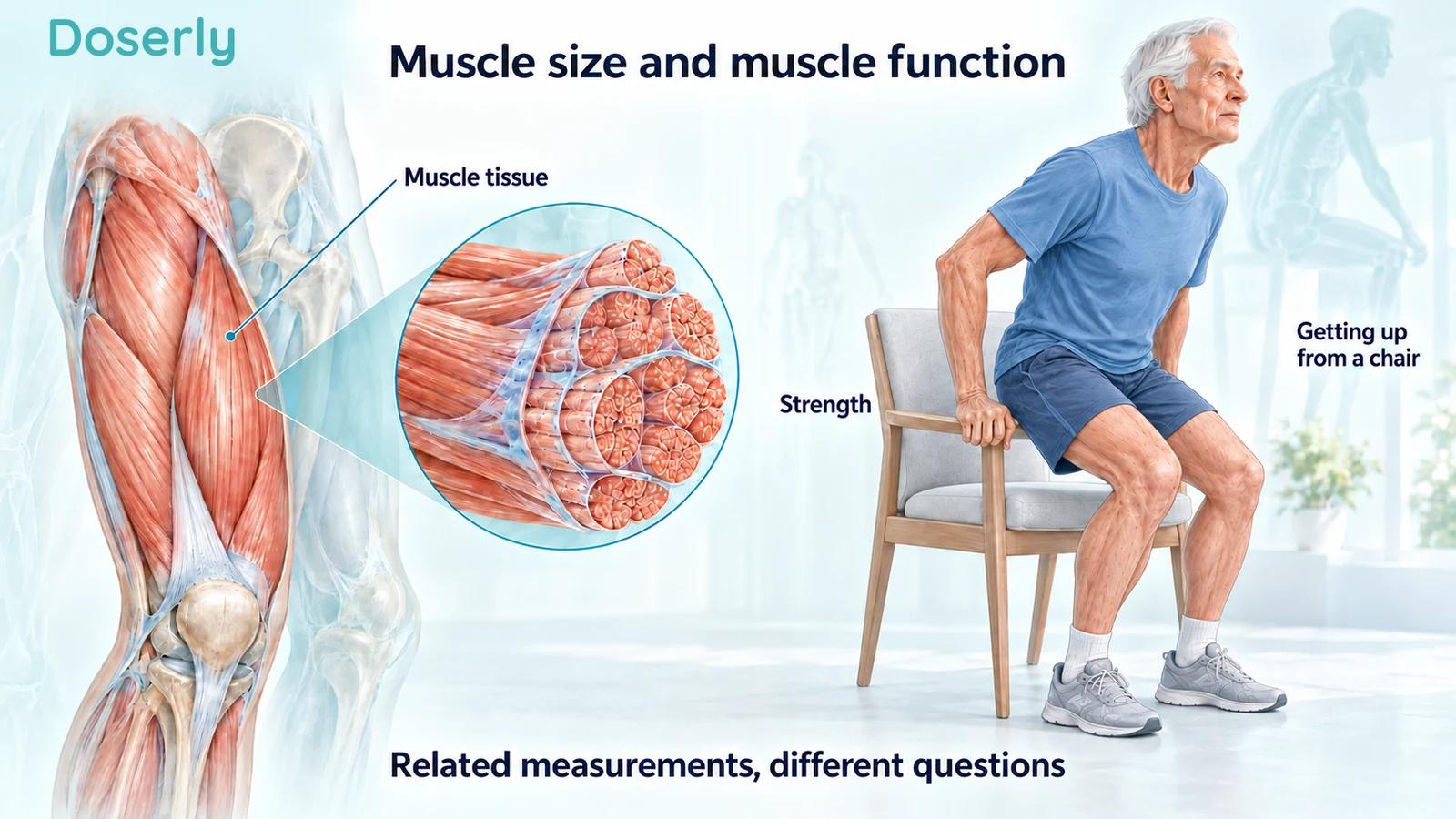
Muscle is continually renewing its proteins. Protein synthesis makes new proteins; protein breakdown removes existing ones. Both are normal processes. Losing muscle over time reflects an imbalance, but a short laboratory measurement of either process doesn't tell us exactly how much tissue someone will gain or retain over several months.
In an acute human experiment, researchers gave calcium HMB and measured muscle protein turnover using tracer methods and tissue sampling. They observed increased synthesis and reduced breakdown after ingestion. This establishes a biological effect under controlled conditions; it doesn't establish that a person will walk farther, avoid a fall or build a visibly larger thigh. The experiment was small and short, with a different purpose from a rehabilitation trial. Wilkinson and colleagues, calcium HMB metabolism study.
The distinction matters because muscle needs more than a signal to grow. HMB isn't a complete protein source. It doesn't provide all the amino acids supplied by dietary protein, and it doesn't reproduce the mechanical demands of exercise. A supplement can influence one part of the process without replacing the conditions that support muscle health as a whole.
Bed rest creates a particular opportunity to preserve muscle
A 2013 randomized trial deliberately studied a period of inactivity. Twenty-four healthy older adults were assigned to calcium HMB or placebo during ten days of complete bed rest, followed by a rehabilitation period. Nineteen participants were evaluable at the end of bed rest. The tested calcium-HMB regimen supplied 3 grams per day; this describes the research, not an individualized recommendation.
The investigators reported preservation of lean body mass with HMB relative to the loss observed in controls. That analysis excluded one participant, and the study did not demonstrate a difference in functional outcomes; its small sample limits what can be concluded about function. The finding is relevant to disuse: a situation in which people stop loading their muscles. It is also a small study, largely involving women, conducted under controlled conditions. Deutz and colleagues, bed-rest trial.
Someone recovering from hospitalization might reasonably find this research more relevant than a young athlete would. Even so, healthy volunteers undergoing planned bed rest aren't identical to patients with infection, surgery, poor appetite and several medications. The study offers a reason to investigate muscle preservation in clinical care; it doesn't establish that buying HMB prevents every consequence of hospitalization.
It also helps explain why “no muscle gained” need not mean “no benefit.” If a control group loses tissue and an intervention group maintains it, preservation may be the intended success. Conversely, a supplement that helps during enforced inactivity need not add muscle in someone whose exercise and nutrition already support maintenance.
Older age alone doesn't identify a responder
It is tempting to combine all older adults into one category. In practice, an active person with adequate nutrition, a person with low muscle mass and a malnourished hospital patient can have very different needs. The trials reflect this diversity.
A 2020 study evaluated 117 adults over 60 with insufficient vitamin D levels over twelve months. Participants received HMB plus vitamin D or a control, with or without resistance exercise. Some functional and strength findings favored supplementation among nonexercisers. The supplement did not further improve the study's combined functional index in the exercising participants. Because HMB and vitamin D were given together, the findings don't isolate HMB. Rathmacher and colleagues, twelve-month trial.
Another trial enrolled 156 women aged 65–79 with low muscle mass. Its four-group design compared exercise, HMB, both and neither over twelve weeks, with further observation afterward. The investigators concluded that exercise was the effective program for improving the outcomes in this population. Low muscle mass did not automatically make HMB a useful addition. Trial report and results recorded in the trial registry.
These findings complicate a simple story in which younger people don't benefit and older people do. The more defensible interpretation is that baseline vulnerability may create an opportunity for benefit, but it doesn't guarantee one. Exercise exposure, nutritional status, the supplement's other ingredients and the chosen measurement all influence the question being answered.
What the 2026 creatine-plus-HMB trial adds
A newer crossover trial included thirty physically active adults aged at least 60: twenty men and ten women. Each participant completed two six-week intervention periods, one with creatine plus HMB and one with placebo, separated by a three-week washout. All took part in supervised strength, endurance and coordination exercise four times weekly.
The authors reported improvements with the combination in gait speed, repeated chair rising, Timed Up and Go and a 400-metre walk. These are practical performance tests, so the study goes beyond a blood marker or a theoretical pathway. The report did not detect period, sequence or carryover effects. 2026 combination trial.
The key limitation is the treatment itself: there was no creatine-only arm and no HMB-only arm. We cannot tell how much either ingredient contributed, whether their effects interacted, or whether creatine alone would have produced similar results. A small, short crossover study also cannot establish long-term prevention of disability. Its findings support further study of the tested combination alongside exercise, rather than a broad claim for HMB alone.
What about someone already lifting regularly?
A trial in twenty-six resistance-trained young men compared whey protein plus calcium HMB with whey protein plus leucine during twelve weeks of resistance training. Both groups gained muscle and strength. Researchers found no between-group advantage for HMB in muscle size, fat- and bone-free mass, strength or power. Jakubowski and colleagues, trained-men trial.
This was an active comparison: the alternative group also received protein and leucine. It answers whether HMB was better than that nutritional strategy under the tested training program. It doesn't compare HMB with doing nothing, and it doesn't prove that every athlete in every circumstance will respond identically.
For a regular lifter, though, the comparison is useful. Supplements are usually added to an existing diet and program. The decision concerns the extra benefit after those foundations are in place. If both groups improve similarly, their progress cannot be credited to HMB simply because one group happened to take it.
Someone dieting aggressively may wonder whether their situation resembles bed rest because both involve a risk of muscle loss. That is a reasonable research question, but the causes differ. A calorie deficit with continued resistance training isn't the same intervention as ten days without normal activity. The bed-rest result doesn't supply a proven cutting protocol, nor does it tell us which calorie deficit would make HMB worthwhile.
A nutritional drink is more than its HMB content
Clinical studies sometimes use an oral nutritional supplement containing HMB, protein, energy and other nutrients. Results from those studies belong to the complete intervention unless the design separates its ingredients.
NOURISH enrolled 652 malnourished adults aged at least 65 who were hospitalized for selected heart or lung conditions. A high-protein HMB-containing drink was compared with a placebo supplement alongside usual care. The main combined outcome of death or nonelective readmission at ninety days did not differ significantly. Mortality, a separate component, was lower with the nutritional drink: 4.8% versus 9.7%. NOURISH primary report.
That is a clinically interesting finding in a vulnerable population. It is not evidence that HMB capsules halve mortality in healthy adults. The study changed nutritional intake through a formulated drink, and the participants had specific illnesses and malnutrition. The distinction protects the useful message—that nutrition deserves attention during recovery—from an unsupported claim about a single ingredient.
What should count as a useful improvement?
Choose a measurement that matches the problem. If a person struggles to stand up or walk safely, a rehabilitation assessment may be more meaningful than a small change in a body-composition estimate. If the goal is sport performance, the relevant question may be whether a repeatable lift or task improves beyond the expected training response.
Lean mass is not a direct count of functioning muscle fibers. Strength also depends on nervous-system activation, skill, pain and the specific task. A chair-rise test introduces balance and coordination as well as leg strength. This is why studies often collect several outcomes: they describe different parts of the person's condition.
It helps to separate an improvement within a group from an advantage over the comparison group. Imagine that both supplement and placebo groups stand up faster after supervised training. That is encouraging for the participants, but the supplement's added value depends on the difference between groups. The training itself, familiarity with the test and ordinary variation can all contribute to change.
Safety and a practical conversation
The NIH Office of Dietary Supplements describes generally reassuring short-term adult safety data at commonly studied HMB intakes, while noting uncertainty about longer use and inconsistent performance findings. Calcium HMB also contributes calcium, which belongs in the overall intake calculation. Different forms and multi-ingredient products should not be assumed interchangeable. NIH exercise-supplement fact sheet.
If muscle loss is new or progressing, the priority is to understand why. A clinician or dietitian can assess weight change, appetite, illness, activity and nutritional intake before deciding whether a supplement fits. For someone returning from bed rest, rehabilitation goals and the ability to eat enough may be more actionable starting points than a product label.
Bring the actual label to that discussion. Is it HMB alone, HMB plus creatine, or a complete nutritional drink? What is the intended outcome, how will it be measured, and when will the plan be reassessed? Keeping dated notes on intake, activity and function can make that review clearer, although a personal log cannot prove which ingredient caused a change.
HMB's biology gives researchers a plausible way to study muscle preservation. The human findings are most useful when kept attached to the population and treatment tested. The Doserly HMB guide provides further background for comparing those choices with your own circumstances.
Explore the research
- Calcium HMB and human muscle protein turnover, 2018: acute mechanism, not long-term function.
- HMB during ten days of bed rest, 2013: small controlled study of older adults.
- HMB plus vitamin D with and without exercise, 2020: combination supplementation over twelve months.
- Exercise and HMB in women with low muscle mass, 2021: factorial trial; registry results.
- Creatine plus HMB with exercise, 2026: thirty-person crossover trial.
- HMB versus leucine alongside whey protein, 2019: resistance-trained young men.
- NOURISH, 2016: multinutrient intervention in malnourished hospital patients.
- NIH Office of Dietary Supplements: efficacy and safety context.