
Peptides
October 16, 2026
Hexarelin versus other secretagogues: what the comparisons really show
On this page
Hexarelin is often described as a powerful growth hormone secretagogue, meaning a substance that stimulates the body to release growth hormone. That description invites a ranking: is it stronger than GHRP-2, more useful than ipamorelin, or better for muscle than an oral secretagogue such as MK-677?
The answer depends on what “better” means. A larger hormone peak, fewer changes in other hormones and an improvement in physical function are different outcomes. The available studies do not put all these compounds into one human trial and measure all of those goals. There are some direct comparisons, however, and they are more informative than a list of marketing adjectives.
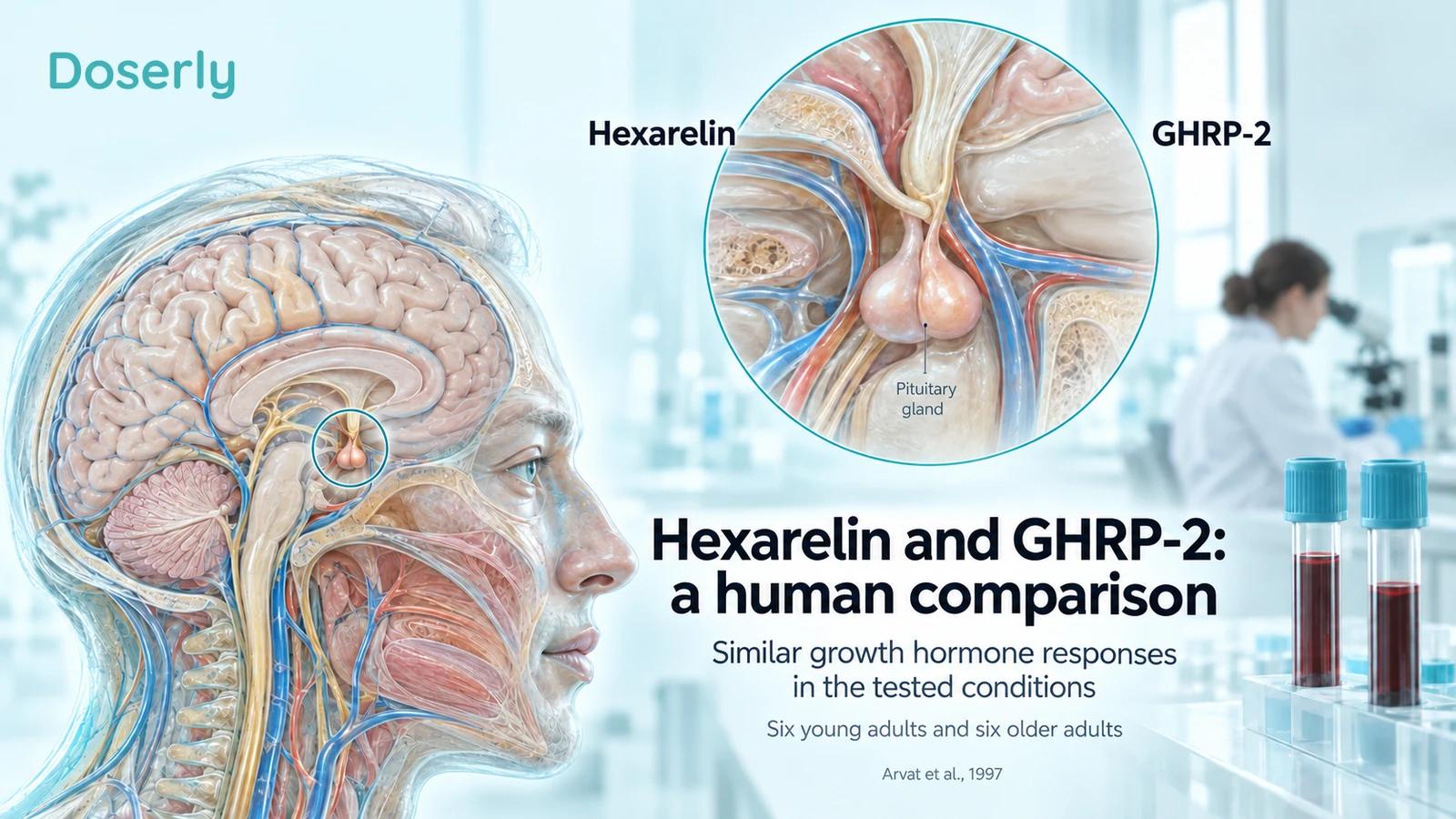
The most relevant human comparison found similar endocrine responses to hexarelin and GHRP-2 under the tested conditions. Other frequently quoted comparisons involve a different population, a different endpoint or animals. Direct GHRP-2 comparison
Potency, maximum response and clinical benefit are different
In pharmacology, potency concerns how much of a substance is needed to produce a particular effect. Maximum response concerns the largest effect observed or estimated under the experimental conditions. A compound can be potent without producing a higher maximum response, and neither property establishes a useful health benefit.
Hexarelin's early dose-response study illustrates the distinction. In 12 healthy men, intravenous exposure produced a marked growth hormone response that approached a plateau within the tested range. That was a measurement of hormone release, not a comparison of muscle gain or recovery against another treatment. Imbimbo and colleagues, 1994
For someone hoping to improve strength, the clinically useful comparison would be how much stronger participants became, alongside adverse effects. For someone with a diagnosed endocrine disorder, the comparison would involve that disorder and the treatment goal. A “most potent” label is incomplete unless it says which effect was measured and under what conditions.
Hexarelin versus GHRP-2: a direct human experiment
The 1997 study compared hexarelin and GHRP-2 in six healthy young adults aged 22–27, with additional growth hormone comparisons in six older adults aged 66–73. The young group received two intravenous test amounts of each peptide, along with other hormonal stimuli used for reference. Arvat and colleagues
At the matched tested amounts, hexarelin and GHRP-2 produced similar growth hormone responses. Both also affected prolactin, ACTH and cortisol; the authors did not describe either as fully specific for growth hormone release. This does not support a confident claim that hexarelin is categorically the strongest peptide in the class or uniquely responsible for the additional endocrine responses.
“Similar” in this small experiment should not be overread as proven equivalence in every respect. It was not a large equivalence trial with a prespecified clinical margin. It also did not compare long-term symptoms, body composition, product tolerability or repeated-use safety. The useful conclusion is limited but concrete: the direct human hormone comparison did not establish the simple superiority sometimes attributed to hexarelin.
A comparison with ghrelin complicates the ranking further
Ghrelin is a hormone produced by the body that can activate the growth hormone secretagogue receptor. A 2001 experiment studied seven healthy men aged 24–32, comparing intravenous ghrelin, hexarelin, growth hormone releasing hormone and placebo. Blood sampling continued through three hours. Arvat and colleagues, 2001
Ghrelin produced a larger growth hormone response than hexarelin in that experiment. It also produced larger prolactin, ACTH and cortisol responses. Six participants additionally underwent combination challenges, which helped investigate how the stimuli interacted.
This finding is a useful reminder that increasing one desired physiological response can accompany changes elsewhere. It does not make ghrelin the best choice for treatment, and it does not make “natural” synonymous with harmless. The experiment tested acute endocrine activity rather than clinical outcomes.
It also used matched amounts by body weight, not a demonstration that the interventions produced identical receptor exposure. Different molecules can have different molecular weights, clearance and response patterns. A numerical comparison within one protocol should remain attached to that protocol when it is explained to readers.
What about ipamorelin's reputation for selectivity?
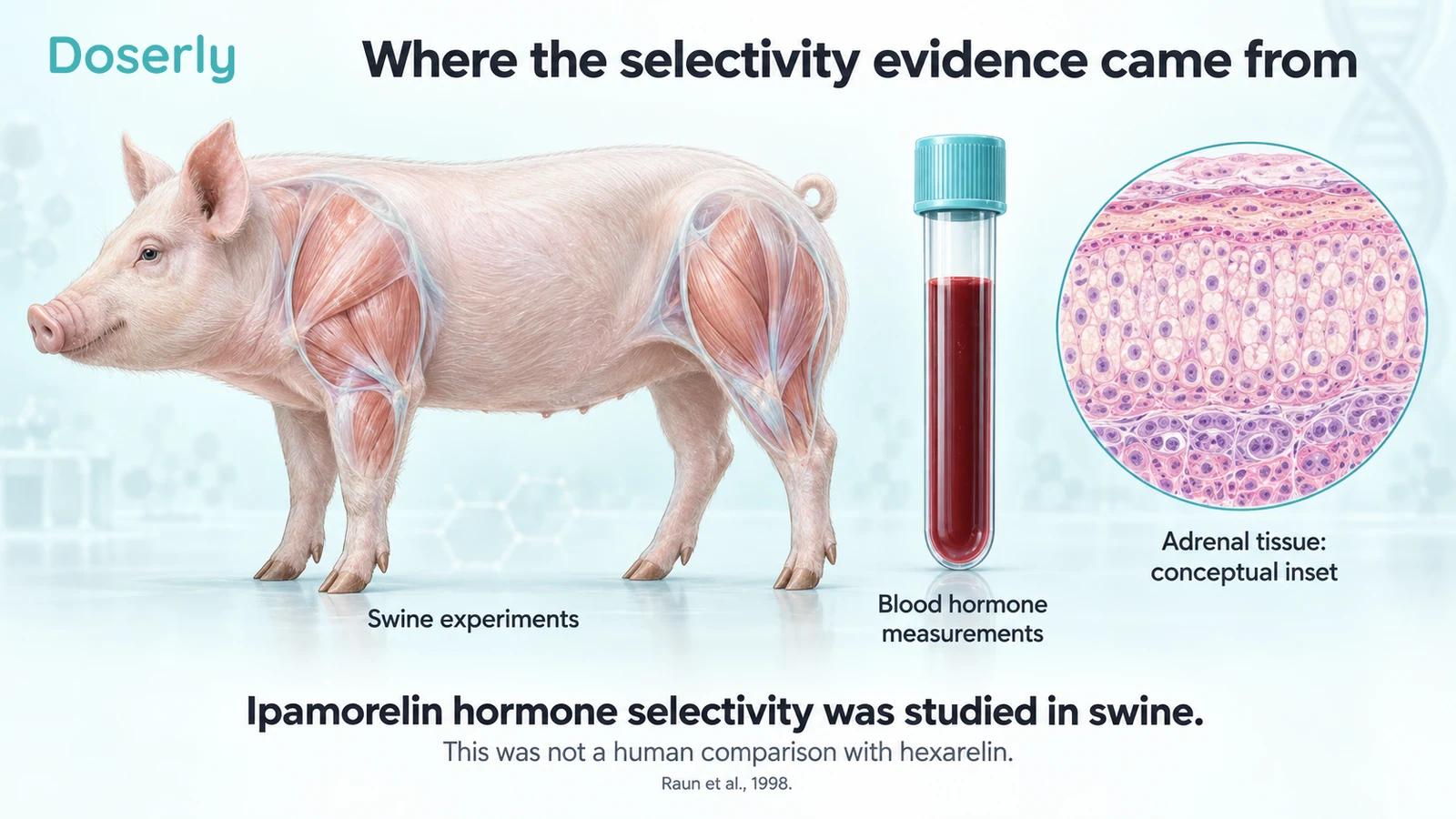
The frequently cited 1998 paper introducing ipamorelin examined laboratory cells, rats and swine. Its hormone-selectivity experiments were conducted in swine. Ipamorelin did not raise ACTH or cortisol beyond the comparison with growth hormone releasing hormone in those experiments, while GHRP-2 and GHRP-6 did. Raun and colleagues
That is a meaningful preclinical finding. It helped explain why ipamorelin was considered a candidate for further development. It is not a direct human comparison of ipamorelin and hexarelin, and hexarelin was not the comparator supporting that specific selectivity conclusion.
The study also illustrates the difference between potency and maximum effect: the compounds did not necessarily rank identically across those measurements in swine. Turning the findings into a single human “strength versus safety” scale loses the species, the actual comparisons and the endpoint.
A defensible explanation can say that the animal work suggests greater selectivity under its tested conditions. It cannot assign a precise human side-effect advantage or guarantee that prolactin and cortisol will be unaffected in every user. That would require human measurements in a suitable comparison.
Does hexarelin's cardiac research make it uniquely beneficial?
Hexarelin has been investigated for cardiovascular actions as well as endocrine effects. In a small human study, it briefly increased left ventricular ejection fraction while administered growth hormone did not, despite similar circulating growth hormone exposure. That suggests the cardiac response was not explained simply by a larger growth hormone rise. Bisi and colleagues, 1999
The mechanistic literature also connects some growth hormone releasing peptides with CD36, a protein found on several cell types. A 2002 study used rat cardiac membranes and genetically modified animal models to investigate hexarelin binding and cardiovascular responses. In perfused hearts, CD36-related activity involved increased coronary perfusion pressure and a vasoconstrictive response. Bodart and colleagues
That is not a simple “extra heart-protection receptor” story. Receptor binding can produce different effects depending on the tissue and experimental setting. The study cannot be used to rank hexarelin as a safer or more protective human therapy, and the short human cardiac response did not establish fewer heart attacks or longer survival.
For a reader comparing compounds, the broader lesson is specific: an additional biological target is not automatically an additional clinical benefit. The relevant outcome still needs to be tested.
The time course can change an apparent advantage
A large response after a first exposure might not persist. In the 16-week hexarelin study, repeated subcutaneous treatment produced a smaller growth hormone response over time, with recovery after withdrawal. IGF-1 and body-composition outcomes did not change significantly. Rahim and colleagues
It would therefore be misleading to compare an initial hexarelin peak with a later measurement from another compound and treat the difference as a durable advantage. The studies would need comparable observation windows. Likewise, a short intravenous challenge and a long oral-treatment study answer different questions even when both measure growth hormone.
That does not mean long studies are automatically more useful for every purpose. A carefully controlled acute experiment may be exactly what is needed to test a receptor hypothesis. The mistake is asking it to settle a repeated-treatment question it was not designed to answer.
MK-677 shows why clinical outcomes need their own comparison
MK-677, also called ibutamoren, is an oral ghrelin mimetic rather than the same peptide as hexarelin. In a randomized trial of 65 healthy older adults, it increased growth hormone, IGF-1 and fat-free mass over a year. The added fat-free mass did not produce demonstrated gains in strength or function, and the investigators noted limited power for those outcomes. Nass and colleagues, 2008
The trial also recorded changes in glucose regulation and adverse effects such as appetite increase and swelling. It provides a more extended observation period for that compound, but it is not a head-to-head hexarelin trial. We cannot use it to calculate how much more or less effective hexarelin would be, or to transfer an adverse-event rate between the two.
What the study does show is that changes in the growth hormone system and body composition can coexist with uncertainty about practical functional benefit. That is why a ranking based solely on hormone release may not answer the question that brought someone to the comparison in the first place.
What evidence would justify choosing one over another?
A useful comparison would begin with a specific goal and population. For example, researchers could study whether either treatment improves a defined functional limitation in adults with a particular diagnosis. They would need comparable background care, clearly specified formulations and enough follow-up to assess both benefit and harm.
The main outcome would need to be chosen before the results were examined. If the goal is strength, strength should be measured. If the concern is endocrine selectivity, the relevant hormones should be sampled appropriately. If the claim is greater safety, the comparison needs enough people and observation time to detect the harms being discussed.
The result should also distinguish no detected difference from evidence that the treatments are equivalent. In a small study, an uncertain estimate may leave room for clinically important differences in either direction. A confident ranking needs more than one group having a slightly higher average number.
For now, the human evidence supports several specific statements rather than an overall winner: hexarelin can stimulate growth hormone; its acute response was similar to GHRP-2 in a small direct comparison; ghrelin produced larger endocrine responses in another experiment; and important ipamorelin selectivity findings came from animals. None of those statements establishes the best treatment for muscle gain, recovery or healthy aging.
If someone recommends a particular compound, ask which outcome supports the choice and whether the cited study actually compared it with the alternative in people like you. Our hexarelin guide can help place the individual studies in context. The most useful decision starts with the health problem and relevant clinical evidence, not the largest hormone peak on a chart.
Sources
- Imbimbo et al., hexarelin dose-response, 1994.
- Arvat et al., GHRP-2 and hexarelin comparison, 1997.
- Arvat et al., ghrelin, hexarelin and GHRH, 2001.
- Raun et al., ipamorelin preclinical pharmacology, 1998.
- Bisi et al., acute human cardiac response, 1999.
- Bodart et al., CD36 experiments, 2002.
- Rahim et al., repeated hexarelin exposure, 1998.
- Nass et al., MK-677 trial in older adults, 2008.