
Peptides
October 16, 2026
Hexarelin and the heart: what the human studies actually measured
On this page
Hexarelin's heart research is more interesting than a simple claim that it raises growth hormone. Small human experiments found a short-lived change in how the heart pumped after an intravenous dose, including in people whose pituitary could release very little growth hormone.
That is a real finding worth understanding. It is also much narrower than saying hexarelin prevents heart attacks, repairs damaged heart muscle or treats chronic heart failure. The human studies measured acute physiology, while much of the longer-term protection research comes from rodents. Healthy-volunteer study, GH-deficient adults.
For someone with heart disease, the useful question is not whether a peptide can change a cardiac measurement. It is whether that change leads to better symptoms, fewer admissions or longer life, with acceptable risks. The published hexarelin experiments provide an early part of that investigation rather than an established treatment answer.
What ejection fraction does—and does not—mean
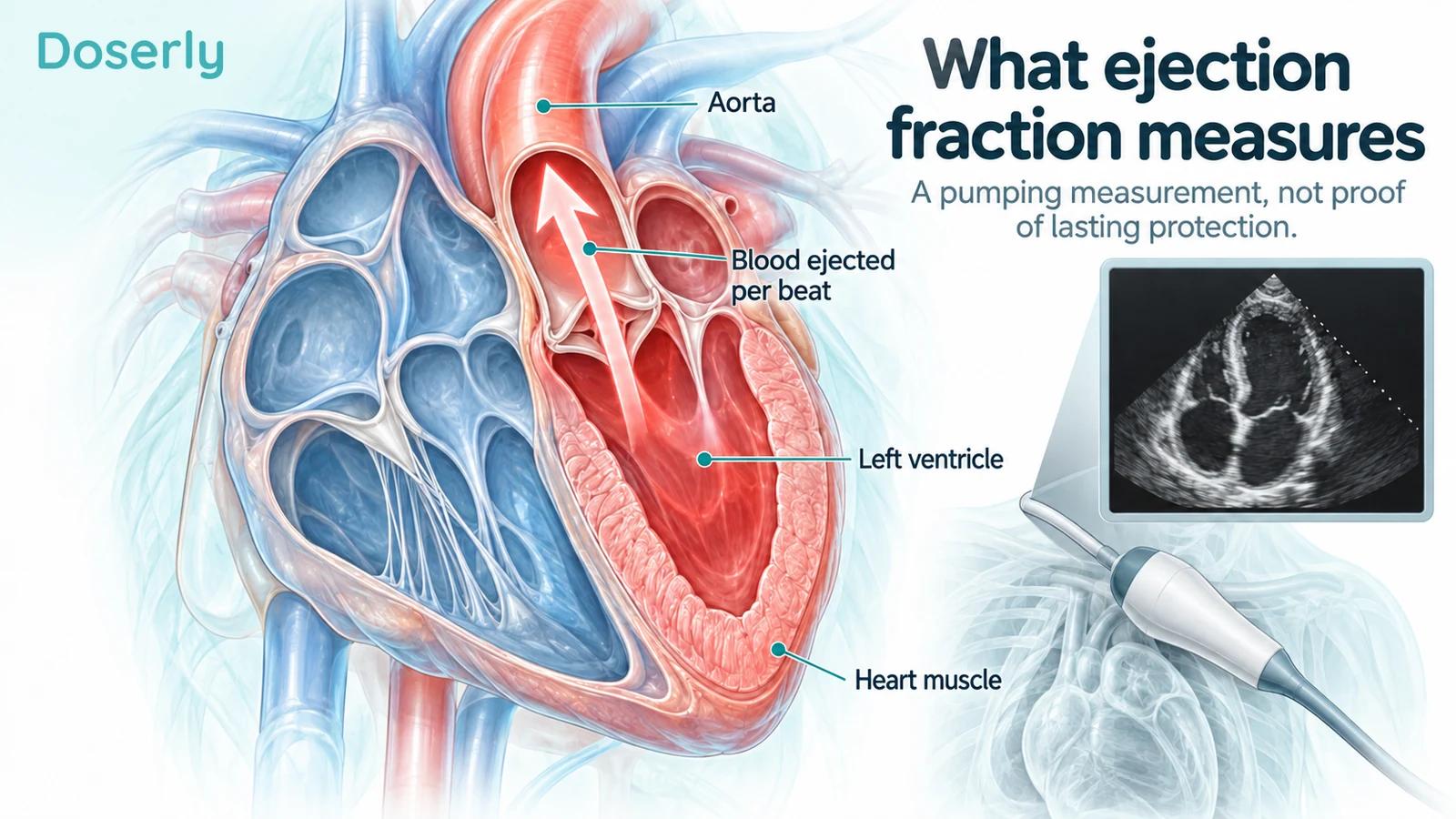
The left ventricle is the main chamber pumping oxygenated blood into the body's circulation. Left ventricular ejection fraction, or LVEF, is the proportion of blood in that chamber expelled during a contraction. It is a fraction, not the total volume pumped per minute.
That distinction matters. Cardiac output describes blood flow per minute; ejection fraction describes the proportion expelled per beat. A change in one does not guarantee an equivalent change in the other. The American Heart Association also emphasizes that heart failure can occur with a preserved ejection fraction. The number is informative, but it is not a complete description of cardiac health. AHA ejection-fraction explanation.
When a paper reports an acute rise in LVEF, it tells us that a measurement changed during the observation period. It does not show that scar tissue disappeared, a blocked coronary artery reopened or the person's future risk of hospitalization fell. Those outcomes need their own evaluation.
This is why the duration of observation belongs beside the result. A response lasting an hour can be valuable for understanding pharmacology, but “improved heart function” without that time frame can sound like a durable clinical benefit.
The healthy-volunteer experiment
In a 1999 experiment involving seven male volunteers, researchers compared intravenous hexarelin with recombinant human growth hormone. Both interventions produced similar overall circulating GH exposure during the observation period, but only hexarelin increased LVEF.
The reported LVEF rose from 64.0% to 70.7% after hexarelin, a difference of 6.7 percentage points. The effect appeared at 15 minutes, peaked at 30 minutes and persisted through 60 minutes. Heart rate and mean blood pressure did not change significantly. Cortisol increased after hexarelin but not after GH. Original human cardiovascular study.
The comparison helped separate a direct or indirect hexarelin effect from the simple explanation that more circulating GH caused the change. It did not establish exactly which cardiac receptor was responsible in these people.
The participants were also healthy volunteers, not a large group receiving long-term treatment for heart failure. A higher ejection fraction in that setting cannot be interpreted as evidence that a person with an already adequate pumping measurement needs it increased.
What the GH-deficiency study added
A separate report studied seven men with growth-hormone deficiency and compared their responses with those of nine male controls. Hexarelin produced very little GH release in the deficient group, yet LVEF increased in both groups. In the GH-deficient patients, the reported mean rose from 50% to 57%. Cardiac output, mean blood pressure and catecholamine concentrations did not change. Hypopituitary-adult study.
That combination of findings strengthened the argument that the acute cardiac response did not require a large GH pulse. It also shows why “heart pumping improved” needs a precise definition: ejection fraction changed while cardiac output did not.
This was a mechanistic clue, not a demonstration that hexarelin should replace treatment for GH deficiency or cardiac disease. The study was small and the authors described the effect as short-lasting. Repeated treatment, patient symptoms and long-term outcomes remained different questions.
The bypass-surgery setting was unusually controlled
A 2002 study examined 24 men with coronary artery disease undergoing bypass surgery under general anesthesia. Researchers compared acute hexarelin with GHRH, recombinant GH and placebo. They used intraoperative transesophageal echocardiography and vascular catheter measurements, giving a detailed view of short-term hemodynamics. Bypass-surgery study.
Hexarelin increased LVEF, cardiac index and cardiac output within ten minutes, with effects observed up to 90 minutes. Wedge pressure fell and mean arterial pressure rose. The other interventions did not produce the same hemodynamic response. The investigators interpreted this as further support for a cardiac effect not explained by the increase in circulating GH.
These findings should not be detached from the setting. Anesthetized patients undergoing cardiac surgery are monitored in ways that do not resemble home use. The study did not test daily subcutaneous treatment, and a 90-minute observation does not establish the balance of benefits and harms over months.
It also did not show that hexarelin prevented a subsequent heart attack or improved surgical survival. The measurements were meaningful to the physiological question, but they were not those clinical outcomes.
Different forms of cardiomyopathy did not respond alike
One small study examined people with severe left ventricular dysfunction: eight with dilated cardiomyopathy and five with ischemic cardiomyopathy. In the ischemic group, LVEF increased from a baseline mean of 22.6% to a peak of 26.2%. In the dilated-cardiomyopathy group, the change was not statistically significant. Both groups had a GH response. Severe-dysfunction study.
The distinction is easy to lose if the paper is summarized as “hexarelin works in heart failure.” It did not show the same acute response across the two groups. It also compared results with healthy and GH-deficient groups studied previously, so those comparisons should not be mistaken for new concurrent randomized control groups.
Small samples limit how confidently we can explain why the groups differed. The finding does not establish a reliable way to select patients for hexarelin treatment. It does establish that the human evidence was not uniformly positive across every cardiac condition studied.
The Doserly hexarelin evidence section places these reports alongside the broader endocrine literature. Multiple papers from related research programs should not automatically be counted as multiple large, independent confirmations.
Animal protection studies answer another question
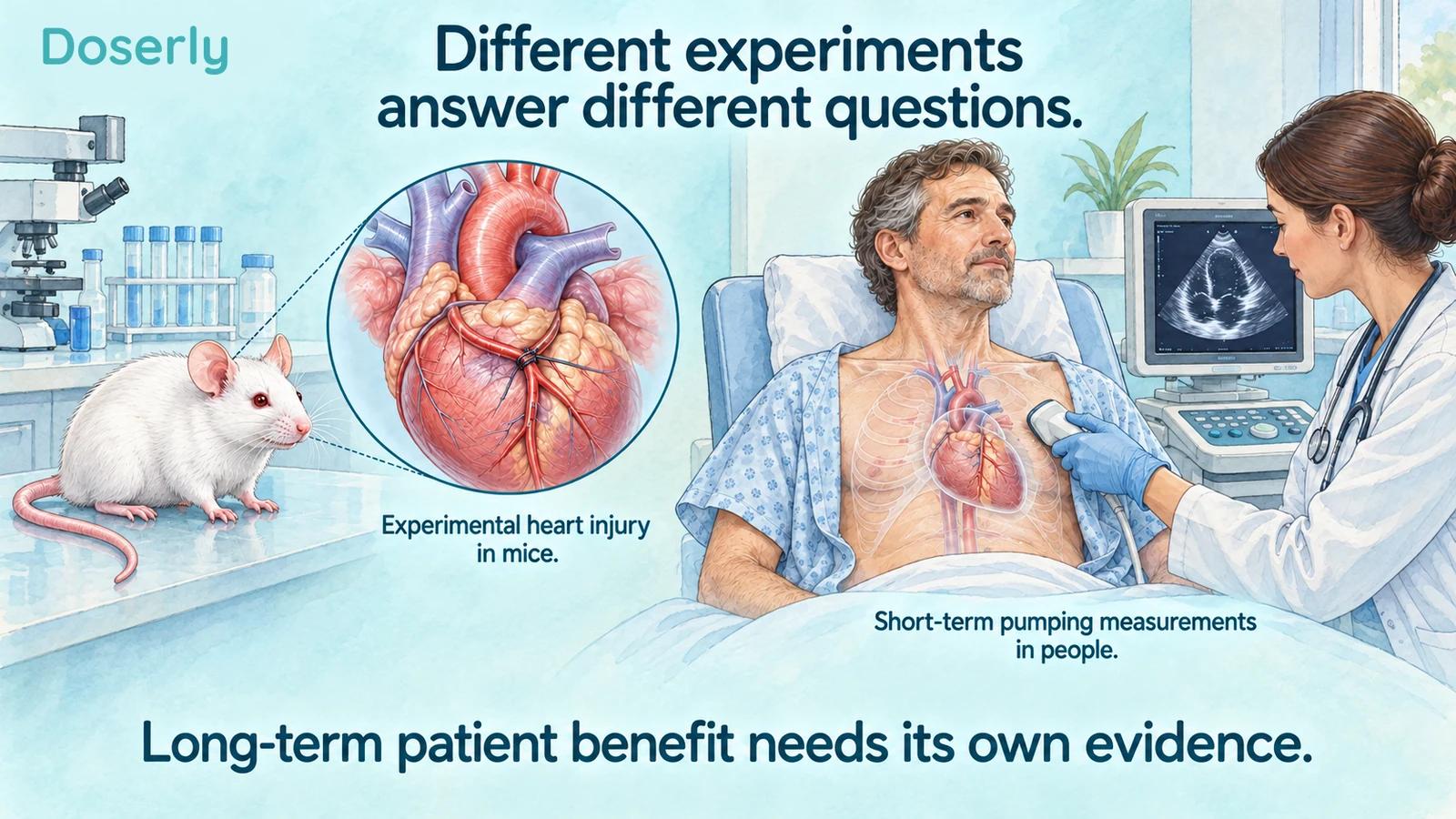
Rodent studies allow researchers to control the timing and type of heart injury more tightly than would be possible in people. That can reveal mechanisms and generate promising treatment hypotheses. It also makes the experimental setting different from ordinary clinical disease.
In a 2014 mouse study, investigators produced myocardial infarction by tying off a coronary artery, then gave a single oral dose of hexarelin 30 minutes later. Subsequent pumping measures were better than in vehicle-treated mice, but mortality over 14 days did not differ. The title's reference to protecting chronic cardiac function therefore describes a mouse experiment, not a human oral-treatment trial. Single-dose mouse study.
A different experiment used male mice genetically unable to produce ghrelin. Two weeks of treatment after coronary ligation produced favorable cardiac and survival findings. That model helps investigate the consequences of ghrelin deficiency, but it cannot establish the same treatment effect in people with an intact ghrelin system. Ghrelin-knockout mouse study.
These studies are not interchangeable replications. Their genetic background, administration schedule and outcomes differ. Reading them together supports continued research, while preserving the need to test the intended treatment in the intended patient population.
The animal findings are not uniformly protective either
A later study used advanced synchrotron imaging to investigate coronary microvessels and right ventricular function in rats. Acute hexarelin caused coronary microvascular dilation in one part of the work. Yet repeated treatment did not prevent right ventricular hypertrophy or impaired heart-muscle relaxation in the experimental pulmonary-hypertension model. Synchrotron imaging study.
This is a useful counterweight to a one-directional account of the literature. An acute vascular action can coexist with failure to prevent longer-term disease changes. The type of heart disease, the receptor pathway and the outcome being measured all matter.
It also makes a broad “cardioprotective peptide” label less useful than a specific description. Protection from what injury, in which species, after what treatment, and measured how? The answer may differ between a left-coronary ligation model and a pressure-loaded right ventricle.
CD36 is a mechanistic lead, not a prescription
Hexarelin's cardiac research includes binding to CD36, a membrane protein with several biological roles. A foundational animal study identified CD36 as a hexarelin-binding protein and found a coronary perfusion-pressure response that disappeared in hearts lacking CD36. The response in that preparation was vasoconstrictive, not a universal improvement in coronary blood flow. CD36 experiment.
This helps explain why receptor research must retain its experimental context. The later rat imaging study observed dilation through other signaling mechanisms. Those results need not mean that one experiment is false; they show that “acts on the heart” is too broad to predict a single favorable outcome.
Nor do the small human LVEF studies prove that CD36 mediated the observed response in their participants. They support GH-independent activity, while receptor attribution requires more specific experiments.
For readers, the practical implication is that a named molecular target adds biological detail. It does not by itself establish the treatment's clinical value.
What is still needed for a treatment claim?
A convincing heart-failure treatment program would need to define the population, route and duration, compare the intervention with appropriate care, and measure benefits that matter to patients. Depending on the intended use, those could include symptoms, exercise capacity, hospitalizations or survival.
Safety needs similar depth. A brief experiment with no significant heart-rate change cannot exclude problems that appear with repeated exposure or in people taking several cardiovascular medicines. Small studies also have limited ability to detect uncommon harms.
The studies discussed here do not establish that hexarelin provides those longer-term benefits or an acceptable long-term risk profile. They should therefore inform research questions, not justify replacing prescribed cardiovascular treatment.
If you have heart failure, the useful conversation with your clinician concerns your specific diagnosis, symptoms, ejection fraction and current treatment plan. AHA's heart-failure resources explain why those measurements are assessed together rather than in isolation. AHA heart-failure information.
New chest discomfort or shortness of breath suggestive of a heart attack needs emergency assessment; call 911 or your local emergency number rather than experimenting with a peptide. AHA warning-sign guidance.
Hexarelin's human heart findings deserve an accurate description: small studies documented a short-term effect on cardiac pumping, sometimes despite little GH release. Whether that can become a useful treatment is a larger question that those experiments did not answer.
Explore the research
- Acute cardiovascular and hormonal effects in seven volunteers.
- Cardiac effects in GH-deficient adults.
- Acute effects during bypass surgery.
- Ischemic versus dilated cardiomyopathy.
- One oral dose after experimental infarction in mice.
- Ghrelin-knockout mouse experiment.
- Rat microvascular and right-ventricular experiments.
- CD36-dependent cardiac response.
- AHA ejection-fraction explanation.
- AHA heart-failure resources.
- AHA heart-attack warning signs.