
Peptides
October 16, 2026
Hexarelin desensitization: what repeated-response studies actually show
On this page
Hexarelin can produce a substantial growth-hormone response after a single exposure. Repeated exposure can produce a smaller response. Both statements are supported by experiments, but neither tells us that a particular cycling schedule improves health.
The most frequently cited longer study followed 12 healthy older adults through 16 weeks of treatment and a later reassessment. The growth-hormone response to a test dose weakened during treatment and recovered after stopping. That is a specific observation about hormone responsiveness—not evidence that the peptide stopped working in every tissue, permanently damaged receptors or became a validated treatment when used in cycles. Long-term study, companion report identifying the cohort.
To understand what tolerance means here, it helps to separate three measurements: signaling inside a cultured cell, the blood-hormone response to a test dose, and the longer-term outcome a person hopes to improve.
Desensitization needs a named response
Desensitization means that a system becomes less responsive to a stimulus under the conditions being tested. In the hexarelin literature, the response might be intracellular calcium, the amount of GH released after an injection, or the response of another hormone.
Those are not interchangeable. A reduced calcium signal in a cell does not directly measure a person's GH secretion. A smaller GH response does not directly measure body composition. And a change in one hormone does not establish that every action of the compound has weakened to the same degree.
The word tolerance is often used more broadly in everyday discussions, sometimes referring to a subjective effect that feels less noticeable. That can be a useful observation to report, but it is not the same as a standardized experiment. The research becomes clearer when the statement specifies what was measured, how often exposure occurred and when the comparison was made.
The Doserly hexarelin guide gives the broader pharmacological context. Here, the question is specifically how repeated exposure changed measured responsiveness.
The cell experiment measured calcium signaling
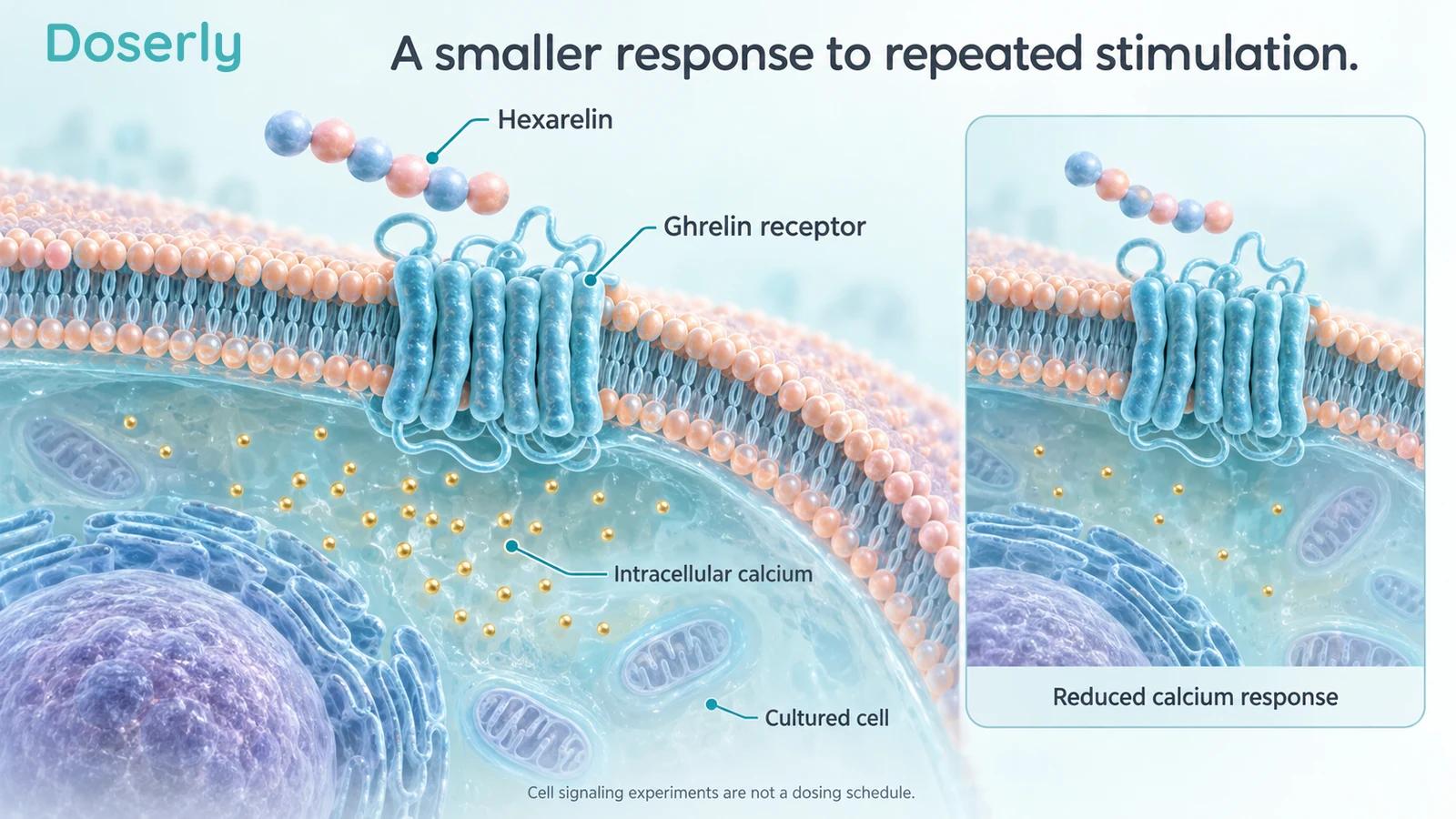
A 2003 study used Chinese hamster ovary cells engineered to express the human ghrelin receptor. Researchers applied hexarelin and measured intracellular calcium with a fluorescent indicator. The engineered cells responded, whereas control cells without the receptor did not show the same response.
After an initial exposure, a marked reduction in the calcium response appeared within two to five minutes. The experiment therefore directly demonstrated rapid desensitization at the level of this cellular signaling readout. Cultured-cell study.
That result is mechanistically useful. It shows that the receptor signaling system can become less responsive without needing a months-long human treatment course. But the cells were not an intact human pituitary, and the experiment did not identify a safe human interval between administrations.
It also does not justify drawing a picture of receptors permanently disappearing. The measured endpoint was calcium signaling. Specific explanations such as receptor trafficking or changes in receptor number require evidence of those processes, not merely a smaller downstream signal.
A second human challenge can produce a smaller GH response
In a 1995 study, six adults received paired intravenous stimuli separated by two hours. Researchers compared repeated GHRH, GHRH followed by hexarelin, and repeated hexarelin. The second hexarelin stimulus produced a substantially smaller GH response than the first, although a response remained. Hexarelin after GHRH produced a different pattern from simply repeating GHRH. Repeated-challenge experiment.
This supports reduced responsiveness over a short interval in people. It also shows why the preceding stimulus matters. The endocrine system's recent history can influence the next response.
It does not mean that two hours is a universal boundary between ineffective and effective use. The experiment compared particular intravenous challenges in a small group, not a range of consumer schedules or treatment outcomes.
Nor does a smaller second response alone establish that the pituitary has “run out” of growth hormone. Several regulatory processes can influence release. A response measurement identifies the change; explaining its cause requires additional experiments.
Feedback is part of the explanation
One human study investigated how previous administration of recombinant GH affected subsequent responses to hexarelin and GHRH. In six young volunteers, GH pretreatment blunted the hexarelin response and more strongly suppressed the GHRH response. The investigators interpreted the pattern as involving changes in hypothalamic GHRH activity and somatostatin signaling. GH-feedback experiment.
The study matters because it demonstrates that a smaller response need not be interpreted solely as a receptor-level event. The whole hormone-regulating system can influence the result.
Normal GH physiology includes pulsatile secretion and feedback involving the hypothalamus, pituitary and IGF-1. Sleep, age, nutrition and other physiological conditions also affect the system. These influences are reasons to compare standardized measurements rather than assume that any two GH readings reflect the same conditions. Endotext physiology reference.
The cellular and whole-person findings can therefore coexist. A receptor signal can desensitize in an engineered cell, while feedback and other factors contribute to the response observed in a person. The experiments do not require a single explanation to account for every timescale.
What changed over 16 weeks?
The longer adult study used twice-daily subcutaneous treatment for 16 weeks. GH responses to a test injection were assessed at baseline and during treatment, with another assessment four weeks after treatment ended. The companion report identifies 12 healthy elderly participants. Cohort and response report.
Mean GH area under the response curve fell from 19.1 at baseline to 10.5 µg/L·h at week 16—about a 45% reduction, calculated from the reported means. At the four-week follow-up after cessation, the mean was 19.4, no longer significantly different from baseline. The response had weakened partially and was reversible in this cohort.
Area under the curve, or AUC, combines concentration and time over the sampling period. It differs from the single highest GH value and from an all-day measure of hormone production. Here it describes the response to the test injection, not the total GH released during all 16 weeks.
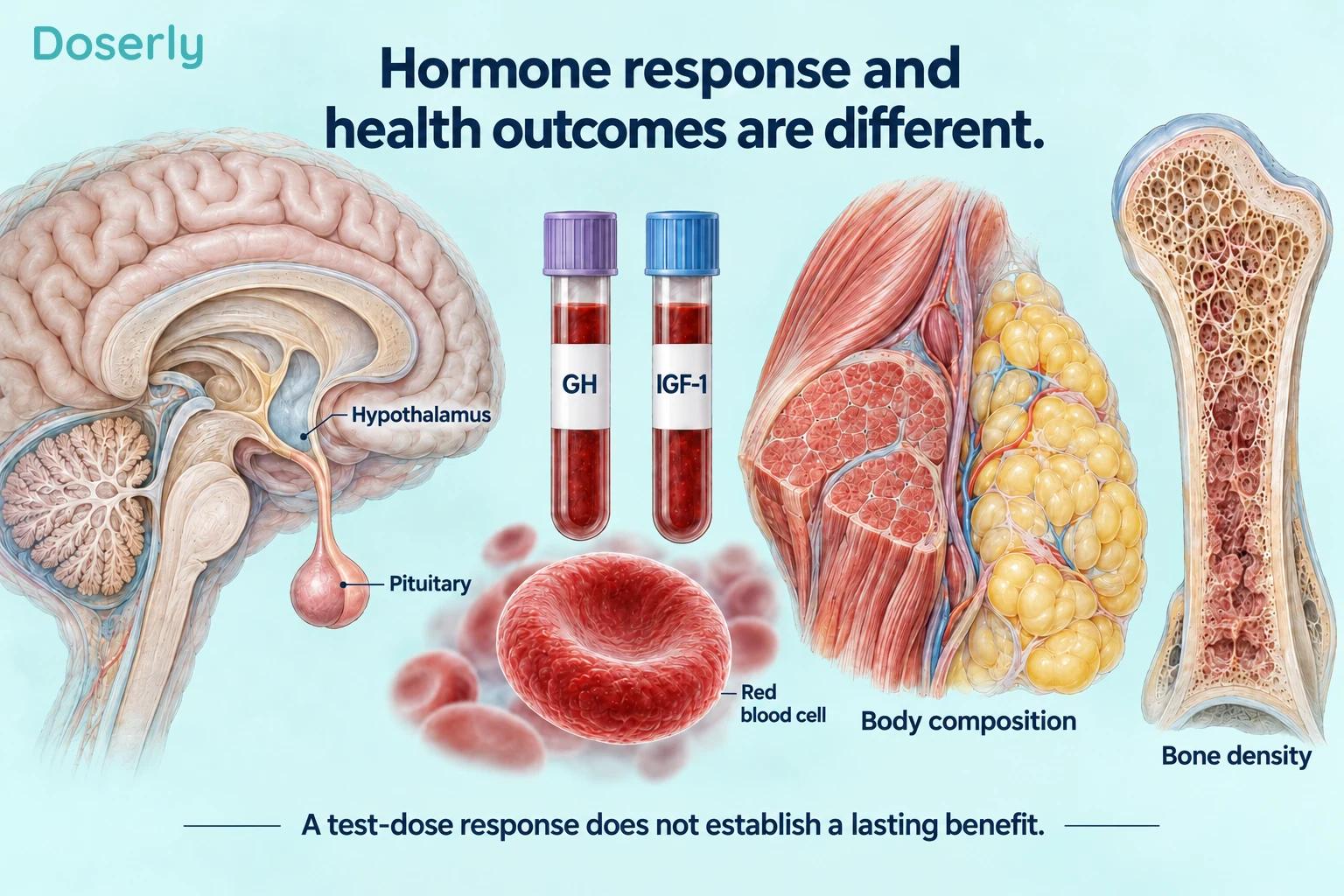
The same long-term report found no significant change in IGF-1, IGF-binding protein 3, body fat, lean mass or bone mineral density. One bone-formation marker changed, but that did not establish an improvement in bone density. Full set of reported outcomes.
That distinction is central to interpreting the study. Restoring the test-dose response after stopping is not the same as demonstrating a useful health benefit while treatment is being given.
The four-week follow-up is not an optimized cycle
The researchers reassessed responsiveness four weeks after treatment ended. That establishes what they observed at that follow-up. It does not establish that four weeks was the shortest necessary recovery period, that every participant recovered at the same time or that repeating the course would improve outcomes.
A cycling recommendation would need additional comparisons. Researchers would have to compare schedules, define the intended benefit, assess repeated courses and examine safety. A study with one treatment period and one later test cannot identify the best schedule among alternatives it did not test.
This is particularly important when the preserved or recovered outcome is only a hormone response. Even perfect preservation of that response would not prove improvements in strength, injury recovery or cardiovascular health. Those benefits cannot be supplied by arithmetic about the size of the GH pulse.
The study is useful evidence against assuming that the initial response remains unchanged indefinitely. It is not a protocol manual.
A one-day study shows why “it stopped working” is too broad
In another experiment, six young men received two or three subcutaneous hexarelin administrations during a 24-hour observation period, with blood sampled every 20 minutes. Both schedules increased daily GH secretion to a similar extent, mainly by increasing the amount released in secretory bursts rather than their frequency.
Yet a subsequent intravenous challenge produced a blunted GH response after prior hexarelin exposure. IGF-1 did not change during these one-day schedules. Twenty-four-hour study.
So increased hormone secretion over a day and reduced responsiveness to an additional challenge occurred together. A smaller test response did not mean that no endocrine stimulation had occurred.
The finding also does not establish that three daily administrations are better than two; the measured GH increase was similar. More frequent exposure is not automatically more effective, and this short physiological experiment did not compare clinical benefits or long-term safety.
Short courses by other routes did not show the same attenuation
A 1996 paper examined two small groups of older adults: seven received an eight-day intranasal course, and seven older women received a 15-day oral course. The measured GH response was maintained in both experiments. The oral group had a small increase in IGF-1, while the nasal group did not show a significant IGF-1 change. Short oral and nasal courses.
These results do not cancel the longer subcutaneous study. Route, exposure, treatment duration and participant characteristics differed. Nor do they establish that switching routes prevents tolerance in long-term use.
The lesson is to avoid turning “desensitization occurs” into “every exposure produces the same decline.” The literature describes different responses under different conditions. It also avoids the opposite error: a short study with preserved responsiveness cannot guarantee that a longer course will behave the same way.
Other hormones followed different patterns
A companion long-term investigation examined ACTH, cortisol and prolactin during 16 weeks of hexarelin treatment. The cortisol response to a test injection decreased during treatment and returned toward its starting level after cessation. Basal cortisol, 24-hour urinary free cortisol, ACTH response and prolactin response did not show significant changes over the study period. Pituitary-adrenal and prolactin report.
This illustrates why one response cannot stand in for the whole endocrine picture. A reduced stimulated cortisol response did not mean that daily urinary cortisol fell in parallel. Similarly, GH attenuation did not establish that prolactin responsiveness disappeared.
The report does not provide a comprehensive long-term safety verdict. Its specific hormone findings are reassuring within their measured scope, but they do not measure every possible harm or establish safety for different products, populations and regimens.
It is also a companion report from the same research program, not an independent large replication of the 16-week GH findings. Counting publications without considering shared participants can make a small evidence base look larger than it is.
What a person can reasonably take from this research
A fading subjective effect is not a reliable way to diagnose receptor desensitization. Hunger, sleep, training, expectations and other treatments can change, and a single GH measurement is difficult to interpret without the sampling context. Increasing exposure to chase an initial sensation is not a strategy validated by these studies.
For a clinician reviewing possible peptide use, the useful information is the exact product, route, duration, timing of tests, other medicines and symptoms. Those details help distinguish a laboratory result from a claim about long-term benefit. They cannot make an unstudied schedule evidence-based, but they improve the accuracy of the discussion.
The hexarelin evidence section separates the human endocrine experiments from animal and cardiac research. A finding about GH responsiveness should not be assumed to describe tolerance at CD36 or the heart; these studies did not establish that connection.
The clearest conclusion is specific: hexarelin can produce partial, reversible attenuation of a measured GH response under some repeated-exposure conditions. The size and timing vary with the experiment, and preserving that response has not been shown here to deliver the health benefits people often seek.
Explore the research
- Long-term GH status study.
- Companion report confirming 12 older participants.
- Engineered-cell calcium desensitization.
- Repeated human intravenous challenges.
- GH negative-feedback experiment.
- Normal GH physiology.
- Two or three administrations during 24 hours.
- Short oral and nasal courses.
- Chronic pituitary-adrenal and prolactin effects.