
Peptides
October 16, 2026
Hexarelin and the heart: what brief changes in pumping can tell us
On this page
Hexarelin was developed to stimulate growth hormone release, but its effects on the heart attracted a separate line of research. In several small human experiments, an intravenous dose changed how effectively the left ventricle pumped blood. Some responses occurred even when growth hormone barely rose, suggesting that the cardiac effect might involve something beyond the hormone response.
That is an interesting finding for drug development. For someone living with heart disease, however, the question is whether treatment improves daily life, prevents hospital admissions or helps people live longer. The small human hexarelin studies discussed here did not establish those benefits. Their main contribution was to describe an immediate physiological response. Human cardiovascular study
The distinction becomes clearer when we look at the actual measurements, the patients studied and the length of follow-up. The findings also differ across types of heart disease, so a general claim that hexarelin “protects the heart” leaves out information that matters. Our hexarelin guide introduces its endocrine effects and broader research history.
What does a better pumping measurement mean?
The left ventricle is the chamber that pumps oxygenated blood into the body's main artery, the aorta. Left ventricular ejection fraction, abbreviated LVEF, describes the proportion of blood in that chamber that is pushed out during a heartbeat. It does not mean the percentage of the entire heart that is healthy.
Clinicians use ejection fraction to help characterize and follow heart disease, but it is only part of the picture. Someone can have heart failure with a preserved ejection fraction, for example, when filling and relaxation are impaired. Symptoms, the underlying cause and other tests matter alongside the percentage. American Heart Association explanation
An inotropic effect means a change in the heart muscle's contractile activity. A short positive response can be scientifically useful without showing that heart tissue has healed. It also doesn't demonstrate that a treatment prevents blocked arteries or changes what happens to a patient over the next year. Those are separate clinical questions.
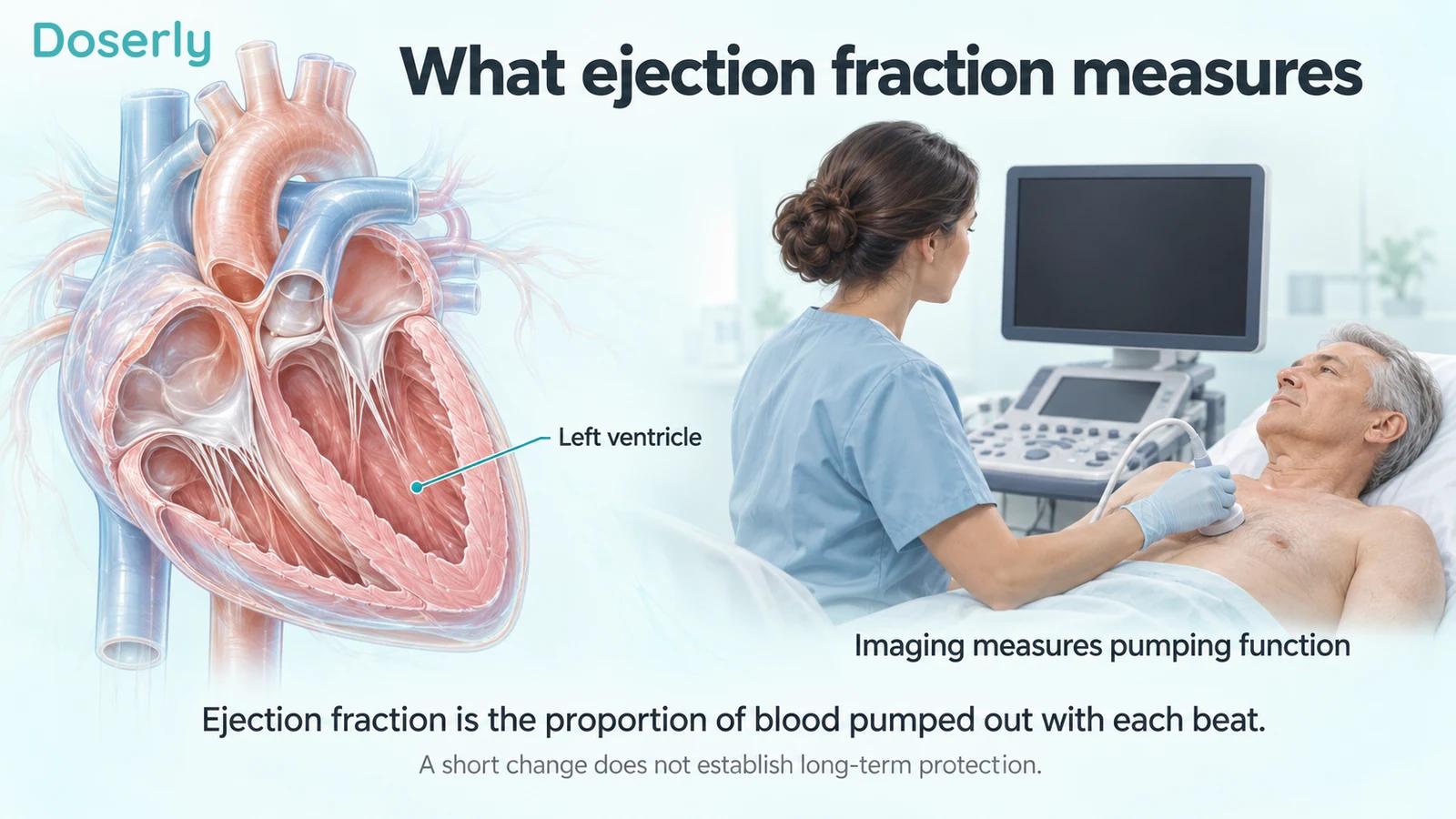
Conceptual anatomy and a generic echocardiography scene. The early experiments used several imaging methods; this is not an image of a study participant or a measured change.
The initial human finding: minutes, not months
A 1999 study examined seven male volunteers after intravenous hexarelin or recombinant human growth hormone. Both interventions produced comparable circulating growth hormone exposure. Hexarelin increased LVEF from about 64.0% to a peak of 70.7%, while growth hormone itself did not produce that response. The rise was evident at 15 minutes, peaked around 30 minutes and remained detectable through 60 minutes. Bisi and colleagues
The change was about 6.7 percentage points, not a 6.7% reduction in cardiovascular risk. No risk reduction can be calculated from that result because the study was measuring ventricular performance, not counting heart attacks or deaths.
The comparison with growth hormone gives the experiment a useful mechanistic feature. If the same degree of hormone exposure does not reproduce the cardiac response, hormone release alone is unlikely to explain everything. It does not identify the exact receptor or establish a treatment benefit. It supports a more specific question about how hexarelin affects cardiac physiology.
What happened in people with growth hormone deficiency?
Another 1999 report studied seven adult men with severe growth hormone deficiency and compared them with nine male controls. Their growth hormone response to hexarelin was very small, yet their LVEF increased from about 50% to 57%. Controls also showed an increase. The effect was brief, and cardiac output did not change in either group. Cardiac effects in hypopituitary adults
This is an important distinction within the cardiac measurements themselves. Ejection fraction is a proportion; cardiac output is the amount of blood pumped over time. They describe related aspects of circulation but are not interchangeable. A report of improvement in one should not be rewritten as improvement in every measure of heart function.
The growth hormone deficiency finding reinforced the possibility of a response that was not driven by a large hormone surge. It did not show that hexarelin could replace appropriate treatment for pituitary disease, nor did it show lasting cardiac recovery in that population. The study's small size and immediate observation window define what it can establish.
The response differed by the cause of heart dysfunction
The most clinically revealing comparison involved patients with severely impaired left ventricular function. A 2002 study included eight people with dilated cardiomyopathy and five with ischemic cardiomyopathy. Ischemic disease involves inadequate blood supply to heart muscle, often related to coronary artery disease. The study distinguished that group from its nonischemic dilated-cardiomyopathy group; the labels should not be treated as mutually exclusive anatomical descriptions in every clinical setting.
In the ischemic group, average LVEF rose from 22.6% to a peak of 26.2%. In the dilated-cardiomyopathy group, it changed from 16.7% to 17.7%, without a statistically significant response. Both groups released growth hormone. The researchers compared their findings with previously studied healthy and growth hormone deficient groups rather than newly enrolling all comparison participants together. Imazio and colleagues
This result argues against presenting the response as uniform across heart failure. It also leaves substantial uncertainty: five patients cannot provide a dependable estimate of how a broad ischemic-heart-failure population would respond to repeated treatment. The numerical rise remained a short-term measurement, not evidence that a patient moved into a better long-term prognosis category.
A related 2001 report also described a lack of significant acute LVEF improvement in its severe dilated-cardiomyopathy group. It reported assessments every 15 minutes for an hour after a single intravenous exposure. These reports came from the same research program and should not automatically be counted as entirely independent replications with unrelated patients. Broglio and colleagues, 2001
The bypass-surgery study provided a different kind of test
In 2002, researchers examined 24 men with coronary artery disease undergoing bypass surgery under general anesthesia. They compared acute intravenous hexarelin with growth hormone releasing hormone, recombinant growth hormone and placebo. Cardiac ultrasound performed through the esophagus and catheter-based pressure measurements allowed detailed assessment during the procedure. Bypass-surgery study
Hexarelin increased LVEF, cardiac index and cardiac output within about 10 minutes, with effects lasting up to 90 minutes. Cardiac index adjusts cardiac output for body size. The other interventions did not show the same hemodynamic response. Mean arterial pressure increased, while one pressure measurement reflecting cardiac filling decreased.
These observations support a short-lived cardiovascular effect in that controlled setting. They are not a trial showing fewer postoperative complications or better long-term survival. The 24 participants represent the entire study, not 24 people all receiving hexarelin. The accessible abstract does not justify assigning an unverified number to each treatment arm or describing the allocation method more strongly than reported.
Anesthesia, surgery and intensive monitoring also make this a very different setting from repeated use at home. The result cannot establish an outpatient schedule or show that a product obtained outside the trial has the same properties.
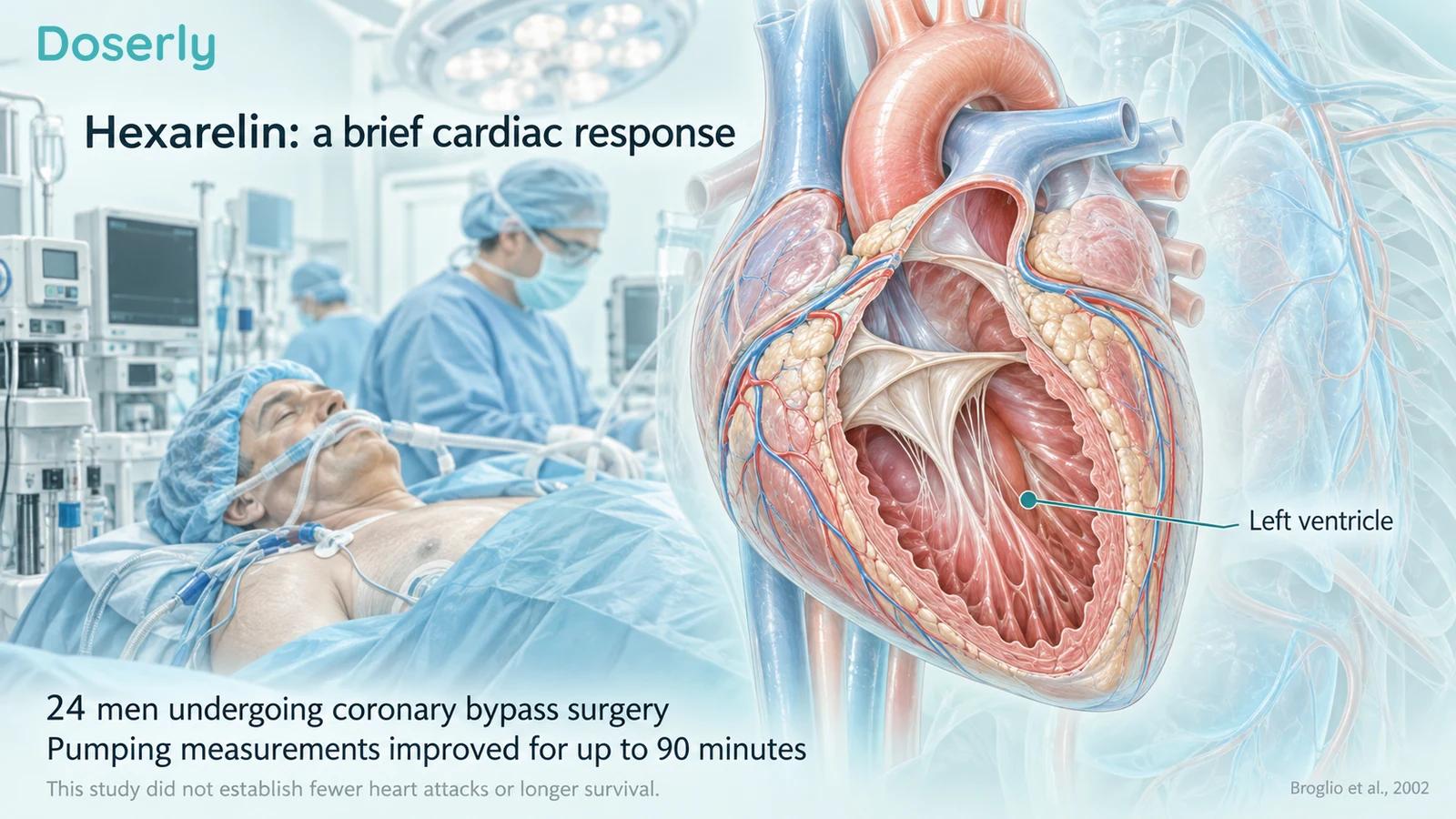
The 24 men were distributed across treatments. The illustration summarizes the short hexarelin response, not an established reduction in complications or deaths. Source.
Why animal “cardioprotection” papers answer another question
Animal studies often use the word cardioprotection for effects on tissue injury, circulation or remodeling after an experimental insult. The term can be appropriate within those experiments. Problems arise when the species and outcome disappear from the description.
In a 2000 rat study, investigators surgically tied off a coronary artery, waited four weeks and then treated animals for two weeks. Higher-dose hexarelin improved several hemodynamic measurements compared with saline, including stroke volume and cardiac output. Stroke volume is the amount ejected per beat. The authors left open whether the effects involved growth hormone or a direct cardiovascular action. Tivesten and colleagues
This was treatment after established experimental injury, which is different from giving a substance before an injury to see whether it prevents damage. Neither model reproduces the full situation of a person with coronary disease, several medications and other medical conditions. The rat findings help explain why researchers pursued the cardiac question; they do not supply evidence that hexarelin prevents human heart attacks.
The time course matters as well. Two weeks of treatment in rats and one hour of observation in people cannot be joined into a single human treatment story. The longer effect has to be demonstrated in the relevant population, with the actual formulation and route proposed for clinical use.
What would establish meaningful cardiac benefit?
A useful next trial would have to decide which clinical problem it is trying to treat. Supporting circulation briefly around surgery is different from preventing recurrent admissions in chronic heart failure. Those goals require different comparators, observation periods and safety assessments.
For chronic disease, patients would generally need to continue appropriate background care, with the experimental treatment compared against a suitable control. A trial could then ask whether adding it improves symptoms, exercise capacity, hospitalization risk or survival. Imaging and blood measurements would help explain the findings, but the clinical benefit should be measured directly.
The existing studies do not provide that comparison. Nor do they resolve the consequences of repeated exposure, including whether the immediate effect persists, diminishes or carries risks that a short experiment cannot reveal. A promising change in a laboratory measurement is a reason to investigate those questions, not a reason to assume favorable answers.
How this fits with actual heart-failure care
Modern heart-failure care is tailored to the cause and type of dysfunction. The 2022 AHA/ACC/HFSA guideline describes several medication classes for heart failure with reduced ejection fraction, including SGLT2 inhibitors, along with other treatment decisions based on a person's circumstances. Its purpose is to improve outcomes supported by clinical evidence, not simply to produce a larger immediate pumping measurement. Guideline announcement from the American Heart Association
The practical question is therefore not whether hexarelin can move a cardiac number at all. It can under some research conditions. The question is whether adding it to current care produces enough meaningful benefit to justify its risks. The human studies discussed here do not answer that.
If you are concerned about a low ejection fraction, ask what caused it, what symptoms and other findings accompany it, and which treatments have evidence for people with your type of disease. It also helps to ask how and when progress will be reassessed. The American Heart Association recommends discussing a treatment plan and follow-up with the clinical team and advises against stopping prescribed medication without medical guidance. Living with a low ejection fraction
A dated record of symptoms, medication changes and test results can help that conversation. An isolated better scan result does not establish why it changed, and a worsening symptom should not be dismissed because one measurement looked reassuring. Heart care depends on the whole clinical picture.
Hexarelin's cardiac research is more substantive than a claim based only on a dish of cells: there are small human experiments. Their value is in showing a brief and variable physiological response and raising a plausible question about a growth hormone independent effect. Their limit is equally concrete: they have not established long-term protection for patients. The human-evidence section of our hexarelin guide places these studies alongside the compound's other clinical research.
Explore the research
- Bisi et al., acute cardiovascular and hormonal effects, 1999.
- Bisi et al., cardiac effects in hypopituitary adults, 1999.
- Imazio et al., ischemic and dilated cardiomyopathy, 2002.
- Broglio et al., acute cardiac physiology across groups, 2001.
- Broglio et al., bypass-surgery study, 2002.
- Tivesten et al., experimental myocardial infarction in rats, 2000.
- American Heart Association, ejection fraction.
- American Heart Association, 2022 heart-failure guideline announcement.
- American Heart Association, discussing care for low ejection fraction.