
TRT
October 18, 2026
Steroids that lower testosterone: glucocorticoids, symptoms and TRT
On this page
Prednisone may make breathing easier, settle an inflammatory flare or protect an organ. It can also complicate the picture when energy, sexual desire and muscle strength change. If a testosterone result comes back low during treatment, two questions deserve attention: could the glucocorticoid be contributing, and would treating the testosterone deficiency actually help?
Those questions have different answers. Human research supports an association between systemic glucocorticoid exposure and lower testosterone. Evidence for adding testosterone is much smaller, especially for outcomes such as fractures, sustained physical function and long-term safety. A plausible explanation for a low laboratory result is not automatically a reason to start lifelong replacement.
Glucocorticoid-associated hypogonadism is a real clinical possibility, but the evaluation needs to account for the illness, the medication exposure and the timing of testing. It also needs to keep testosterone deficiency separate from adrenal suppression. TRT cannot replace cortisol or make it safe to stop a glucocorticoid suddenly.
What “steroids” means in this discussion
The word can cause confusion. Prednisone, prednisolone and dexamethasone are glucocorticoids, often prescribed to control inflammation or immune activity. Testosterone is an androgen. Both belong to a broad chemical family called steroids, but they do not perform the same job. A prescription for one does not substitute for the other.
The distinction matters in practice. A person taking prednisone for inflammatory disease is not following an anabolic-steroid bodybuilding regimen. Conversely, testosterone replacement does not treat the inflammatory condition for which prednisone was prescribed. Putting both medicines under a single “steroid use” heading can obscure the reason each is being considered.
Current European Association of Urology guidance lists glucocorticoids among medication-related causes of secondary hypogonadism. It also recognizes that chronic disease can impair the reproductive hormone system. Some impairment is functional and potentially reversible, which makes addressing contributing conditions part of the assessment. EAU male hypogonadism guideline
“Potentially reversible” is an important phrase. It offers a reason to investigate the cause, not a promise that everyone will recover on the same schedule. It also does not mean the symptoms are imaginary or too minor to discuss. The useful question is what is driving this person's symptoms and hormone results now.
How strong is the human evidence for lower testosterone?
Some of the direct evidence is older and surprisingly small. A 1994 study compared 35 men with respiratory disease, divided among oral and inhaled corticosteroid groups, with 19 age-matched controls. Mean testosterone in the oral-prednisolone group was approximately one-third lower than in controls: 14.5 versus 21.7 nmol/L. The two inhaled-treatment groups did not differ significantly from controls. Morrison and colleagues
That is evidence of an association in a particular clinical setting. It is not a probability that any individual taking prednisone will become hypogonadal. The groups were small, and treatment was not randomly assigned. The nonsignificant inhaled results also do not establish that every inhaled preparation, exposure or combination is hormonally harmless.
A separate 1997 comparison studied 17 men taking prednisolone for chronic inflammatory disease and 13 patients not taking it. The investigators found a lower testosterone-to-SHBG ratio in the treated group. SHBG is a protein that binds sex hormones. The ratio was used as an indicator of available testosterone, rather than a modern direct measurement of free testosterone. Fitzgerald and colleagues
These studies support taking the medication history seriously. They cannot separate every effect of the drug from disease severity, nutrition, other treatments and general health. Someone requiring prolonged systemic treatment may differ substantially from someone whose condition is controlled without it.
A 2020 study added a different population: 152 men, including 57 current glucocorticoid users, 43 former users and 52 controls. Current users had lower total and free testosterone. Former users, defined as having stopped at least 30 days earlier, generally had hormone measurements comparable to controls apart from estradiol. Exposure included varied indications and patterns of use. Mohammed and colleagues
Crucially, this was a comparison between groups, not repeated follow-up of the same men recovering after withdrawal. It therefore cannot establish a 30-day recovery rule. Nor should its estimated cumulative-exposure associations become a universal dose threshold for testing or treatment.
Why a low result does not identify one cause
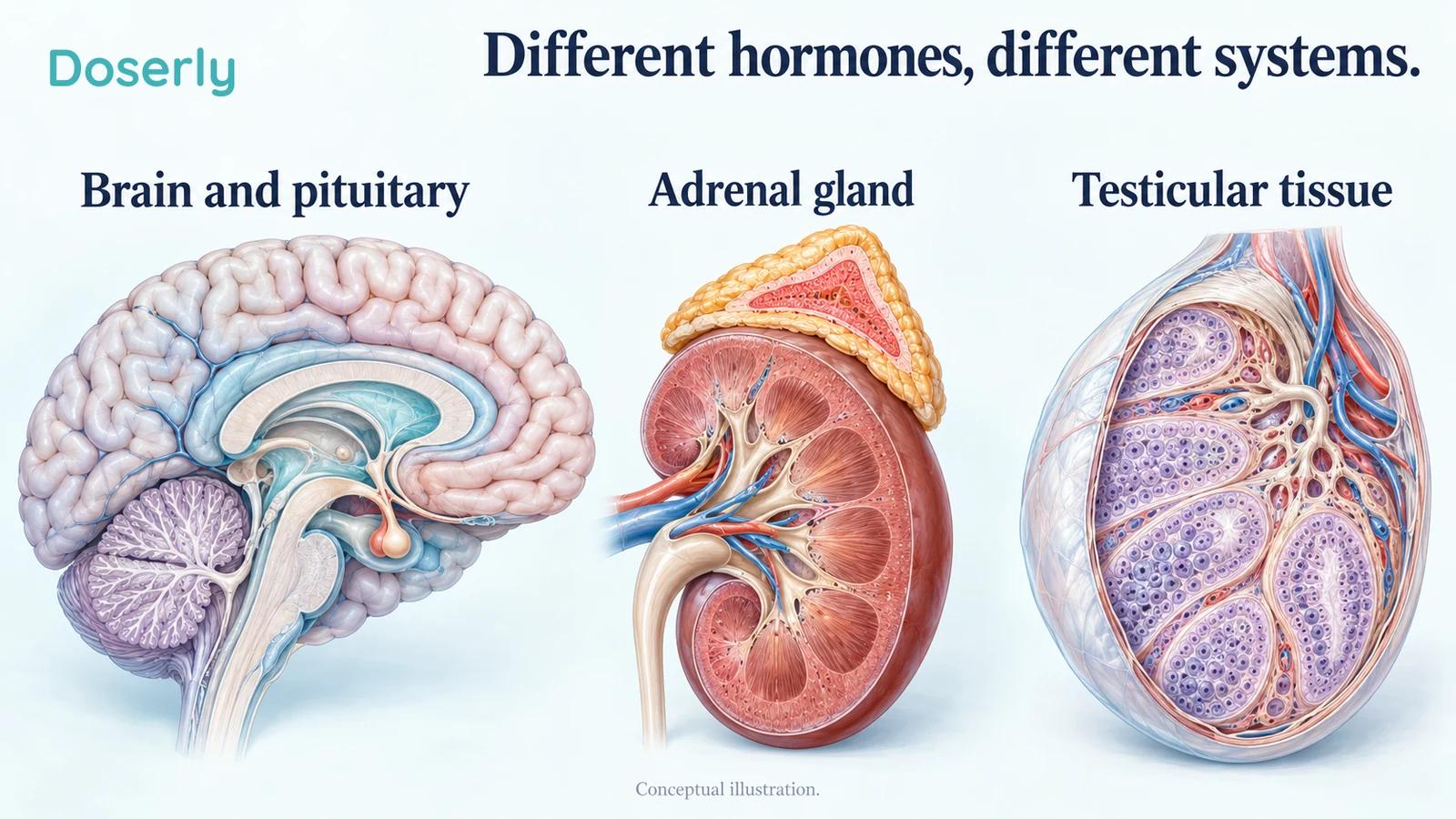
Glucocorticoids can interfere with reproductive signaling at the brain and pituitary and with testicular hormone production. The biological explanation includes several possible sites of action; it is not simply that the medicine “uses up” testosterone. Human hormone measurements and laboratory mechanisms contribute different kinds of evidence. The mechanistic discussion in the 2020 paper does not prove permanent testicular damage in people taking prescribed treatment. Human study and mechanistic context
Imagine two people with the same low testosterone measurement. One is hospitalized during a severe inflammatory flare and has just started intensive treatment. The other has stable disease, persistent sexual symptoms and repeated low results over several months. The numbers look alike, but the clinical histories create different questions about persistence, causation and the next assessment.
This is why the timeline matters as much as the medicine's name. Did symptoms begin before the illness, during the flare, after treatment started or during a later reduction? Did the blood test occur during an unusually difficult week? Were there earlier measurements taken when health was stable? These details cannot prove causation, but they can prevent a single result from becoming the whole diagnosis.
The goal is not to decide that either the disease or the drug must explain everything. More than one contributor can be present, and an unrelated testicular or pituitary problem can coexist with glucocorticoid exposure.
Symptoms deserve assessment, not a hormone assumption
Lower sexual desire and fewer spontaneous erections can make testosterone evaluation particularly relevant. Fatigue, low mood, sleep problems and reduced strength are less specific. The EAU guidance emphasizes that symptoms must be interpreted in the broader clinical setting; acute illness can distort the assessment, and medication use needs review. Glucocorticoids can also lower SHBG, complicating interpretation of total testosterone alone. EAU diagnostic guidance
For someone living with chronic disease, symptom descriptions can become very general: “I am tired all the time” or “I am not myself.” More concrete examples help. Is the main difficulty climbing stairs, staying awake, wanting sex, maintaining an erection or recovering from poor sleep? These are different treatment goals, even if they all appeared around the same period.
A useful record captures a few meaningful changes rather than an exhaustive daily score. For example, note when sexual interest changed, whether a usual household task became harder and whether symptoms fluctuated with a disease flare. Bring that record alongside the medication list. It gives the clinician something more specific to investigate than a request to raise a number.

Confirming deficiency while the treatment history is changing
The Endocrine Society recommends diagnosing hypogonadism when compatible symptoms accompany consistently low testosterone, confirmed with repeat morning fasting testing. Free testosterone can help when total testosterone is borderline or SHBG is altered. LH and FSH help distinguish impaired testicular function from inadequate upstream stimulation, and the cause should be investigated. Endocrine Society testosterone guideline
The details of that assessment belong to the treating clinician, especially when illness, shift work or an existing hormone prescription affects interpretation. A result from before glucocorticoid treatment may be useful context, but it is not a substitute for evaluating current symptoms. A result obtained after starting TRT answers a different question from one obtained before replacement.
Medication reconciliation should include the exact preparation, route, dates and any recent changes. “I take steroids sometimes” leaves too much uncertain. Tablets, injections, inhalers and creams may appear on different specialists' medication lists. An accurate combined list helps the clinicians understand actual exposure rather than assuming that one prescription represents the whole picture.
It also helps to separate the decisions being made. One decision concerns whether the inflammatory disease still requires the current treatment. Another concerns whether testosterone deficiency has been confirmed. A third concerns whether an additional therapy is likely to improve the outcome that matters to the patient. Answering the first question does not automatically settle the other two.
Testosterone suppression and adrenal suppression are different problems
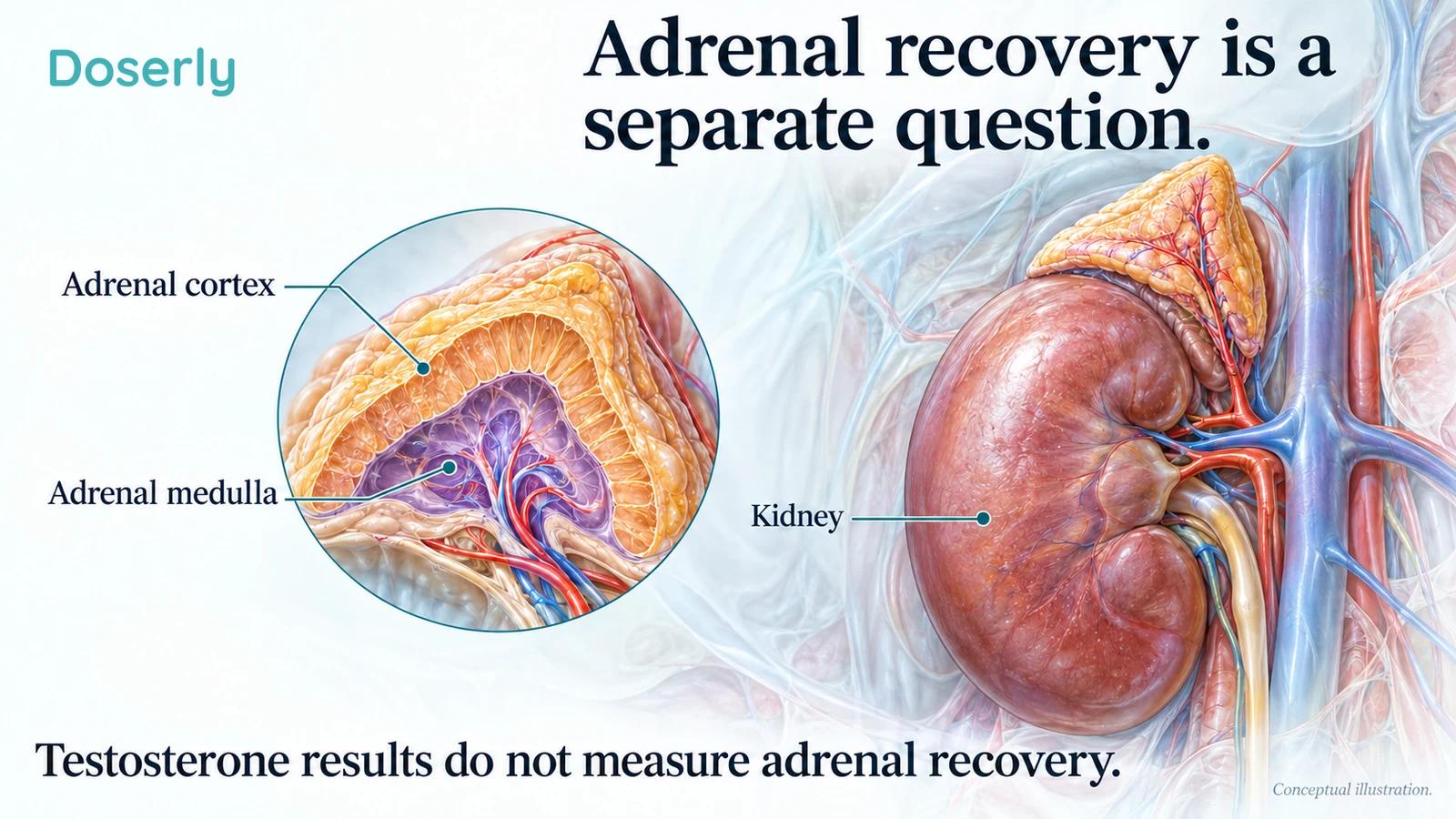
The adrenal glands make cortisol, a hormone essential to normal stress responses. Prolonged corticosteroid treatment can suppress the signaling that normally stimulates cortisol production. When treatment is withdrawn, that system may not immediately resume normal function. NIDDK describes abrupt withdrawal after long-term use as an important cause of adrenal insufficiency. NIDDK explanation of adrenal insufficiency
This creates an apparent paradox: someone can have received substantial glucocorticoid treatment and still be unable to produce enough of their own cortisol when the external supply is reduced. Testosterone results cannot determine whether that adrenal response has recovered.
The 2024 joint European Society of Endocrinology and Endocrine Society guideline advises attempting withdrawal of long-term glucocorticoid treatment only when the underlying disease is controlled and the medicine is no longer required. It recognizes overlap among withdrawal symptoms, adrenal insufficiency and recurrence of the original illness. Joint adrenal guideline
Do not stop or alter a prescribed glucocorticoid to “test” whether testosterone rebounds. The plan needs the prescriber who manages the underlying condition. TRT does not supply cortisol, prevent adrenal crisis or establish that withdrawal is safe.
Severe weakness with fainting, persistent vomiting or marked deterioration during or after glucocorticoid reduction warrants urgent medical attention, particularly if adrenal recovery has not been established. The joint guideline treats suspected adrenal crisis as an emergency, independent of the steroid's route. Follow any existing emergency or illness plan supplied by the treating team. Adrenal crisis guidance
What happened when researchers added testosterone?
The direct trials are useful, but they are much smaller than the confidence of many online claims suggests.
In 1996, researchers studied 15 men with asthma receiving long-term glucocorticoids. The randomized study compared testosterone treatment with a control period, using a crossover design after an initial year. Lumbar-spine bone mineral density increased by about 5% during testosterone treatment, with a significant between-group difference reported at one year. Reid and colleagues
That finding concerns a bone-density measurement in a tiny selected group. It does not establish fewer fractures, applicability to every inflammatory disease or the best modern treatment approach. The study is a reason to investigate the question, not a prescription template.
A 2003 double-blind trial randomized 51 men requiring long-term systemic glucocorticoids to testosterone, nandrolone or placebo for 12 months. Muscle mass changed by approximately 3.5%, 5.8% and minus 0.9%, respectively, and strength measures improved in the androgen groups. Testosterone increased lumbar-spine bone density by about 4.7%; hip and total-body density did not significantly change. Quality-of-life improvement was reported in the testosterone group. Crawford and colleagues
These results should remain separated by endpoint. Muscle mass, a strength test, a questionnaire and a spine scan are not interchangeable measures of benefit. The trial was too small and short to establish uncommon harms or long-term fracture protection. Its nandrolone arm also does not make that drug a routine substitute for TRT.
For a patient considering treatment today, the most useful translation is modest: selected men may improve some measures, but the expected benefit needs to be defined individually. The available direct trials do not show that adding testosterone is the default solution to glucocorticoid-related weakness.
Bone protection needs its own plan
A reassuring testosterone level should not close the discussion about fracture risk. Glucocorticoid-related bone care is based on more than the reproductive hormone result.
The American College of Rheumatology's 2022 guideline, published in 2023, recommends fracture-risk assessment for adults receiving sufficiently prolonged glucocorticoid treatment. Depending on age and circumstances, assessment includes fracture history, bone-density measurement, vertebral assessment and a risk calculator. Treatment decisions follow the estimated fracture risk and clinical context. ACR glucocorticoid-induced osteoporosis guideline
The same guideline treats nutrition, lifestyle and osteoporosis medicines within a dedicated bone-health framework. The small testosterone trials do not replace that framework. A person can need both an evaluation of symptomatic hypogonadism and a separate intervention aimed at preventing fractures.
Consider what each follow-up result actually means. A testosterone value can show hormone exposure. A bone scan estimates density at particular sites. A fracture history records an event that matters directly to the person. Improvement in one measure does not make the others irrelevant, and a plan should not silently substitute the easiest measurement for the most important outcome.

When TRT enters the conversation
TRT may be considered when symptomatic testosterone deficiency is confirmed and the balance of benefits and risks supports treatment. The discussion should include fertility, because exogenous testosterone can suppress sperm production, as well as contraindications and planned monitoring. The Endocrine Society advises against starting testosterone in men planning fertility in the near term and identifies conditions requiring exclusion or further evaluation before treatment. Testosterone treatment recommendations
There is no single decision that fits both a short period of potentially reversible suppression and persistent deficiency during years of necessary treatment. A clinician may need to revisit the decision as the disease course changes. This is particularly relevant when the original reason for considering TRT was closely tied to a medication that later becomes unnecessary.
Before starting, name the desired benefit. “Improve sexual desire” is assessable in a way that “optimize hormones” is not. “Make ordinary walking easier” may require a broader evaluation than testosterone alone. Naming the target also makes follow-up more honest: has the person improved in the way that justified adding treatment?
If a hormone result improves while the target symptom does not, the next discussion should examine the original explanation and other contributors. Automatically escalating treatment turns an uncertain diagnosis into an increasingly complicated medication history. The better question is whether the treatment is delivering a meaningful benefit within an appropriate monitoring plan.
A productive conversation with the treating team
Bring the glucocorticoid history, prior laboratory results and a short description of the symptoms that matter most. The following questions keep the discussion connected to decisions:
- Were the low testosterone results obtained under conditions that make them reliable, and have they been confirmed?
- Which parts of the picture could reflect the illness, glucocorticoid exposure or another cause?
- Is a change in the underlying disease treatment feasible, and who will manage any reduction safely?
- Does adrenal recovery need assessment independently of testosterone?
- What is the fracture-prevention plan, whether or not TRT is used?
- If testosterone treatment is considered, what benefit would justify continuing it and how will that be assessed?
Glucocorticoids can be indispensable treatment and a contributor to endocrine problems at the same time. Recognizing both facts allows a more useful conversation than either dismissing symptoms or assuming another hormone will solve them. The aim is a coordinated plan that protects disease control, identifies persistent deficiency and measures whether treatment improves everyday life.
For more background on diagnosis, treatment options and monitoring, explore the Doserly TRT guides.