
Peptides
October 16, 2026
Glargine versus lente in diabetic cats: what a small trial can tell you
On this page
Choosing insulin for a diabetic cat involves more than comparing names. The formulation affects how insulin is absorbed, the dosing interval affects coverage through the day, and the cat's remaining insulin production can change during treatment.
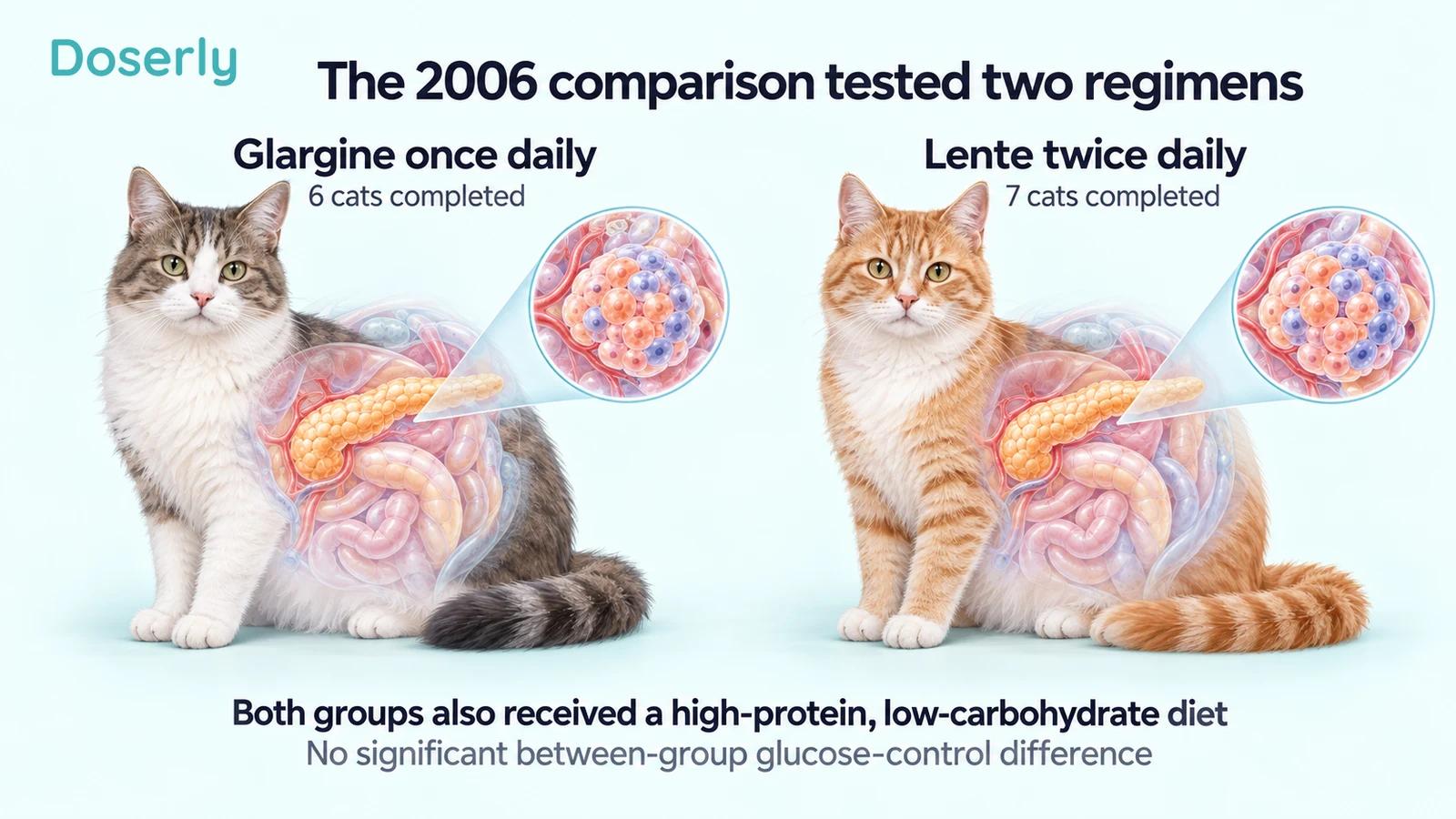
A 2006 study compared once-daily glargine with twice-daily lente insulin, alongside a high-protein, low-carbohydrate diet. Thirteen cats completed the study. Both groups improved, without a significant difference in the reported glucose-control measures. Original study
The finding is sometimes read as showing that the insulins are interchangeable, or that one injection of glargine is enough for every cat. Neither conclusion follows. The study compared particular regimens in a small group, and current veterinary guidance has developed considerably since then.
How formulation and schedule work together
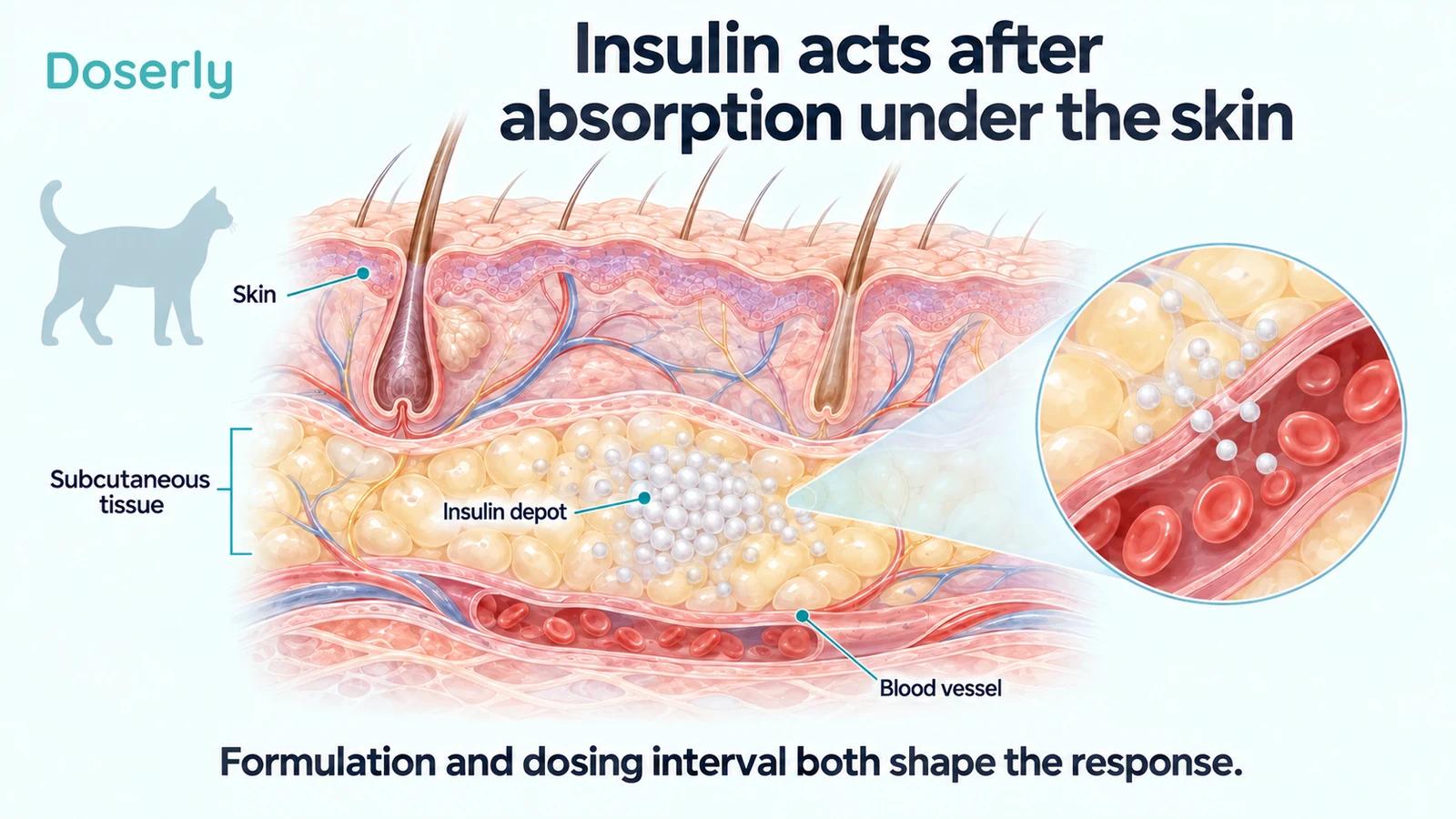
Injected insulin first has to leave the tissue under the skin and reach the circulation. Its formulation influences that process. Different preparations can produce different patterns of onset, duration and glucose lowering.
Glargine is an insulin analogue: a modified form of insulin. Lente is a zinc-containing insulin suspension. The practical question is not simply whether both lower glucose. It is whether a particular regimen provides an appropriate pattern for the animal receiving it.
If the action ends before the next dose, glucose may remain excessive for part of the interval. If the effect is too strong at another point, a cat can experience low glucose despite having high readings elsewhere. That is why treatment decisions consider the pattern across time.
Current AAHA guidance distinguishes glargine U-100, glargine U-300, lente and other preparations rather than treating the word “insulin” as a sufficient prescription. AAHA feline insulin guidance
What exactly did the 2006 experiment compare?
Cats were assigned to once-daily glargine or twice-daily lente. Both groups ate the same type of diabetes-focused diet, and reassessments included clinical observations, glucose curves and fructosamine.
At twelve weeks, six glargine-treated and seven lente-treated cats had completed the study. Glucose and fructosamine improved overall, with no significant difference between groups. Four completers entered remission: one receiving glargine and three receiving lente. Study abstract
Those counts are small. One additional remission would substantially change either group's percentage. The numerical direction should not be turned into proof that lente is better at producing remission.
The accessible abstract reports completers. It is not sufficient to reconstruct every screened animal, withdrawal reason or adverse event. A careful account should avoid filling those gaps with assumptions, particularly when discussing how reliably a treatment can be used.
Why the unequal schedules are central to the answer
A study comparing different drugs at different intervals evaluates the whole regimen. It does not isolate the molecule from the schedule.
Imagine comparing two hypothetical regimens that differ in both formulation and timing. If the outcomes are similar, the result supports the observed performance of those combinations. It cannot tell you what would happen if you changed one regimen's interval while keeping everything else the same.
This is directly relevant to the old feline comparison. Once-daily glargine versus twice-daily lente is not the same question as twice-daily glargine versus twice-daily lente. It also does not establish that all glargine concentrations behave alike.
For owners, the practical message is to ask about the exact product and prescribed interval. The study schedule can be explained as history without becoming an instruction to reduce injections in a cat whose veterinarian has prescribed a different regimen.
What did later research add?
A 2009 study examined twenty-four newly diagnosed cats receiving twice-daily glargine, protamine zinc insulin or lente, with a low-carbohydrate diet. All eight glargine-treated cats entered remission, compared with three receiving protamine zinc insulin and two receiving lente. Later comparative study
That result points in a different direction from the small remission counts in the 2006 comparison. It is not helpful to select whichever percentage supports a preferred insulin and ignore the other study.
The studies differed in treatment schedules and populations, among other design features. Small samples make their remission estimates especially sensitive to individual animals and selection. A striking outcome in eight cats is encouraging, but it is not a promise that every similar cat will stop insulin.
The 2025 iCatCare consensus notes that claims of superior remission with glargine U-100 rely heavily on small, uncontrolled or nonrandomized evidence. It advises interpreting the literature in the context of the overall management plan. iCatCare consensus
This does not mean glargine lacks a clinical role. It means clinical usefulness and proof of universal superiority are different propositions.
What does current guidance recommend?
The 2026 AAHA feline guidance identifies glargine U-100 and protamine zinc recombinant human insulin as common choices. It does not routinely favour lente as an initial option because its action can be shorter in cats. The same guidance stresses reducing clinical signs while avoiding hypoglycemia. Current AAHA guidance
That is a more current basis for a treatment discussion than treating a twenty-year-old trial as the final answer. Guidelines consider a broader body of research and clinical experience, although they do not remove the need to assess individual response.
A cat already doing well on lente should not have its treatment changed by an owner solely because another product is often preferred at initiation. The veterinarian can explain whether the current glucose pattern, symptoms or practical circumstances create a reason to reconsider it.
Similarly, choosing glargine does not eliminate monitoring. A commonly used option can still require careful adjustment, especially as appetite, body weight or residual insulin production changes.
Remission is valuable, but it is not the only outcome
Feline remission means that a cat can maintain acceptable glucose without administered insulin for a defined period. Current iCatCare guidance uses at least four weeks without an insulin requirement and without clinical signs. Remission definition
Owners understandably hope for that outcome. Fewer injections can reduce cost, stress and daily complexity. But a cat that remains insulin dependent can still have good health and a manageable routine.
When selecting treatment, consider what success would look like before remission is known. Less excessive drinking, stable appropriate weight, a normal appetite and a safe glucose pattern all matter. A treatment that reliably supports those goals has value even if injections continue.
This also helps avoid blaming an owner when remission does not occur. The underlying biology and timing of diagnosis matter; the outcome is not simply a measure of how carefully someone followed instructions.
What glucose curves and fructosamine contribute
A glucose curve records repeated readings over a period of time. It can show the lowest measured glucose and whether the effect appears to last across the dosing interval.
Fructosamine reflects glucose exposure over a longer recent period. It is useful context, but an average does not reveal every low or high point. A reassuring average can coexist with excursions that deserve attention. Cornell monitoring explanation
The two measurements therefore complement each other. They should also be interpreted with the cat's condition. A laboratory improvement accompanied by poor appetite or weakness is not a complete success story.
For a practical example, imagine that a cat's drinking improves but occasional home readings are still high. That does not automatically establish that the dose is too low. The veterinarian needs to understand when those readings occur and whether lower values appear elsewhere. The timing can distinguish different problems that a single number cannot.
Does glargine concentration change the question?
Yes. Glargine U-100 and U-300 contain different concentrations and have different absorption behaviour. The 2026 AAHA guidance explicitly treats U-300 as a separate insulin type, not simply three times an interchangeable U-100 preparation. AAHA formulation discussion
An article or conversation that says only “glargine” may therefore leave out an essential detail. Product name, concentration, device and prescribed schedule should be clear whenever a treatment plan is discussed.
This does not require owners to become pharmacologists. It requires a reliable check when a prescription or refill changes. If the packaging, concentration or delivery system differs, confirm the instructions with the veterinary team before using it.
The Vetsulin label provides another example of why product details matter: its vials require a matching U-40 syringe. Vetsulin label
How household circumstances fit the decision
An ideal plan must be possible to carry out. Work schedules, the cat's tolerance of handling, other pets and the availability of help can affect consistency.
Tell the veterinary team about those constraints early. They can discuss realistic options and monitoring methods, rather than discovering after several weeks that a prescribed routine has been impossible.
A written plan should explain what to record, how to contact the practice about unexpected results, and what to do when the cat will not eat normally or an injection is missed. Those instructions should come from the prescriber because they depend on the product and the animal.
Keep records factual and dated. Notes about appetite, medicines actually given and unusual events are more useful than trying to label each day a success or failure. Over time, they help distinguish a persistent pattern from an isolated disruption.
What should owners take from the comparison?
The 2006 study showed that both tested regimens could improve glucose control in a small group of cats receiving dietary care. It did not settle the best insulin for every cat, prove equivalence, or establish once-daily glargine as a universal schedule.
Later research and current guidance give a broader picture, including reasons veterinarians often select longer-acting feline options. The remaining task is to match that evidence to the exact product, the cat's response and a sustainable home routine.
The most useful question is therefore not “Which insulin wins this old study?” It is “Why is this formulation and schedule appropriate for my cat, and what observations will tell us whether it is working safely?”
Sources
- Weaver and colleagues, glargine versus lente, 2006.
- Marshall and colleagues, three-insulin comparison, 2009.
- iCatCare diabetes consensus, 2025.
- AAHA feline insulin treatment and monitoring, 2026.
- Cornell, feline diabetes.
- Vetsulin prescribing information.