
Supplements
October 16, 2026
Ginger for nausea: the cause of the symptom matters
On this page
Ginger is familiar as a food, a tea ingredient and a remedy people reach for when their stomach feels unsettled. Its underground stem, or rhizome, contains compounds investigated for effects on digestive function. But nausea is a symptom with many possible causes, and a product that helps in one setting may do little in another.
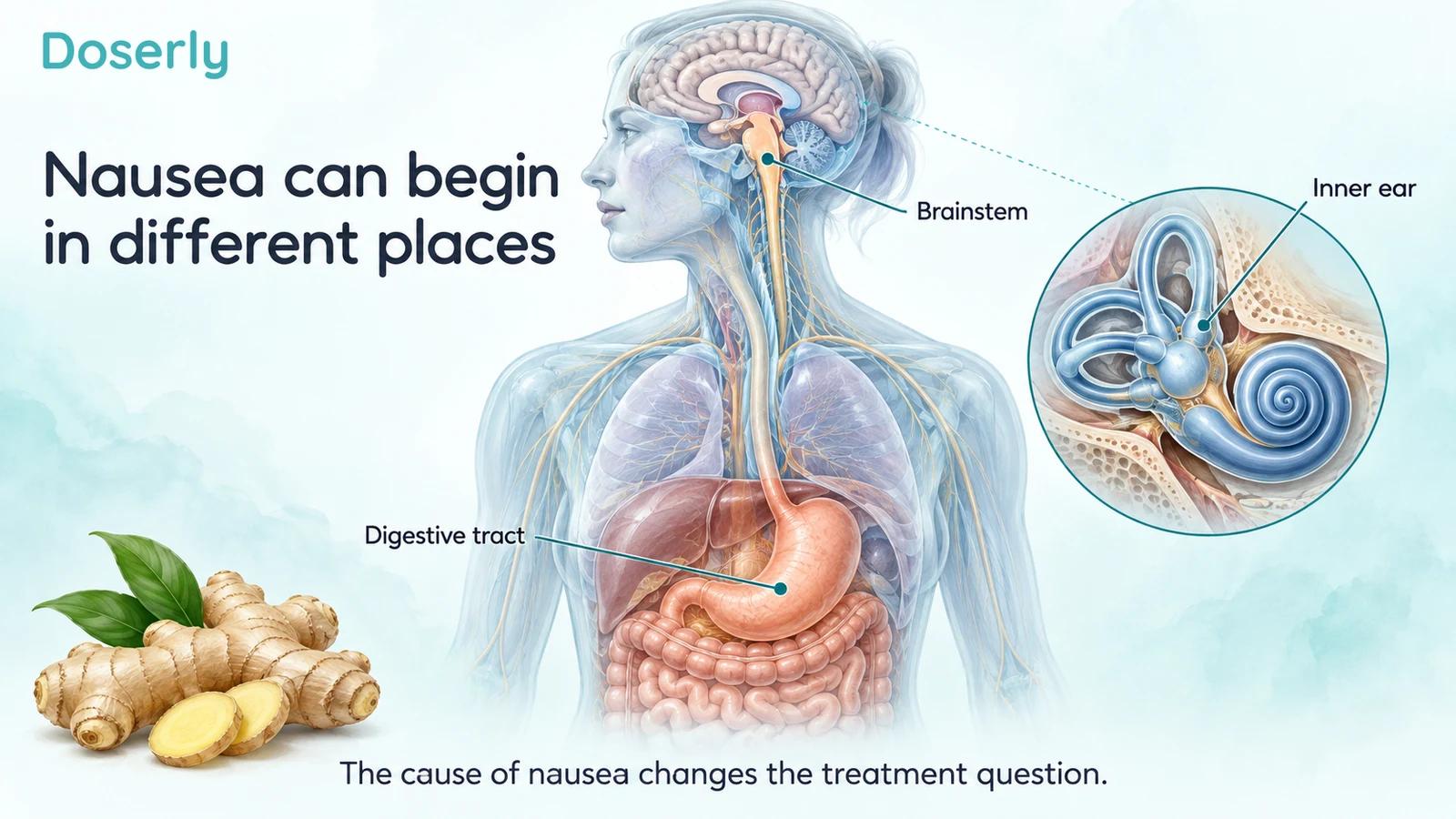
The most useful question is not simply whether ginger helps nausea, but which kind of nausea, with which preparation, and alongside what care. Pregnancy-related nausea, chemotherapy-associated nausea, motion sickness and discomfort after a meal are different research questions. Human studies give different answers, including some encouraging findings and some well-designed trials without added benefit.
We'll look at those settings separately, including why faster stomach emptying doesn't necessarily make a person feel better. Our ginger root guide provides a broader introduction to the ingredient, product forms and safety considerations.
Nausea and vomiting are different outcomes
Nausea is the unpleasant feeling that you might vomit. Vomiting is the physical event. Someone can have persistent nausea without vomiting, or fewer vomiting episodes while still feeling quite ill. This is why researchers often measure nausea intensity, vomiting frequency and the effect on daily life separately.
That distinction matters when you read a headline saying a treatment “worked.” A change in the average nausea score is not the same as everyone being free of nausea. Preventing vomiting is not necessarily the same as being able to enjoy a meal or travel comfortably. A well-chosen outcome should describe the problem the person actually wants help with.
The trigger also matters. Chemotherapy studies distinguish acute nausea, occurring around the first treatment day, from delayed nausea over subsequent days. Nausea before a later treatment can involve anticipation of the experience. A trial designed around one of these periods cannot automatically answer the others. Ryan and colleagues and Bossi and colleagues
What pregnancy research found
A placebo-controlled trial published in 2001 enrolled 70 pregnant women who first attended before or at 17 weeks of gestation. Participants received ginger or an identical placebo for four days. The ginger preparation supplied 1 g daily under the study protocol. Participants recorded nausea severity and vomiting episodes.
Average improvement in nausea was greater with ginger: the reported score reduction was 2.1 points versus 0.9 with placebo. Vomiting episodes also decreased more in the ginger group. Three placebo participants did not remain in the study. Vutyavanich and colleagues
This supports a possible short-term benefit in the population tested. It does not establish that ginger treats every cause of vomiting during pregnancy or that any amount and formulation is equally suitable. Four days is a short treatment window, and a small trial cannot settle uncommon pregnancy-safety outcomes.
NCCIH's current overview says ginger may help pregnancy-related nausea and vomiting, while recommending that pregnant people discuss supplement use with their healthcare provider. It also notes that most ginger research used supplements, rather than ordinary foods. A ginger biscuit, brewed tea and standardized capsule should therefore not be assigned the same evidence simply because they share an ingredient name. NCCIH ginger information
Severe pregnancy sickness needs a different response
A person who cannot eat or drink normally needs assessment, not repeated reassurance to try ginger. Hyperemesis gravidarum is severe pregnancy sickness that can interfere with everyday activities and cause dehydration. The Royal College of Obstetricians and Gynaecologists describes assessment of fluid intake, weight changes, other symptoms and possible alternative causes, with anti-sickness medicines and rehydration when needed. RCOG patient guidance
Difficulty keeping fluids or oral medicines down, reduced wellbeing and rapidly worsening symptoms should be brought to the maternity team promptly. Other symptoms, such as abdominal pain, or vomiting that begins later in pregnancy may require investigation for another cause. Ginger research should not delay that conversation.
This is also a quality-of-life issue. If nausea disrupts work, sleep or meals, it deserves to be taken seriously even without frequent vomiting. There is no need to demonstrate that a food remedy has failed before explaining the full burden to a clinician. The care plan should respond to the person's condition and ability to stay nourished and hydrated.
The large chemotherapy trial tested an addition to medicine
A multicenter trial published in 2012 is often cited as evidence for ginger. It randomized 744 patients, with 576 included in the analysis; the analyzed group was predominantly female. Participants received placebo or one of three ginger amounts around chemotherapy cycles. All received a prescribed 5-HT3 receptor-antagonist antiemetic on the first chemotherapy day.
Ginger reduced the severity of acute nausea in the analysis, with the largest reductions in the 0.5 g and 1 g daily groups. These are descriptions of the research arms, not a recommendation to copy the schedule. The study evaluated ginger alongside anti-nausea treatment, rather than in place of it. Original URCC CCOP trial
The distinction between randomized and analyzed participants also matters. The title refers to 576 patients, but more entered randomization, and fewer completed all study procedures. Reporting only the title's number would hide part of the study's participant flow. The positive finding concerns the measured acute-nausea outcome; it is not proof of complete protection across every treatment day.
For someone undergoing cancer treatment, this makes ginger a question for the oncology team. The relevance depends on the chemotherapy regimen, existing antiemetics, symptom timing and the exact supplement. Changing prescribed nausea prevention without that team would depart from the trial that generated the positive claim.
Why other chemotherapy studies did not show the same benefit
In a separate double-blind trial involving 244 people receiving high-dose cisplatin, 121 received a standardized ginger extract and 123 received placebo, both in addition to usual antiemetic prevention. The main question was delayed nausea. Ginger did not reduce the incidence of delayed, between-cycle or anticipatory nausea overall. Some subgroup findings were favorable, but those require further investigation rather than replacing the overall result. Bossi and colleagues, 2017
Another crossover trial studied 34 women receiving an adriamycin-cyclophosphamide regimen for breast cancer. They had already experienced moderate to severe nausea or vomiting during the first cycle. Ginger and placebo were compared during subsequent cycles alongside ondansetron and dexamethasone. The mean difference in maximum nausea score was about three points, with a confidence interval from −3 to +9, and no significant added benefit was demonstrated. Breast-cancer crossover trial
These results do not simply cancel the positive study. They help define how conditional the answer is. The preparations, chemotherapy regimens, timing and existing medicines differed. A treatment can appear useful for one setting while adding little in another. The correct description is mixed clinical evidence, not a universal anti-nausea effect.
NCCIH likewise describes the value of ginger as an addition to chemotherapy care as uncertain. NCCIH overview
Does ginger prevent motion sickness?
A small laboratory experiment offers an interesting clue. Thirteen volunteers with a history of motion sickness underwent circular vection, a visual-motion procedure that can produce nausea. In a randomized, blinded crossover design, ginger reduced nausea and some associated stomach-rhythm changes during the visual-motion challenge. Lien and colleagues, 2003
This is a human experiment, but its setting is narrow. Watching a controlled moving visual field in a laboratory is not the same exposure as a rough ferry journey or hours in the back of a car. A small crossover experiment also cannot identify which travelers will reliably benefit.
NCCIH's assessment is that most ginger studies for motion sickness have not shown it to be helpful. NCCIH ginger information
For planning travel, that means a positive mechanistic study should not be treated as dependable protection. A person who experiences severe motion sickness needs a plan matched to the journey and their medical circumstances. It is particularly useful to discuss the issue before travel, when there is time to review options and their effects on alertness or other medicines.
Faster stomach emptying can occur without feeling better
An experiment in 11 adults with functional dyspepsia, a condition involving troublesome upper-digestive symptoms, tested a single 1.2 g ginger dose against placebo. Participants then consumed a low-nutrient soup meal, and researchers used ultrasound to assess stomach emptying. The median half-emptying time was 12.3 minutes with ginger versus 16.1 minutes with placebo.
Despite the faster emptying, gastrointestinal symptoms did not differ. The measured GLP-1, motilin and ghrelin concentrations also did not differ. Hu and colleagues, 2011
The result is useful because it shows why a plausible digestive effect is not enough to predict relief. Stomach movement is one part of a person's experience. A laboratory meal and short observation period do not reproduce every aspect of recurring nausea or post-meal discomfort. The experiment does not establish a long-term treatment for dyspepsia or for another condition involving slow stomach emptying.
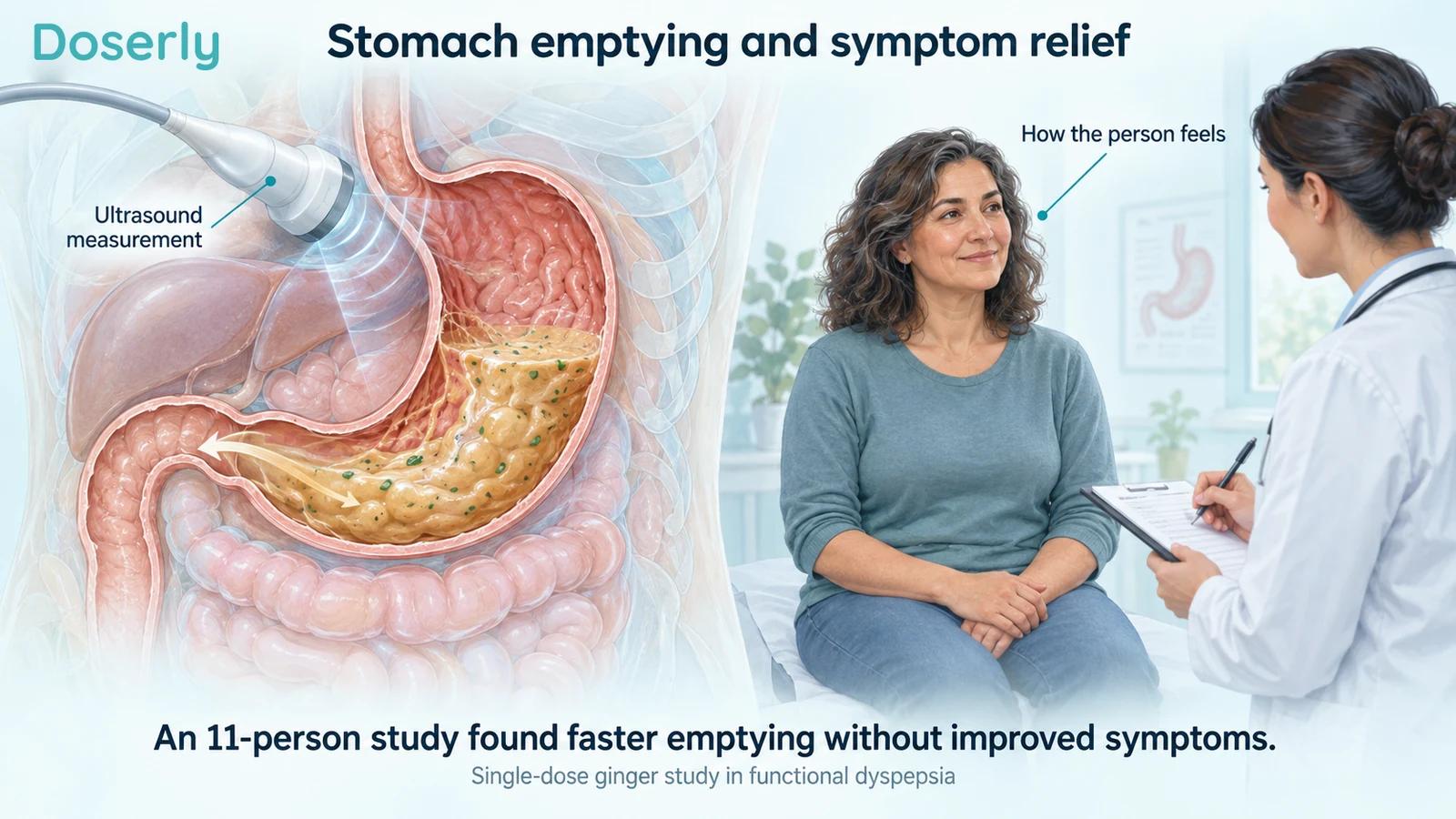
Image sources: Study source
Product form and tolerability matter
A trial of a specified extract tells us more about that preparation than about every ginger product. The amount of dried rhizome is not automatically equivalent to the same mass of an extract. Nor does the taste or strength of a tea provide a reliable way to match its content to a clinical trial.
Ginger itself can cause digestive discomfort, including heartburn and diarrhea, as well as mouth or throat irritation. If a product worsens the symptoms you are trying to manage, that is relevant information rather than something to ignore. People taking medicines should review herbal products with their healthcare provider. NCCIH safety information
Bring the label, including other ingredients, rather than relying on the word ginger. During pregnancy, cancer treatment or recovery from surgery, the treating team can assess whether the proposed product fits the existing plan. Evidence for one circumstance should not be borrowed to justify use in another without considering those differences.
A clearer way to describe your symptoms
A brief record can make the clinical conversation more useful. Note when nausea begins, whether vomiting occurs, whether food and fluids stay down, and how symptoms relate to meals, travel or treatment days. Include the timing of prescribed medicines and any supplement changes.
For chemotherapy, distinguishing the treatment day from later days helps identify whether acute and delayed symptoms need different attention. For pregnancy, the ability to drink and carry out ordinary activities is more informative than calling everything morning sickness. For recurring meal-related symptoms, describing fullness, pain and nausea separately avoids losing important details.
The aim is not to prove that ginger caused a good or bad day. It is to give the clinician a clear description of the problem and the treatment already tried. The Doserly ginger guide can help you prepare, but the cause and severity of nausea remain central to choosing care.
Sources
- NCCIH: Ginger—usefulness and safety.
- Vutyavanich et al., 2001: pregnancy nausea trial.
- RCOG: pregnancy sickness and hyperemesis guidance.
- Ryan et al., 2012: acute chemotherapy nausea.
- Bossi et al., 2017: high-dose cisplatin trial.
- Thamlikitkul et al., 2017: breast-cancer crossover trial.
- Lien et al., 2003: visual-motion challenge.
- Hu et al., 2011: gastric emptying and dyspepsia.