
Peptides
October 16, 2026
GHRP-2 in sport: the rules do not depend on whether it works for you
On this page
GHRP-2's status in sport does not depend on whether an athlete notices more muscle, better recovery or any effect at all. Anti-doping rules identify prohibited substances and conduct; they do not require each athlete to demonstrate a performance benefit before the rules apply.
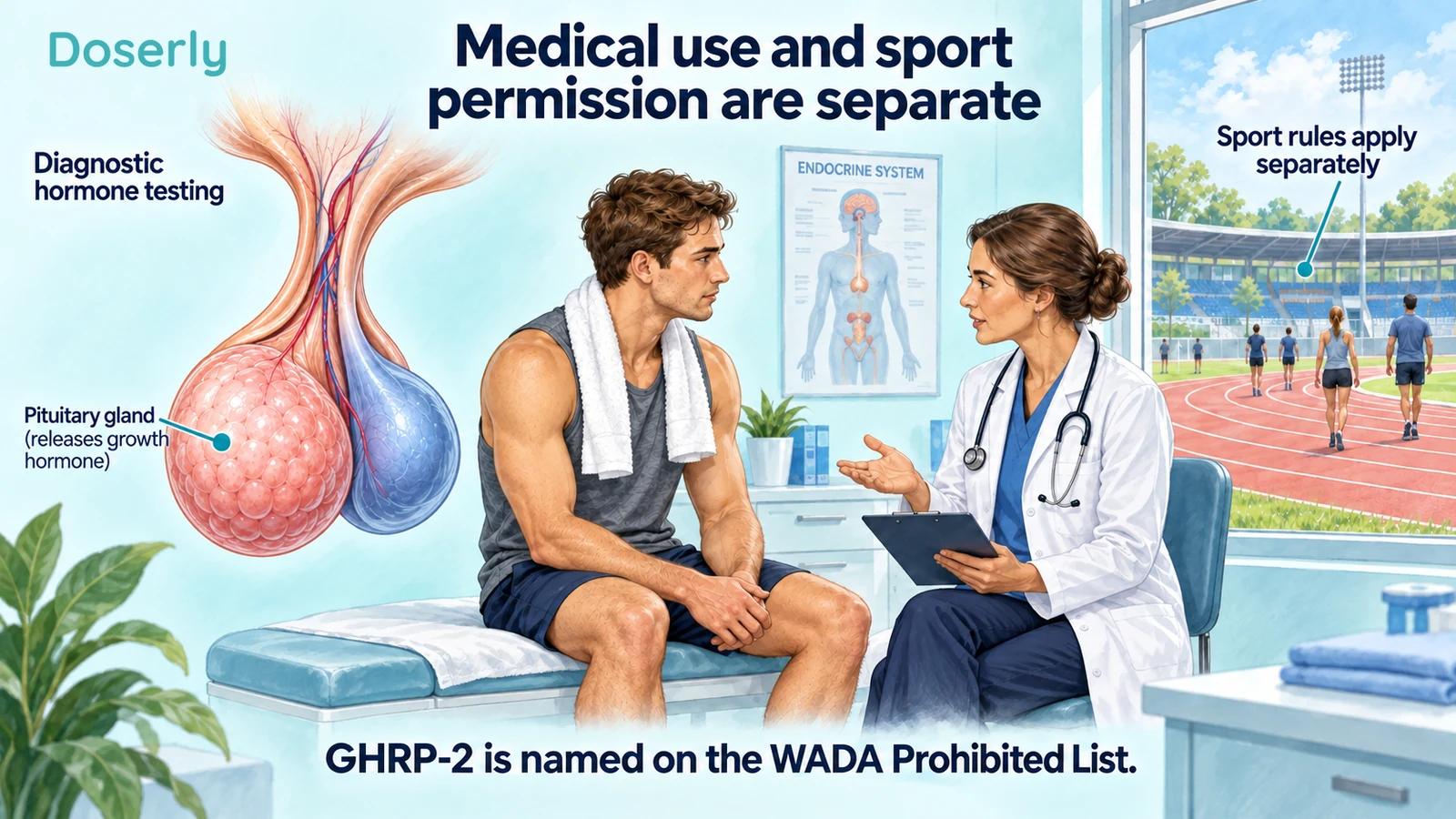
That distinction is especially important for a peptide discussed in both clinical testing and performance-enhancement settings. A medicine can have a legitimate diagnostic use while remaining prohibited under the rules of a sporting organization. A prescription, a laboratory result and permission to use a substance in sport answer different questions.
This article checks GHRP-2's named listing, explains what detection studies actually show, and outlines the information an athlete should clarify with the relevant anti-doping organization. The rule check below is dated October 15, 2026. The GHRP-2 guide provides the broader clinical and research background.
The 2026 list names GHRP-2 explicitly
The World Anti-Doping Agency's 2026 Prohibited List names GHRP-2, also called pralmorelin, in section S2.2.4, among growth-hormone-releasing peptides. Section S2 prohibits these substances both during and outside competition. The 2026 list took effect on January 1, 2026. Official 2026 list
For an athlete subject to these rules, “outside competition” is not permission to use it during a training block. Nor does changing the product's marketing description change the identity of its active ingredient.
The substance should be checked by name and synonym. A search for pralmorelin and a search for GHRP-2 concern the same listed peptide, rather than two different regulatory categories.
The relevant question is also which rules govern the athlete and event. WADA's list is part of an anti-doping system implemented through sporting organizations; athletes should identify their responsible federation or anti-doping authority rather than assume every event uses an identical process.
The 2027 list is published, but its effective date matters
As of this article's review date, WADA had also published its 2027 list. It again names GHRP-2 under the growth-hormone-releasing-peptide provision, with an effective date of January 1, 2027. Official 2027 list
The distinction between publication and effective date prevents a common error when checking rules late in the year. A newly available document may describe the next year's requirements.
For GHRP-2, the named prohibition is present in both editions. That continuity does not remove the need to check future editions when the article is read later. A saved screenshot without a year or date is a weaker reference than the current official document and an answer from the responsible organization.
Why a ban is not proof of a personal performance benefit
USADA explains that a substance or method is generally considered for the Prohibited List when it meets at least two of three criteria: actual or potential performance enhancement, actual or potential health risk, and conflict with the spirit of sport. USADA explanation of the list
Those criteria are not equivalent to a randomized trial showing that a particular product improves a particular athlete's strength. Potential effects and wider policy considerations are part of the framework.
The reverse argument also fails. Uncertain evidence for muscle gain does not make a named substance permitted. A clinical-efficacy debate and a rule check require different evidence.
An athlete who says, “I tried it and nothing happened,” has described a personal observation. That observation does not change the ingredient's identity or its place on the list.
The Code addresses unsuccessful use directly
Article 2.2.2 of the 2021 World Anti-Doping Code states that success or failure does not determine whether use or attempted use can constitute a violation. Article 2.1 separately addresses the presence of a prohibited substance, its metabolites or markers in an athlete's sample. World Anti-Doping Code
For presence violations, the Code's strict-liability principle does not require proof that the athlete intended to cheat. Fault can still matter when consequences are determined. That distinction is important: establishing a violation and deciding its consequences are separate stages.
These provisions should not be reduced to a universal prediction about a particular person's sanction. Individual circumstances and the applicable process matter. They do explain why neither a lack of perceived benefit nor an assertion of good intentions is a substitute for checking a substance before use.
Medical use requires a separate sporting assessment
Japan's pralmorelin label describes a diagnostic use: testing for growth-hormone secretion deficiency. The peptide is administered under defined clinical conditions and blood samples are collected to assess the response. PMDA diagnostic prescribing information
That use does not establish a treatment for athletic recovery. It also does not create an automatic sporting exemption.
An athlete referred for endocrine testing should tell the clinician about their anti-doping obligations before the planned test. The clinician can identify the exact proposed agent and the medical reason for it; the responsible anti-doping authority can explain the sporting requirements.
This is a coordination problem that can be addressed before a planned appointment. It should not be left to a coach, seller or general product description to resolve.
What a therapeutic use exemption does—and does not—mean
A therapeutic use exemption, or TUE, is a formal process for medically necessary use of a prohibited substance or method. USADA's current guidance makes clear that requirements depend on competition level and the substance's status; it provides a pre-check process when athletes are unsure. USADA TUE guidance
An application is not an approval, and a clinician's prescription is not the same document as a TUE. Athletes should establish which organization handles their situation and what documentation is required before planned use.
Emergency care is different. USADA advises seeking necessary care first, retaining medical documentation and addressing the anti-doping requirements afterward. Its guidance describes circumstances in which a retroactive TUE may be considered; that possibility is not a guarantee.
The useful next step for a specific medical situation is an answer from the responsible organization, with the clinician involved. An article cannot grant permission or determine eligibility from the name of a diagnosis alone.
Detection studies look for the substance and its breakdown products
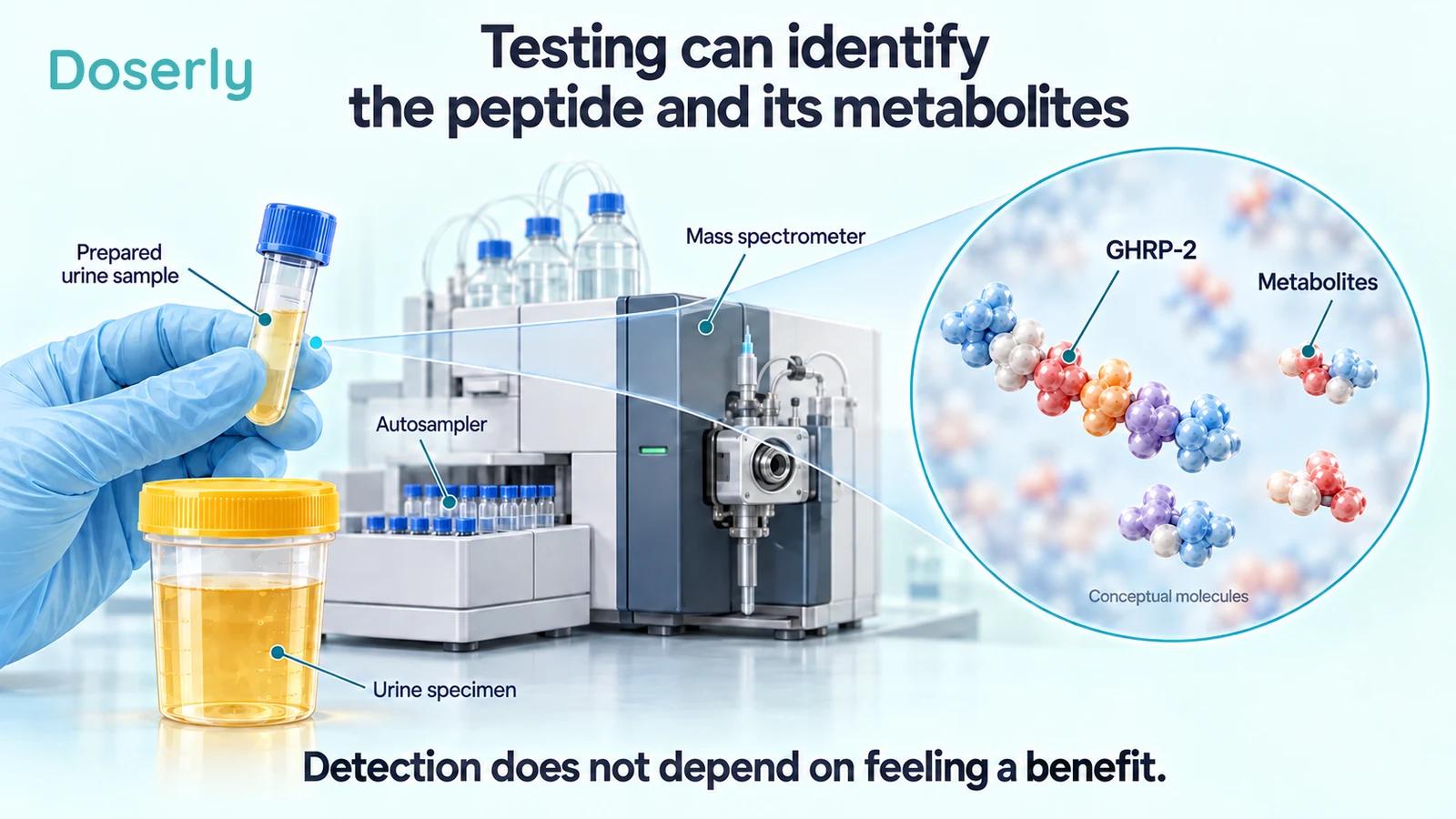
Anti-doping laboratories do not need an athlete to report feeling stronger before they can look for GHRP-2. Analytical research has developed methods for identifying the peptide and metabolites, which are products formed as the body processes a substance.
A 2010 study used liquid chromatography with tandem mass spectrometry to identify GHRP-2 and a specific metabolite in urine. After administration in ten male volunteers, both targets were detected in all ten cases. Urinary detection study
Liquid chromatography separates components of a sample; mass spectrometry helps identify compounds through their molecular characteristics. The important point is that the test targets chemical evidence of exposure.
The experiment was a method-development and administration study. It was not evidence that the volunteers gained muscle or improved performance. Analytical sensitivity and clinical efficacy are different properties.
Different routes and sample types have also been investigated
A 2015 study examined urinary metabolites after nasal administration of several growth-hormone-releasing peptides, including GHRP-2. Each compound was administered to one volunteer. Researchers identified parent compounds and metabolites with differing patterns across the substances. Nasal-administration metabolite study
That very small design supports analytical investigation, not a universal prediction for every person or preparation. It also shows why the parent peptide alone is not necessarily the only relevant target.
A later study developed a method for detecting GHRP-2 in dried blood spots. It successfully detected the parent peptide in administration-study samples, while low metabolite levels limited the metabolite's usefulness in that sample format. Dried-blood-spot study
These findings should not be converted into an athlete's personal clearance schedule. A research method has specified conditions, and a result from one route, sample type or participant does not describe every testing situation.
Nor does a publication establish that every laboratory uses exactly that procedure for every sample. What the studies establish is that direct analytical approaches exist and have been investigated in human administration samples.
A positive sample is not the only possible basis for a case
In 2017, USADA announced a four-year sanction involving track-and-field athlete Jason Young. The announced case concerned use and possession of multiple prohibited growth-hormone-releasing factors, including GHRP-2 and ipamorelin, and was described as a non-analytical violation. USADA case announcement
The case illustrates that anti-doping enforcement is not limited to detecting a compound in one sample. It should not be presented as a GHRP-2-only case, or as a prediction that every future case will receive the same sanction.
It also does not establish that either peptide improved the athlete's performance. An enforcement announcement and a controlled efficacy trial answer different questions.
Product language is not a permission check
Operation Supplement Safety, a US military health resource, describes confusing peptide-product marketing, including products presented as research-only while promoted for physique or performance purposes. It also notes that product names and ingredient panels may not communicate the same thing. OPSS peptide guidance
A label such as “research use” therefore should not be read as an anti-doping assurance. Neither should a seller's description of a product as natural, restorative or intended only for recovery.
The useful information to bring to a clinician or anti-doping organization is concrete: the product name, ingredient list, active-substance synonyms, proposed purpose and any available prescribing documentation. Marketing claims are not a substitute for those details.
A practical check before planned care or competition
Start with the organization that governs the event and establish which anti-doping rules apply to you. Then identify every active substance involved in the proposed medicine, diagnostic test or product, including alternative names such as pralmorelin.
Use the official list for the relevant year and the organization's medication-checking resources. If medical use is involved, ask about the applicable exemption process before planned administration. Keep the dated response and the clinical documentation together.
A change in product, event, competition level or calendar year is a reason to revisit the check. Permission should never be inferred from another athlete's experience.
For GHRP-2, the central point is clear: the 2026 and published 2027 lists name it, clinical diagnostic use is a separate matter, and uncertainty about athletic benefit does not remove anti-doping responsibilities.
Sources
- WADA 2026 Prohibited List.
- WADA 2027 Prohibited List.
- USADA explanation of the Prohibited List.
- 2021 World Anti-Doping Code.
- PMDA pralmorelin diagnostic label.
- USADA therapeutic use exemption guidance.
- 2010 urinary GHRP-2 detection study.
- 2015 nasal-administration metabolite study.
- 2021 dried-blood-spot study.
- 2017 USADA Jason Young announcement.
- OPSS peptide-product guidance.