
Peptides
October 16, 2026
GHRP-2 and appetite: what the human meal studies actually found
On this page
GHRP-2 can make people eat more during a controlled meal experiment. That is one of the clearer human findings for this synthetic peptide, and it helps explain why hunger appears so often in discussions about it. The next question is more difficult: does that short-term effect translate into useful, lasting improvement in nutrition, body weight or muscle?
The answer depends on which study you mean. Researchers have examined a single meal in healthy adults, appetite reports in children with growth-hormone deficiency, and an individual patient with severe longstanding anorexia nervosa. These are different situations. Their results should not be merged into a general promise that GHRP-2 safely helps anyone gain weight.
We'll look at the actual experiments, then consider what the findings mean for someone struggling with appetite. For the broader endocrine and safety background, see our GHRP-2 guide.
Why a growth-hormone peptide can also affect hunger
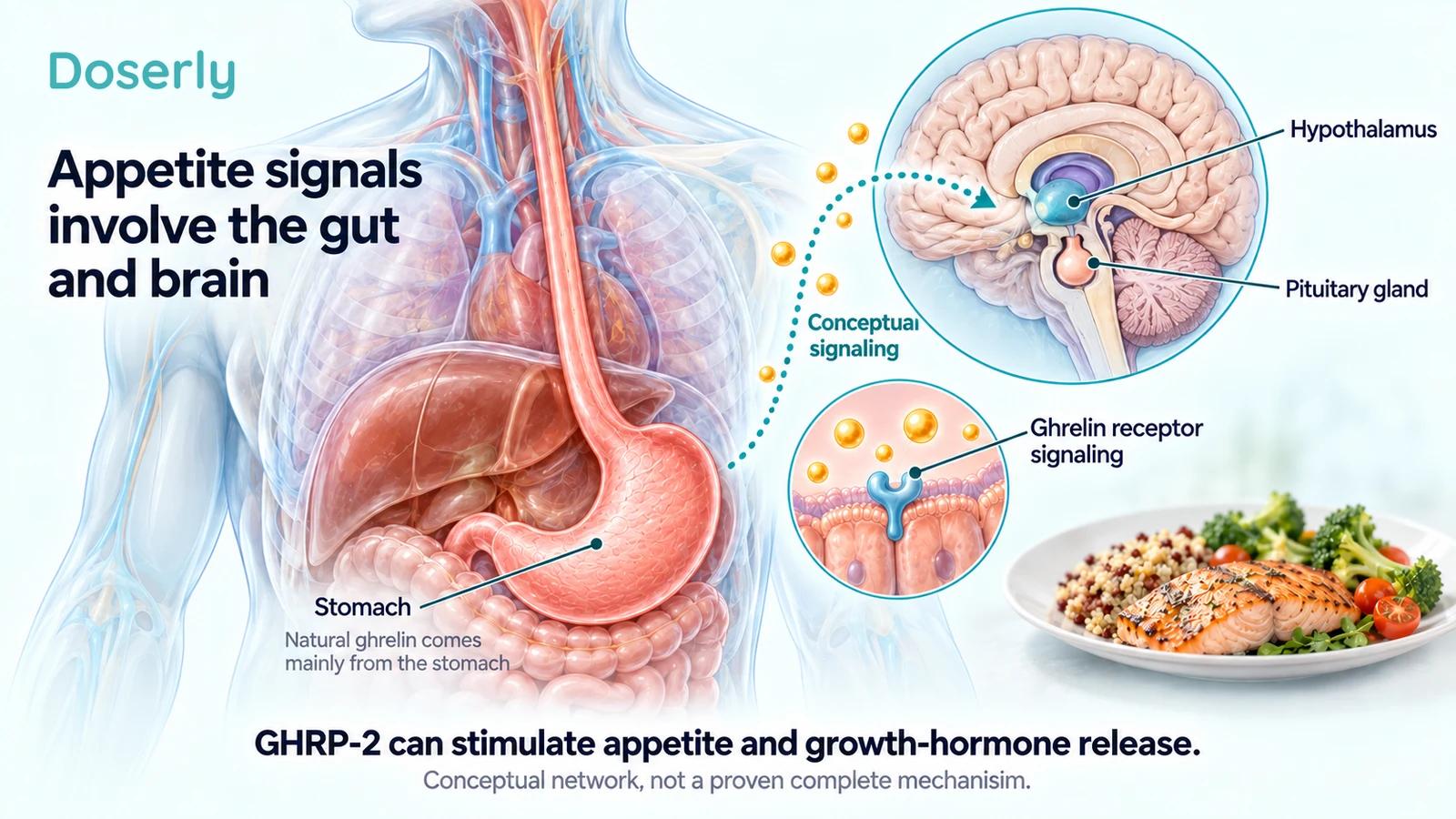
GHRP-2 belongs to a group called growth-hormone secretagogues: substances that stimulate growth-hormone release. It activates the receptor also used by ghrelin, a peptide produced naturally in the body.
The discovery of ghrelin helped connect a receptor originally studied for growth-hormone release with signals from the stomach. The original 1999 research identified ghrelin in rat stomach and described its human counterpart. It did not test GHRP-2 as an appetite treatment in patients. Ghrelin discovery paper
This shared receptor explains why scientists investigated food intake alongside hormones. It does not mean that GHRP-2 is identical to natural ghrelin, or that stimulating the receptor reproduces every aspect of normal appetite regulation. Hunger, the feeling of fullness and the decision to eat are related experiences, but they are not one measurement.
The seven-man experiment: more food at a buffet meal
In a 2005 study, seven lean, healthy men received GHRP-2 or saline during a 270-minute subcutaneous infusion. Researchers then measured how much the participants ate at a buffet-style meal where they could choose their intake.
The men ate an average of 35.9% more with GHRP-2 than with saline. All seven increased their intake, and the comparison remained positive when intake was expressed relative to body weight. The proportions of carbohydrate, fat and protein consumed did not differ between conditions. Growth-hormone exposure also rose. Laferrère and colleagues, 2005
This is evidence of an acute effect under the study conditions. The saline comparison helps distinguish the effect from simply having a meal available. Measuring actual food intake is also more informative for this question than asking only whether someone felt hungry.
However, a 35.9% larger meal does not mean a 35.9% increase in daily intake, body weight or muscle. The experiment did not follow those outcomes over months. It also cannot tell us how someone with illness-related appetite loss, a different body composition or another medication would respond.
The larger follow-up included adults with obesity
A 2006 experiment enrolled 19 healthy, weight-stable adults: ten lean participants and nine with obesity. Each attended three study visits involving placebo or one of two GHRP-2 infusion exposures. The study was randomized and double-blind.
Participants received a fixed breakfast, rated hunger and fullness, and later ate a buffet lunch. Food intake increased by 10.2% at the lower exposure and 33.5% at the higher exposure relative to placebo. The investigators did not find that obesity status altered the food-intake response. At the higher exposure, participants reported greater appetite before lunch but similar fullness after eating. Follow-up appetite study
The study therefore addressed more than whether hunger can occur. It examined whether the effect depended on exposure and whether adults with obesity retained the response. The results supported both an exposure-related effect and preserved responsiveness in that small sample.
It would still be too strong to conclude that every person responds equally regardless of weight. Nine participants with obesity cannot represent the full range of metabolic health, medications, ages and eating patterns seen in clinical practice.
Why hunger ratings and food intake both matter
A hunger rating describes a person's experience. Food intake describes behavior during the meal. Neither is automatically a measure of nutritional recovery.
Someone may feel hungrier but be unable to eat comfortably because of nausea or early fullness. Another person may eat more when offered a large buffet but compensate by eating less later. A treatment could also change the experience of eating without producing a durable change in weight. These are possibilities a longer study would need to examine, not outcomes established by the buffet experiments.
The follow-up study's similar post-meal fullness is useful here. Greater appetite before eating did not simply mean that participants remained unsatisfied afterward. The investigators measured different stages of a meal rather than treating appetite as a single permanent state.
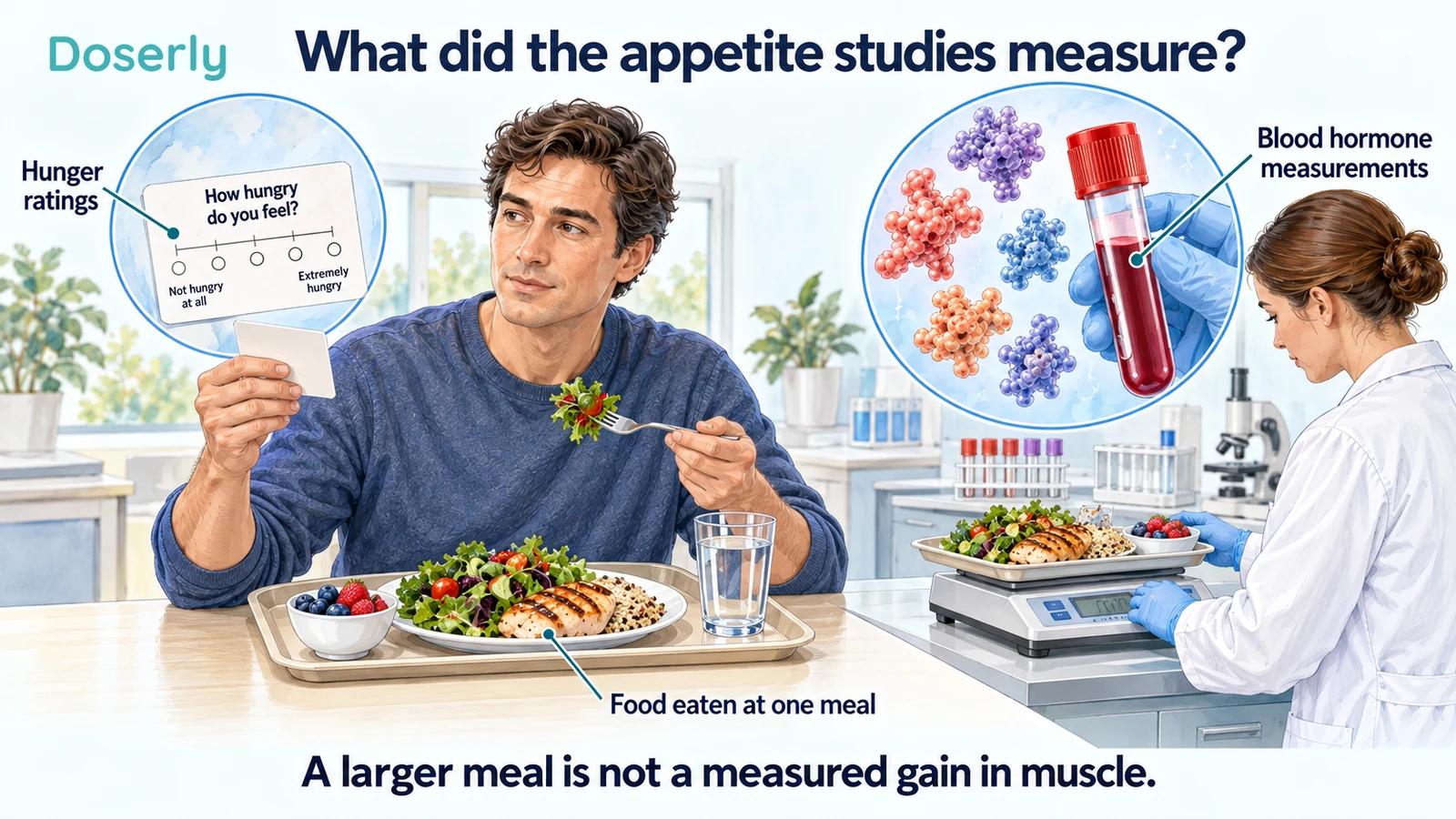
A practical reading of these studies is therefore quite specific: GHRP-2 increased food eaten during the measured visits. Whether that would be welcome or problematic depends on the person's goal. For someone seeking weight reduction, increased hunger could be an unwanted effect rather than a benefit.
What happened during a year of oral treatment in children?
A small 2003 report followed ten prepubertal children with growth-hormone deficiency who received an oral GHRP-2 preparation for 12 months. Seven reported increased appetite during the first six months.
The study did not find a statistically significant sustained change in body-mass-index standard deviation score. That score compares a child's BMI with an age-appropriate reference rather than treating childhood growth like adult weight change. The reported average score changed only from 0.21 to 0.25. Pediatric appetite study
The authors interpreted the appetite effect as transient rather than evidence of a clinically meaningful chronic BMI effect. This matters because it directly challenges the assumption that repeated appetite stimulation necessarily produces continuing weight gain.
The study was small, lacked a parallel placebo group for this comparison and involved children with a specific hormone diagnosis. Its oral preparation also differs from the infusions used in the adult experiments. Those limitations prevent a confident general estimate of long-term benefit, but they do not justify ignoring the lack of a clear BMI result.
The anorexia nervosa report involved one severely ill patient
A 2015 case report described a patient with a 20-year history of anorexia nervosa and severe emaciation. Despite prior improvement in fear of eating and desire for thinness, she continued to struggle with digestive symptoms and inadequate intake.
The clinicians administered intranasal GHRP-2 for one year. They reported increased hunger and food intake, less early satiety and improved hypoglycemia. Weight rose from 21.1 to 27.8 kilograms over 14 months after treatment began, a gain of 6.7 kilograms. The report also described improvements in fatigue and physical activity. Original case report
This is clinically interesting because the patient's difficulty was not simply a wish to eat a bigger meal. It involved severe illness, gastrointestinal symptoms and ongoing care. The report suggests a question worth studying in a carefully defined population.
It does not establish a standard treatment for anorexia nervosa. There was no randomized comparison, and the effects of ongoing care, time and other changes cannot be separated confidently. The absence of obvious adverse effects in one patient cannot establish safety for others. Neither the large relative weight change nor the descriptive strength improvement should be repurposed as a bodybuilding result.
More growth hormone is not the same as more growth
The appetite studies also measured growth hormone, which can encourage an additional leap: if hunger and growth hormone both rise, perhaps the extra food must become muscle.
The clinical record does not support that shortcut. A separate double-blind trial assigned 126 short children with growth-hormone deficiency to intranasal GHRP-2 or placebo for 48 weeks. Although the preparation stimulated endogenous hormone release, it did not significantly improve the reported growth outcome or IGF-I levels between groups. Pediatric randomized trial
Children's linear growth and adult muscle gain are different outcomes, so this is not a direct muscle trial. Its relevance is narrower: it demonstrates that a measurable hormone response does not automatically deliver the hoped-for tissue outcome.
Likewise, the acute meal studies did not measure muscle mass, strength or training adaptation. More food consumed at lunch and a higher hormone concentration remain two observations. They do not establish how nutrients were used or whether functional benefit followed.
Why the route and setting cannot be ignored
The studies used prolonged infusion, oral administration or an intranasal preparation. Those exposures should not be treated as interchangeable. A peptide's route influences how it reaches the circulation, and a continuous research infusion is different from intermittent use outside a study.
Japan's prescribing information for pralmorelin, another name for GHRP-2, describes an intravenous diagnostic test for growth-hormone deficiency. It includes controlled preparation, timed blood sampling and adverse-reaction information. That diagnostic indication is separate from appetite treatment. PMDA prescribing information
The label lists effects such as warmth, gastrointestinal symptoms, sleepiness and hunger in the diagnostic setting. It cannot provide reliable long-term side-effect rates for an unrelated appetite regimen. Nor does a legitimate diagnostic product validate a research product purchased elsewhere.
For the reader, the important point is to identify the actual preparation in a paper before borrowing its conclusion. An oral result in ten children does not predict the effects of a different preparation in an adult.
What would establish a useful appetite treatment?
For someone with inadequate intake, the relevant goal is usually more than feeling hungry for a few hours. A useful trial would need to show whether treatment improves sustained intake, nutritional status and the person's ability to function, while measuring tolerability and harms.
The target condition matters. Appetite loss associated with severe illness, early fullness, an eating disorder and the ordinary difficulty of eating enough during training are not interchangeable problems. A study should define the population rather than assume that one appetite signal explains them all.
It would also need a comparison that separates the drug effect from nutrition support and other care. Repeated measurements could show whether an early response fades, persists or changes over time. Body-weight data would need context: the amount gained, its composition where relevant, and whether the person actually feels or functions better.
That is a proposed standard for research, not a recommendation to experiment with a peptide.
Bringing an appetite concern to a clinician
If eating enough has become difficult, describe what is happening: reduced hunger, getting full quickly, pain, nausea, vomiting, fear around food or unintended weight change. Those details help identify the problem being treated. “I want more appetite” is less informative than explaining what prevents you from eating.
A dated record of meals, symptoms and weight can support that conversation without becoming a self-diagnosis. If someone proposes GHRP-2, ask which study matches your condition and whether the intended outcome is better intake, weight restoration or improved function. Ask how success and adverse effects would be assessed.
The controlled experiments give a credible answer to one physiological question: GHRP-2 can increase food intake in people. The longer-term clinical question remains much less settled. Our GHRP-2 research guide explains how the appetite findings fit with the wider hormone studies.
Sources
- Seven-man appetite experiment.
- Lean and obese adult crossover study.
- Oral treatment and appetite in children.
- Anorexia nervosa case report.
- Original ghrelin discovery.
- 48-week pediatric growth trial.
- Japanese pralmorelin prescribing information.