
Peptides
October 16, 2026
GHRP-2 and growth-hormone deficiency: what treatment studies show
On this page
Growth-hormone deficiency is a clinical diagnosis, not a synonym for fatigue, slow recovery or wanting more muscle. GHRP-2 has been studied in people with that diagnosis because it can stimulate the body's own growth-hormone release. The central treatment question is whether the response is sufficient to improve the outcome that matters.
That question has produced a mixed research history: small early studies reported encouraging growth observations, while a larger randomized trial of an intranasal preparation did not demonstrate a growth benefit. Understanding why those studies differ is more useful than treating every hormone rise as evidence of successful treatment.
The diagnosis also changes how relevant a paper is to a reader. Children with growth failure, adults with established pituitary disease and otherwise healthy adults seeking wellness are different populations. The GHRP-2 guide provides an overview; here we focus on deficiency and treatment outcomes.
Why the clinical setting matters
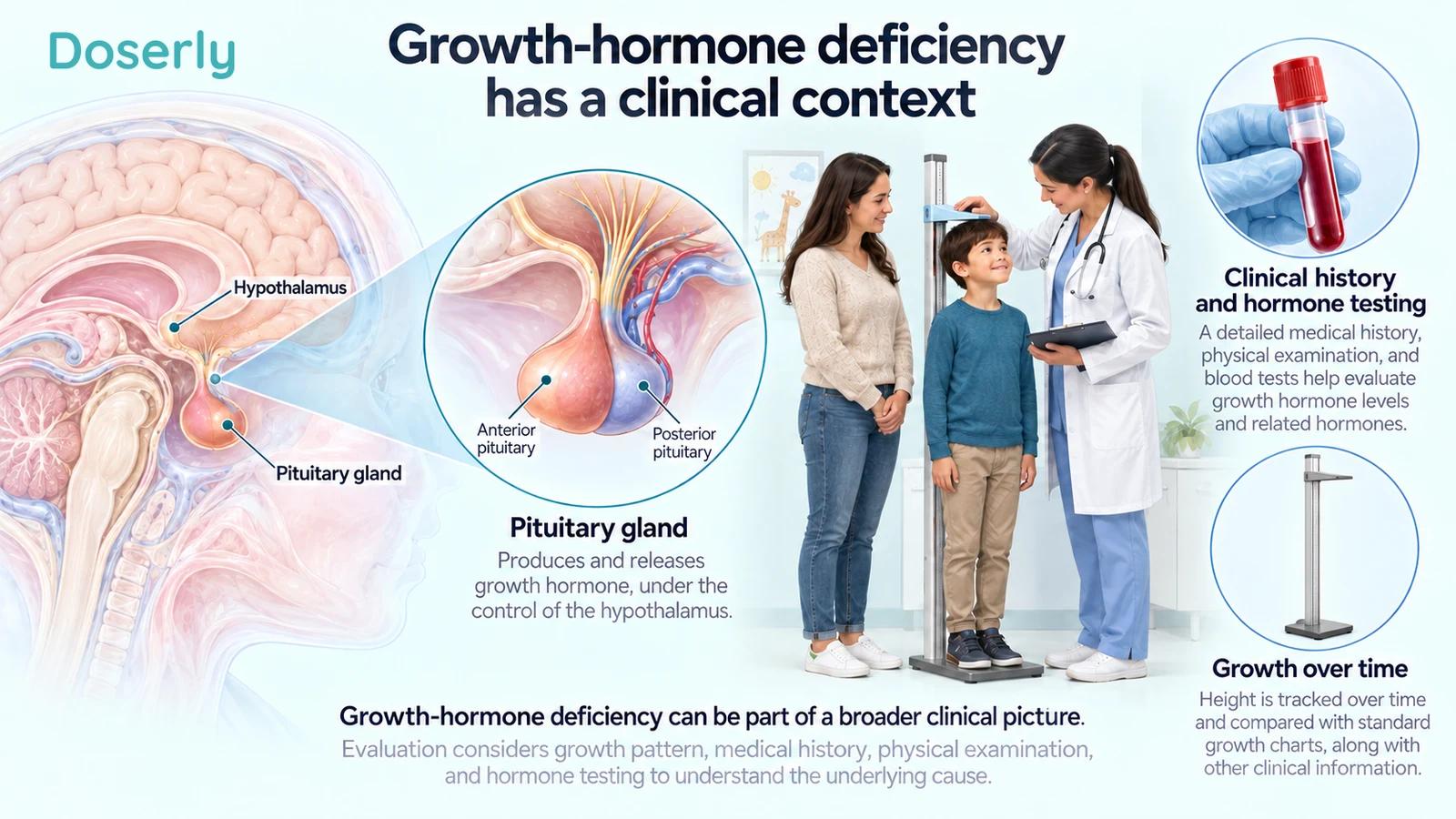
The pituitary gland releases growth hormone. A disorder affecting that system can lead clinicians to investigate deficiency, but the diagnostic process requires more than identifying a symptom that could have many causes.
The Endocrine Society's adult guideline states that stimulation testing is usually needed to confirm deficiency, with exceptions for particular established genetic or structural conditions. It also describes potential benefits of growth-hormone therapy in appropriately diagnosed patients. Adult deficiency guideline
Those treatment findings concern growth-hormone replacement. They cannot be transferred automatically to GHRP-2, which stimulates secretion rather than supplying growth hormone directly. The two interventions may aim at a related system, but they are different treatments.
For a child, the clinical question includes growth over time. For an adult, height is no longer the relevant outcome, and treatment decisions concern other effects of established deficiency. Mixing those goals makes it difficult to interpret the research accurately.
A diagnostic response does not establish replacement efficacy
Japan's pralmorelin prescribing information describes GHRP-2 as a diagnostic agent for growth-hormone secretion deficiency. It is used to provoke a measurable response during testing. PMDA label
That role depends on what the pituitary system does after a challenge. A strong response can be useful for interpreting the test; a weak response can provide different information. Neither result alone answers whether repeated administration will improve a patient's health.
The distinction is particularly important for a secretagogue. The remaining capacity of the system being stimulated matters. Increasing the concentration from a very low baseline is not necessarily the same as restoring an adequate pattern of hormone exposure.
The clinical task therefore has two stages: establish the diagnosis appropriately, then evaluate the evidence for the proposed treatment. Evidence from the first stage cannot replace evidence from the second.
The early intranasal study looked encouraging
A 1997 report studied 15 children with short stature, poor growth velocity, delayed bone age and low IGF-I. Approximately half were classified as growth-hormone deficient; the others had idiopathic short stature, meaning their short stature did not have an identified explanation in that classification.
All had demonstrated a response to GHRP-2 before treatment. During intranasal administration, reported growth velocity increased from 3.7 to 6.1 centimeters per year at six months. Six children continued for 18–24 months, with a reported growth velocity around 6.0 centimeters per year. IGF-I and IGF-binding protein-3 did not change significantly. Early study
These findings gave researchers a reason to investigate further. They were not a randomized placebo comparison, and the group combined two diagnostic categories. The children selected for their initial response were also not a representative sample of every child with growth-hormone deficiency.
A change from the pretreatment period can be clinically interesting without isolating the drug's contribution. Growth varies over time, and the selection process, concurrent care and measurement variability all need consideration when there is no concurrent control group.
The six-child injection study raised an exposure question
Another small study followed six prepubertal children with growth-hormone deficiency through increasing GHRP-2 exposures over several months. The final treatment period added GHRH.
GHRP-2 stimulated overnight hormone secretion, but the effect after an injection was relatively brief and had little influence later in the night. IGF-I and IGF-binding protein-3 did not increase. Growth velocity was higher during treatment than during the comparison periods before and afterward. Eight-month study
The authors suggested that a longer duration of action might be needed for a useful therapeutic approach. That was a research interpretation, not validation of a particular schedule.
The study also has an attribution limit: the final period combined two substances. Any finding during that period cannot automatically be assigned to GHRP-2 alone. With six participants and changing exposures, the report could explore physiology but could not provide a robust estimate of efficacy or uncommon harms.
The larger randomized trial did not confirm a growth benefit
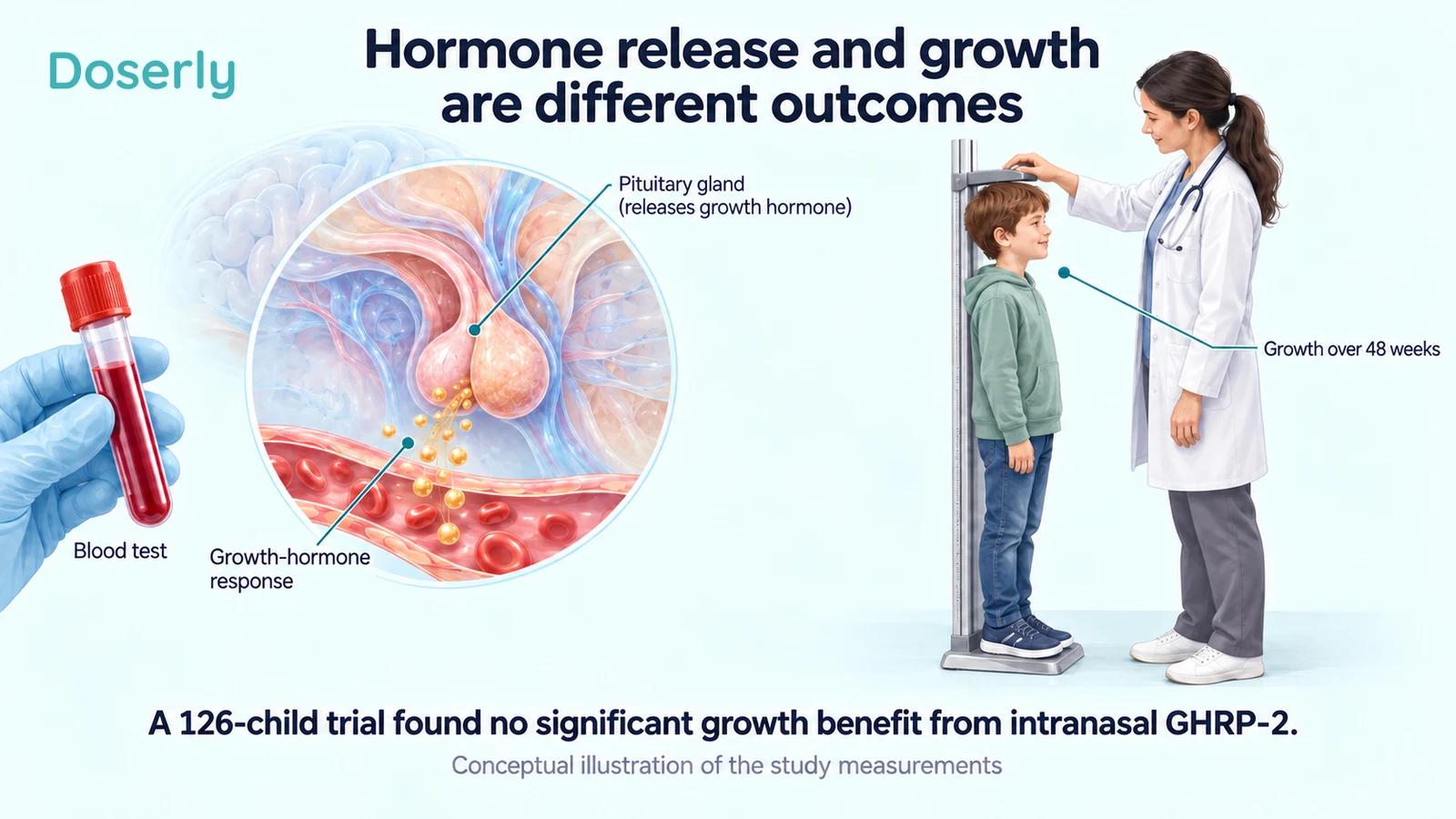
A 2014 report described a double-blind study of 126 prepubertal short children diagnosed with growth-hormone deficiency. Participants were assigned to placebo or one of two intranasal GHRP-2 groups for 48 weeks.
The groups included 44, 41 and 41 children at allocation. The reported changes in height standard deviation score were 0.07 with placebo, 0.03 with the lower exposure and 0.02 with the higher exposure. There was no significant difference between groups, and IGF-I measurements did not show a significant benefit. Randomized pediatric trial
A height standard deviation score describes how a child's height compares with a reference population. The small changes above are not centimeters and should not be reported as such.
The trial's importance lies in the direct comparison. It showed that a preparation capable of stimulating endogenous growth hormone did not deliver the expected growth advantage under the tested conditions. That is more directly informative about treatment than an acute stimulation result.
Why the later result deserves more weight
The earlier reports and the larger trial need not be described as if one were fraudulent or useless. They asked related questions with different levels of control.
An uncontrolled study can identify an observation worth testing. Random assignment with a placebo comparison then helps determine whether the observation exceeds what occurs without the active treatment under similar conditions. A larger sample also gives a more stable estimate than a handful of selected participants.
The negative result is still formulation- and population-specific. It does not prove that every possible secretagogue strategy is incapable of benefit. However, a claim that another preparation or exposure would work requires its own evidence. It cannot be treated as established simply because the tested regimen was unsuccessful.
For parents, that means the clinically relevant question is not just whether a peptide can raise growth hormone. It is whether the exact proposed treatment has improved growth and other important outcomes in comparable children.
IGF-I provides additional information, not a complete answer
Insulin-like growth factor I, or IGF-I, is involved in growth-hormone biology. The pediatric studies measured it because it can help describe the downstream response to treatment.
Several of the studies above reported stimulated growth-hormone release without a clear rise in IGF-I. That is one reason a sharp hormone peak should not be assumed to represent adequate sustained biological exposure.
However, the reverse shortcut would also be wrong. An IGF-I increase alone would not establish the desired clinical benefit. For a growth treatment, researchers still need growth measurements; for an adult treatment, they need outcomes relevant to adults.
A useful study therefore measures both the proposed biological pathway and what happens to the patient. Hormone results help explain the outcome rather than replace it.
An inherited receptor disorder illustrates the difference between a rise and restoration
Researchers administered GHRP-2 to 11 people with isolated growth-hormone deficiency caused by a mutation in the GHRH receptor, comparing them with eight controls.
The deficient group showed a 4.5-fold increase from a very low baseline, but its post-stimulation concentration remained far below the control response. The study supported some GHRH-independent action of GHRP-2. Receptor-mutation study
A fold increase can sound impressive when the starting number is tiny. It should therefore be interpreted alongside the absolute concentration and the control group. Here, “the hormone increased” did not mean “the response normalized.”
The experiment also did not establish a long-term treatment outcome. It helps researchers understand the system's remaining responsiveness. Whether that can be turned into meaningful benefit remains a separate question.
Why adult wellness claims cannot inherit pediatric treatment evidence
The pediatric studies addressed growth in children with short stature or diagnosed deficiency. They did not test muscle gain in healthy adults, routine fatigue or recovery after training.
Even a successful growth trial would not automatically answer those adult questions. Age, diagnosis, tissue development and intended outcomes differ. In this case, the larger trial also failed to demonstrate its planned growth benefit, making broad extrapolation still less justified.
Likewise, the adult deficiency guideline's discussion of growth-hormone replacement does not validate GHRP-2 for people without the diagnosis. The treatment, population and benefit all need to match the claim being made.
Someone may have symptoms worth investigating without having growth-hormone deficiency. Taking those symptoms seriously means evaluating their cause, rather than deciding in advance that stimulation of one hormone is the solution.
What to discuss after a confirmed diagnosis
If deficiency is established, ask the treating endocrinologist to explain the available treatment options and the evidence for each. Clarify whether the proposed medicine replaces a hormone or stimulates its release, and why that mechanism is appropriate for the underlying condition.
The intended outcome should be specific. In a child, that may involve growth velocity and longer-term growth assessment. In an adult, the goals should reflect the effects of the diagnosed deficiency and the benefits demonstrated for the treatment being considered.
Ask how benefit will be assessed alongside laboratory results and adverse effects, and what would lead to reassessment. A rise in a blood marker should not become the only definition of success if the original problem remains unchanged.
For GHRP-2 specifically, the available treatment record includes small exploratory observations and a larger negative pediatric trial. Its diagnostic use remains a separate, established context. Keeping those facts together allows a more informed conversation than presenting either the early positive reports or a stimulation response on its own.
Sources
- Endocrine Society adult deficiency guideline.
- PMDA pralmorelin diagnostic label.
- 1997 intranasal study in 15 children.
- 1998 study in six children.
- 2014 randomized trial in 126 children.
- 2001 inherited receptor-disorder experiment.