
Peptides
October 16, 2026
GHRP-2 and cortisol: why measuring more than growth hormone matters
On this page
GHRP-2 is usually discussed as a way to stimulate growth hormone. Human experiments show that its endocrine effects can be broader: researchers have also measured changes in ACTH, cortisol and prolactin. That matters when a product is described as acting only on the growth-hormone pathway.
It does not follow that every brief cortisol rise is dangerous, or that repeated GHRP-2 necessarily causes a chronic cortisol disorder. Those are different claims requiring different evidence. The useful question is what the studies measured, under which conditions, and what they leave unresolved about longer exposure.
This article explains the hormone pathway and the human findings without turning them into a self-treatment protocol. Our GHRP-2 guide covers the broader research and diagnostic use.
Where cortisol comes from
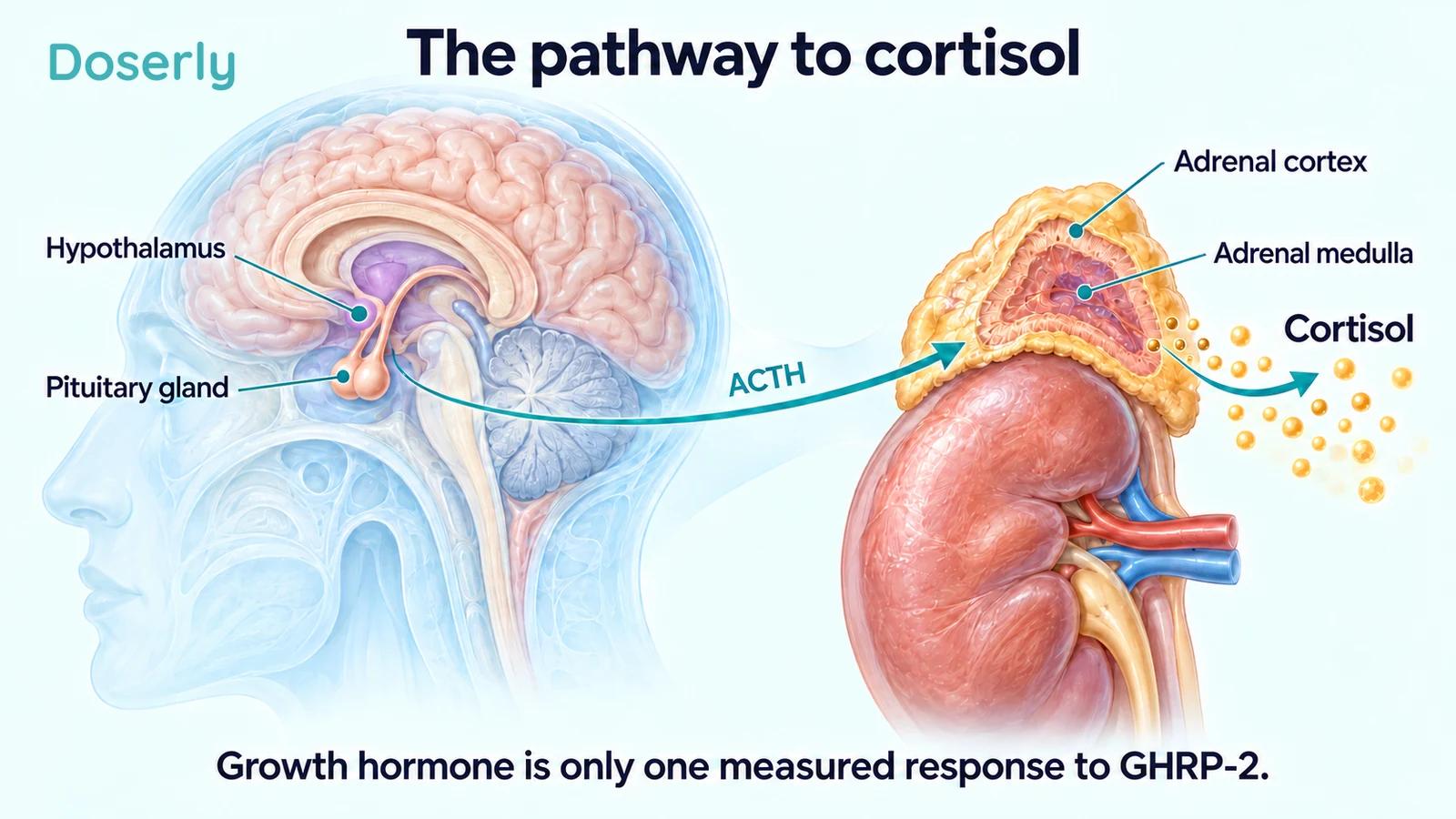
Cortisol is made in the adrenal glands, which sit above the kidneys. It helps regulate processes including blood pressure, glucose and the response to stress. It is a normal hormone the body needs, rather than a substance that should always be minimized.
The pituitary releases adrenocorticotropic hormone, or ACTH, which signals the adrenal glands to make cortisol. The hypothalamus, a region of the brain, participates upstream through corticotropin-releasing hormone. Together these structures are often called the hypothalamic–pituitary–adrenal axis, shortened to HPA axis. NIDDK explanation
Growth hormone is another pituitary hormone. Measuring growth hormone alone therefore provides only one view of what happened after a stimulus. If ACTH and cortisol also change, describing the intervention as exclusively growth-hormone selective would omit relevant physiology.
What the early human comparison found
A 1997 study compared GHRP-2 with hexarelin and other hormone stimuli. The investigators examined six young adults, with additional growth-hormone comparisons in six older adults. They measured growth hormone, prolactin, ACTH and cortisol rather than relying on a single endocrine endpoint.
GHRP-2 and hexarelin produced strong growth-hormone responses. The study also found increases in prolactin, ACTH and cortisol and concluded that their activity was not fully specific to growth hormone. Original human study
The finding is useful for rejecting an absolute “GH only” claim. It does not give a population-wide frequency of symptoms during long-term use. The study was small and examined acute administration, not months of a home regimen.
It is also important to identify the comparator correctly. This was a GHRP-2 and hexarelin study, not a direct human safety comparison of GHRP-2 with GHRP-6. The molecules are related, but replacing one name with another changes the claim.
The response varied with the stimulus and the person
A 2010 investigation analyzed cortisol samples from 42 healthy men studied under different sex-steroid conditions. Samples were collected every ten minutes over five hours. On separate mornings, participants received different stimuli, including GHRP-2 alone and a combination of GHRP-2, growth-hormone-releasing hormone and arginine.
Stimulated peak cortisol differed by stimulus. The reported mean peak was 616 nmol/L after GHRP-2 and 868 nmol/L after the combined stimulus, compared with a pooled mean of 420 nmol/L for saline, somatostatin and growth-hormone-releasing hormone conditions. Age and other participant characteristics were associated with aspects of the response. Cortisol physiology study
These are study-group measurements under particular experimental conditions, not diagnostic limits or target values. They should not be used to decide whether an unrelated cortisol result is safe.
The study also complicates simple claims about combinations. Adding another stimulus did not merely reproduce the response to GHRP-2 alone. A combination can change the endocrine response, which is why results from one substance cannot establish the safety of a multi-peptide regimen.
Why one peak is not the whole exposure
A peak concentration is the highest measured value during a sampling period. It tells you about the maximum observed response, but not how long the concentration remained elevated or what happened outside the observation window.
Researchers may also examine the area under a concentration-time curve, which summarizes measured exposure across a period, or analyze the timing of secretion pulses. Those are different descriptions of the same hormone system. A higher peak can coexist with a brief response; a modest peak can occur during a more sustained change.
This is relevant when someone quotes a single dramatic number. Before deciding what it means, identify whether it is a peak, a baseline concentration, an average or a time-integrated measurement. Ask when sampling began and ended, and what the comparator received.
The 42-man investigation used repeated sampling to examine secretion patterns. That is much more informative about the acute response than a single blood draw. It still does not describe every hour of repeated use over months.
What rat experiments add—and what they cannot establish
A mechanistic study examined how GHRP-2, also called KP-102, stimulated ACTH in rats. Investigators used experimental conditions intended to reduce stress and tested agents that blocked different signaling pathways.
Blocking corticotropin-releasing factor substantially inhibited the ACTH response, supporting a hypothalamic contribution in that rat model. GHRP-2 did not directly stimulate ACTH release from the rat pituitary-cell preparation used in the study. Rat mechanism study
This helps explain why researchers investigate upstream signaling rather than assume that every observed hormone comes from direct stimulation of the same pituitary cell. It is a mechanistic clue, not a complete demonstration of the pathway in people.
Rat antagonist experiments also cannot tell a patient how likely they are to develop a symptom. A biological explanation and a clinical risk estimate are different products of research. The human studies establish the measured response; the animal work offers a possible explanation to investigate further.
Why adrenal testing research does not settle chronic safety
Because GHRP-2 can stimulate cortisol, clinicians have investigated whether the response could help assess adrenal function. In a retrospective series of 254 people evaluated for hypopituitarism, cortisol responses to GHRP-2 and insulin tolerance testing showed a strong correlation.
However, overall diagnostic sensitivity and specificity were 64% and 79%. Performance improved in a selected subgroup of men without functional adenomas. The authors' conclusion was therefore restricted to a particular clinical subgroup. Adrenal-axis diagnostic study
This is a useful reminder that two hormone tests can correlate without being interchangeable for every patient. It is also a different question from whether repeated GHRP-2 exposure is safe.
Diagnostic testing uses a controlled challenge to learn about the system. A treatment regimen repeatedly exposes the system to a stimulus. A promising diagnostic response cannot provide missing follow-up on chronic exposure, and an inadequate diagnostic comparison does not by itself prove a drug causes chronic harm.
Does a transient rise mean Cushing's syndrome?
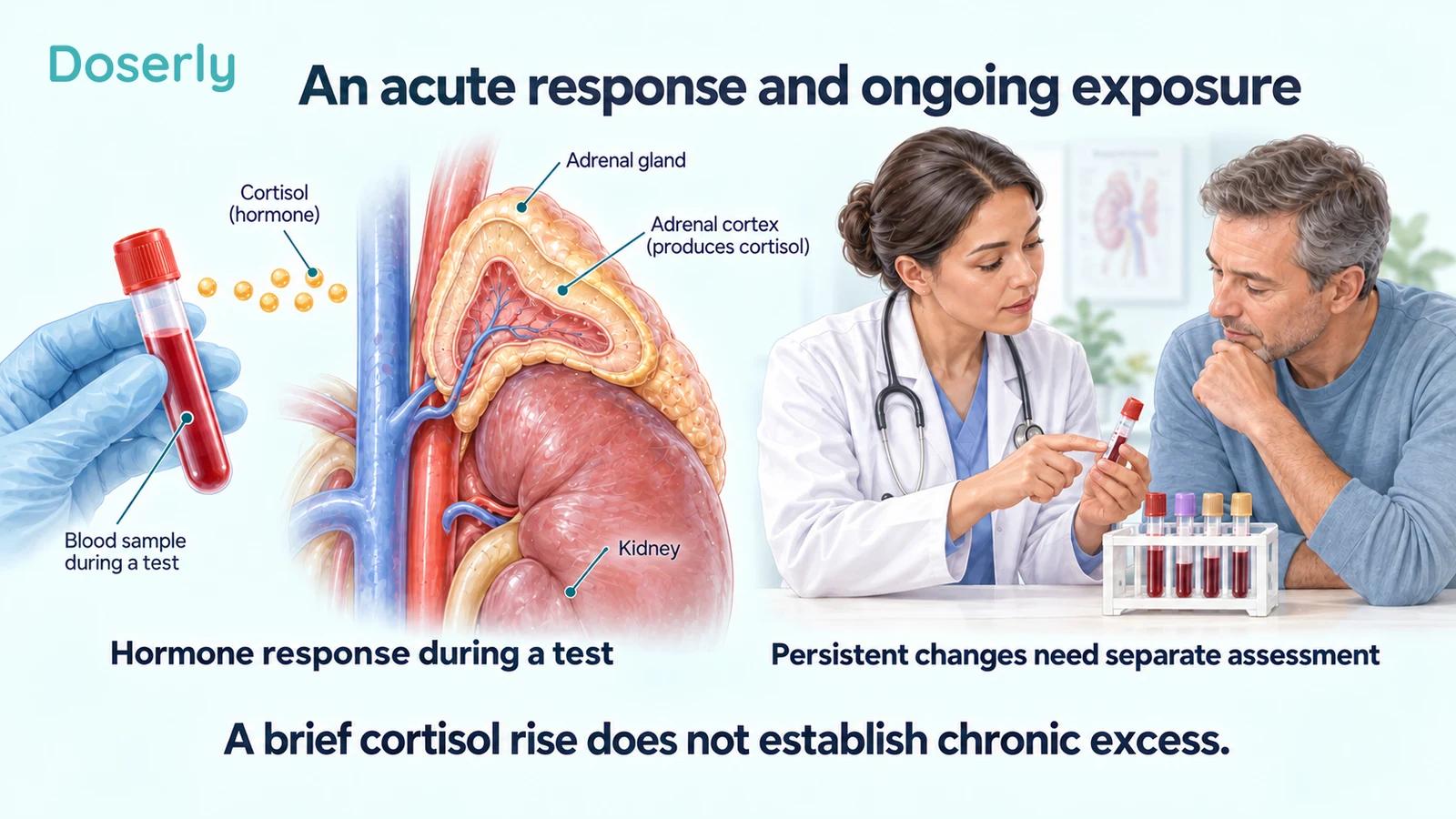
No. Cushing's syndrome concerns excessive cortisol exposure over a prolonged period. Its evaluation involves the clinical history, examination and appropriate testing; an isolated post-stimulation value is not enough to establish it. NIDDK describes several tests that examine different features of cortisol regulation. NIDDK
This distinction matters in both directions. It would be misleading to turn an acute GHRP-2 experiment into a claim that users routinely develop Cushing's syndrome. It would also be misleading to dismiss all concern because the experiment observed only a short response. The longer-term question remains a question.
The studies discussed here do not establish a reliable rate of persistent cortisol excess during repeated GHRP-2 use. They also do not identify a symptom pattern that can diagnose such an effect without clinical evaluation.
Can symptoms tell you which hormone changed?
Symptoms alone cannot reconstruct a hormone profile. Feeling anxious, tired, hungry or unwell after an exposure may deserve attention, but it does not identify cortisol as the cause. Conversely, the absence of an obvious sensation does not establish that only growth hormone changed.
The Japanese pralmorelin label provides adverse-reaction information for its diagnostic use, including warmth, gastrointestinal symptoms and sleepiness. It does not assign every reported sensation to cortisol, nor does it establish chronic side-effect rates for repeated non-diagnostic use. PMDA prescribing information
If symptoms develop, a useful account includes what was taken, when it was taken, when symptoms began and any other medications or supplements involved. Trying to correct an assumed hormone problem by adding another drug can make the picture harder to interpret and introduces its own risks.
The objective of a clinical review is to identify the actual problem, not to force every symptom into the pathway that was most recently discussed online.
What a more informative long-term study would measure
A study addressing repeated-use safety would need to define the preparation, route, schedule and population. It would need measurements that distinguish baseline hormone status from stimulated responses, along with follow-up long enough to observe persistent changes.
It should also record clinical outcomes and adverse events. A laboratory change can be useful without being a disease, and a patient can experience a clinically important problem that is not explained by one hormone measurement. Both belong in the assessment.
Including appropriate comparison groups would help separate treatment effects from ordinary variation and other exposures. Combination studies would need their own comparisons rather than assuming that each ingredient's individual findings predict the whole regimen.
These are unresolved research needs. The existing acute work is valuable because it identifies what should be measured; it does not supply the missing long-term outcome data.
The practical meaning of “not fully selective”
For a patient, the finding is best understood as a reason for precision. GHRP-2 can stimulate growth hormone, but the human endocrine response is not confined to that one measurement. Claims of complete selectivity go beyond the observed results.
At the same time, broader hormone activity is not a numerical estimate of personal harm. Dose, route, timing, participant characteristics and concurrent exposures all affect what a particular experiment can tell us.
If GHRP-2 is proposed for a health goal, ask what benefit is expected, which study supports it and how relevant endocrine effects will be assessed. The GHRP-2 safety discussion places these findings alongside the other available human research. The aim is to understand the full intervention, rather than let a growth-hormone result stand in for the whole endocrine picture.
Sources
- 1997 human endocrine comparison.
- 2010 cortisol secretion study.
- Rat ACTH mechanism study.
- Adrenal diagnostic comparison.
- NIDDK: Cushing's syndrome and cortisol.
- Japanese pralmorelin label.