
Peptides
October 16, 2026
GHK-Cu and hair growth: what an eyebrow study can tell us
On this page
Hair grows from living follicles within the skin. The visible strand is only part of that system: cells around its base help determine how the hair develops, while the follicle moves through periods of growth and rest. This is why a peptide that affects skin cells attracts interest as a possible hair treatment. It is also why the location and cause of hair loss matter so much.
GHK-Cu is a small copper-binding peptide found in discussions of skin care and hair restoration. A 2026 controlled study offers an early human finding worth examining: a topical serum produced a modest improvement in eyebrow measurements over 12 weeks. It did not investigate scalp hair loss, eyelashes, injections or people with inflammatory hair-loss disorders. Original eyebrow study.
If you are trying to decide what that means for thinning brows or a widening scalp part, the answer starts with three questions: which peptide was tested, where was it applied, and what actually changed? Our GHK-Cu guide introduces the compound's broader skin research; here we will focus on hair and the practical decisions surrounding it.
Why eyebrows need their own research
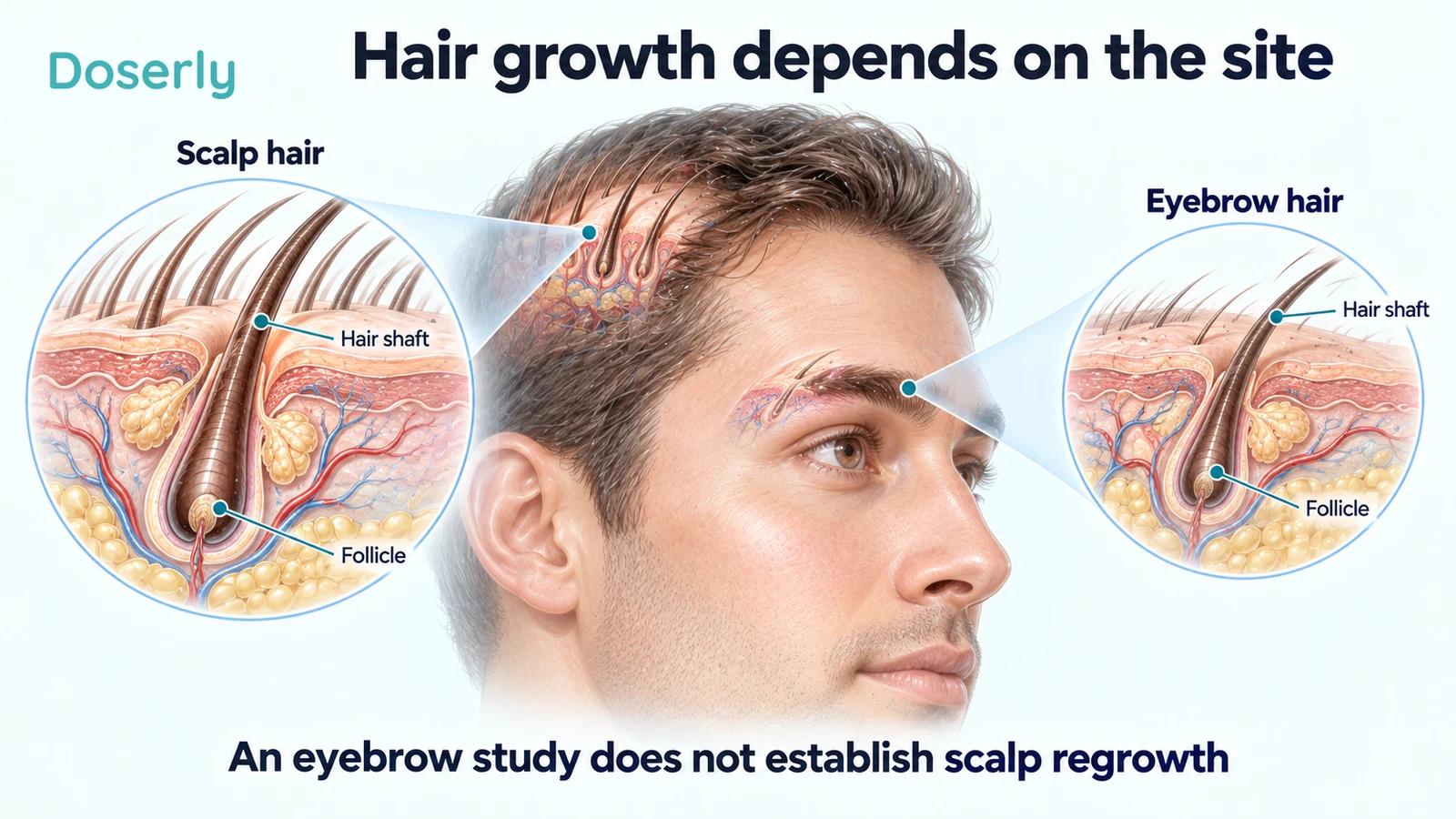
Eyebrows and scalp hair are both produced by follicles, but their normal behavior differs. Brow hairs stay short, whereas scalp hairs can continue growing much longer. A fuller-looking eyebrow also depends on the direction, thickness and darkness of individual strands, not simply on the total number of follicles. Those features make the outcome someone wants from a brow serum different from the outcome wanted from a scalp treatment.
There is another distinction between naturally sparse brows and new hair loss. A person who has always had thin brows may be seeking cosmetic enhancement. Someone whose brows have recently disappeared may have an underlying disorder that requires treatment. Calling both situations “hypotrichosis,” a term for reduced hair, does not make their causes identical.
The American Academy of Dermatology describes how evaluation can include examining hair and skin, reviewing possible triggers, and using blood testing or a biopsy when a particular disease, deficiency, hormonal problem or infection is suspected. Testing follows the history and examination; it is not a universal panel that everyone needs. AAD diagnosis and treatment guidance.
For a concrete example, imagine two people with visibly thin eyebrows. One has had the same brow shape since adolescence and has no skin symptoms. The other has developed eyebrow loss together with a receding frontal hairline. A cosmetic trial in otherwise healthy volunteers may be relevant to the first person's question while leaving the second person's main problem unanswered. Choosing a product before recognizing that difference can delay a more useful conversation.
What did the GHK-Cu eyebrow trial actually test?
Bo and colleagues studied 18 adults aged 18–40 with sparse eyebrows without a significant underlying medical cause. Each person used the study's 2% GHK-Cu serum on one eyebrow and the matching vehicle on the other, twice daily for 12 weeks. The vehicle was the base formulation without the active ingredient. Treatment side was randomized, and the study was described as double-blind.
Researchers counted hairs within a standardized 1 cm² sampling area. At week 12, average counts were 30.50 on the active side and 28.67 on the vehicle side, a reported paired difference of 1.833 hairs with p=0.049. Photographic assessments and participant satisfaction also favored the active serum. No local adverse reactions were reported during follow-up. Full study, methods and results.
This is a small positive finding, rather than evidence of dramatic restoration. The count refers to the photographed area, not an entire eyebrow and certainly not a whole scalp. The report also describes improved diameter measurements, but its table does not clearly state their physical units; converting those numbers into millimetres would be unjustified.
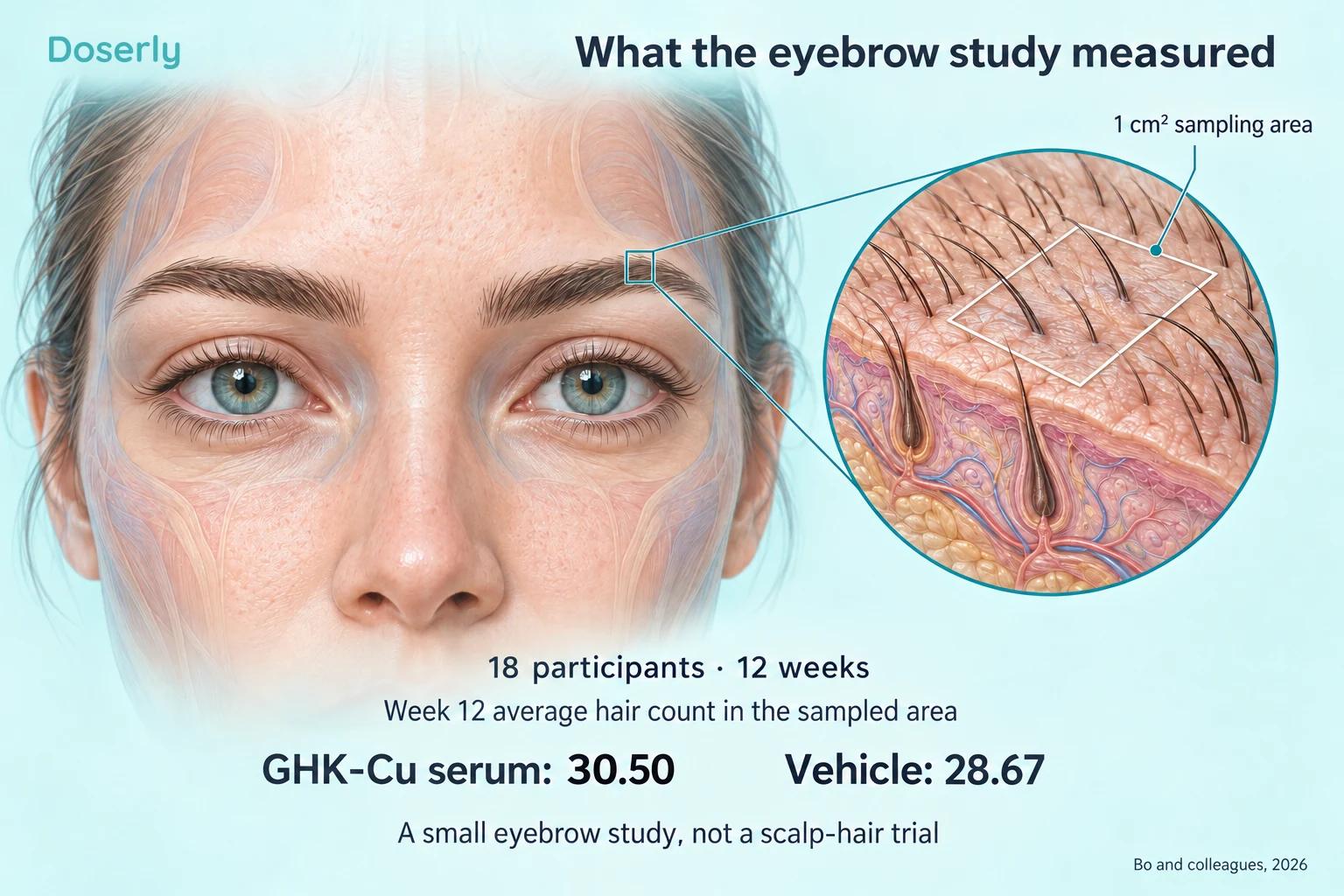
Image sources: Source: Bo and colleagues
How much confidence should that result carry?
The split-face study has a useful design advantage: both eyebrows belong to the same person. Age, general health and many day-to-day influences are shared. It can therefore reduce some differences that arise when completely separate groups are compared. But the number of independent people remains 18. Counting both eyebrows does not turn the trial into a study of 36 unrelated participants.
The p-value also needs context. A value just below 0.05 does not tell us that a product has a 95% chance of working. Nor does it describe how noticeable the change would be to a particular person. Here the clinically useful question is whether a small count difference translates into an improvement someone values, whether it persists, and whether it can be reproduced in larger studies.
Several outcomes and follow-up visits were assessed. A promising result among multiple comparisons needs careful interpretation, especially in a small study. Independent replication would help distinguish a reliable treatment effect from a finding that is unusually favorable in one sample.
A short study also cannot answer the maintenance question. Someone may be willing to use a serum temporarily but reluctant to continue indefinitely. Research would need to follow people after stopping treatment to establish whether any benefit lasts, fades or requires ongoing application. That is different from checking whether the brows look better at the end of a treatment period.
These are implications of the design, not reasons to dismiss the result. The finding is useful because it identifies a specific formulation and a specific clinical question that can be tested again. It becomes less useful when its limits disappear from the headline.
The frequently cited hair-follicle experiment used AHK-Cu
A separate 2007 paper is often cited in copper-peptide hair discussions. Its title refers to human hair growth, but the experiments used isolated human follicles and cultured dermal papilla cells, specialized cells involved in follicle development and growth. The tested peptide was AHK-Cu, containing alanine, histidine and lysine. GHK-Cu contains glycine in the first position instead.
The researchers observed follicle elongation and increased proliferation of cultured cells. A reduction in apoptotic cells, cells undergoing programmed death, did not reach statistical significance in the reported assay. The work helps explain interest in copper peptides, but it was not a trial of people applying GHK-Cu to their scalps. Pyo and colleagues, 2007.
“Human” in a paper can describe the source of cells or tissue. It does not necessarily mean people received treatment. A follicle maintained in culture gives researchers control over its surroundings; it does not reproduce delivery through intact skin, repeated product use or the causes of hair loss in a patient. That distinction remains important even when the laboratory experiment is carefully performed.
Nor can changing one amino acid simply be ignored. Related compounds may share some biological behavior, but a clinical claim belongs to the substance actually tested. Combining a GHK-Cu eyebrow trial with an AHK-Cu follicle experiment does not create a GHK-Cu scalp trial.
What can other eyebrow treatments teach us?
Studies of other medicines illustrate why testing the exact location is feasible and worthwhile. In a randomized split-face minoxidil study, 40 participants were enrolled and 39 completed 16 weeks. The 2% minoxidil side performed better than placebo on photographic assessment, eyebrow count, diameter and satisfaction. Those results concern minoxidil under that study's conditions; they are not evidence that copper peptides work equally well. Lee and colleagues, 2014.
A multicenter bimatoprost study compared once-daily or twice-daily 0.03% treatment with vehicle over seven months. Its main outcome was eyebrow fullness, with additional measurements of darkness and satisfaction. Both active groups had more improvement than vehicle. This is a separate drug with its own mechanism and safety considerations. Carruthers and colleagues, 2016.
There is no valid ranking of these products from reading separate study headlines. Different starting brow density, observation periods and scoring methods can change the apparent size of a benefit. A fair comparison would require a suitable head-to-head study or careful synthesis of sufficiently comparable trials. The GHK-Cu study does not establish superiority to either medicine.
These examples are research context, not instructions to apply scalp or eye medicines to the brows. Whether an off-label use makes sense depends on the diagnosis, the formulation and a clinician's assessment of potential harms. It is reasonable to bring the studies to an appointment; it is less reasonable to treat the percentages printed on different bottles as interchangeable instructions.
Eyelashes introduce a different safety question
A serum intended for skin near an eyebrow should not automatically be treated as an eyelash product. The eyelid margin sits close to the eye, and ingredients, preservatives and application methods matter. Evidence from an eyebrow trial cannot establish ocular safety or tell us what happens with repeated accidental eye exposure.
Bimatoprost provides a useful example of how specific this can be. The FDA's Latisse labeling concerns eyelash hypotrichosis and contains warnings about pigmentation changes, eye-pressure effects and contamination of applicators or solution. Some iris pigmentation changes may be permanent. These are drug-specific warnings, not demonstrated adverse effects of GHK-Cu. FDA Latisse label.
The broader lesson is practical: “used near the eye” is not one uniform category. A formulation tested on eyebrow skin cannot inherit the testing of an ophthalmic medicine, and an ophthalmic medicine cannot be assumed harmless because it also changes hair appearance. New eye pain or vision changes should be assessed promptly rather than managed by continuing a cosmetic experiment.
When thinning brows deserve a diagnosis first
Eyebrow loss can accompany frontal fibrosing alopecia, a condition that damages follicles and can cause permanent hair loss. The AAD notes that eyebrow loss may be an early sign and that early diagnosis and treatment can help prevent further progression. A receding frontal hairline or changes elsewhere can make this particularly important to consider. AAD overview of frontal fibrosing alopecia.
This does not mean that every sparse eyebrow indicates disease. It means that a new change deserves a different response from a stable cosmetic preference. Rapid progression, patchy loss, skin inflammation or loss extending beyond the brows are reasons to describe the pattern to a qualified clinician.
Before an appointment, useful observations include when the change started, whether it affected one or both brows, and whether it followed a new medicine, cosmetic procedure or grooming habit. Bring the actual ingredient list of anything being applied. That makes it easier to distinguish the question of treating an underlying condition from the question of enhancing otherwise healthy hair.
Photographs can help document change if lighting, distance, brow makeup and grooming are reasonably consistent. They do not diagnose the cause or prove which product helped. If several products start together, even a clear improvement may leave the contribution of each one uncertain.
What would make GHK-Cu scalp claims more convincing?
A useful scalp trial would enroll people with a defined form of hair loss, specify the exact GHK-Cu formulation, compare it with an appropriate control and follow participants long enough to assess meaningful change. Measurements should include a consistent scalp area and distinguish hair count from thickness and cosmetic appearance. Adverse events and outcomes after treatment ends would also matter.
For someone considering treatment today, the most useful question is therefore specific: “Is there a controlled study of this formulation for my type of hair loss?” An eyebrow finding may justify further research without answering that question for a scalp condition. An isolated-follicle result may explain a biological possibility without establishing patient benefit.
GHK-Cu has an early eyebrow signal worth following. It does not yet justify treating all copper-peptide products, all forms of hair loss and all anatomical sites as one proven use. A diagnosis and a clear treatment goal will usually make the next conversation more productive than a broad promise of hair growth. For the wider evidence on skin applications and routes of administration, continue with the Doserly GHK-Cu guide.
Sources
- Bo and colleagues, 2026: original GHK-Cu eyebrow trial and full text.
- Pyo and colleagues, 2007: AHK-Cu in isolated follicles and cultured cells.
- Lee and colleagues, 2014: minoxidil eyebrow trial.
- Carruthers and colleagues, 2016: bimatoprost eyebrow trial.
- AAD: diagnosing and treating hair loss.
- AAD: frontal fibrosing alopecia.
- FDA: Latisse prescribing information, 2021 revision.